 The oldest ship of the fleet is the steam ship Uri. It was built in 1901.
Here it cruises the lake near Vitznau. [May 2015].
The oldest ship of the fleet is the steam ship Uri. It was built in 1901.
Here it cruises the lake near Vitznau. [May 2015].
 Uri particulars: Passengers: 800 pax. Length: 61.5m
Width: 14.00m Shipyard: Gebrüder Sulzer.
The ship is seen here near Meggenhorn.
In the background is Mt Pilatus. [May 2015].
Uri particulars: Passengers: 800 pax. Length: 61.5m
Width: 14.00m Shipyard: Gebrüder Sulzer.
The ship is seen here near Meggenhorn.
In the background is Mt Pilatus. [May 2015].
 From Vitznau a rack railway ascends Mt Rigi.
That's why between Luzern and Vitznau a large stream of tourists is moved by ship all year round.
The Uri has just left Vitznau in the direction of Lucerne. [May 2015].
From Vitznau a rack railway ascends Mt Rigi.
That's why between Luzern and Vitznau a large stream of tourists is moved by ship all year round.
The Uri has just left Vitznau in the direction of Lucerne. [May 2015].
 But first the Uri takes course towards Weggis, the next stop on its voyage. [May 2015].
 The steam ship Uri near Vitznau.
[Apr 2016].
The steam ship Uri near Vitznau.
[Apr 2016].
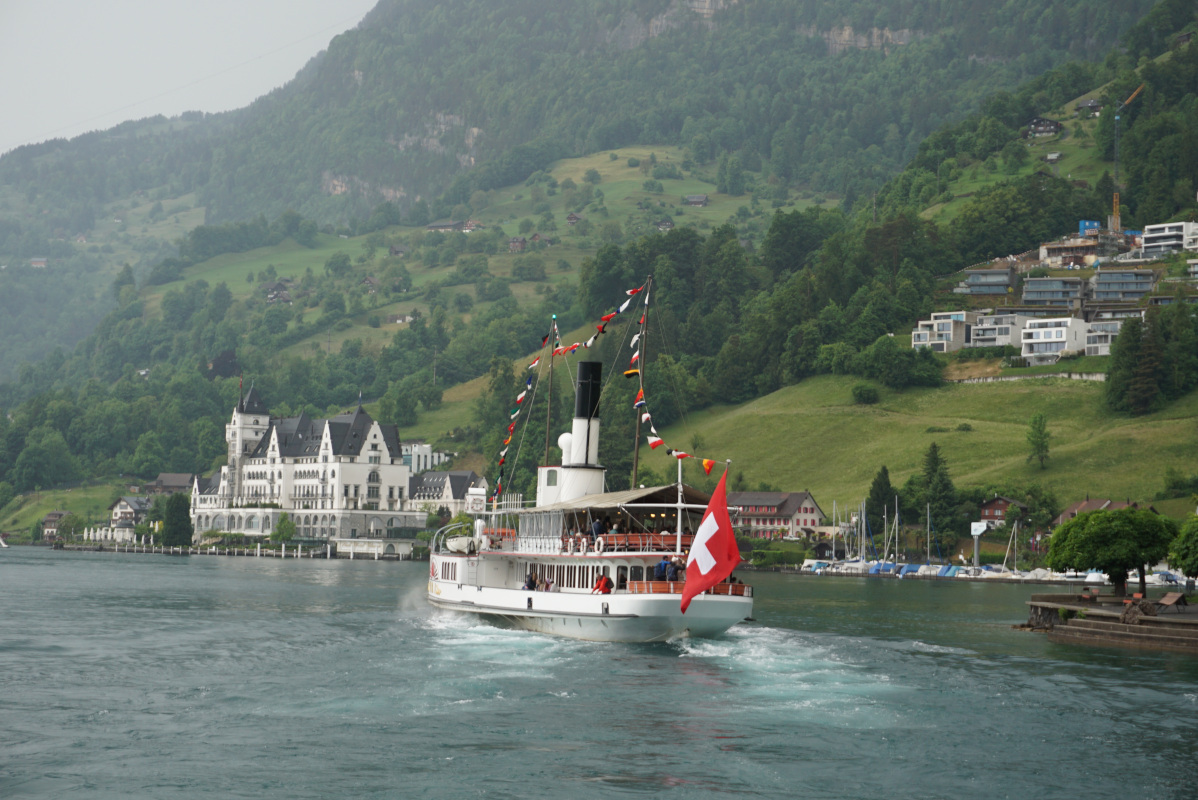 The view 9 years later is quite similar.
The Uri has departed from Vitznau and passes the Park Hotel Vitznau on its voyage towards Bern.
[May 2025].
The view 9 years later is quite similar.
The Uri has departed from Vitznau and passes the Park Hotel Vitznau on its voyage towards Bern.
[May 2025].
 The steam engine of the Uri.
[Apr 2016].
The steam engine of the Uri.
[Apr 2016].
 The forward cabin of the Uri is under the forward deck
and decorated in a maritime theme.
Because the cabin can only reached by relatively steep stairs, not many people come down here.
[Apr 2016].
The forward cabin of the Uri is under the forward deck
and decorated in a maritime theme.
Because the cabin can only reached by relatively steep stairs, not many people come down here.
[Apr 2016].
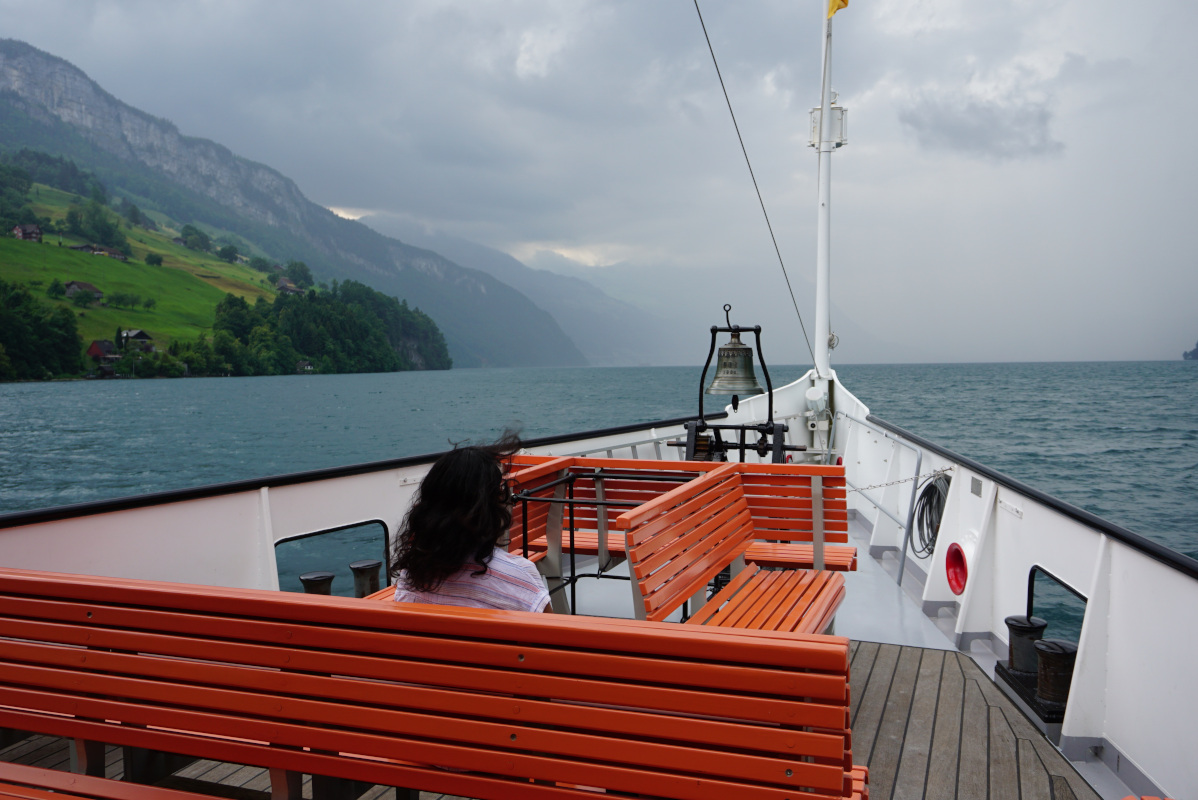 On a late spring day the Uri heads into a storm.
[May 2025].
On a late spring day the Uri heads into a storm.
[May 2025].
 The shipper's house of Treib with its painted wooden sides is famous and much photographed.
It was built in 1658.
The Uri arrives in Treib.
[May 2025].
The shipper's house of Treib with its painted wooden sides is famous and much photographed.
It was built in 1658.
The Uri arrives in Treib.
[May 2025].
 The paddle steamer Uri near Brunnen.
On this spring day many of the trees around Lake Lucerne stood full of blossoms.
[Apr 2016].
The paddle steamer Uri near Brunnen.
On this spring day many of the trees around Lake Lucerne stood full of blossoms.
[Apr 2016].
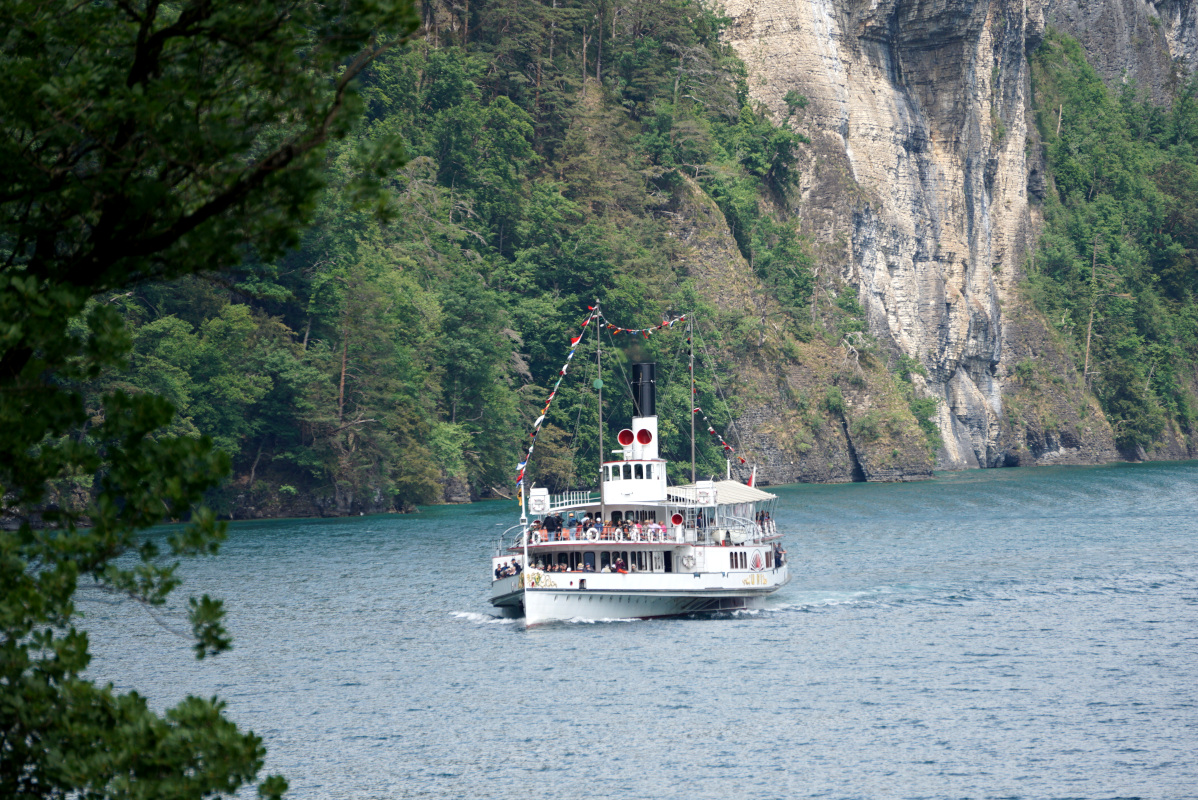 The Uri travels on the Uri part of Lake Lucerne, also called Lake Uri.
Here it is between Brunnen and Rütli.
[May 2025].
The Uri travels on the Uri part of Lake Lucerne, also called Lake Uri.
Here it is between Brunnen and Rütli.
[May 2025].
 The steam ship Uri approaches Rütli.
On the Rütli meadow the original cantons swore to support each other in 1291,
particularly against the occupying Habsburg empire.
They thus formed Switzerland.
The Rütli can only be reached via the lake or arduous walking tracks.
[Apr 2016].
The steam ship Uri approaches Rütli.
On the Rütli meadow the original cantons swore to support each other in 1291,
particularly against the occupying Habsburg empire.
They thus formed Switzerland.
The Rütli can only be reached via the lake or arduous walking tracks.
[Apr 2016].
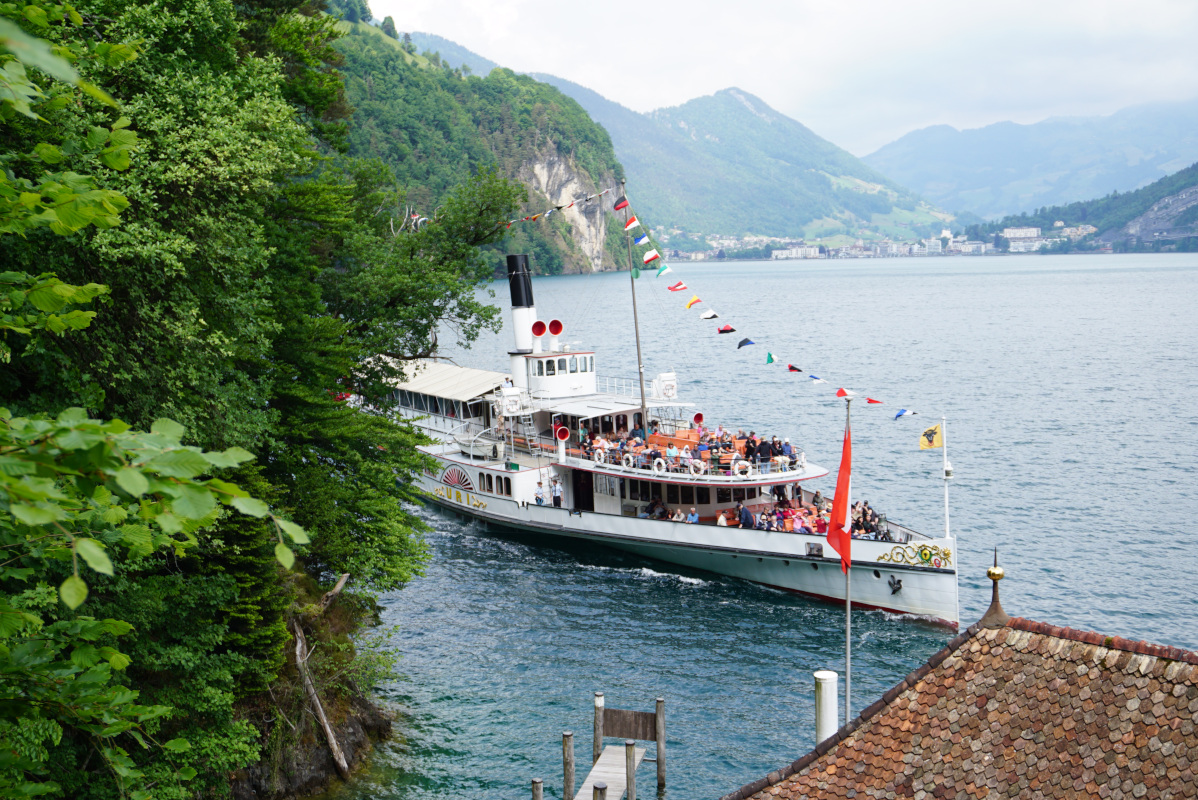 The Uri arriving at Rütli.
The shipping station is still from 1913.
[May 2025].
The Uri arriving at Rütli.
The shipping station is still from 1913.
[May 2025].
 The wheel covers of the Uri.
[Apr 2016].
The wheel covers of the Uri.
[Apr 2016].
 The steam ship Unterwalden was introduced into service in 1902.
Here it is seen in Lucerne.
Unterwalden particulars: Passengers: 700 pax. Length: 61.0m
Width: 13.70m Shipyard: Escher, Wyss & Cie. [Aug 2015].
The steam ship Unterwalden was introduced into service in 1902.
Here it is seen in Lucerne.
Unterwalden particulars: Passengers: 700 pax. Length: 61.0m
Width: 13.70m Shipyard: Escher, Wyss & Cie. [Aug 2015].
 The bow of the Unterwalden in Luzern.
[Apr 2016].
The bow of the Unterwalden in Luzern.
[Apr 2016].
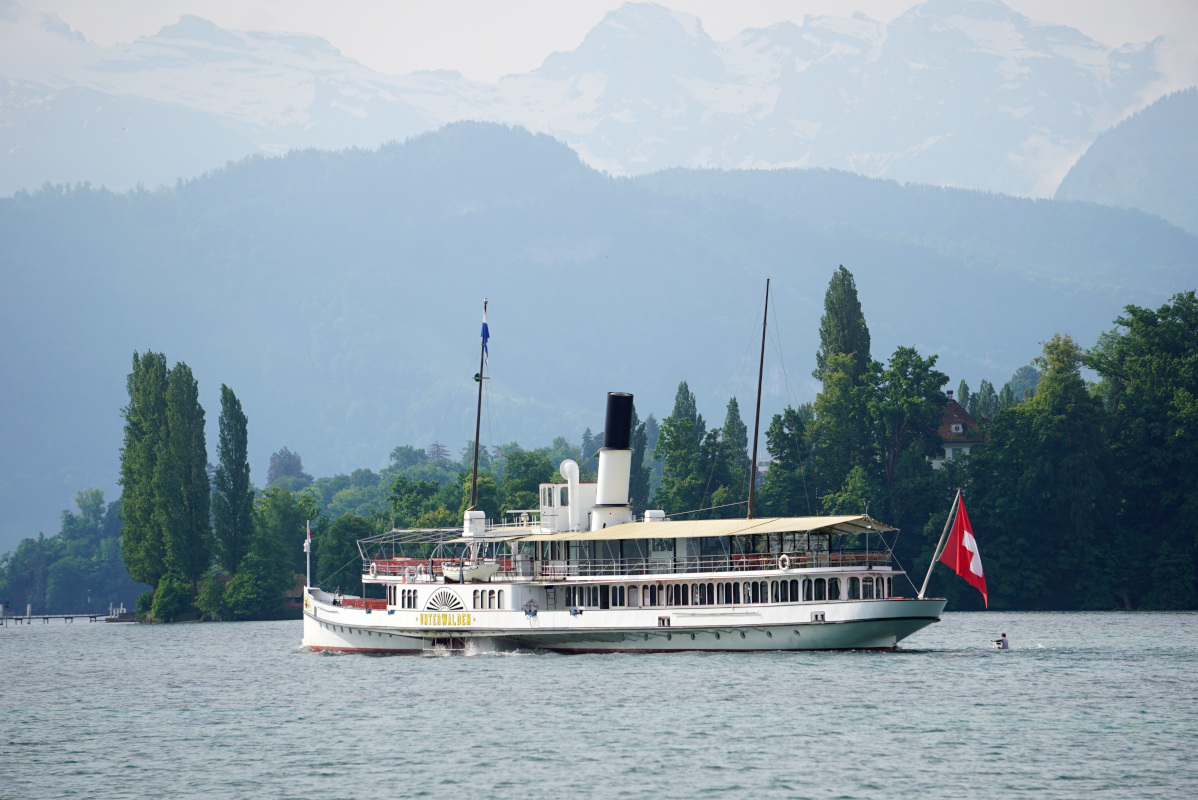 The Unterwalden is leaving Lucerne on a testing voyage at the beginning of the main season.
The many windows of the salon on the main deck are visible, as well as the large panorama windows for the restaurant on the upper deck. [May 2025].
The Unterwalden is leaving Lucerne on a testing voyage at the beginning of the main season.
The many windows of the salon on the main deck are visible, as well as the large panorama windows for the restaurant on the upper deck. [May 2025].
 The Unterwalden on Lake Lucerne near Weggis. In the background Vitznau and its distinctive hotels are visible.
At that time the Panorama-Restaurant on the upper deck had a rounded roof with no sail cloth above it.
[May 1991].
The Unterwalden on Lake Lucerne near Weggis. In the background Vitznau and its distinctive hotels are visible.
At that time the Panorama-Restaurant on the upper deck had a rounded roof with no sail cloth above it.
[May 1991].
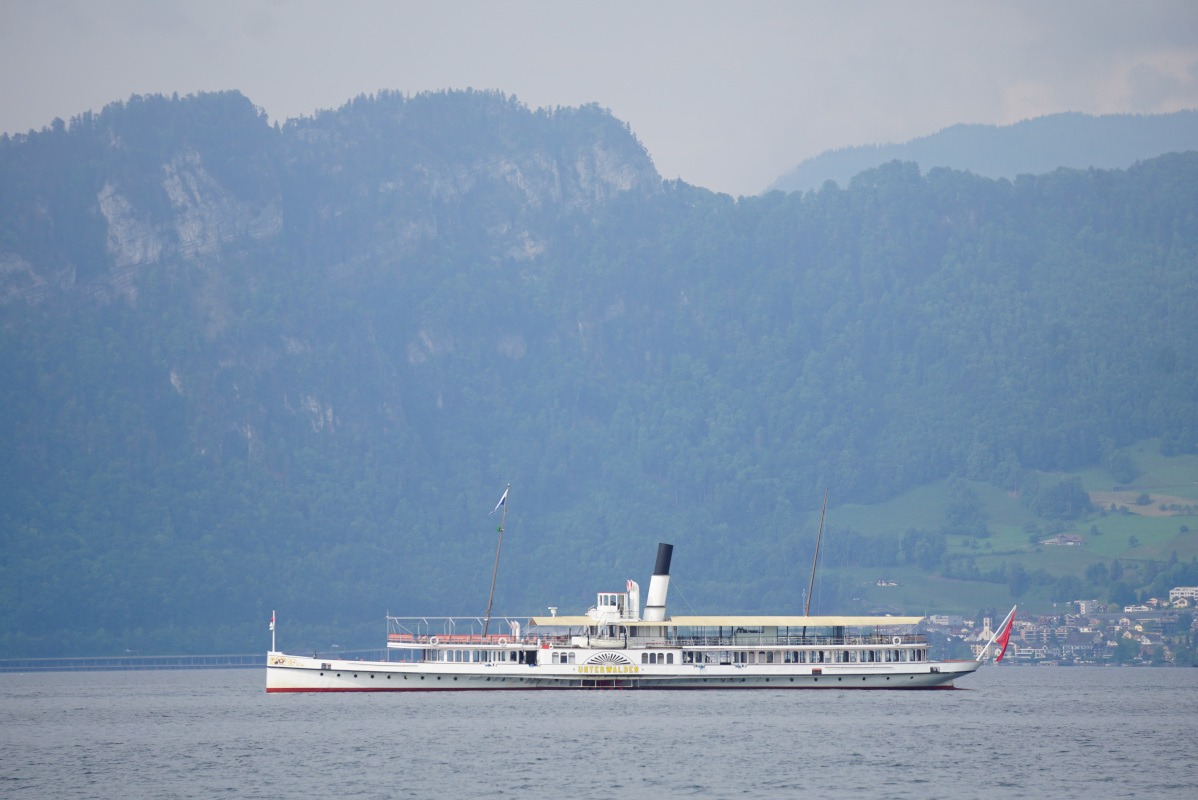 The Unterwalden travels near Kehrsitten across Lake Lucerne.
The classic form of the paddle steamer is on display.
[May 2025].
The Unterwalden travels near Kehrsitten across Lake Lucerne.
The classic form of the paddle steamer is on display.
[May 2025].
 The Park Hotel Vitznau looks similar to a castle.
The Unterwalden has passed the hotel and approaches the landing bridge of Vitznau.
This was at the end of May with nice weather in Switzerland, but the lake water was very cold,
as it is sourced directly from the melting snow on the mountains.
Still, when we were there we swam quite a few times in the lake at Vitznau.
[May 1991].
The Park Hotel Vitznau looks similar to a castle.
The Unterwalden has passed the hotel and approaches the landing bridge of Vitznau.
This was at the end of May with nice weather in Switzerland, but the lake water was very cold,
as it is sourced directly from the melting snow on the mountains.
Still, when we were there we swam quite a few times in the lake at Vitznau.
[May 1991].
 A paddle on one of the large wheels of the paddle steamer Unterwalden as seen through a window from the main deck.
[May 1991].
A paddle on one of the large wheels of the paddle steamer Unterwalden as seen through a window from the main deck.
[May 1991].
 Schiller particulars: Passengers: 900 pax. Length: 63.0m
Width: 14.05m Shipyard: Gebrüder Sulzer.
The Schiller entered service in 1906.
Here, the ship is near Tellsplatte, where William Tell is said to have jumped off his captor's boat.
Photo: H. Frank. [Jul 2009].
Schiller particulars: Passengers: 900 pax. Length: 63.0m
Width: 14.05m Shipyard: Gebrüder Sulzer.
The Schiller entered service in 1906.
Here, the ship is near Tellsplatte, where William Tell is said to have jumped off his captor's boat.
Photo: H. Frank. [Jul 2009].
 The steam ship Schiller in Lucerne.
[May 1991].
The steam ship Schiller in Lucerne.
[May 1991].
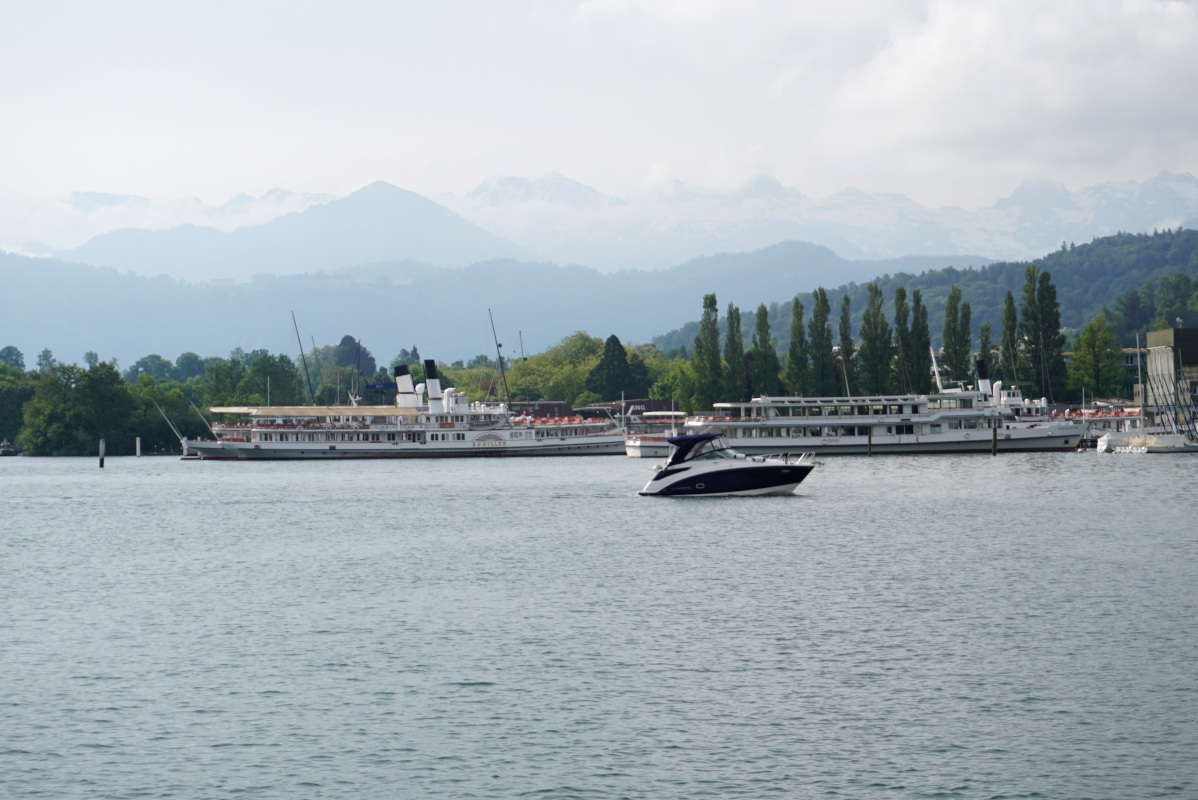 Prior to the main season the steam ship Schiller is tied up in Lucerne.
Behind it is the steam shipStadt Luzern.
The motor ship Waldstätter can also be clearly seen, with more ships in the background.
A motor boat cruises across the bay of Lucerne in front of the ships.
[May 2025].
Prior to the main season the steam ship Schiller is tied up in Lucerne.
Behind it is the steam shipStadt Luzern.
The motor ship Waldstätter can also be clearly seen, with more ships in the background.
A motor boat cruises across the bay of Lucerne in front of the ships.
[May 2025].
 The paddle steamer Wilhelm Tell was built in 1908.
It was taken out of service in 1970 and since 1972 has been used as a restaurant
on the waterfront of Lucerne. [Aug 2015].
The paddle steamer Wilhelm Tell was built in 1908.
It was taken out of service in 1970 and since 1972 has been used as a restaurant
on the waterfront of Lucerne. [Aug 2015].
 Wilhelm Tell particulars: Passengers: 1000 pax. Length: 63.0m
Width: 14.30m Shipyard: Gebrüder Sulzer.
On this photo the Castle Church of Lucerne is quite prominent. [Mar 2015].
Wilhelm Tell particulars: Passengers: 1000 pax. Length: 63.0m
Width: 14.30m Shipyard: Gebrüder Sulzer.
On this photo the Castle Church of Lucerne is quite prominent. [Mar 2015].
 The steam ship Gallia was built in 1913,
I spotted it in Brunnen.
In the background the ugly motorway mares the steep shoreline of the lake.
Gallia particulars: Passengers: 900 pax. Length: 62.85m
Width: 14.50m Shipyard: Escher Wyss.
[Jul 2005].
The steam ship Gallia was built in 1913,
I spotted it in Brunnen.
In the background the ugly motorway mares the steep shoreline of the lake.
Gallia particulars: Passengers: 900 pax. Length: 62.85m
Width: 14.50m Shipyard: Escher Wyss.
[Jul 2005].
 It's not easy to identify this steam ship on Lake Lucerne, but
I believe this is the Gallia, which is seen steaming across Lake Lucerne near Vitznau.
The photo was taken from the slopes of Mt Rigi.
[May 1991].
It's not easy to identify this steam ship on Lake Lucerne, but
I believe this is the Gallia, which is seen steaming across Lake Lucerne near Vitznau.
The photo was taken from the slopes of Mt Rigi.
[May 1991].
 The flagship of the SGV fleet is the Stadt Luzern. The steam ship entered service in 1928.
Here it approaches Gersau. [May 2015].
The flagship of the SGV fleet is the Stadt Luzern. The steam ship entered service in 1928.
Here it approaches Gersau. [May 2015].
 Stadt Luzern particulars: Passengers: 1100 pax. Length: 63.85m
Width: 15.20m Shipyard: Gebrüder Sachsenberg, Germany.
The Stadt Luzern arrives in Gersau. [May 2015].
Stadt Luzern particulars: Passengers: 1100 pax. Length: 63.85m
Width: 15.20m Shipyard: Gebrüder Sachsenberg, Germany.
The Stadt Luzern arrives in Gersau. [May 2015].
 In the bow of the Stadt Luzern with course towards Beckenried.
[May 2015].
In the bow of the Stadt Luzern with course towards Beckenried.
[May 2015].
 This view across the roofs of Vitznau shows the Stadt Luzern sailing towards Lucerne.
In the background are the steep slopes of the Bürgenstock, where the famous resort is located.
[May 1991].
This view across the roofs of Vitznau shows the Stadt Luzern sailing towards Lucerne.
In the background are the steep slopes of the Bürgenstock, where the famous resort is located.
[May 1991].
 As on many other paddle steamers, the salon on the main deck is reserved for 1st class passengers.
Therefore the ship offers little space for 2nd class passengers.
The Stadt Luzern arrives in the bay of Lucerne.
[Aug 2015].
As on many other paddle steamers, the salon on the main deck is reserved for 1st class passengers.
Therefore the ship offers little space for 2nd class passengers.
The Stadt Luzern arrives in the bay of Lucerne.
[Aug 2015].
 The steam ship Stadt Luzern near Lucerne.
[Aug 2015].
The steam ship Stadt Luzern near Lucerne.
[Aug 2015].
 The motorship Rütli was built in 1929.
It is named after the meadow at the lake, where the fathers of the Swiss Federation swore an oath of reciprocal loyalty.
The ship has just left Meggenhorn.
[May 2015].
The motorship Rütli was built in 1929.
It is named after the meadow at the lake, where the fathers of the Swiss Federation swore an oath of reciprocal loyalty.
The ship has just left Meggenhorn.
[May 2015].
 Rütli particulars: Passengers: 140 pax. Length: 22.60m
Width: 5.10m Shipyard: SGV-Werft Luzern.
The Rütli is underway near Meggenhorn.
[May 2015].
Rütli particulars: Passengers: 140 pax. Length: 22.60m
Width: 5.10m Shipyard: SGV-Werft Luzern.
The Rütli is underway near Meggenhorn.
[May 2015].
 I don't have any good photos of the original motor ship Waldstätter.
Therefore, this less than ideal photo will have to do.
The Waldstätter is in the background as it heads to the landing bridge Tellsplatte.
The ship entered service in 1949 and was scrapped in 2001.
[May 1991].
I don't have any good photos of the original motor ship Waldstätter.
Therefore, this less than ideal photo will have to do.
The Waldstätter is in the background as it heads to the landing bridge Tellsplatte.
The ship entered service in 1949 and was scrapped in 2001.
[May 1991].
 I do not have a photo of the motor ship Mythen,
so that a picture of Vitznau must take its place for now.
The ship entered service in 1931.
Mythen particulars: Passengers: 200 pax. Length: 31.6m
Width: 5.00m Shipyard: SGV-Werft Luzern .
[May 2015].
I do not have a photo of the motor ship Mythen,
so that a picture of Vitznau must take its place for now.
The ship entered service in 1931.
Mythen particulars: Passengers: 200 pax. Length: 31.6m
Width: 5.00m Shipyard: SGV-Werft Luzern .
[May 2015].
 The motor ship Titlis was built in 1951.
Here it approaches the landing bridge at the transport museum of Lucerne.
[Aug 2015].
The motor ship Titlis was built in 1951.
Here it approaches the landing bridge at the transport museum of Lucerne.
[Aug 2015].
 Titlis particulars: Passengers: 300 pax. Length: 43.15m
Width: 8.25m Shipyard: SGV Werf Luzern.
The Titlis has just departed from Beckenried.
[May 2015].
Titlis particulars: Passengers: 300 pax. Length: 43.15m
Width: 8.25m Shipyard: SGV Werf Luzern.
The Titlis has just departed from Beckenried.
[May 2015].
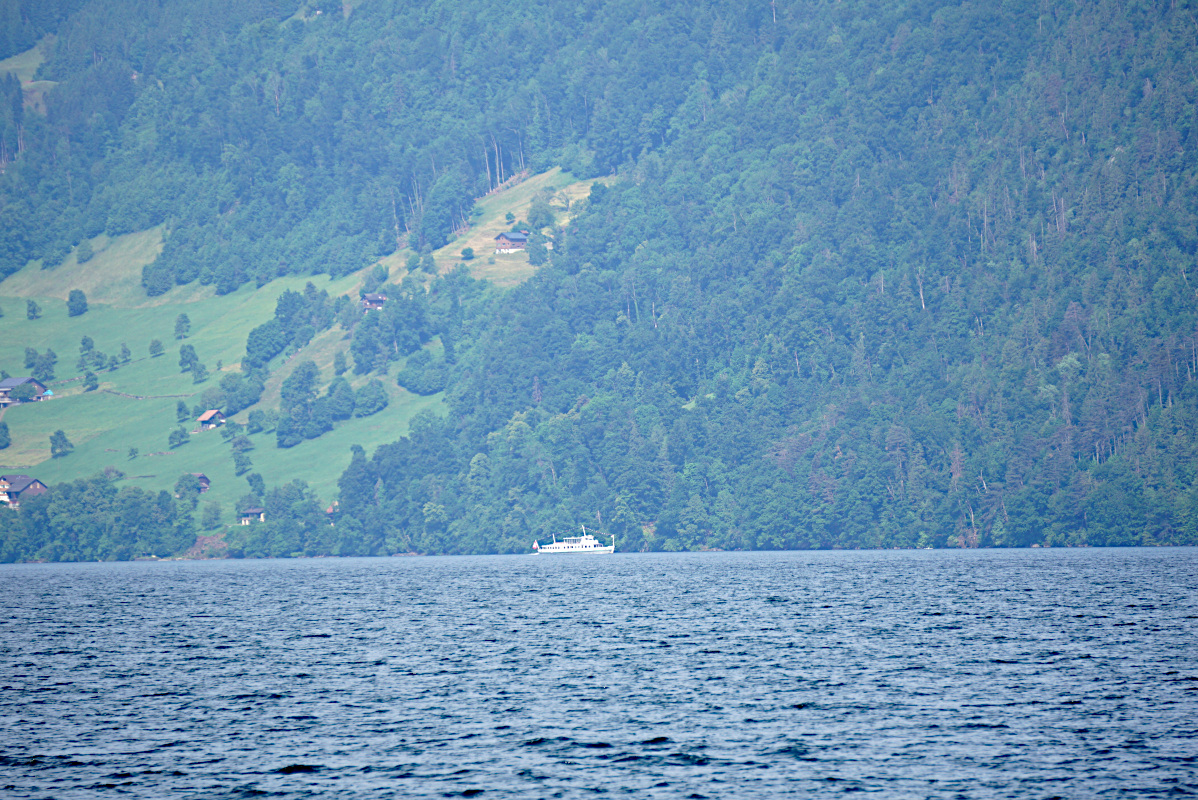 The Titlis cruises across the lake near Ennetbürgen.
Only few services operate to the bay of Buochs and Ennetbürgen.
Behind it rises the Bürgenstock ridge.
[May 2025].
The Titlis cruises across the lake near Ennetbürgen.
Only few services operate to the bay of Buochs and Ennetbürgen.
Behind it rises the Bürgenstock ridge.
[May 2025].
 The Rigi was built in the classical Swiss style for diesel-powered passenger ships.
It entered service in 1955.
The ship has just arrived in Lucerne.
[Aug 2015].
The Rigi was built in the classical Swiss style for diesel-powered passenger ships.
It entered service in 1955.
The ship has just arrived in Lucerne.
[Aug 2015].
 Rigi particulars: Passengers: 600 pax. Length: 47.50m
Width: 8.45m Shipyard: SGV Werf Luzern.
The Rigi lies at the landing bridge of Lucerne.
In the background is the famous water tower, which is part of the Kapellbrücke.
[Aug 2015].
Rigi particulars: Passengers: 600 pax. Length: 47.50m
Width: 8.45m Shipyard: SGV Werf Luzern.
The Rigi lies at the landing bridge of Lucerne.
In the background is the famous water tower, which is part of the Kapellbrücke.
[Aug 2015].
 The motor ship Rigi has departed from Beckenried.
This photo was taken in the last few months of its operation.
The Rigi was taken out of service on 31 December 2016 and scrapped in 2018.
[Apr 2016].
The motor ship Rigi has departed from Beckenried.
This photo was taken in the last few months of its operation.
The Rigi was taken out of service on 31 December 2016 and scrapped in 2018.
[Apr 2016].
 The Rigi crosses the lake from Beckenried to Gersau.
[Apr 2016].
The Rigi crosses the lake from Beckenried to Gersau.
[Apr 2016].
 In the southern reaches of Lake Lucerne the motor ship Rigi operates past steep, rocky cliffs that line the lake.
[May 1991].
In the southern reaches of Lake Lucerne the motor ship Rigi operates past steep, rocky cliffs that line the lake.
[May 1991].
 The Schwyz was the first of a whole row of ships that followed a new style, which was
particular to Lake Lucerne. The ship entered service in 1959.
The Schwyz approaches Weggis.
[Mar 2015].
The Schwyz was the first of a whole row of ships that followed a new style, which was
particular to Lake Lucerne. The ship entered service in 1959.
The Schwyz approaches Weggis.
[Mar 2015].
 Schwyz particulars: Passengers: 900 pax. Length: 58.36m
Width: 11.27m Shipyard: SGV Werf Luzern.
The Schwyz at Gersau.
[May 2015].
Schwyz particulars: Passengers: 900 pax. Length: 58.36m
Width: 11.27m Shipyard: SGV Werf Luzern.
The Schwyz at Gersau.
[May 2015].
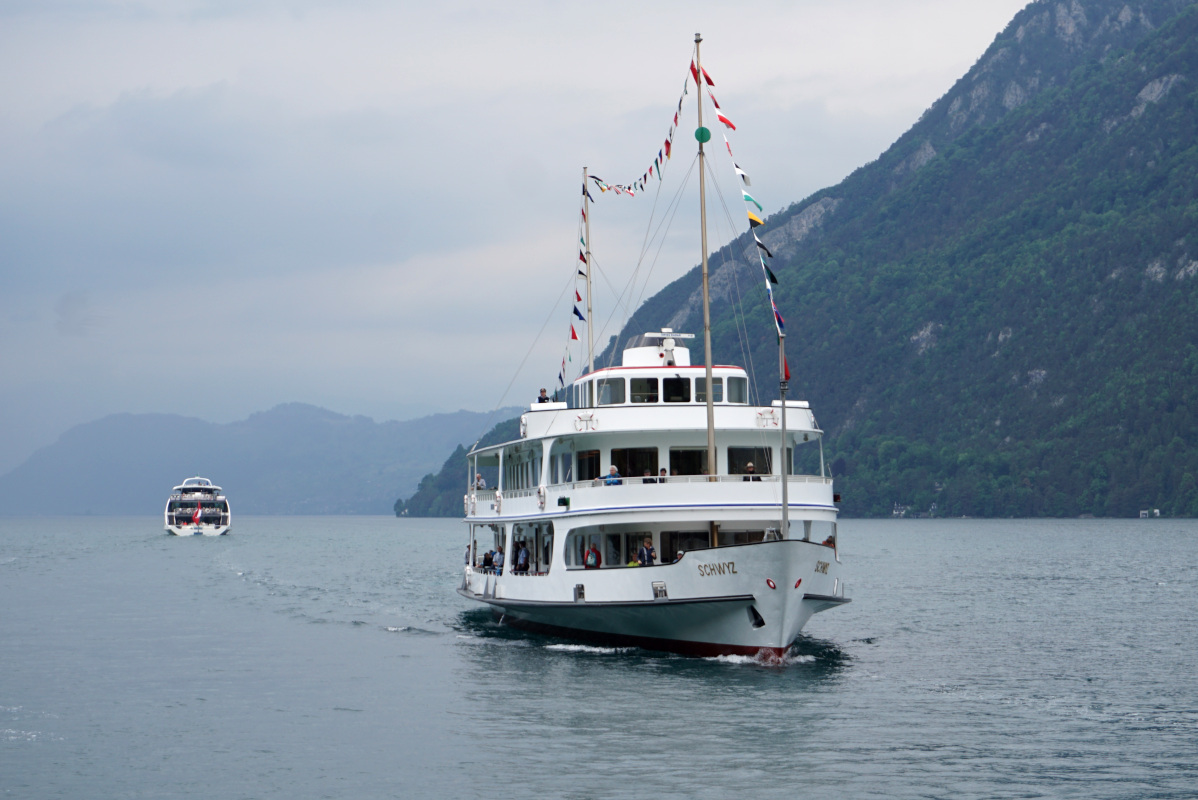 The Schwyz approaches Treib.
It has just passed the new ship Diamant.
[May 2025].
The Schwyz approaches Treib.
It has just passed the new ship Diamant.
[May 2025].
 The Winkelried was built in 1963.
Here she is underway in the bay of Lucerne.
[Aug 2015].
The Winkelried was built in 1963.
Here she is underway in the bay of Lucerne.
[Aug 2015].
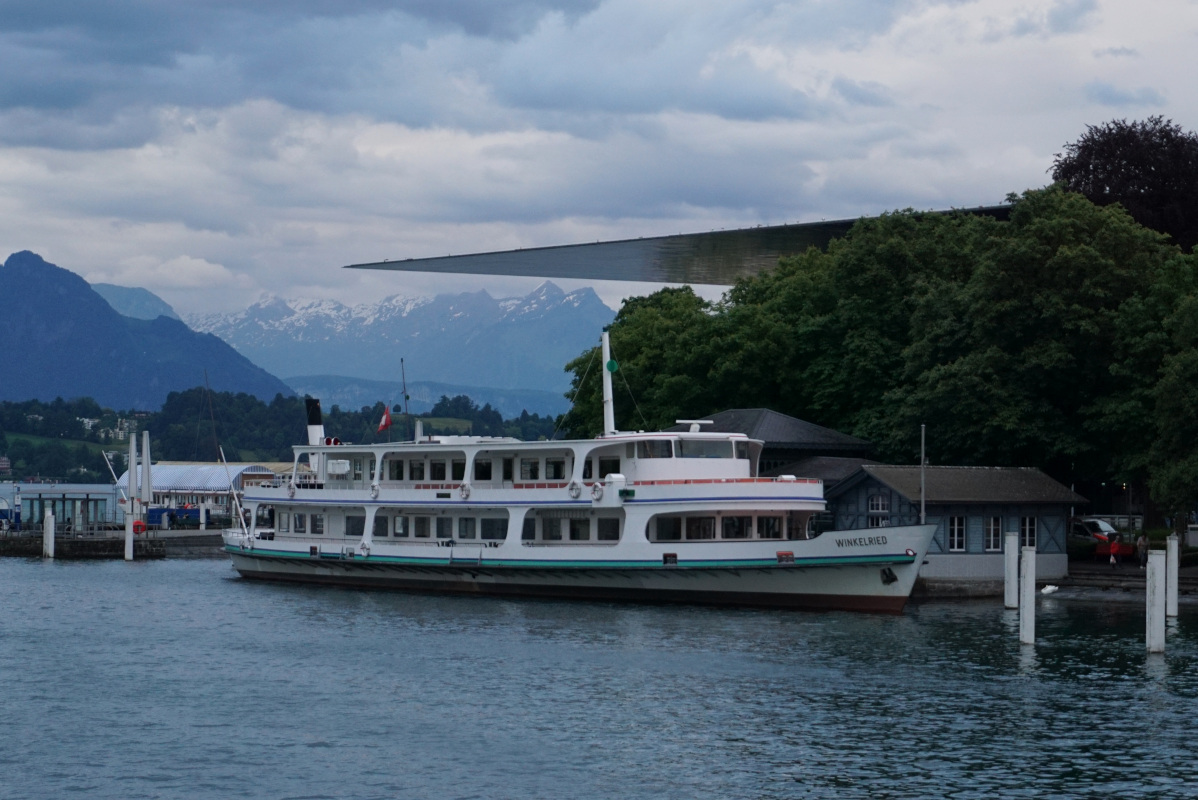 The Winkelried lies at the Station Quay in Lucerne.
The flat roof in the background belongs to the Culture and Cogress Centre in Lucerne.
[May 2025].
The Winkelried lies at the Station Quay in Lucerne.
The flat roof in the background belongs to the Culture and Cogress Centre in Lucerne.
[May 2025].
 Winkelried particulars: Passengers: 700 pax. Length: 58.36m
Width: 11.27m Shipyard: SGV Werf Luzern.
The crew of the ships is predominately male, but
the Winkelried was navigated by a woman that day.
Here she is on one of the wings during a manouvre.
[Aug 2015].
Winkelried particulars: Passengers: 700 pax. Length: 58.36m
Width: 11.27m Shipyard: SGV Werf Luzern.
The crew of the ships is predominately male, but
the Winkelried was navigated by a woman that day.
Here she is on one of the wings during a manouvre.
[Aug 2015].
 The Winkelried arrives in Vitznau.
[Apr 2016].
The Winkelried arrives in Vitznau.
[Apr 2016].
 Das bridge of the Winkelried is in front of the accommodation of the upper deck, not above it as on some other ships.
Here the ship travels across Lake Lucerne near Treib.
[Apr 2016].
Das bridge of the Winkelried is in front of the accommodation of the upper deck, not above it as on some other ships.
Here the ship travels across Lake Lucerne near Treib.
[Apr 2016].
 The motor ship Gotthard entered service in 1970.
With the bullish figurehead the ship looks somewhat unfriendly.
The figure is supposed to symbolise the Gotthard Pass, which was a serious obstacle to travellers and
the hardest and sometimes deadly part of their voyage across the Alps.
The ship is seen near Rütli. [Apr 2016]
The motor ship Gotthard entered service in 1970.
With the bullish figurehead the ship looks somewhat unfriendly.
The figure is supposed to symbolise the Gotthard Pass, which was a serious obstacle to travellers and
the hardest and sometimes deadly part of their voyage across the Alps.
The ship is seen near Rütli. [Apr 2016]
 Nearly 25 years prior my father took a photo from not far where I later stood.
The Gotthard at the Rütli landing bridge.
[May 1991].
Nearly 25 years prior my father took a photo from not far where I later stood.
The Gotthard at the Rütli landing bridge.
[May 1991].
 Gotthard Particulars: Passengers: 700 pax. Length: 58.36m
Width: 11.27m Shipyard: SGV Werf Luzern.
The motorship Gotthard approaches Rütli.
[Apr 2016].
Gotthard Particulars: Passengers: 700 pax. Length: 58.36m
Width: 11.27m Shipyard: SGV Werf Luzern.
The motorship Gotthard approaches Rütli.
[Apr 2016].
 The Rütli meadow is a place that is difficult to access by land.
Here the locals are said to have pledged allegiance to each other in 1291 against the imperial forces and thus
the Swiss Confederation was born.
The Gotthard has just left the Rütli landing bridge and travels towards Brunnen.
[Apr 2016].
The Rütli meadow is a place that is difficult to access by land.
Here the locals are said to have pledged allegiance to each other in 1291 against the imperial forces and thus
the Swiss Confederation was born.
The Gotthard has just left the Rütli landing bridge and travels towards Brunnen.
[Apr 2016].
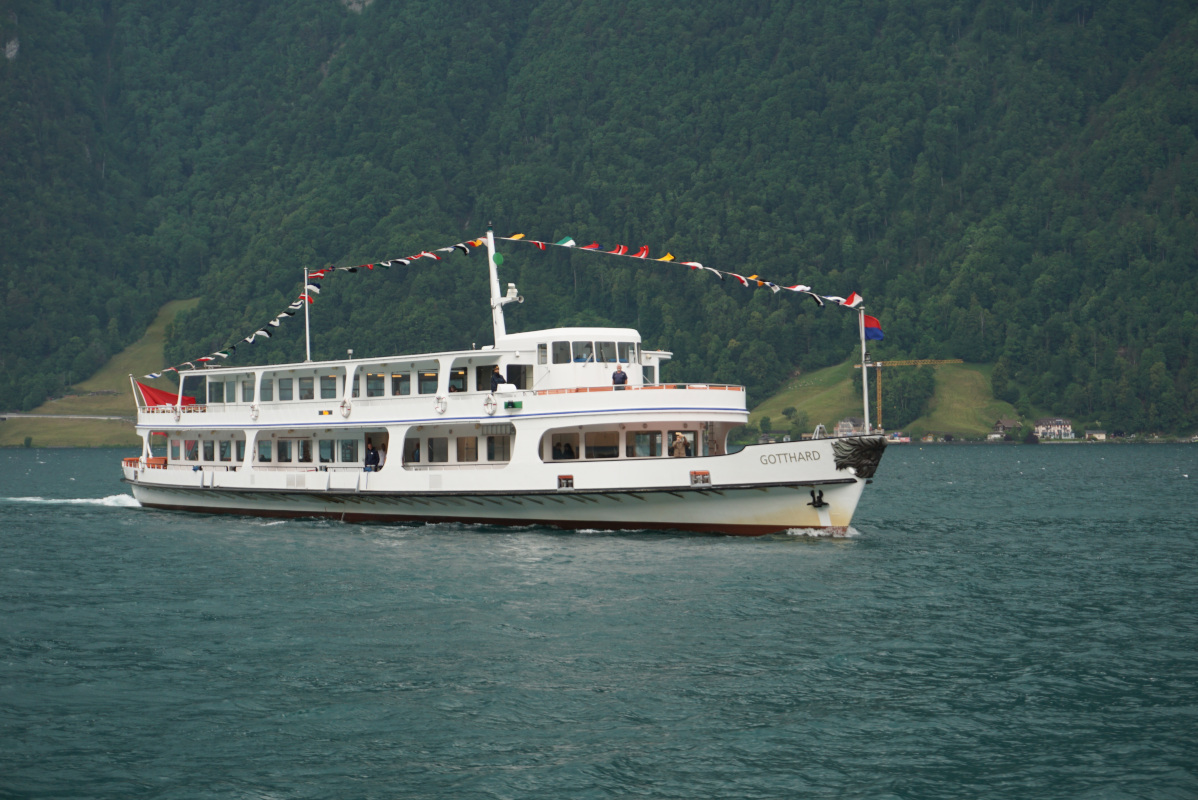 The Gotthard is making the approach to Treib.
The flags across the topmast blow in the strong wind.
[May 2025].
The Gotthard is making the approach to Treib.
The flags across the topmast blow in the strong wind.
[May 2025].
 In the evening, the Gotthard is underway near Weggis.
Commuters travel home from Lucerne to the shore communities of Weggis and Vitznau.
[Apr 2016].
In the evening, the Gotthard is underway near Weggis.
Commuters travel home from Lucerne to the shore communities of Weggis and Vitznau.
[Apr 2016].
 On this fine spring day there is still plenty of snow on the mountains of Uri.
The motor ship Gotthard travels towards Vitznau.
[Apr 2016].
On this fine spring day there is still plenty of snow on the mountains of Uri.
The motor ship Gotthard travels towards Vitznau.
[Apr 2016].
 The motor ship Europa entered service in 1976.
With it the style initiated by the Schwyz came to an end.
These ships also have the same hull dimensions, with just the
accommodation above deck being varied.
The Europa underway near Beckenried.
[May 2015].
The motor ship Europa entered service in 1976.
With it the style initiated by the Schwyz came to an end.
These ships also have the same hull dimensions, with just the
accommodation above deck being varied.
The Europa underway near Beckenried.
[May 2015].
 The Europa approaches Beckenried.
Europa particulars: Passengers: 1000 pax. Length: 58.36m
Width: 11.27m Shipyard: SGV Werf Luzern.
[May 2015].
The Europa approaches Beckenried.
Europa particulars: Passengers: 1000 pax. Length: 58.36m
Width: 11.27m Shipyard: SGV Werf Luzern.
[May 2015].
 The Europa approaches Brunnen.
[Apr 2016].
The Europa approaches Brunnen.
[Apr 2016].
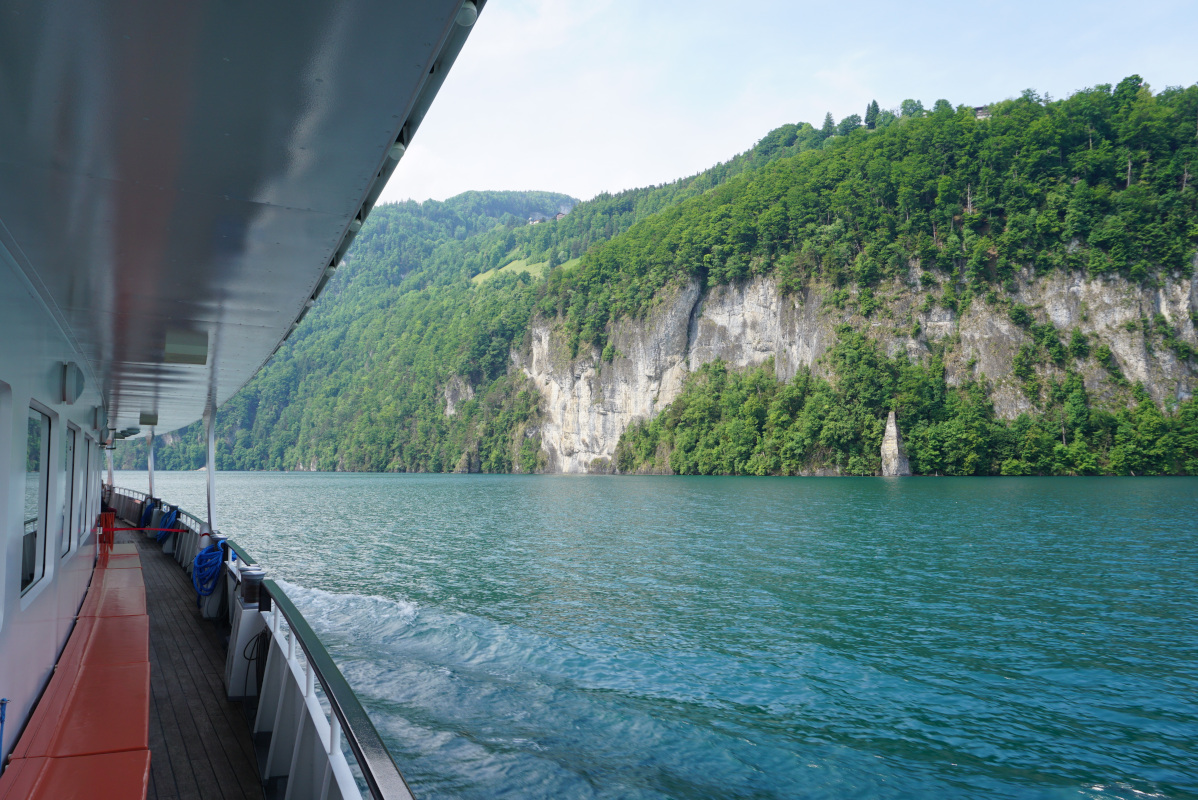 The Europa takes course in the direction of Rütli.
Schiller Rock can be seen at the foot of the steep cliffs going down to the lake.
Friedrich Schiller made the legend of William Tell known and also the landscape around Lake Lucerne with it.
[May 2025].
The Europa takes course in the direction of Rütli.
Schiller Rock can be seen at the foot of the steep cliffs going down to the lake.
Friedrich Schiller made the legend of William Tell known and also the landscape around Lake Lucerne with it.
[May 2025].
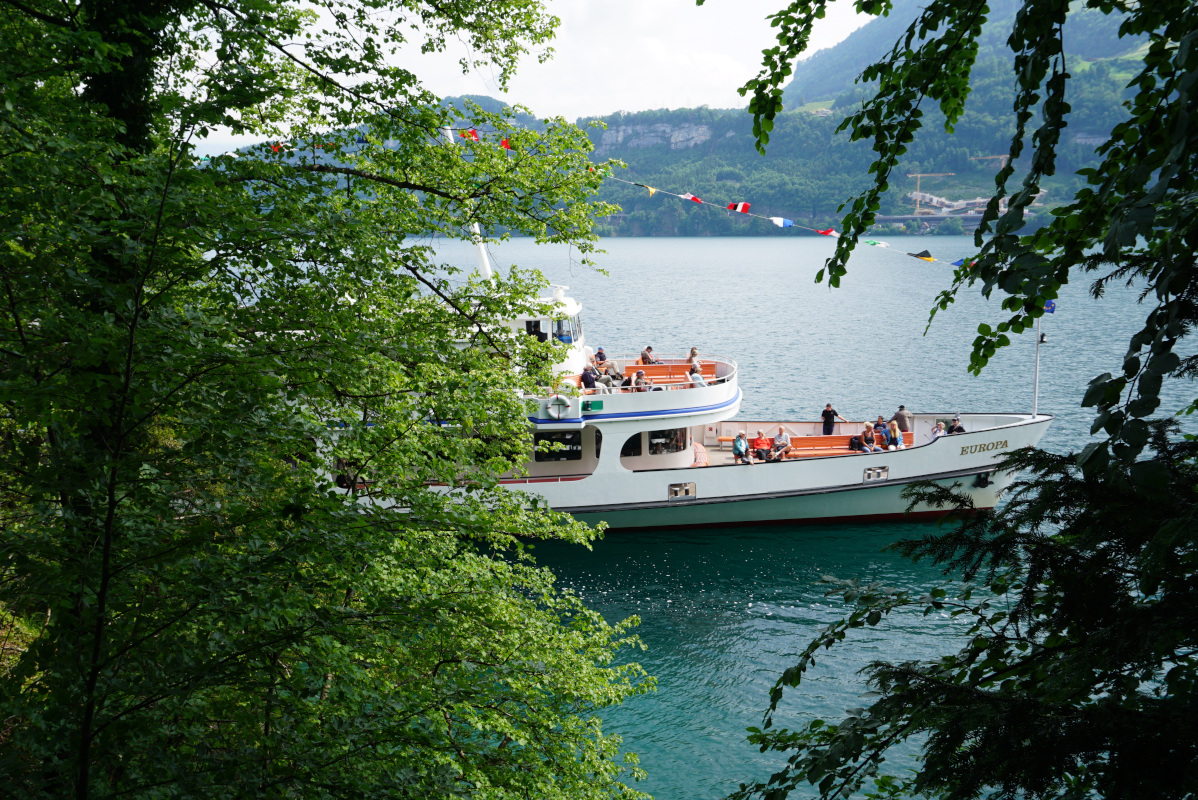 The Europa has just left the landing bridge Rütli and slowly travels along the forested shore of the lake.
[May 2025].
The Europa has just left the landing bridge Rütli and slowly travels along the forested shore of the lake.
[May 2025].
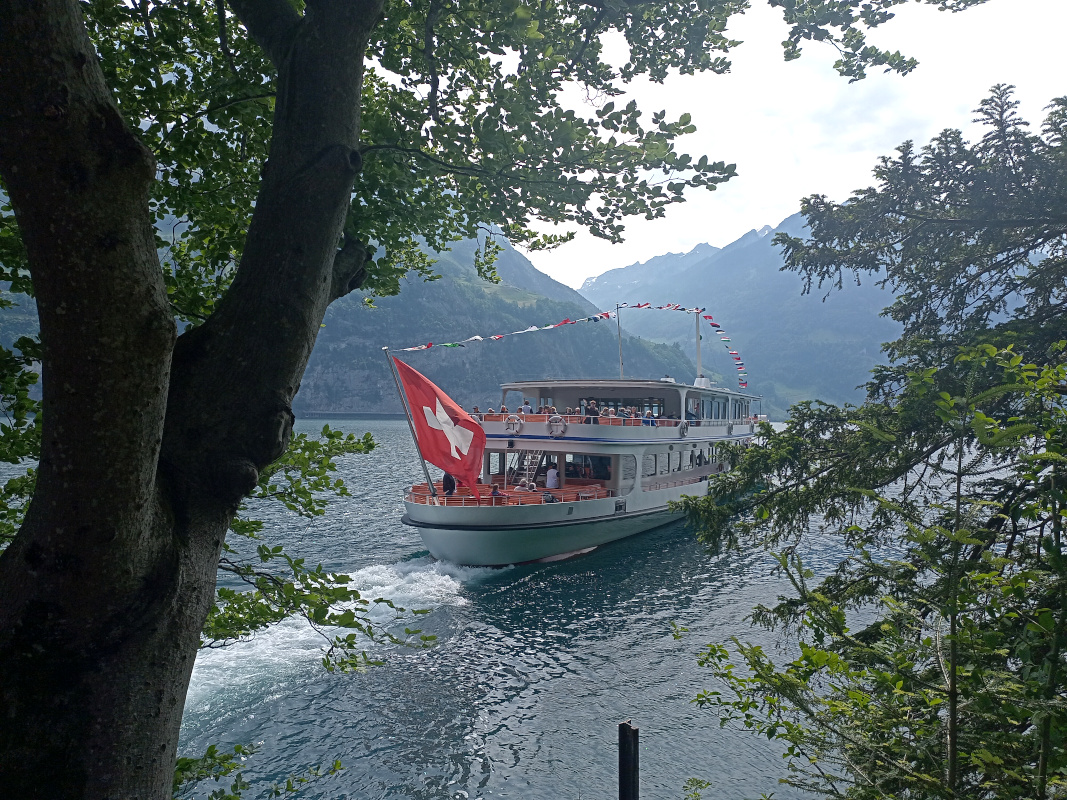 Through the trees the Europa can be seen heading out across the lake near Rütli.
[May 2025].
Through the trees the Europa can be seen heading out across the lake near Rütli.
[May 2025].
 The Europa just after departure from Rütli.
[Apr 2016].
The Europa just after departure from Rütli.
[Apr 2016].
 The motor ship Europa on the lake near the Rütli meadow.
[Apr 2016].
The motor ship Europa on the lake near the Rütli meadow.
[Apr 2016].
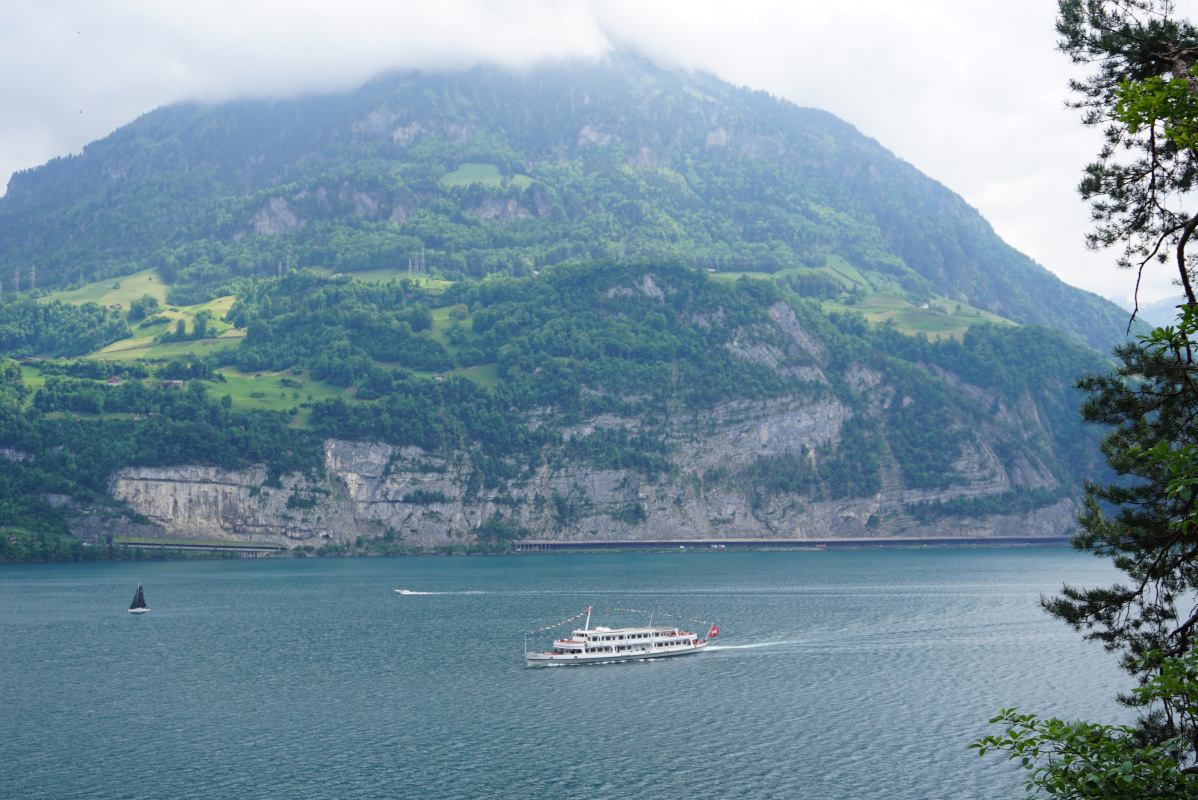 In front of the mountain mass of the Fronalpstock the Europa travels across Lake Uri.
[May 2025].
In front of the mountain mass of the Fronalpstock the Europa travels across Lake Uri.
[May 2025].
 The Europa travels on the Uri section of Lake Lucerne.
This southern part of the lake is surrounded by high mountains.
[Apr 2016].
The Europa travels on the Uri section of Lake Lucerne.
This southern part of the lake is surrounded by high mountains.
[Apr 2016].
 The three identical panorama ships Flüelen, Brunnen and Weggis were introduced into service in 1991.
They are the first ships since the paddle steamers that were not fully built at the shipyard in Lucerne.
The Flüelen cruises near Lucerne. [May 2015].
The three identical panorama ships Flüelen, Brunnen and Weggis were introduced into service in 1991.
They are the first ships since the paddle steamers that were not fully built at the shipyard in Lucerne.
The Flüelen cruises near Lucerne. [May 2015].
 Flüelen, Brunnen, Weggis particulars: Passengers: 400 pax.
Length: 48.21m
Width: 9.66m Shipyard: Deggendorfer-Werft.
The Flüelen in Lucerne. [Apr 2016].
Flüelen, Brunnen, Weggis particulars: Passengers: 400 pax.
Length: 48.21m
Width: 9.66m Shipyard: Deggendorfer-Werft.
The Flüelen in Lucerne. [Apr 2016].
 The motor ship Brunnen crosses the lake near Lucerne when it was still nearly brand new.
In the background is the steam ship Gallia.
[May 1991].
The motor ship Brunnen crosses the lake near Lucerne when it was still nearly brand new.
In the background is the steam ship Gallia.
[May 1991].
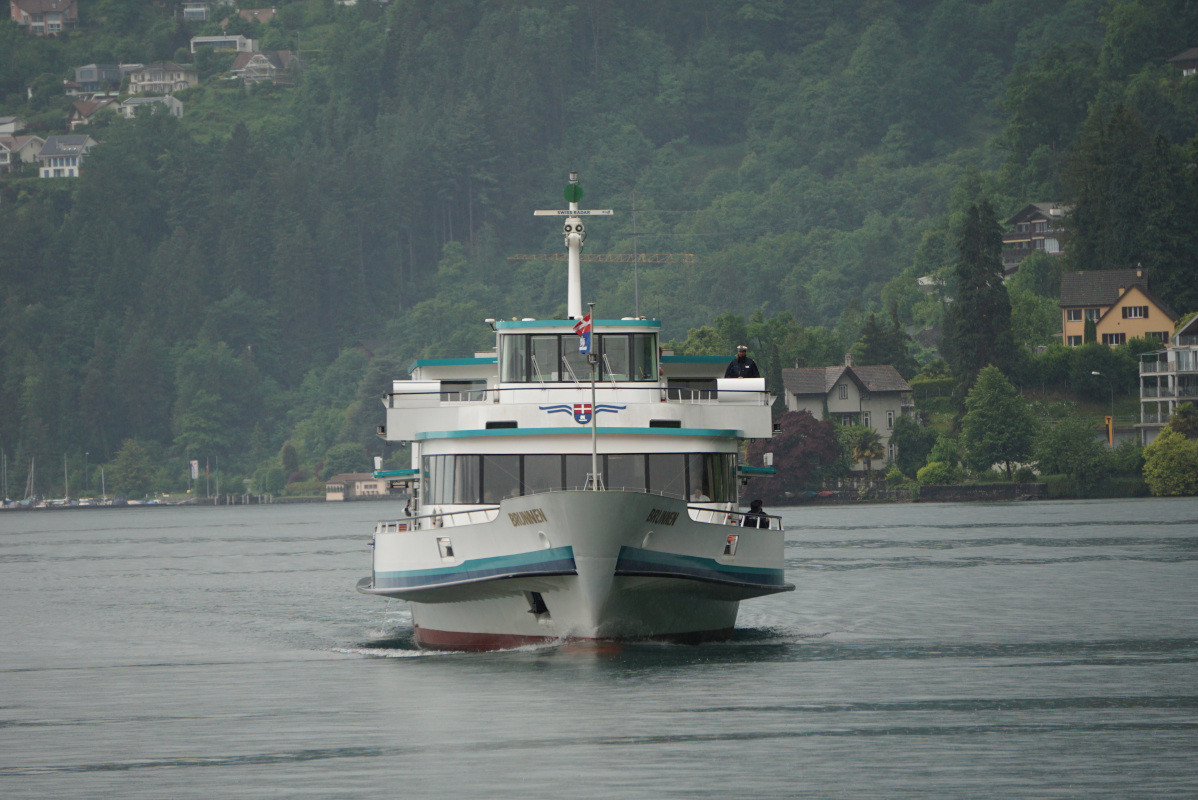 On the front of the bridge of the Brunnen the coast of arms of the town of Brunnen is prominently displayed.
The motor ship Brunnen heads for Vitznau.
[May 2025].
On the front of the bridge of the Brunnen the coast of arms of the town of Brunnen is prominently displayed.
The motor ship Brunnen heads for Vitznau.
[May 2025].
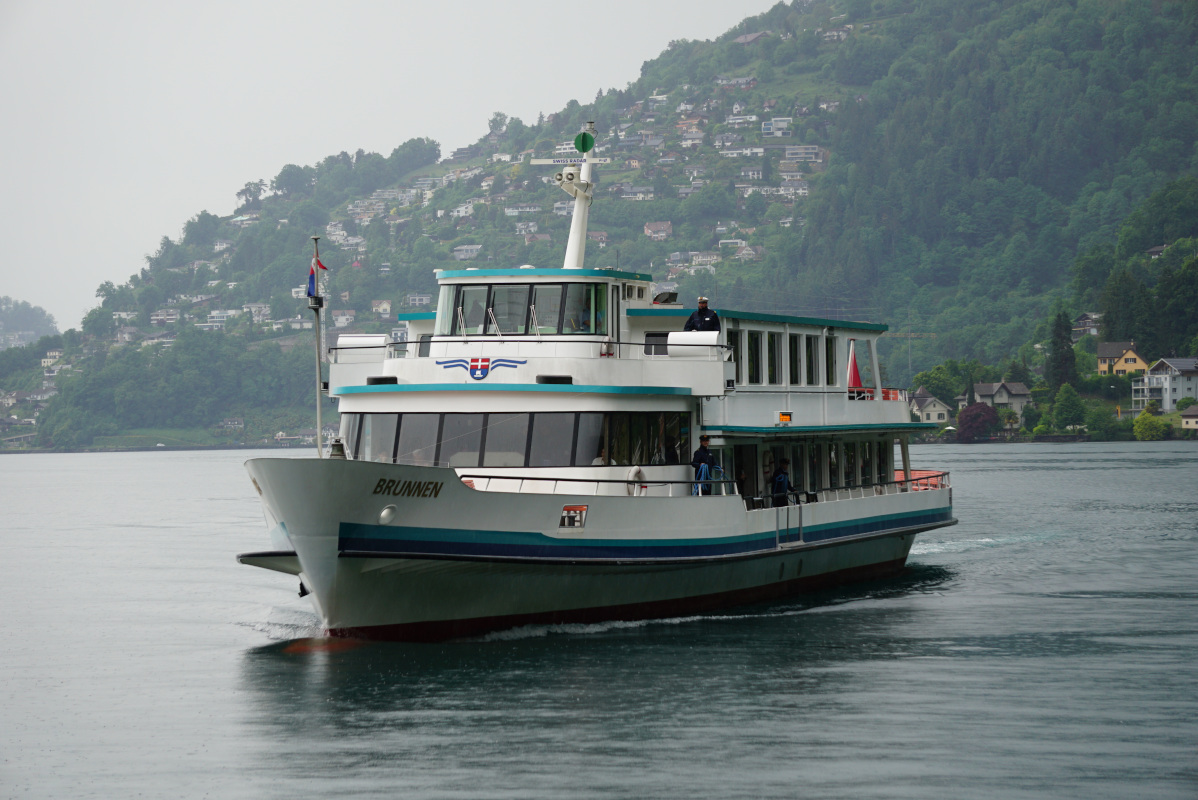 The captain of the Brunnen stands on the bridge wings while the ship comes alongside the landing bridge.
[May 2025].
The captain of the Brunnen stands on the bridge wings while the ship comes alongside the landing bridge.
[May 2025].
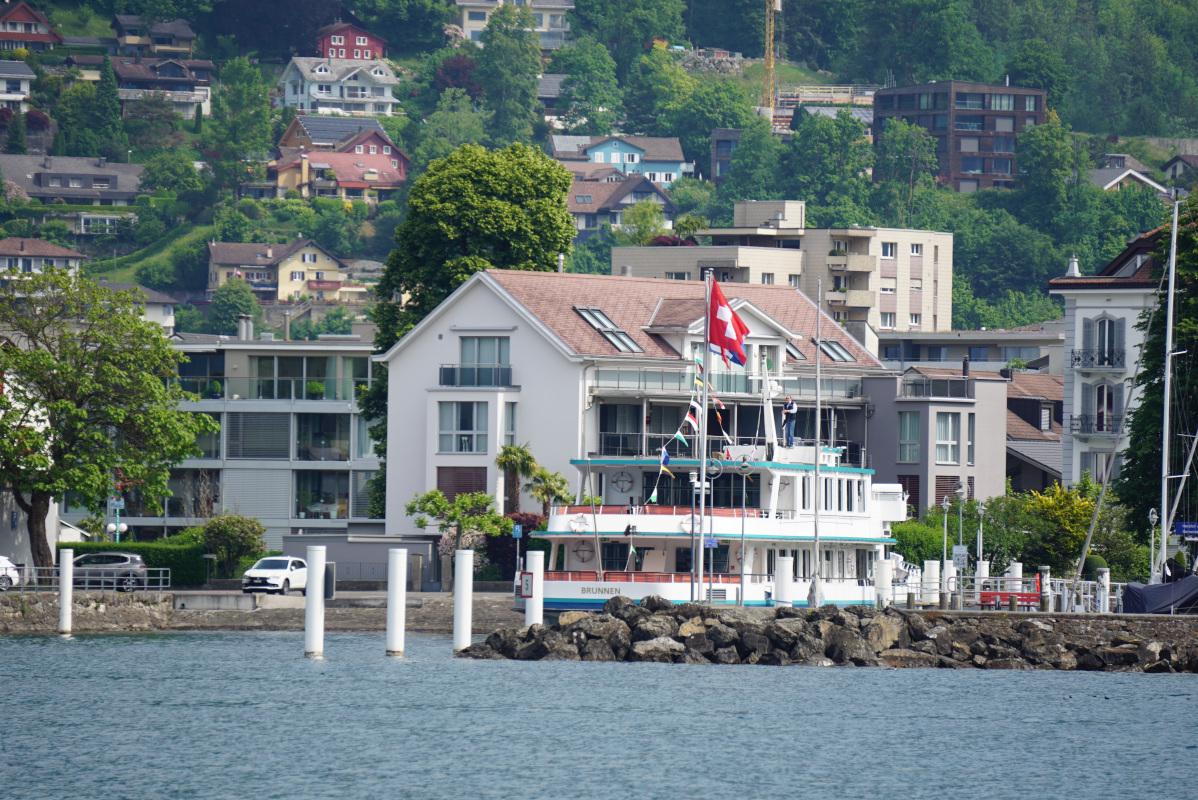 The motor ship Brunnen lies in the protected port of Brunnen.
Ships normally don't call here in the port, but rather at the more exposed landing bridge.
Only ships that stay overnight use the port, which is more protected from the strong winds that sometimes sweep across Lake Lucerne.
[May 2025].
The motor ship Brunnen lies in the protected port of Brunnen.
Ships normally don't call here in the port, but rather at the more exposed landing bridge.
Only ships that stay overnight use the port, which is more protected from the strong winds that sometimes sweep across Lake Lucerne.
[May 2025].
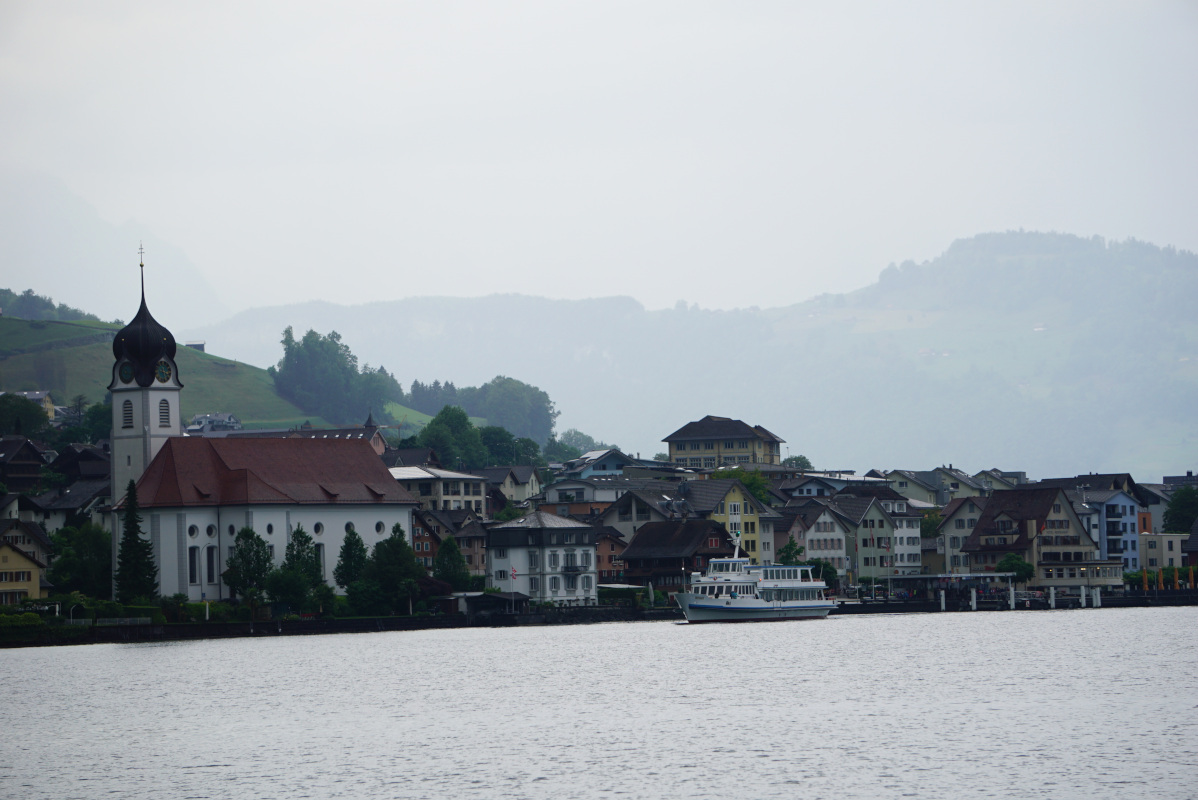 The motor ship Weggis has left Beckenried in the rain.
It is the third of the panorama ships.
[May 2025].
The motor ship Weggis has left Beckenried in the rain.
It is the third of the panorama ships.
[May 2025].
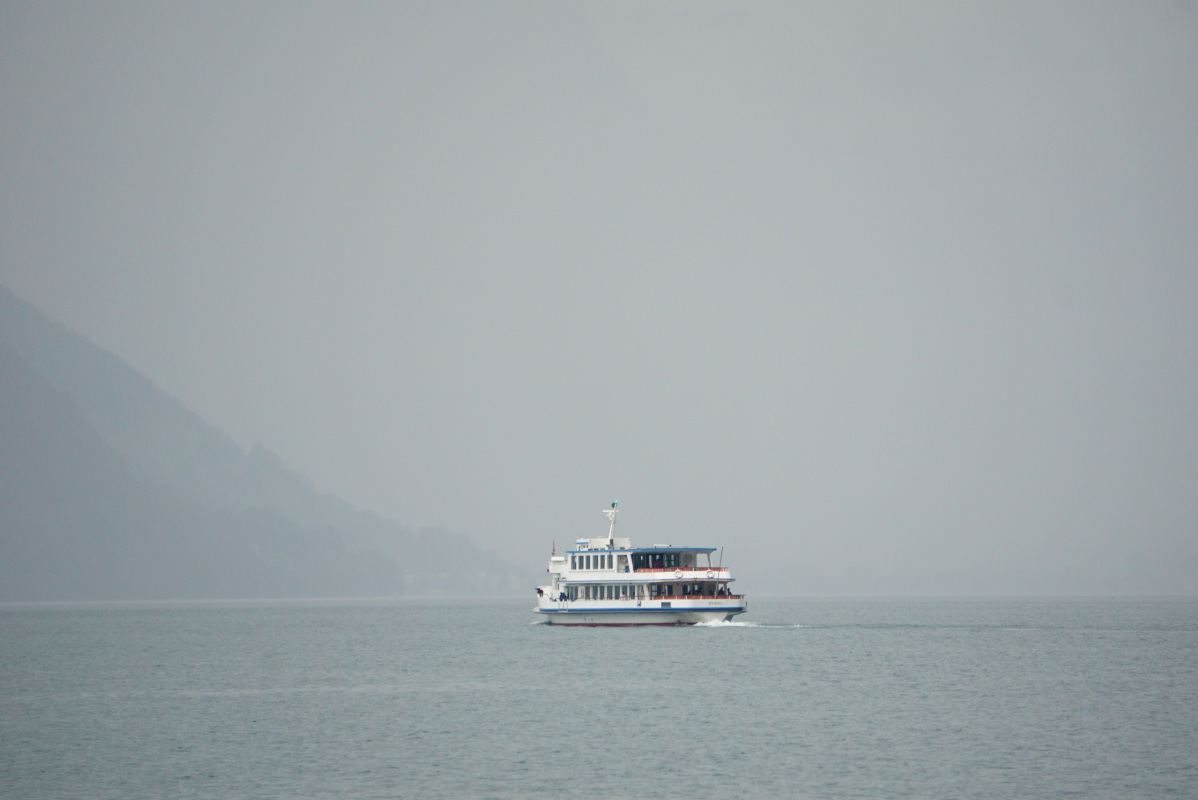 And then the Weggis heads into the rain.
Even in the rain a ship cruise on Lake Lucerne is impressive.
[May 2025].
And then the Weggis heads into the rain.
Even in the rain a ship cruise on Lake Lucerne is impressive.
[May 2025].
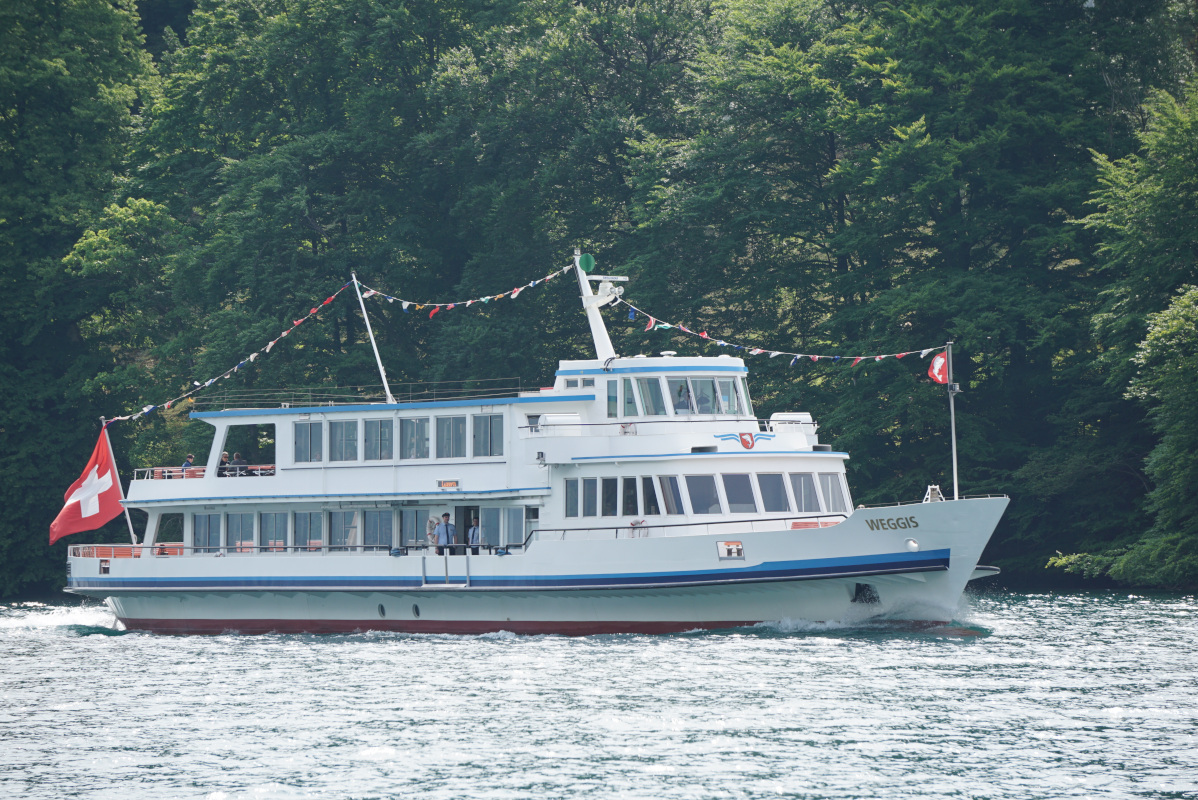 The Weggis travels along the lake near Treib.
The forward deck of the panorama ships is considerably higher than the aft deck.
[May 2025].
The Weggis travels along the lake near Treib.
The forward deck of the panorama ships is considerably higher than the aft deck.
[May 2025].
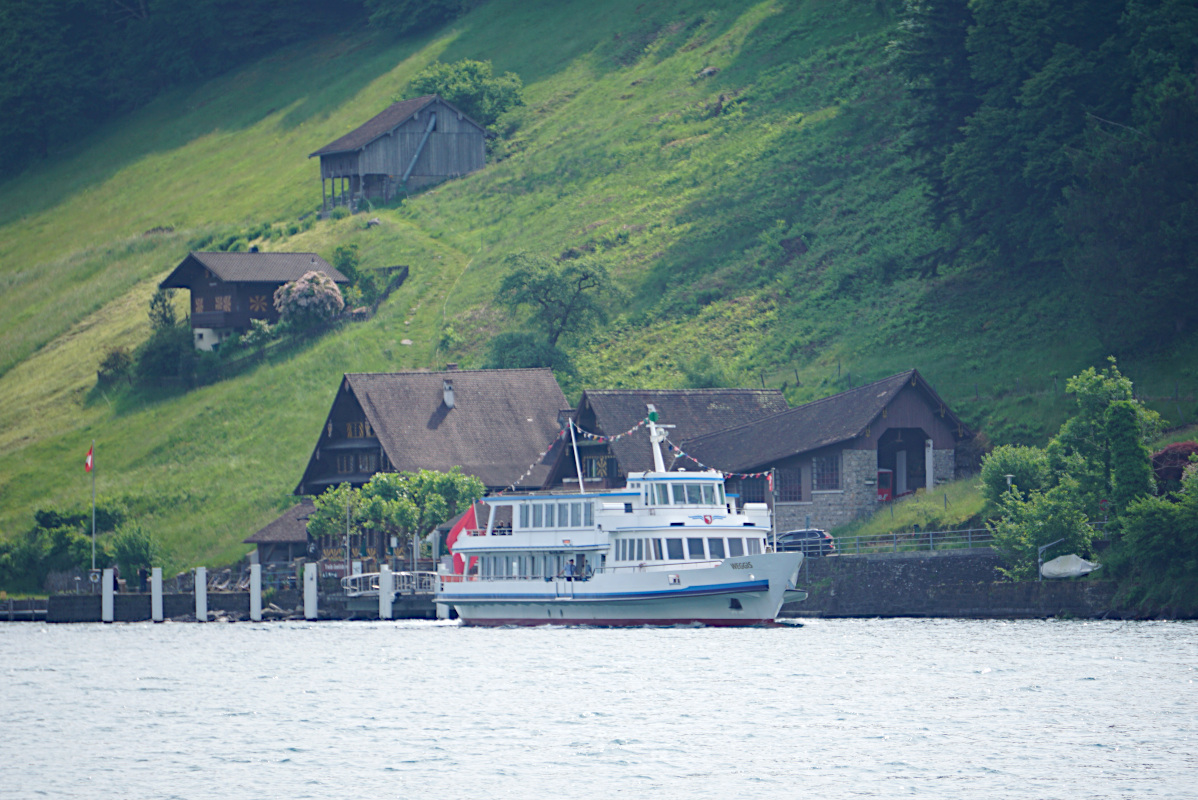 The Weggis has just departed from Treib.
To the left is the shipper house of Treib, beside it the lower station of the Treib-Seelisberg Funicular.
On the slopes above are another house and a shed.
Treib definitely is not a big settlement, but it provides a connection to Seelisberg.
[May 2025].
The Weggis has just departed from Treib.
To the left is the shipper house of Treib, beside it the lower station of the Treib-Seelisberg Funicular.
On the slopes above are another house and a shed.
Treib definitely is not a big settlement, but it provides a connection to Seelisberg.
[May 2025].
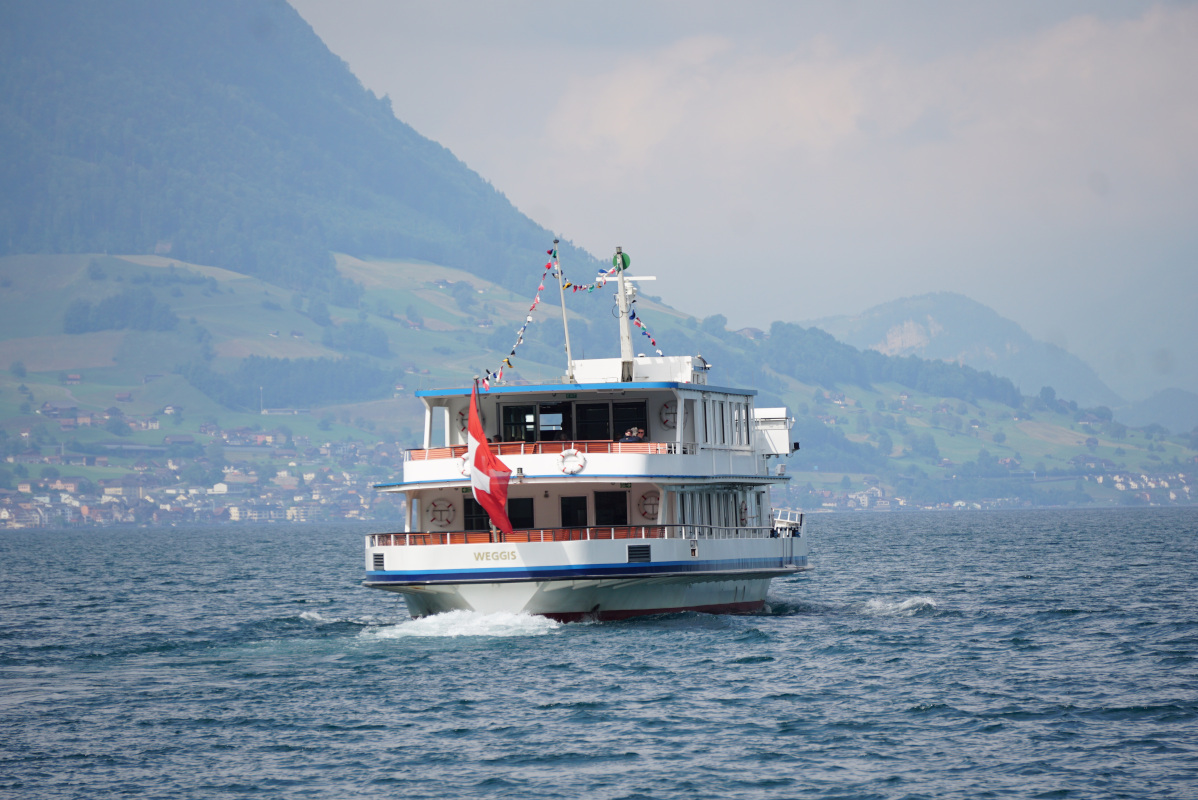 As if in greeting waves the flag on the stern of the Weggis as the ship travels towards Lucerne from Treib.
The vessel will arrive in Weggis, the village after which the ship is named, in approximately one hour.
[May 2025].
As if in greeting waves the flag on the stern of the Weggis as the ship travels towards Lucerne from Treib.
The vessel will arrive in Weggis, the village after which the ship is named, in approximately one hour.
[May 2025].
 The Waldstätter was built in 1998.
It was designed as a hospitality ship and is particularly used for culinary cruises.
Here it is near Weggis.
[Mar 2015].
The Waldstätter was built in 1998.
It was designed as a hospitality ship and is particularly used for culinary cruises.
Here it is near Weggis.
[Mar 2015].
 Waldstätter particulars: Passengers: 700 pax.
Length: 58.0m
Width: 11.50m Shipyard: SGV-Werft Luzern.
The Waldstätter leaves the Bay of Lucerne on an evening voyage.
[Apr 2016].
Waldstätter particulars: Passengers: 700 pax.
Length: 58.0m
Width: 11.50m Shipyard: SGV-Werft Luzern.
The Waldstätter leaves the Bay of Lucerne on an evening voyage.
[Apr 2016].
 The Waldstätter near Vitznau.
[Apr 2016].
The Waldstätter near Vitznau.
[Apr 2016].
 The motor ship Waldstätter is also in regular use during winter, because it has many inside seats.
Here it approaches Vitznau.
[Apr 2016].
The motor ship Waldstätter is also in regular use during winter, because it has many inside seats.
Here it approaches Vitznau.
[Apr 2016].
 TheWaldstätter at the landing bridge of Beckenried.
The village is built right against the lake shore.
In the background is Mt Pilatus.
[May 2015].
TheWaldstätter at the landing bridge of Beckenried.
The village is built right against the lake shore.
In the background is Mt Pilatus.
[May 2015].
 The Waldstätter between Beckenried and Gersau.
[May 2015].
The Waldstätter between Beckenried and Gersau.
[May 2015].
 In recent years, the new ships on Lake Lucerne have an overtly modern design.
They are meant to portray a cruise on the lake as a luxury experience.
The names of the ships also have become more abstract and are no longer related to the surroundings.
The first of these ships is the catamaran Cirrus.
It entered service in 2009.
Here it is near Hertenstein.
[May 2015].
In recent years, the new ships on Lake Lucerne have an overtly modern design.
They are meant to portray a cruise on the lake as a luxury experience.
The names of the ships also have become more abstract and are no longer related to the surroundings.
The first of these ships is the catamaran Cirrus.
It entered service in 2009.
Here it is near Hertenstein.
[May 2015].
 Cirrus particulars: Passengers: 300 pax.
Length: 40.0m
Width: 12.50m Shipyard: SGV-Werft Luzern.
In the background is Mt Pilatus.
[May 2015].
Cirrus particulars: Passengers: 300 pax.
Length: 40.0m
Width: 12.50m Shipyard: SGV-Werft Luzern.
In the background is Mt Pilatus.
[May 2015].
 The Saphir has the design of a luxury yacht.
It entered service in 2012 and is now mainly used for short cruises from Lucerne.
Here it is at Lucerne Helvetiakai.
[Aug 2015].
The Saphir has the design of a luxury yacht.
It entered service in 2012 and is now mainly used for short cruises from Lucerne.
Here it is at Lucerne Helvetiakai.
[Aug 2015].
 Saphir particulars: Passengers: 300 pax.
Length: 49.0m
Width: 8.30m Shipyard: SGV-Werft Luzern.
The Saphir in Lucerne.
[Aug 2015].
Saphir particulars: Passengers: 300 pax.
Length: 49.0m
Width: 8.30m Shipyard: SGV-Werft Luzern.
The Saphir in Lucerne.
[Aug 2015].
 Chinese tourists prefer the modern ship Saphir over paddle steamers or the more classic motor ships.
With a short cruise they are also able to quickly complete this obligatory part of their Switzerland tour.
The shipping company has even hired Chinese sailors to adequately target this growing market segement.
The Saphir at Helvetiakai, Lucerne, where these round trips leave from.
[May 2015].
Chinese tourists prefer the modern ship Saphir over paddle steamers or the more classic motor ships.
With a short cruise they are also able to quickly complete this obligatory part of their Switzerland tour.
The shipping company has even hired Chinese sailors to adequately target this growing market segement.
The Saphir at Helvetiakai, Lucerne, where these round trips leave from.
[May 2015].
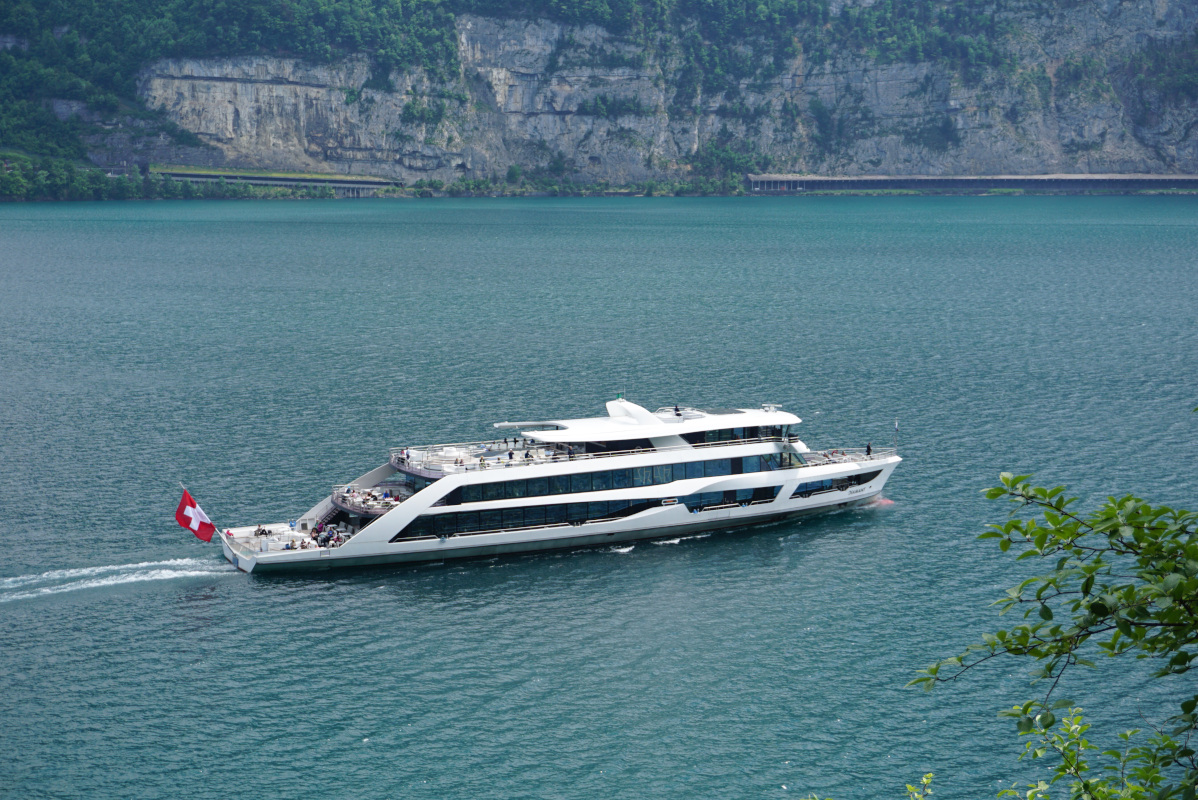 For regular timetabled services SGV built a large, modern ship, the Diamant, which entered service in 2017.
It also is designed in the form of a luxury yacht.
The Diamant travels across the lake near the Rütli meadow.
I wonder what the men who had sworn help here in the 13th century would have said, had they seen such a modern ship on the lake.
[May 2025].
For regular timetabled services SGV built a large, modern ship, the Diamant, which entered service in 2017.
It also is designed in the form of a luxury yacht.
The Diamant travels across the lake near the Rütli meadow.
I wonder what the men who had sworn help here in the 13th century would have said, had they seen such a modern ship on the lake.
[May 2025].
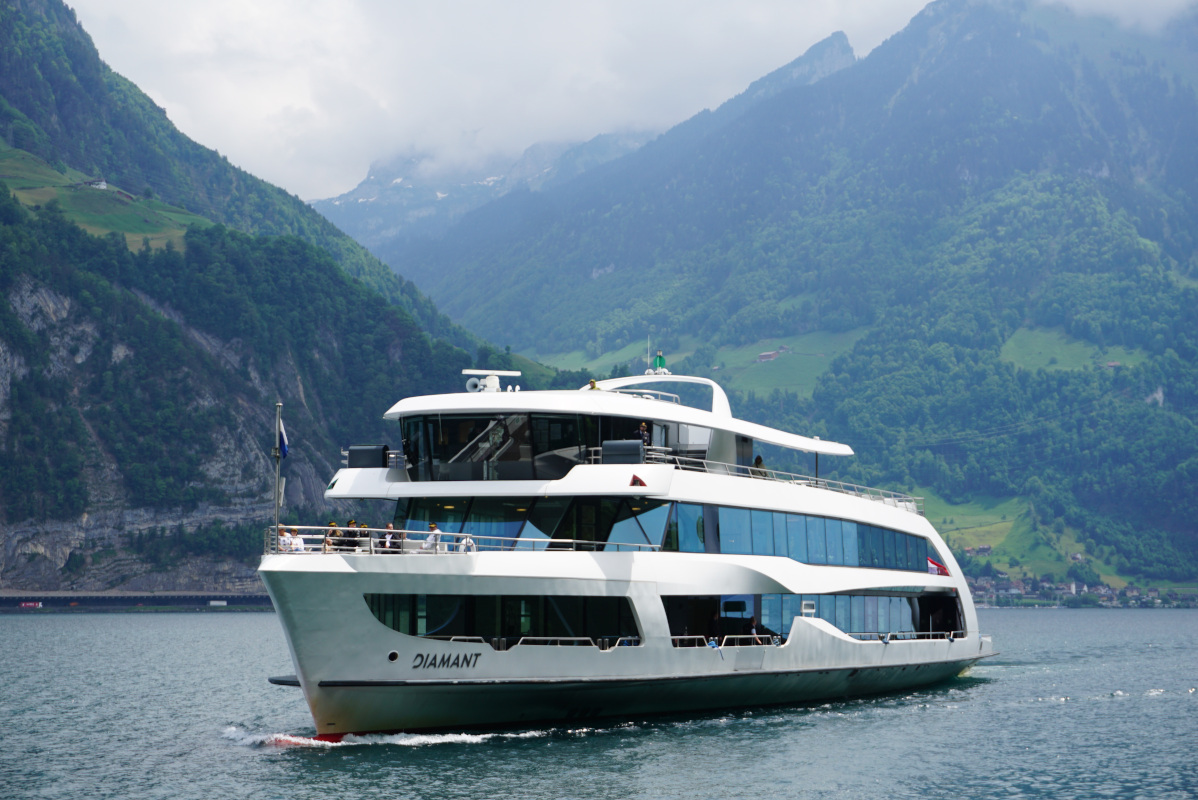 Diamant Particulars: Passengers: 1100 pax.
Length: 63.50m
Width: 13.50m Shipyard: Shiptec Lucerne.
Shiptec is the new name for the SGV-Werft Luzern.
The shipyard also builds and maintains ships for other lakes.
The Diamant approaches the Rütli.
[May 2025].
Diamant Particulars: Passengers: 1100 pax.
Length: 63.50m
Width: 13.50m Shipyard: Shiptec Lucerne.
Shiptec is the new name for the SGV-Werft Luzern.
The shipyard also builds and maintains ships for other lakes.
The Diamant approaches the Rütli.
[May 2025].
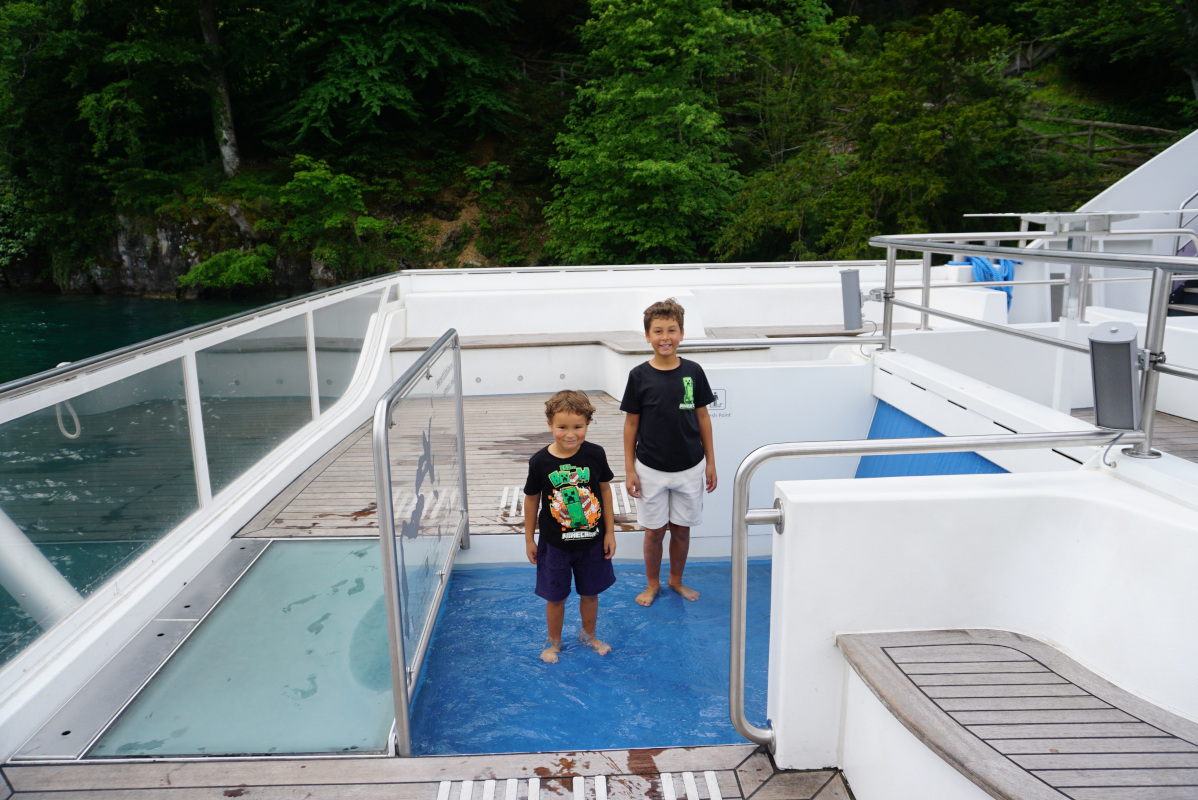 On the aft deck of the Diamant in the 2nd class area there is foot bath.
Fresh lake water is pumped into this shallow pool and then flows back into the lake at the stern.
[May 2025].
On the aft deck of the Diamant in the 2nd class area there is foot bath.
Fresh lake water is pumped into this shallow pool and then flows back into the lake at the stern.
[May 2025].
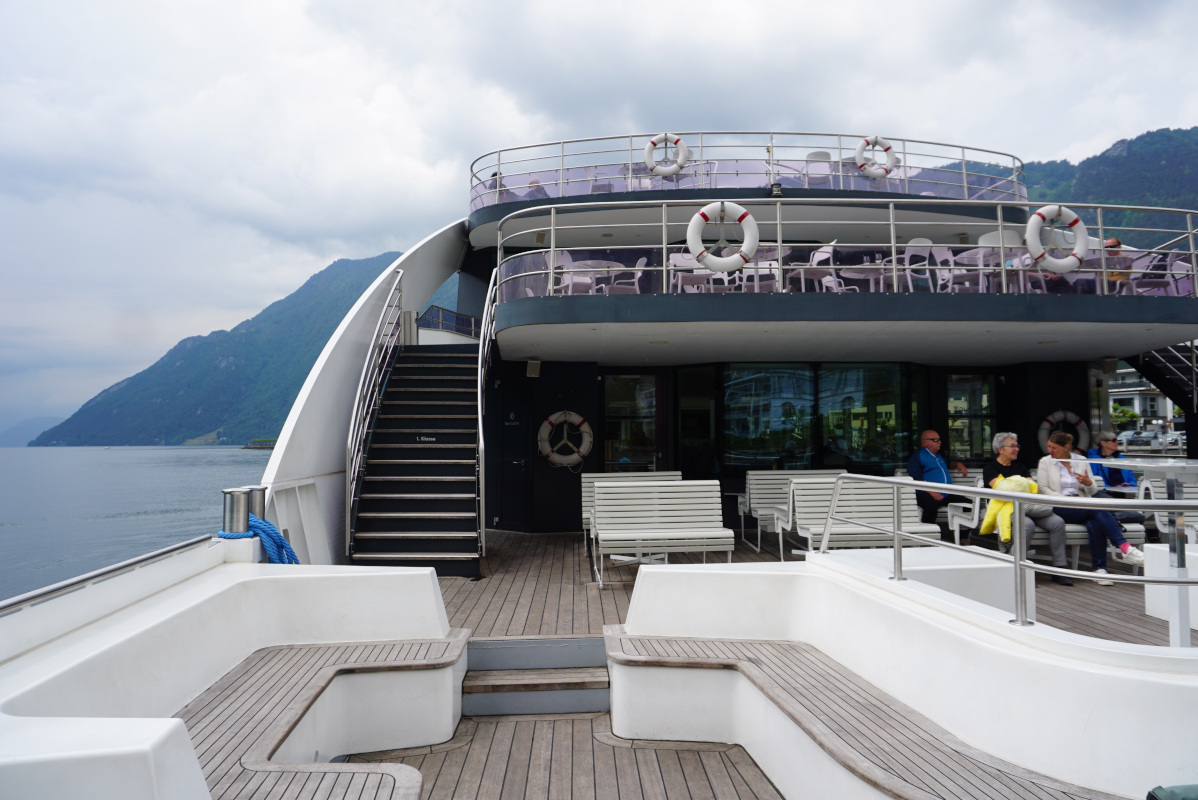 From the aft main deck of the Diamant these stairs sweep up from the 2nd class area to the 1st class on the upper deck.
The modern style is visible everywhere on the ship. The name means diamond.
[May 2025].
From the aft main deck of the Diamant these stairs sweep up from the 2nd class area to the 1st class on the upper deck.
The modern style is visible everywhere on the ship. The name means diamond.
[May 2025].
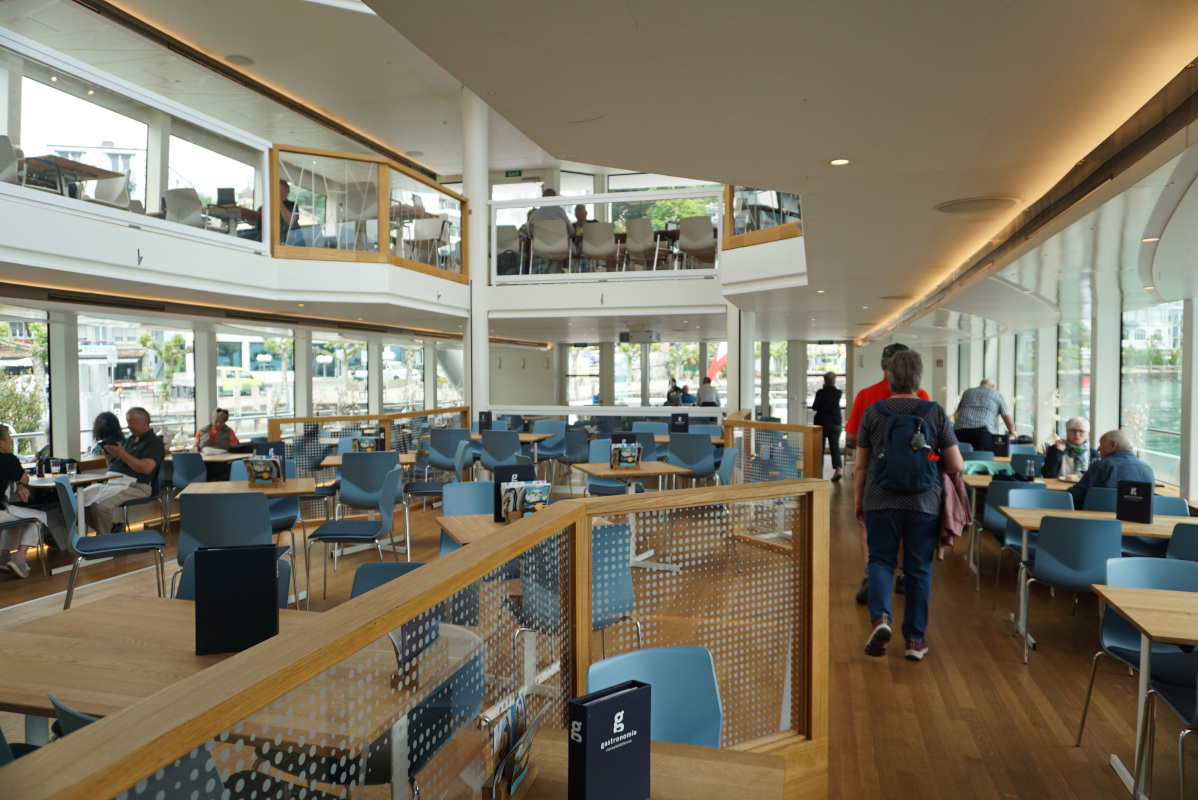 In the interior of the Diamant is a large atrium with mezzanine floor.
This allows ample space for the economically important hospitality business.
[May 2025].
In the interior of the Diamant is a large atrium with mezzanine floor.
This allows ample space for the economically important hospitality business.
[May 2025].
 The SGV is a limited liability company, with the shares held by private individuals.
But the company does not pay out a dividend.
Rather the shareholders receive free tickets and discounts for travelling on the ships and can participate at the shareholder meeting.
The company serves shipping on Lake Lucerne, not profit.
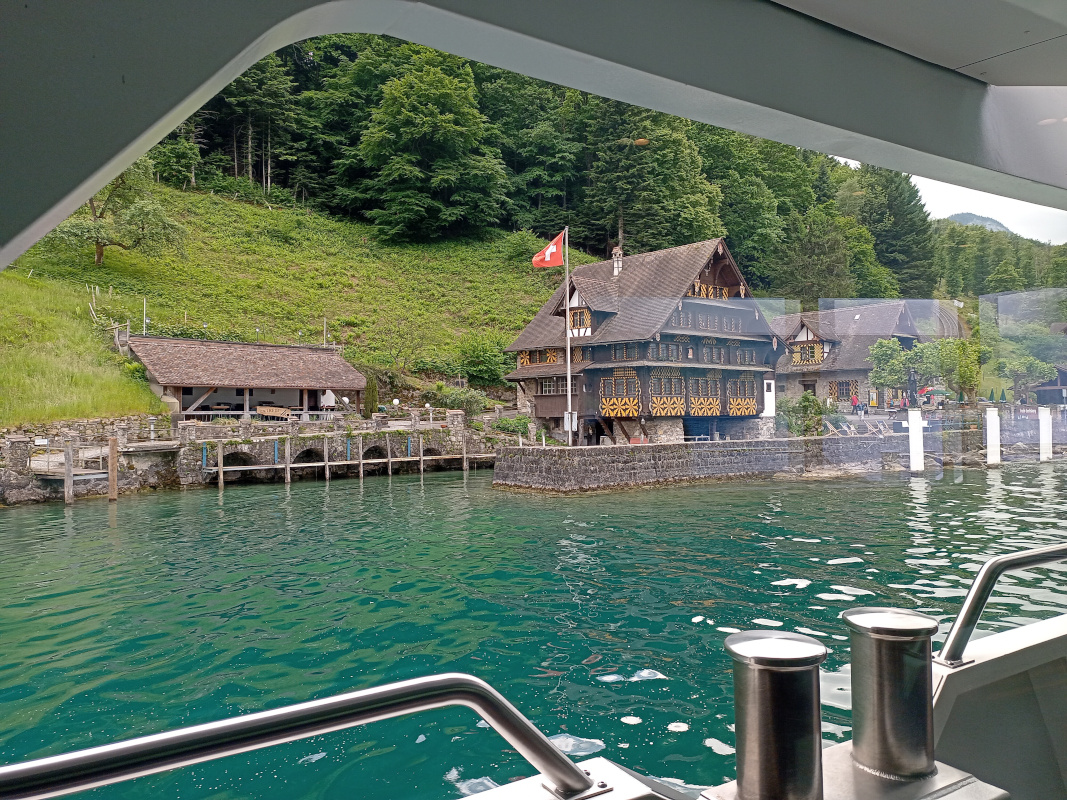
This is the view of Treib from on board the Diamant.
[Mai 2025].
The SGV is a limited liability company, with the shares held by private individuals.
But the company does not pay out a dividend.
Rather the shareholders receive free tickets and discounts for travelling on the ships and can participate at the shareholder meeting.
The company serves shipping on Lake Lucerne, not profit.
This is the view of Treib from on board the Diamant.
[Mai 2025].
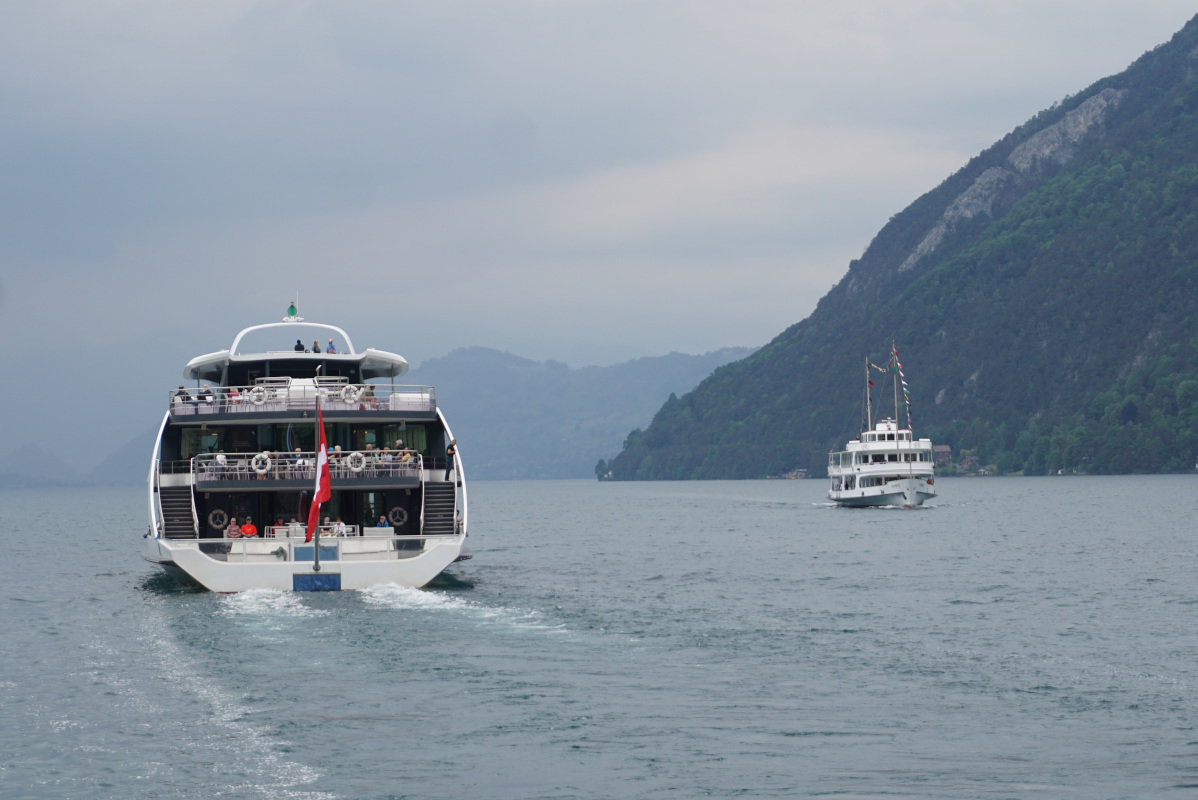 The Diamant has departed from Treib in the direction of Lucerne and meets the Schwyz, a ship from the previous century.
[May 2025].
The Diamant has departed from Treib in the direction of Lucerne and meets the Schwyz, a ship from the previous century.
[May 2025].
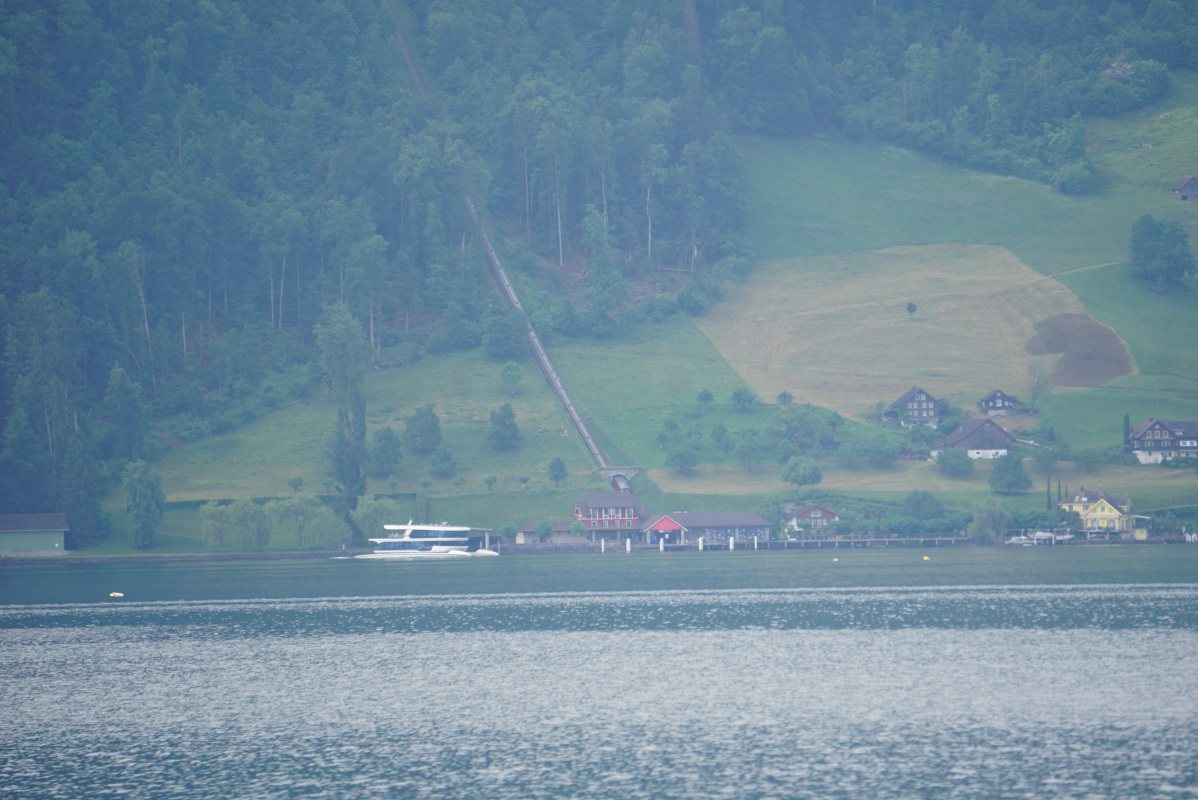 The newest ship of the fleet is the catamaran Bürgenstock,
which entered service in 2018.
This ship connects Lucerne and Bürgenstock-Kehrsitten hourly.
Here, a funicular railway takes guests to the exclusive resort Bürgenstock.
The ship Bürgenstock in front of the lower station of the funicular.
[May 2025].
The newest ship of the fleet is the catamaran Bürgenstock,
which entered service in 2018.
This ship connects Lucerne and Bürgenstock-Kehrsitten hourly.
Here, a funicular railway takes guests to the exclusive resort Bürgenstock.
The ship Bürgenstock in front of the lower station of the funicular.
[May 2025].
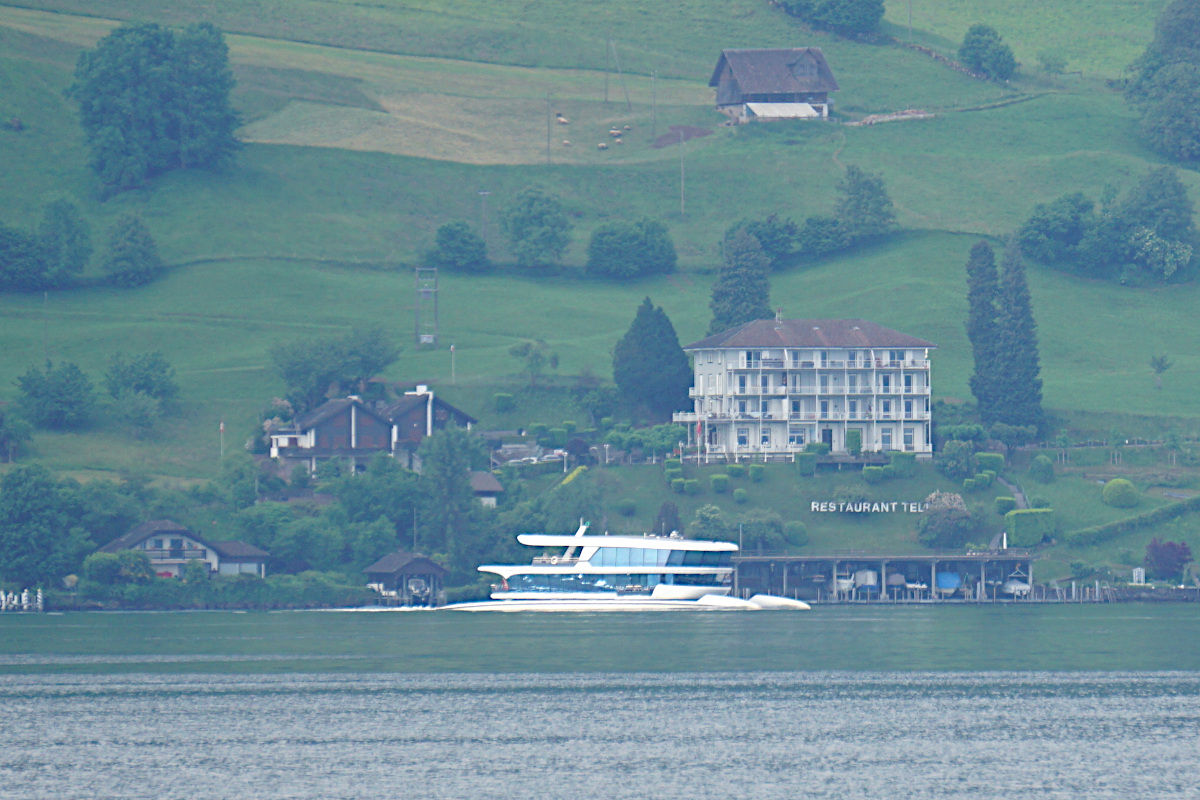 Bürgenstock Particulars: Passengers: 300 pax.
Length: 38.00m
Width: 10.30m Shipyard: Shiptec Luzern.
The Bürgenstock is near the Restaurant Tell in Kehrsitten.
[May 2025].
Bürgenstock Particulars: Passengers: 300 pax.
Length: 38.00m
Width: 10.30m Shipyard: Shiptec Luzern.
The Bürgenstock is near the Restaurant Tell in Kehrsitten.
[May 2025].