 Steam engines often provide a major attraction, but not all heritage operations
use steam engines.
Steam engines often provide a major attraction, but not all heritage operations
use steam engines.
 The Pleasant Point Railway also uses a small
Ford Model T railcar to transport visitors. During the summer months it provides a daily service.
Here it is seen loading passengers at a separate platform at Keanes Crossing, while the locomotive-hauled train sits at the main platform. [Jan 2013]
The Pleasant Point Railway also uses a small
Ford Model T railcar to transport visitors. During the summer months it provides a daily service.
Here it is seen loading passengers at a separate platform at Keanes Crossing, while the locomotive-hauled train sits at the main platform. [Jan 2013]
The two Ford Model T railcars originally operated on branch lines in Southland in the 1920s and 1930s.
Here is a view of an original The Model T railcar.
The railcar at Pleasant Point is not a preserved actual railcar, but a rebuild of a railcar according to the original plans
from a real Ford Model T.
Ford rail motor, RM 4 (Rail Motor no 4), in 1926.. Godber, Albert Percy, 1875-1949 :Collection of albums, prints and negatives. Ref: APG-0334-1/2-G.
Alexander Turnbull Library, Wellington, New Zealand. http://natlib.govt.nz/records/22560330

 At the Pleasant Point end a small turntable is installed on the Fairlie side of the railway station.
It is just large enough to fit the railcar and is let into the pavement of the town reserve.
The railcar has just been turned to take more passengers for a ride on the railway. [Jan 2013].
At the Pleasant Point end a small turntable is installed on the Fairlie side of the railway station.
It is just large enough to fit the railcar and is let into the pavement of the town reserve.
The railcar has just been turned to take more passengers for a ride on the railway. [Jan 2013].

 At the end of the day RM 4 makes its way from the Pleasant Point railway station through the township back towards Keane's Crossing.
[Dec 2023].
At the end of the day RM 4 makes its way from the Pleasant Point railway station through the township back towards Keane's Crossing.
[Dec 2023].
 The Ford Model T railcar travels along the straight from Pleasant Point to Keanes Crossing.
It has just passed Pleasant Point Apiaries, where very nice honey can be purchased.
[Jan 2019].
The Ford Model T railcar travels along the straight from Pleasant Point to Keanes Crossing.
It has just passed Pleasant Point Apiaries, where very nice honey can be purchased.
[Jan 2019].
 The Ford Model T railcar has turned on the turntable at Keane's Crossing and drives past the loco shed to the platform.
[Dec 2024].
The Ford Model T railcar has turned on the turntable at Keane's Crossing and drives past the loco shed to the platform.
[Dec 2024].
 A look back along the train to railcar RM 4, as it gets the green flag for departure from Keane's Crossing.
[Dec 2024].
A look back along the train to railcar RM 4, as it gets the green flag for departure from Keane's Crossing.
[Dec 2024].
 The Ford Model T railcar is leaving Keane's Crossing on its way to Pleasant Point.
In the background is the class D steam engine and a diesel shunting tractor. [Jun 2016].
The Ford Model T railcar is leaving Keane's Crossing on its way to Pleasant Point.
In the background is the class D steam engine and a diesel shunting tractor. [Jun 2016].
 The entrance signal to Keane's Crossing is just visible in the background as RM 4 sets out on another trip back to Pleasant Point. [Dec 2023].

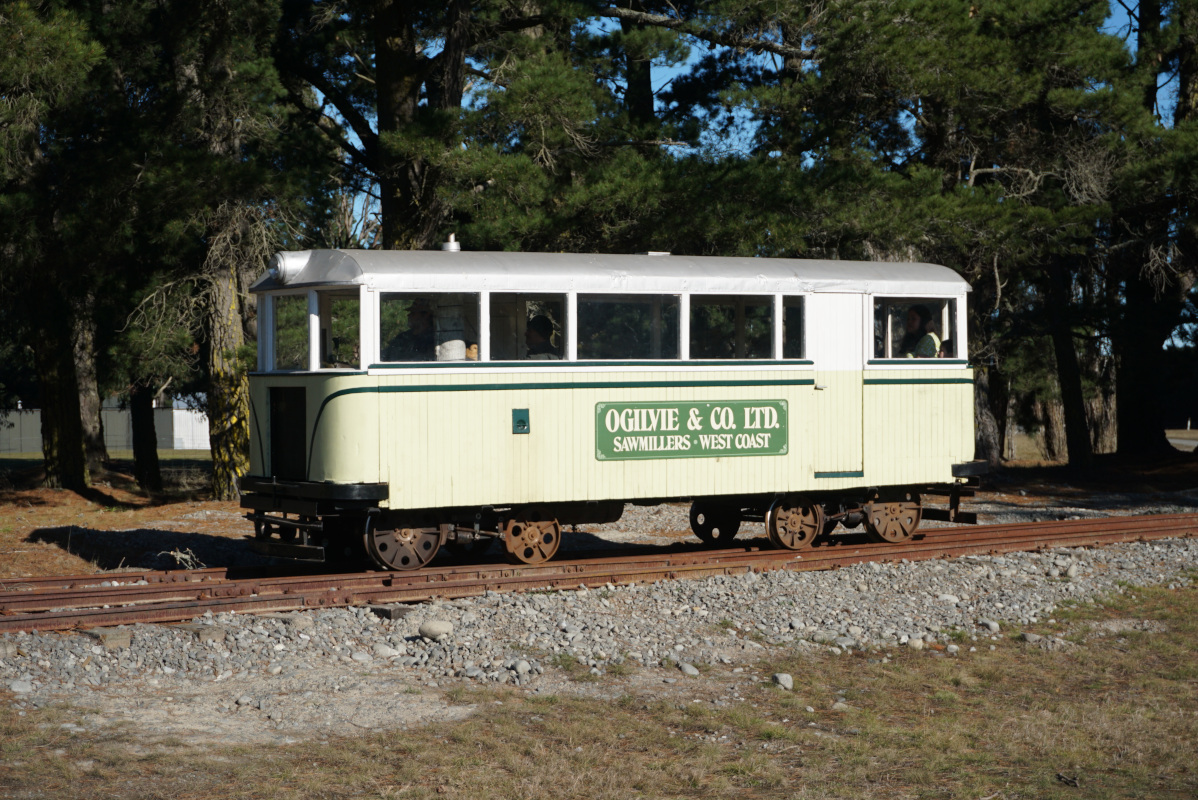
 Ogilvie & Co operated the bush tram
until 1959. However, the railcar was still used for shunting and the recovery of the rails and other materials from the bush in 1965. The Ogilvie & Co railcar was moved to Canterbury in 1970 and is now operated by Steam Scene at McLeans Island near Christchurch.
Here it stands at the platform while the driver returns to the railcar.
Today it runs on a flat section of track around the Steam Scene site.
[Sep 2023].
Ogilvie & Co operated the bush tram
until 1959. However, the railcar was still used for shunting and the recovery of the rails and other materials from the bush in 1965. The Ogilvie & Co railcar was moved to Canterbury in 1970 and is now operated by Steam Scene at McLeans Island near Christchurch.
Here it stands at the platform while the driver returns to the railcar.
Today it runs on a flat section of track around the Steam Scene site.
[Sep 2023].

 Originally, there was a driving position at each end of the railcar; today only one end has controls.
[Dec 2024].
Originally, there was a driving position at each end of the railcar; today only one end has controls.
[Dec 2024].

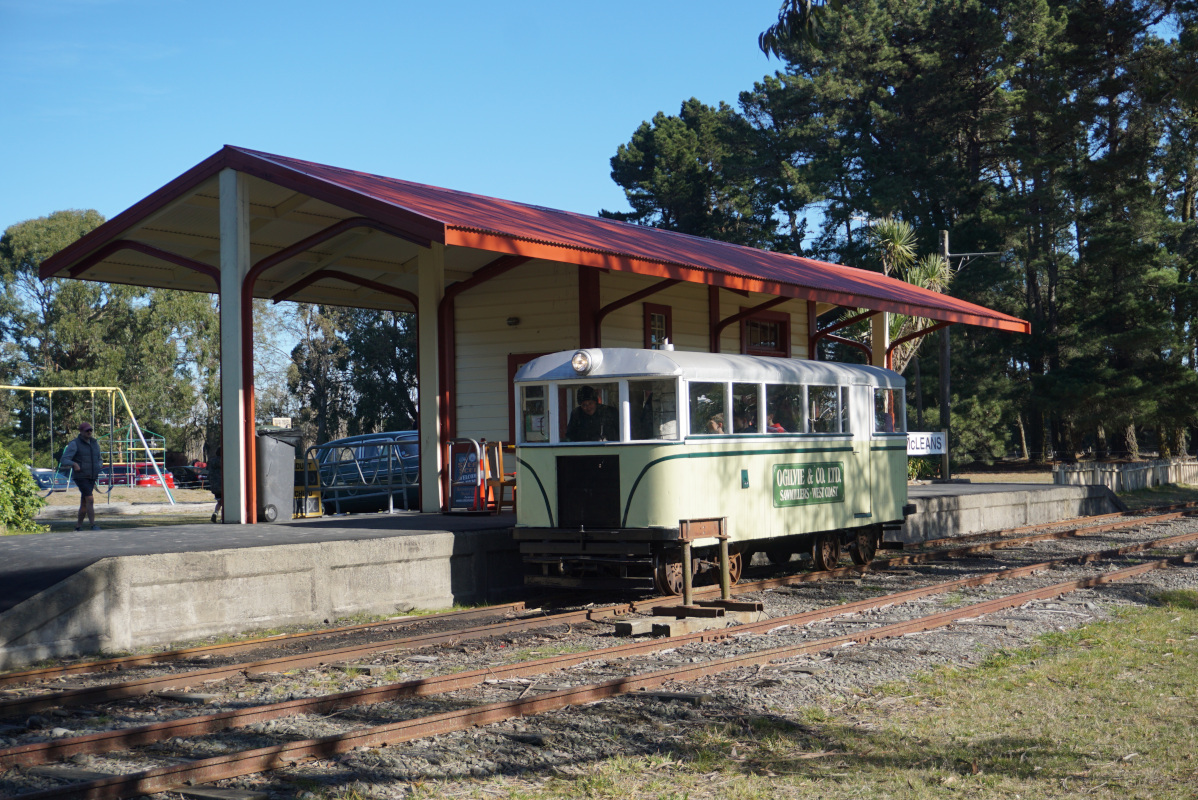 In 2026 Steam Scene built a new traditional-looking station.
The Ogilvie Railcar stands at the station ready to take more passengers on a ride.
[Aug 2026].
In 2026 Steam Scene built a new traditional-looking station.
The Ogilvie Railcar stands at the station ready to take more passengers on a ride.
[Aug 2026].
 These small railcars ran the Christchurch-Hokitika newspaper overnight run from 1936-1940
New Zealand Railways. View of rail motor No 20 (R.M. 20), 1936. Godber, Albert Percy, 1875-1949 :Collection of albums, prints and negatives. Ref: APG-1158-1/2-F. Alexander Turnbull Library, Wellington, New Zealand. http://natlib.govt.nz/records/22893011

One succesful model was the Vulcan railcar. From 1940 Vulcan railcars once ran throughout the South Island, both on the main lines and major branch lines. Several are now preserved by enthusiasts. One of them was seen at the Ferrymead Railway in Christchurch. [Feb 2005].
 At the Plains Railway near Ashburton another of the Vulcan railcars is preserved.
Here it stands at the Plains railway station. [Jan 2017].
At the Plains Railway near Ashburton another of the Vulcan railcars is preserved.
Here it stands at the Plains railway station. [Jan 2017].

RM 50 has departed the station area and now picks up a bit of speed as it travels to the open country. This railcar set the official New Zealand rail speed record of 78 mph (125.5 km/h) in 1940. [Jan 2017].
 This is the interior of a Vulcan railcar.
I'm sure that it would have appeared much trendier when it was new. [Jan 2017].
This is the interior of a Vulcan railcar.
I'm sure that it would have appeared much trendier when it was new. [Jan 2017].

RM 50 arrives back in the station area of the Plains Railway, located in Tinwald near Ashburton. The toilet was located in the middle of the railcar in the entrance area between the two passenger compartments. [Jan 2017].
 The Canterbury Railway Society at Ferrymead
has three Vulcan railcars.
RM 51 travels from Moorhouse Station to Ferrymead Station.
[Dec 2021].
The Canterbury Railway Society at Ferrymead
has three Vulcan railcars.
RM 51 travels from Moorhouse Station to Ferrymead Station.
[Dec 2021].

RM 51 sits at Moorhouse Station waiting for passengers for the next run. It will depart southwards towards the turning triangle, before running from there to Ferrymead. [Dec 2021].
 Vulcan railcar RM 51 travels along the Ferrymead Railway.
In the background is RM57, which is not in a good condition.
The other Vulcan Railcar at Ferrymead is RM 56.
In total four of the nine Vulcan Railcars have been preserved.
[Dec 2021].
Vulcan railcar RM 51 travels along the Ferrymead Railway.
In the background is RM57, which is not in a good condition.
The other Vulcan Railcar at Ferrymead is RM 56.
In total four of the nine Vulcan Railcars have been preserved.
[Dec 2021].

Another view of RM 51 at Moorhouse Station. Ten railcars were ordered from Vulcan Foundry in England, but one railcar was lost at sea when the ship that carrying it was sunk by a German submarine attack. [Jul 2022].
 Vulcan railcar RM 50 travels on the former Mt Somers Branch, which now is part of the Plains Railway.
[Oct 2022].
Vulcan railcar RM 50 travels on the former Mt Somers Branch, which now is part of the Plains Railway.
[Oct 2022].

On a brilliant spring day Vulcan railcar RM 51 travels along the Ferrymead Railway. [Oct 2022].
 RM 51 is ready to depart from Ferrymead Station, right by the Heathcote Estuary. The railcar is used regularly, because it is easy to run when there is no high patronage.
[May 2023].
RM 51 is ready to depart from Ferrymead Station, right by the Heathcote Estuary. The railcar is used regularly, because it is easy to run when there is no high patronage.
[May 2023].
 The interior view of the driver's cab of RM 51, as it sits at the platform of Moorhouse Station.
[Aug 2023].
The interior view of the driver's cab of RM 51, as it sits at the platform of Moorhouse Station.
[Aug 2023].
 RM 50 travels along the Plains Railway along the former Mount Somers Branch.
[Nov 2023].
RM 50 travels along the Plains Railway along the former Mount Somers Branch.
[Nov 2023].
 RM 56 has arrived at Moorhouse Station in the evening.
Even the moon can be seen in the sky.
This railcar is not used as frequently as RM 51, but is in a similar condition.
[Mar 2024].
RM 56 has arrived at Moorhouse Station in the evening.
Even the moon can be seen in the sky.
This railcar is not used as frequently as RM 51, but is in a similar condition.
[Mar 2024].
 RM 56 stands in the evening sun at Ferrymead Station right next to the Heathcote Estuary.
[Mar 2024].
RM 56 stands in the evening sun at Ferrymead Station right next to the Heathcote Estuary.
[Mar 2024].
 The silhouette of Vulcan railcar RM 56 is seen against the Heathcote Estuary.
The engine of the Vulcan railcars was mounted in a compartment above the three-axle bogie.
The other bogie had just two axles.
[Mar 2024].
The silhouette of Vulcan railcar RM 56 is seen against the Heathcote Estuary.
The engine of the Vulcan railcars was mounted in a compartment above the three-axle bogie.
The other bogie had just two axles.
[Mar 2024].
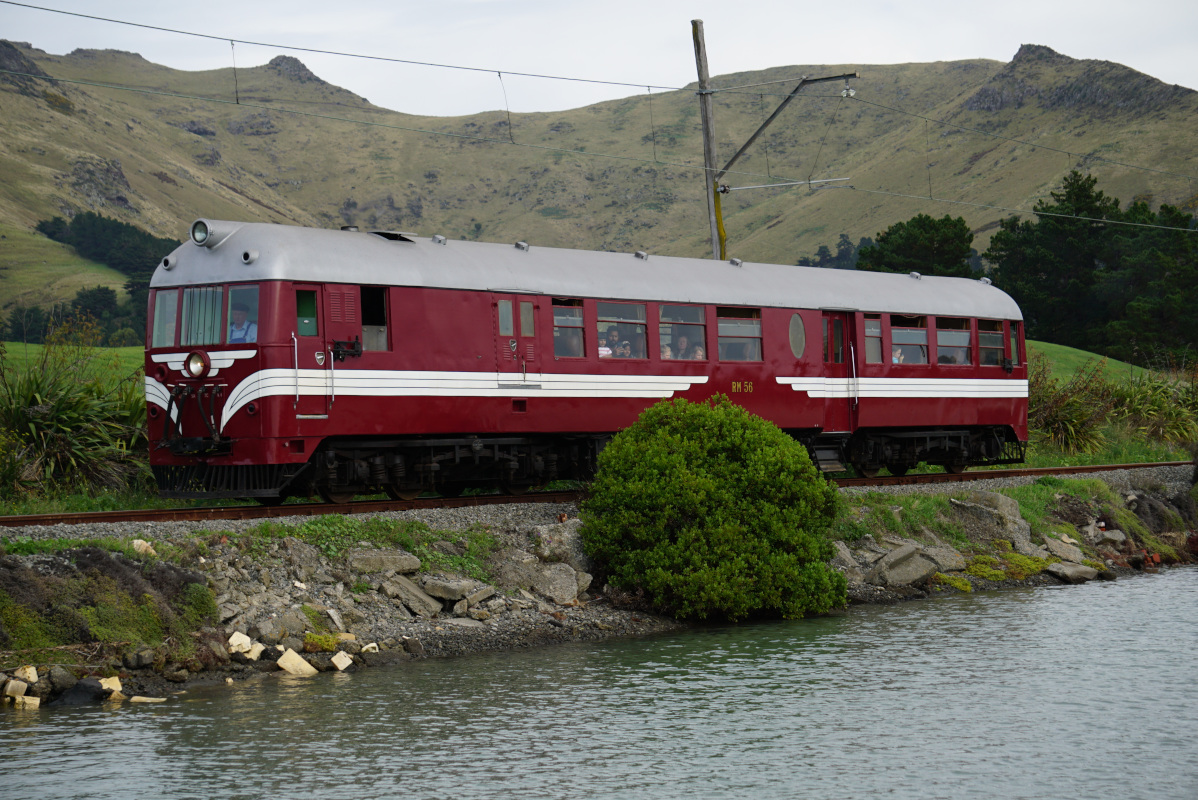 RM 56 travels along the Heathcote Estuary on a cloudy
Sunday afternoon.
One of the railcars is often used when light loadings are expected on the railway.
[Apr 2025].
RM 56 travels along the Heathcote Estuary on a cloudy
Sunday afternoon.
One of the railcars is often used when light loadings are expected on the railway.
[Apr 2025].
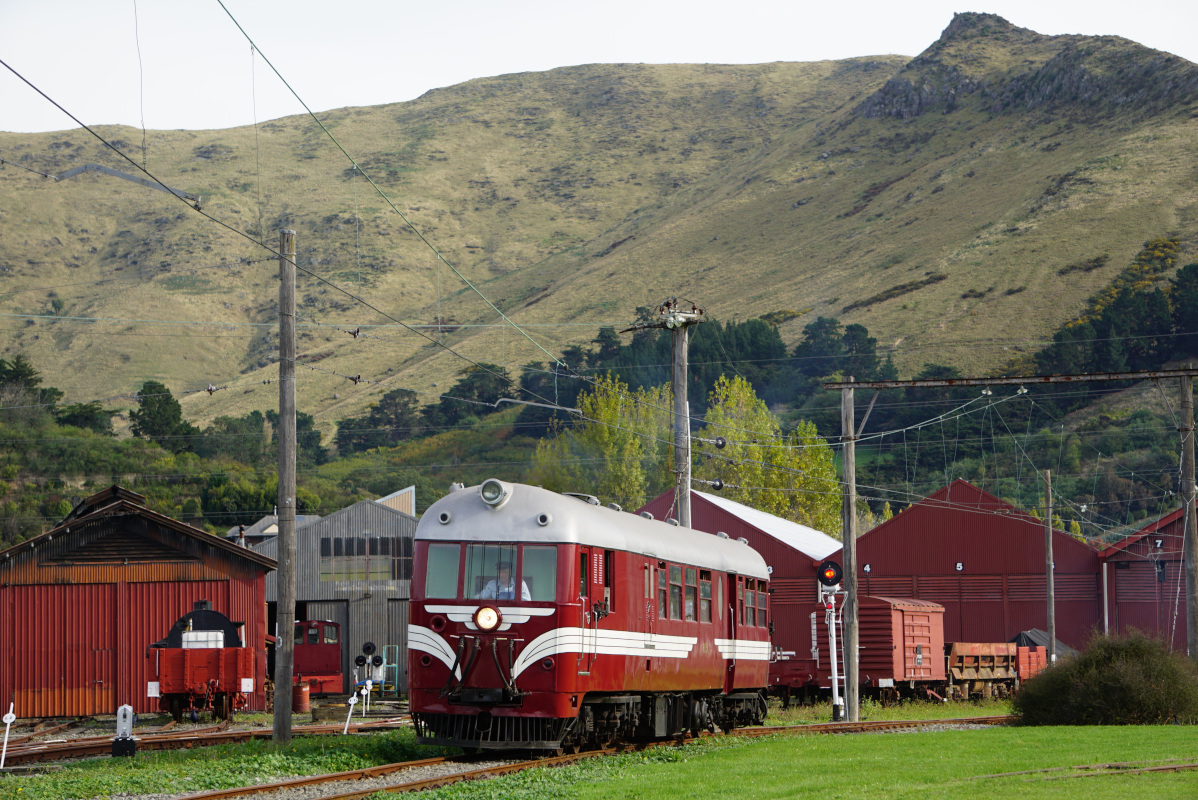 RM 56 travels along the line connecting the Ferrymead Railway to the main line.
On Sundays trains often travel the longer route across the triangle that forms part of the railway.
[Apr 2025].
RM 56 travels along the line connecting the Ferrymead Railway to the main line.
On Sundays trains often travel the longer route across the triangle that forms part of the railway.
[Apr 2025].
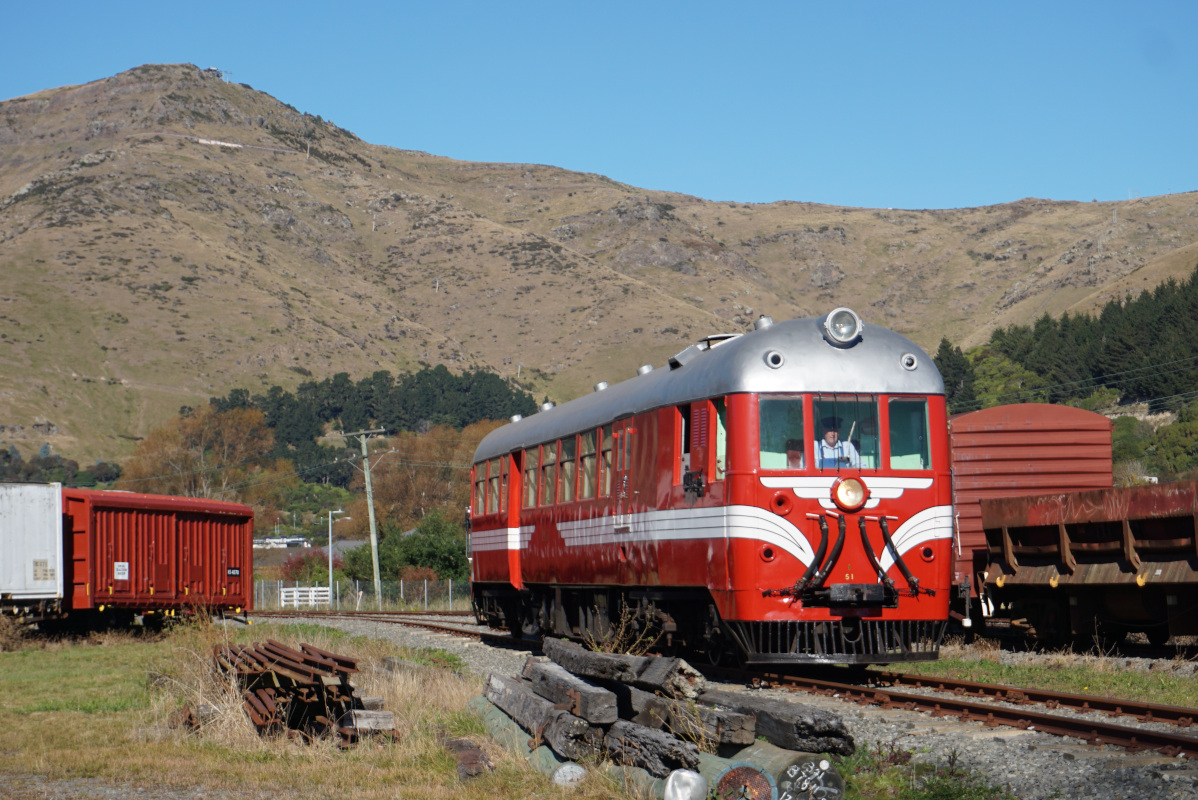 RM 51 travels along the triangle from the site of the future Valley Station to the line connecting with the main line.
In the background is Mt Cavendish with the Christchurch Gondola.
[May 2026].
RM 51 travels along the triangle from the site of the future Valley Station to the line connecting with the main line.
In the background is Mt Cavendish with the Christchurch Gondola.
[May 2026].
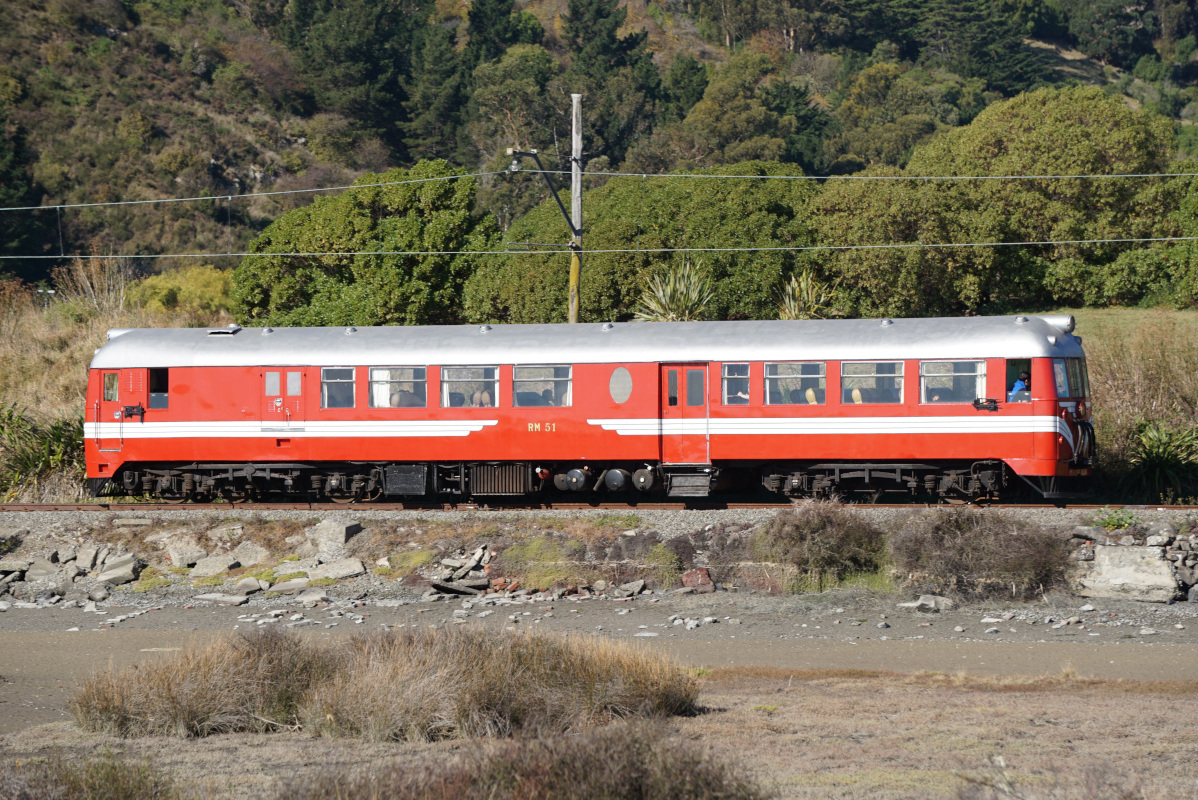 On a Sunday afternoon RM 51 travels along the Heathcote Estuary.
[May 2026].
On a Sunday afternoon RM 51 travels along the Heathcote Estuary.
[May 2026].
 A Vulcan railcar, as used in the South Island,
is seen together with a Standard railcar, as used in the North Island. at Ferrymead Station.
The Vulcan railcars are slightly higher, the standard railcars slightly wider.
[Mar 2024].
A Vulcan railcar, as used in the South Island,
is seen together with a Standard railcar, as used in the North Island. at Ferrymead Station.
The Vulcan railcars are slightly higher, the standard railcars slightly wider.
[Mar 2024].
 In March 2024 Standard railcar RM 31 was in the South Island for the first time ever to transport a tour group from Australia
and run several excursions for locals. It was stabled at the Ferrymead Railway while in Christchurch.
This was taken as an opportunity to run Standard and Vulcan railcars together.
[Mar 2024].
In March 2024 Standard railcar RM 31 was in the South Island for the first time ever to transport a tour group from Australia
and run several excursions for locals. It was stabled at the Ferrymead Railway while in Christchurch.
This was taken as an opportunity to run Standard and Vulcan railcars together.
[Mar 2024].
 The Standard railcar RM 31 stands together with two Vulcan railcars, RM 51 and RM 56, at Moorhouse Station.
Each of the railcars has a slightly different red livery.
[Mar 2024].
The Standard railcar RM 31 stands together with two Vulcan railcars, RM 51 and RM 56, at Moorhouse Station.
Each of the railcars has a slightly different red livery.
[Mar 2024].
 Standard railcar RM 31 passes through Papanui as it arrives in Christchurch for the first time in its life.
The lower ditch lights were added as part of the restoration process to comply with modern safety requirements.
[Mar 2024].
Standard railcar RM 31 passes through Papanui as it arrives in Christchurch for the first time in its life.
The lower ditch lights were added as part of the restoration process to comply with modern safety requirements.
[Mar 2024].
 Six Standard railcars were built by Hutt Workshops and entered service in the North Island from 1938 to 1939.
They were used on lines between Wellington and Taranaki and Hawke's Bay, including to Gisborne.
The two diesel engines were mounted on the bogies.
The railcars were popular and effective but due to a full capacity in the NZR workshops no more railcars were built in New Zealand.
[Mar 2024].
Six Standard railcars were built by Hutt Workshops and entered service in the North Island from 1938 to 1939.
They were used on lines between Wellington and Taranaki and Hawke's Bay, including to Gisborne.
The two diesel engines were mounted on the bogies.
The railcars were popular and effective but due to a full capacity in the NZR workshops no more railcars were built in New Zealand.
[Mar 2024].
 All the Standard railcars were taken out of service in December 1972.
RM 31 was purchased by a private individual.
From 2001 it was owned by the Pahiatua Railcar Society, which restored the railcar.
It has been operational again since 2008.
Here it is at Waikari on the Weka Pass Railway.
[Mar 2024].
All the Standard railcars were taken out of service in December 1972.
RM 31 was purchased by a private individual.
From 2001 it was owned by the Pahiatua Railcar Society, which restored the railcar.
It has been operational again since 2008.
Here it is at Waikari on the Weka Pass Railway.
[Mar 2024].
 RM 31 did two trips from Christchurch to Waikari and return.
The railcar could not used the curved platformin Waikari, because it is slightly too wide.
The Pahiatua Railcar Society did not want their nice railcar damaged by a tight platform.
[Mar 2024].
RM 31 did two trips from Christchurch to Waikari and return.
The railcar could not used the curved platformin Waikari, because it is slightly too wide.
The Pahiatua Railcar Society did not want their nice railcar damaged by a tight platform.
[Mar 2024].
 On its return trip to the North Island RM 31 passes through the rural landscape of North Canterbury near Scargill.
Unfortunately the farmer ordered me off land that was an unformed road, where I normally would be allowed to walk.
Therefore, I walked back along the railway line.
The railcar was so quiet that I did not hear it come in time and only got this shot.
[Mar 2024].
On its return trip to the North Island RM 31 passes through the rural landscape of North Canterbury near Scargill.
Unfortunately the farmer ordered me off land that was an unformed road, where I normally would be allowed to walk.
Therefore, I walked back along the railway line.
The railcar was so quiet that I did not hear it come in time and only got this shot.
[Mar 2024].
 It also ran between Christchurch and Little River. Unfortunately it burnt out in 1934.
It's my personal opinion that it is time to try battery railcars again.
Since 1926 there have been many developments, which would make the operation of battery railcars more efficient and safer.
It also ran between Christchurch and Little River. Unfortunately it burnt out in 1934.
It's my personal opinion that it is time to try battery railcars again.
Since 1926 there have been many developments, which would make the operation of battery railcars more efficient and safer.
Edison storage battery railcar, RM-6. Godber, Albert Percy, 1875-1949 :Collection of albums, prints and negatives. Ref: PA1-q-101-091. Alexander Turnbull Library, Wellington, New Zealand. http://natlib.govt.nz/records/22747952

 They were introduced in 1923 and continuously shuttled between Otira and Arthurs Pass up the steep grades of the Otira Tunnel.
One of those engines was photographed inside the tunnel, with icicles hanging from the ceiling.
They were introduced in 1923 and continuously shuttled between Otira and Arthurs Pass up the steep grades of the Otira Tunnel.
One of those engines was photographed inside the tunnel, with icicles hanging from the ceiling.
Railway locomotive in Otira Tunnel. Original photographic prints and postcards from file print collection, Box 13. Ref: PAColl-6407-70. Alexander Turnbull Library, Wellington, New Zealand. http://natlib.govt.nz/records/22778159
One of the Eo locomotives was preserved at Ferrymead and now runs occasional trips on the Ferrymead Railway. After running around its train at Ferrymead Station, the Eo locomotive was about to couple onto its wagons for the journey back to Moorhouse Station. [Jun 2013].


In contrast, several months later, the Eo sits in splendid sunshine outside the electric engine shed near Moorhouse Station. Basking in the sun beside it is Ec 7, a locomotive that did its duty in Christchurch during NZR days. [Oct 2013]
 The two locomotives sat outside the shed again on the occassion of the centenary celebrations of the Otira Tunnel.
This time they were decorated with festive banners.
Initially, the two classes were just known as E class, only later being separated into EO and EC.
[Aug 2023].
The two locomotives sat outside the shed again on the occassion of the centenary celebrations of the Otira Tunnel.
This time they were decorated with festive banners.
Initially, the two classes were just known as E class, only later being separated into EO and EC.
[Aug 2023].
 That's what the inside of EO 3 looks like.
The driver's stand was initially not separated from the engine comportment.
Later the driver's controls were removed from one end and the other driver's stand was enclosed.
When EO 3 came to Ferrymead the driver's stand on one end was re-installed in its open configuration, while the driving compartment
at the other end was retained.
[Aug 2023].
That's what the inside of EO 3 looks like.
The driver's stand was initially not separated from the engine comportment.
Later the driver's controls were removed from one end and the other driver's stand was enclosed.
When EO 3 came to Ferrymead the driver's stand on one end was re-installed in its open configuration, while the driving compartment
at the other end was retained.
[Aug 2023].
 With the British flag fluttering in the headwind, EO 3 heads along the Heathcote Estuary with a passenger train to Ferrymead.
[Aug 2023].
With the British flag fluttering in the headwind, EO 3 heads along the Heathcote Estuary with a passenger train to Ferrymead.
[Aug 2023].
 EO 3 heads along the Ferrymead Railway back towards Moorhouse Station.
On this side, the locomotive is in the condition from 1940 onwards, when the cab design was changed.
It has smaller, higher windows, the door was shifted to one side of the cab, and additional space was created at the driver's controls.
This way the engines looked even more like European electric locos of the time.
[Aug 2023].
EO 3 heads along the Ferrymead Railway back towards Moorhouse Station.
On this side, the locomotive is in the condition from 1940 onwards, when the cab design was changed.
It has smaller, higher windows, the door was shifted to one side of the cab, and additional space was created at the driver's controls.
This way the engines looked even more like European electric locos of the time.
[Aug 2023].
 To celebrate the opening of the Otira Tunnel 100 years previously, the Canterbury Railway Society organised a photographers' day
at Ferrymead.
Several locomotives were in operation. But EO 3, one of the original Otira Tunnel locomotives, was the star of the day.
Here she hauls a freight train towards Ferrymead station.
[Aug 2023].
To celebrate the opening of the Otira Tunnel 100 years previously, the Canterbury Railway Society organised a photographers' day
at Ferrymead.
Several locomotives were in operation. But EO 3, one of the original Otira Tunnel locomotives, was the star of the day.
Here she hauls a freight train towards Ferrymead station.
[Aug 2023].
 In the late afternoon sun EO 3 departs Ferrymead Station with a goods train.
[Aug 2023].
In the late afternoon sun EO 3 departs Ferrymead Station with a goods train.
[Aug 2023].
 The electric locomotive heads home with its goods train.
[Aug 2023].
The electric locomotive heads home with its goods train.
[Aug 2023].
 The next day, the EO was on duty again for the normal running day on the first Sunday of the month.
Here the electric locomotive is ready to depart Moorhouse Station with a passenger train.
At the back is EC 7, the loco that brought the train into the station.
[Aug 2023].
The next day, the EO was on duty again for the normal running day on the first Sunday of the month.
Here the electric locomotive is ready to depart Moorhouse Station with a passenger train.
At the back is EC 7, the loco that brought the train into the station.
[Aug 2023].

 A frequent suburban passenger service operated between Lyttelton and Christchurch until 1964 when the road tunnel
to Lyttelton was opened. Here preserved Ec 7 stands at the platform at Moorhouse Station. [Jun 2013]
A frequent suburban passenger service operated between Lyttelton and Christchurch until 1964 when the road tunnel
to Lyttelton was opened. Here preserved Ec 7 stands at the platform at Moorhouse Station. [Jun 2013]
The railway did not have many passengers on such a rainy day, but the weather made for some classic New Zealand working conditions. [June 2013].

 Ec 8 is seen in Christchurch in this scene from 1929.
Ec class electric locomotive, New Zealand Railways no 8. Godber, Albert Percy, 1875-1949 :Collection of albums, prints and negatives. Ref: APG-0323-1/2-G. Alexander Turnbull Library, Wellington, New Zealand. http://natlib.govt.nz/records/23116322
And another photo of Ec7 about to depart Moorhouse Station at the Ferrymead Heritage Park. [Jun 2013]
 For the occasion of the Otira Tunnel centenary
EC 7 was also decorated with flags.
With both the Union Jack and the New Zealand flag waving the electric locomotive travels along the Ferrymead Railway.
[Aug 2023].
For the occasion of the Otira Tunnel centenary
EC 7 was also decorated with flags.
With both the Union Jack and the New Zealand flag waving the electric locomotive travels along the Ferrymead Railway.
[Aug 2023].
 A bike had been attached to one end of EC 7, representing the connection to Christchurch, which once was a bike city.
The train is heading back towards Moorhouse Station.
[Aug 2023].
A bike had been attached to one end of EC 7, representing the connection to Christchurch, which once was a bike city.
The train is heading back towards Moorhouse Station.
[Aug 2023].
 The electric locomotive also hauled a goods train.
Here it is departing Ferrymead Station.
[Aug 2023].
The electric locomotive also hauled a goods train.
Here it is departing Ferrymead Station.
[Aug 2023].
 The EC heads along the Ferrymead Railway on yet another trip during the Otira Tunnel centenary celebrations.
[Aug 2023].
The EC heads along the Ferrymead Railway on yet another trip during the Otira Tunnel centenary celebrations.
[Aug 2023].
 In the past the EC locomotives shuttled between Lyttelton and Christchurch.
Now, the only survivor occasionally shuttles between Moorhouse and Ferrymead Stations.
[Aug 2023].
In the past the EC locomotives shuttled between Lyttelton and Christchurch.
Now, the only survivor occasionally shuttles between Moorhouse and Ferrymead Stations.
[Aug 2023].
 EC 7 stands at the platform of Moorhouse Station at night.
The driver and station attendant have something to talk about - probably railways.
[Aug 2023].
EC 7 stands at the platform of Moorhouse Station at night.
The driver and station attendant have something to talk about - probably railways.
[Aug 2023].
 Railway enthusiasts young and old admire the nicely presented electric locomotive.
[Aug 2023].
Railway enthusiasts young and old admire the nicely presented electric locomotive.
[Aug 2023].
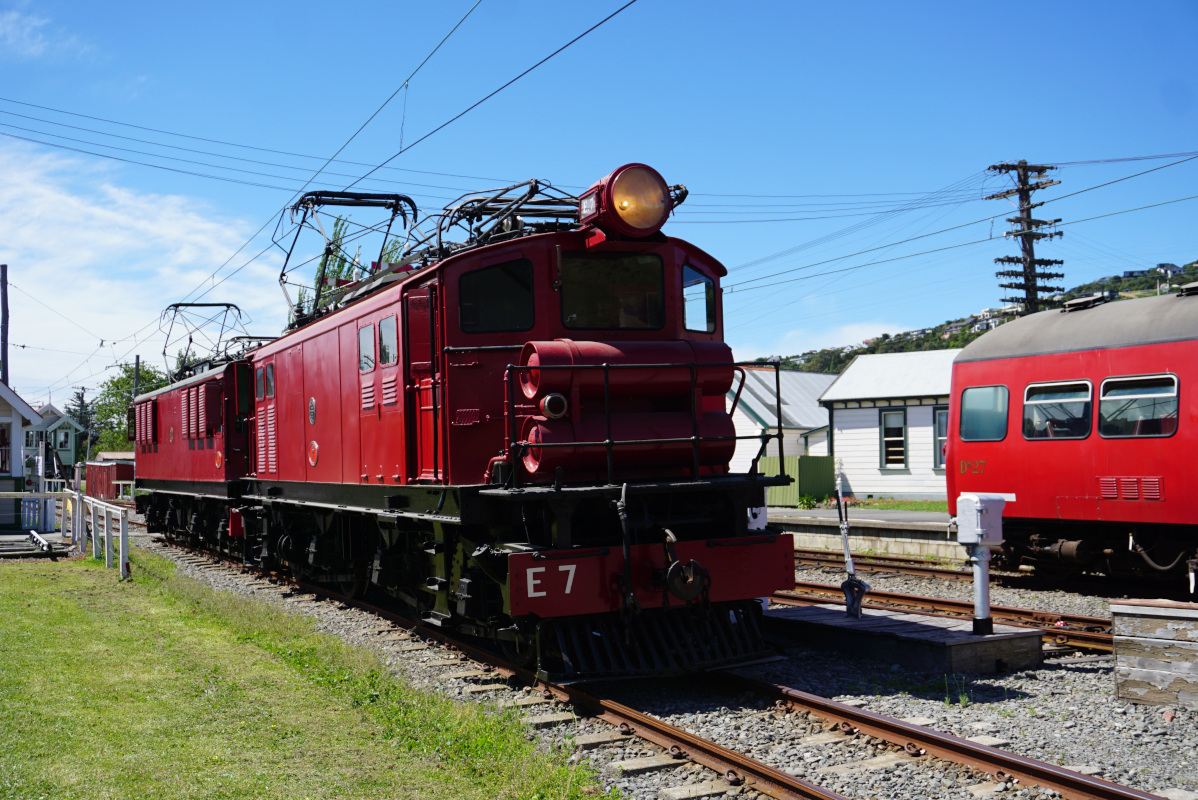 EC 7 and EO 3 stand together at Moorhouse Station.
Due to staff shortage the electrics could not be operated and the electric multiple unit DM 27 was used instead to operate passenger service that day.
[Oct 2025].
EC 7 and EO 3 stand together at Moorhouse Station.
Due to staff shortage the electrics could not be operated and the electric multiple unit DM 27 was used instead to operate passenger service that day.
[Oct 2025].
 This railcar spent its working life in Wellington. After it was withdrawn, the Ferrymead Railway stored it for future restoration.
However, when there was not enough rolling stock to transport the increasing passenger numbers in the Wellington
suburban network, the Wellington Regional Council requested a loan of the railcar from Ferrymead Railway.
As a result, the railcar was restored, even though it received a yellow front to comply with safety regulations.
After new trains were delivered to Wellington, the railcar has now returned to the Ferrymead Railway and is fully operational. [Oct 2013]
This railcar spent its working life in Wellington. After it was withdrawn, the Ferrymead Railway stored it for future restoration.
However, when there was not enough rolling stock to transport the increasing passenger numbers in the Wellington
suburban network, the Wellington Regional Council requested a loan of the railcar from Ferrymead Railway.
As a result, the railcar was restored, even though it received a yellow front to comply with safety regulations.
After new trains were delivered to Wellington, the railcar has now returned to the Ferrymead Railway and is fully operational. [Oct 2013]
 In early 2021 the front was repainted in the old red colour.
With the D 2695 trailer leading, the train shuttles passengers about during the Ferrymead night markets.
[Feb 2021].
In early 2021 the front was repainted in the old red colour.
With the D 2695 trailer leading, the train shuttles passengers about during the Ferrymead night markets.
[Feb 2021].
 The multiple units consisted normally of one DM electric motor car and one or two D trailer cars.
The units were built by English Electric in England and entered service from 1938.
DM 320 entered service in 1951; D 2695 entered service in 1953.
Both were taken out of service in 1988 before returning for another stint on the Wellington network from 2009 to 2012.
[Feb 2021].
The multiple units consisted normally of one DM electric motor car and one or two D trailer cars.
The units were built by English Electric in England and entered service from 1938.
DM 320 entered service in 1951; D 2695 entered service in 1953.
Both were taken out of service in 1988 before returning for another stint on the Wellington network from 2009 to 2012.
[Feb 2021].
 With the Port Hills in the background, the English Electric multiple unit skirts along the estuary of the Heathcote River to Ferrymead Station.
[Feb 2021].
With the Port Hills in the background, the English Electric multiple unit skirts along the estuary of the Heathcote River to Ferrymead Station.
[Feb 2021].
 Ferrymead Railway is the only heritage railway in New Zealand with overhead electric catenary (at 1500V DC).
That's why electric heritage rolling stock from different parts of New Zealand has found its way here.
[Feb 2021].
Ferrymead Railway is the only heritage railway in New Zealand with overhead electric catenary (at 1500V DC).
That's why electric heritage rolling stock from different parts of New Zealand has found its way here.
[Feb 2021].
 The distance between Moorhouse Station and Ferrymead Station is only about 750 m.
That's why the journeys are quite short and the trains run up to every 15 minutes (or 20 minutes when the EMU is not used).
DM 320 returns with a late train to Moorhouse Station.
[Feb 2021].
The distance between Moorhouse Station and Ferrymead Station is only about 750 m.
That's why the journeys are quite short and the trains run up to every 15 minutes (or 20 minutes when the EMU is not used).
DM 320 returns with a late train to Moorhouse Station.
[Feb 2021].
 On a fine autumn day, DM 320 stands with its trailer at Moorhouse Station, ready to depart on another trip to Ferrymead.
[Apr 2024].
On a fine autumn day, DM 320 stands with its trailer at Moorhouse Station, ready to depart on another trip to Ferrymead.
[Apr 2024].
 After the short trip to Ferrymead Station the electric multiple unit returns back along the Heathcote Estuary to Moorhouse Station.
On a normal operating Sunday the electric multiple unit offers sufficient runs to move over 2,800 passengers between the two stations.
However, only less than 10% of that count is normally travelling on opearting Sundays these days.
[Apr 2024].
After the short trip to Ferrymead Station the electric multiple unit returns back along the Heathcote Estuary to Moorhouse Station.
On a normal operating Sunday the electric multiple unit offers sufficient runs to move over 2,800 passengers between the two stations.
However, only less than 10% of that count is normally travelling on opearting Sundays these days.
[Apr 2024].
 The electric multiple unit is the cheapest train to run
for the Canterbury Railway Society.
Here it travels along the Heathcote Eastuary with Mt Cavendish in the background, the peak of the port hills to which the Christchurch
Gondola travels.
[Apr 2024].
The electric multiple unit is the cheapest train to run
for the Canterbury Railway Society.
Here it travels along the Heathcote Eastuary with Mt Cavendish in the background, the peak of the port hills to which the Christchurch
Gondola travels.
[Apr 2024].
 When these trains were still operating in Wellington,
they frequently travelled along the Porirua Harbour and the Wellington Harbour.
In Christchurch they still travel along the sea, but now along the Heathcote Estuary.
[Apr 2024].
When these trains were still operating in Wellington,
they frequently travelled along the Porirua Harbour and the Wellington Harbour.
In Christchurch they still travel along the sea, but now along the Heathcote Estuary.
[Apr 2024].
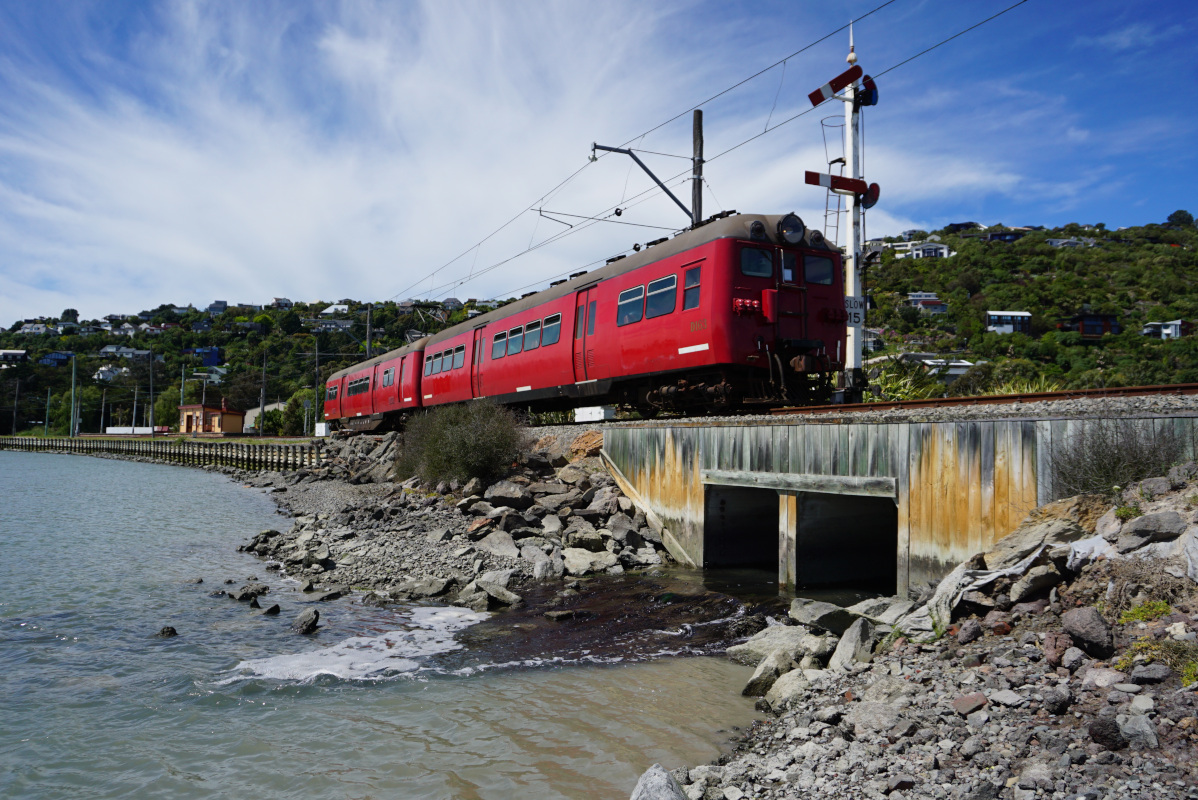 By now the electric multiple unit has the original number again.
D 2695 now carries the number D 163 again.
It is leaving Ferrymead Station on a run to Moorhouse Station.
During low tide a small stream empties into the Heathcote underneath this bridge.
[Oct 2025].
By now the electric multiple unit has the original number again.
D 2695 now carries the number D 163 again.
It is leaving Ferrymead Station on a run to Moorhouse Station.
During low tide a small stream empties into the Heathcote underneath this bridge.
[Oct 2025].
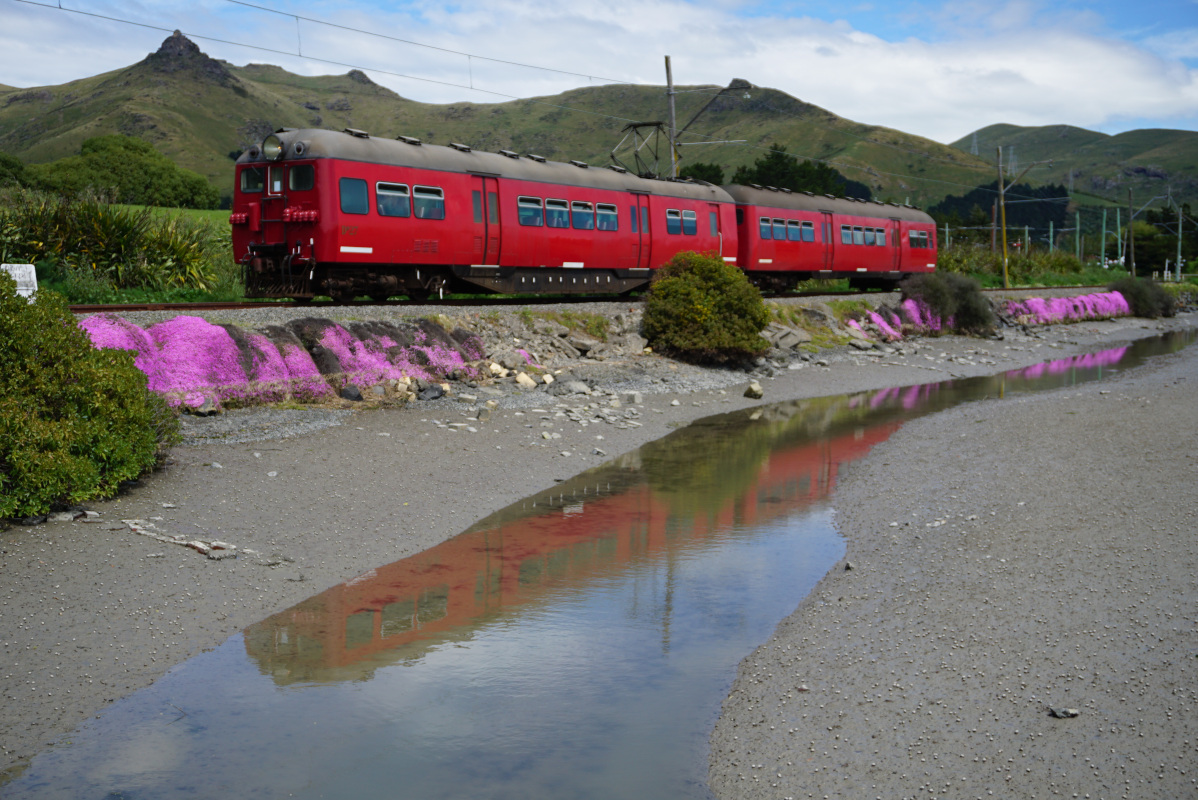 DM 320 now carries its original number DM 27 again.
Here it travels along the Heathcote Estuary on a spring day above the blooming pink flowers that frame the railway line here.
[Oct 2025].
DM 320 now carries its original number DM 27 again.
Here it travels along the Heathcote Estuary on a spring day above the blooming pink flowers that frame the railway line here.
[Oct 2025].
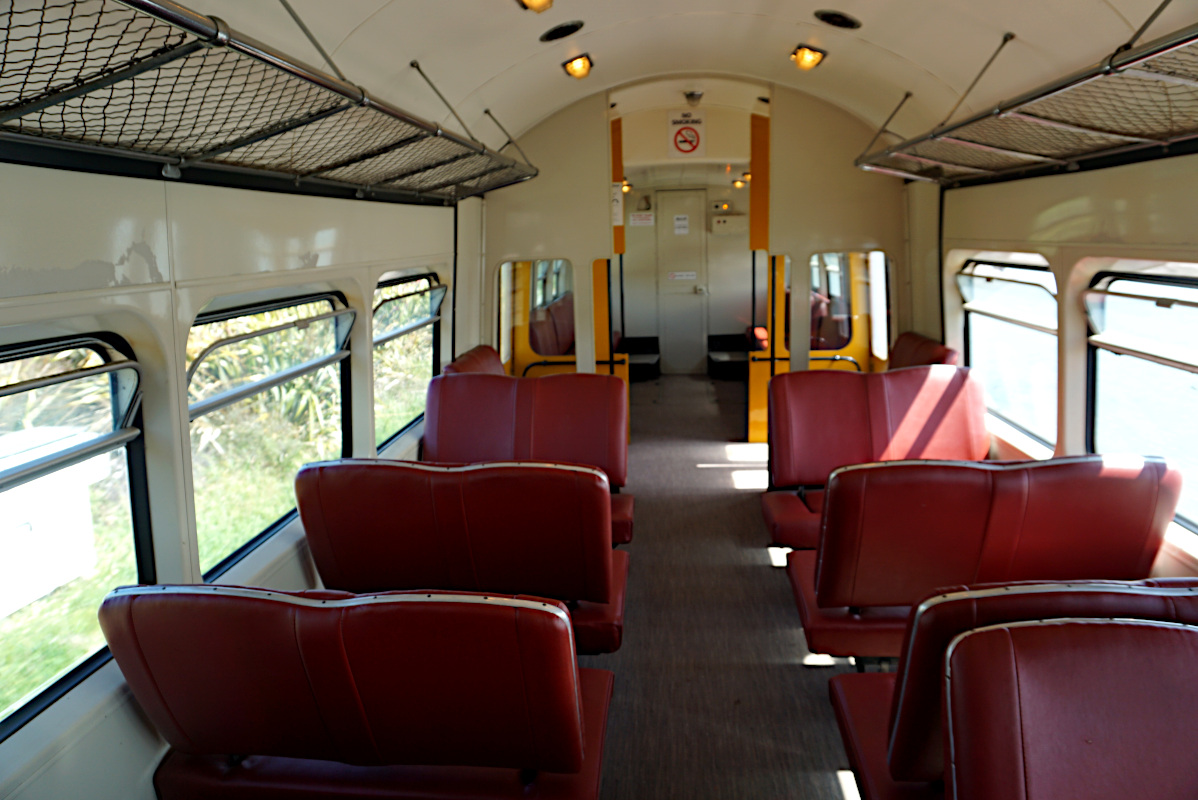 This is the internal view of DM 27.
For shorter trips these electric units were quite comfortable.
[Oct 2025].
This is the internal view of DM 27.
For shorter trips these electric units were quite comfortable.
[Oct 2025].
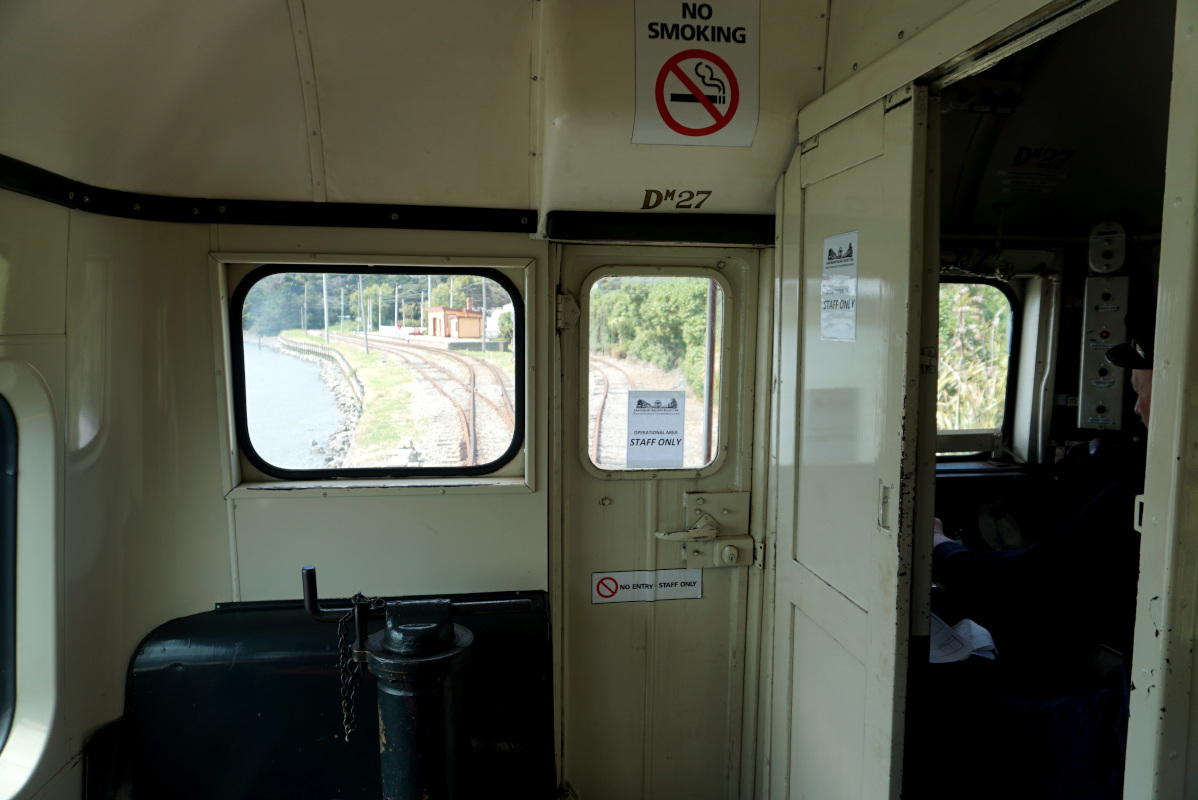 With the driver sitting in a small compartment on the right hand of the train, passengers able to look at the track ahead through the other front windows.
Here DM 27 is approaching Ferrymead Station.
[Oct 2025].
With the driver sitting in a small compartment on the right hand of the train, passengers able to look at the track ahead through the other front windows.
Here DM 27 is approaching Ferrymead Station.
[Oct 2025].
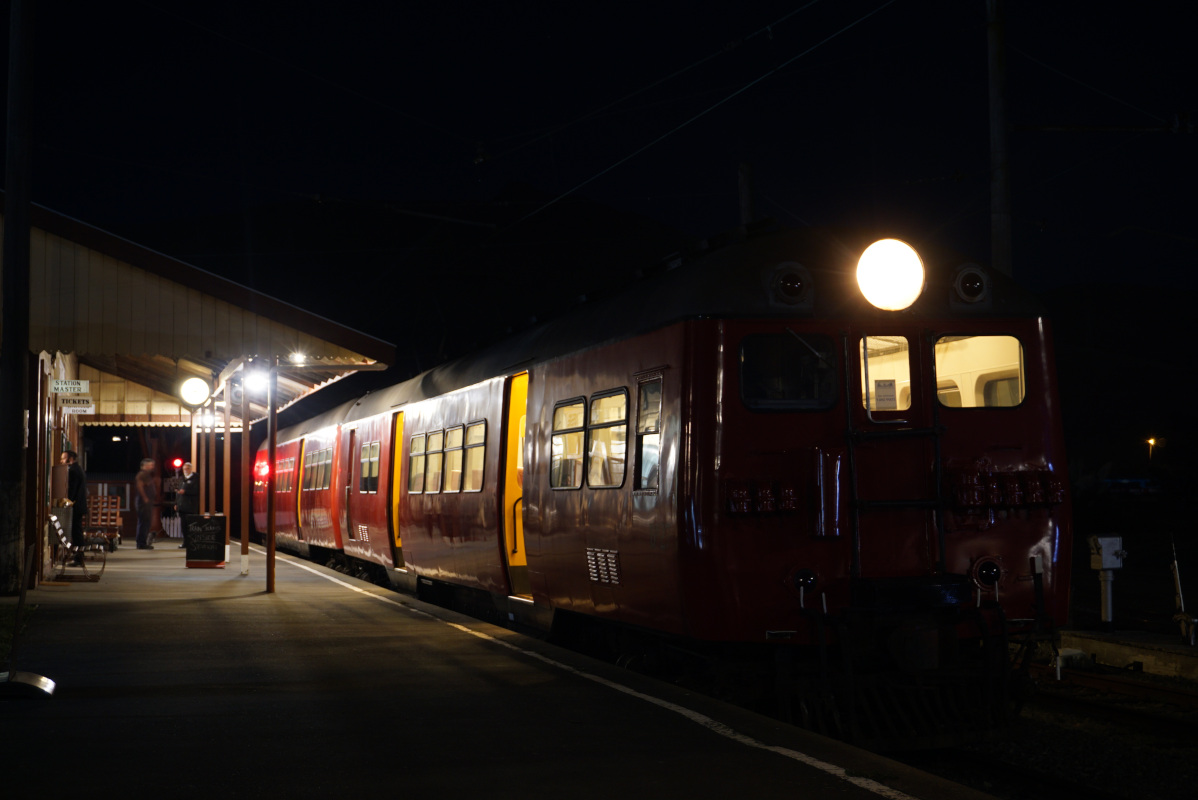 DM 27 and D163 stand at the platform of Moorhouse Station during the night market, ready to take passengers along the line to Ferrymead.
[May 2026].
DM 27 and D163 stand at the platform of Moorhouse Station during the night market, ready to take passengers along the line to Ferrymead.
[May 2026].
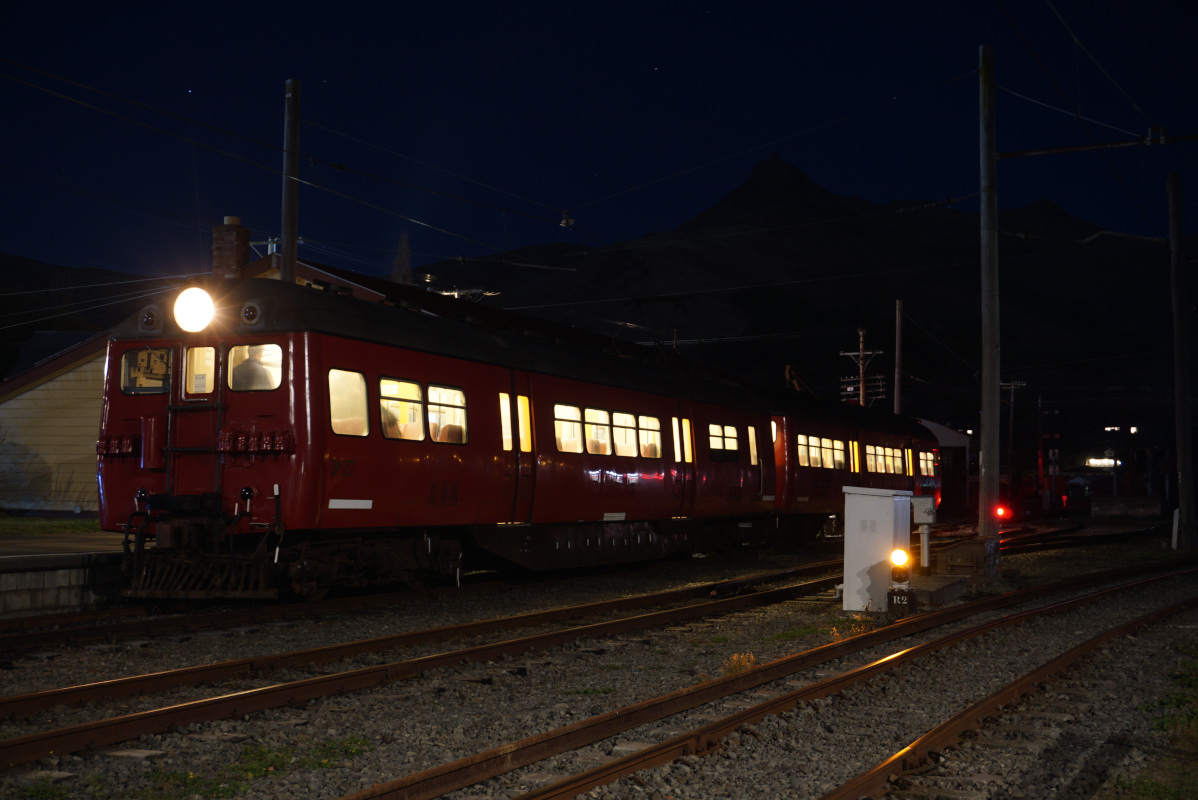 Due to the cost of living fewer people were coming to the
Ferrymead Heritage Park night markets.
The Iran war crisis increased the price of diesel.
Therefore, the DM electric unit was the train of choice at night markets, allowing the Canterbury Railway Society to contain costs.
[May 2026].
Due to the cost of living fewer people were coming to the
Ferrymead Heritage Park night markets.
The Iran war crisis increased the price of diesel.
Therefore, the DM electric unit was the train of choice at night markets, allowing the Canterbury Railway Society to contain costs.
[May 2026].
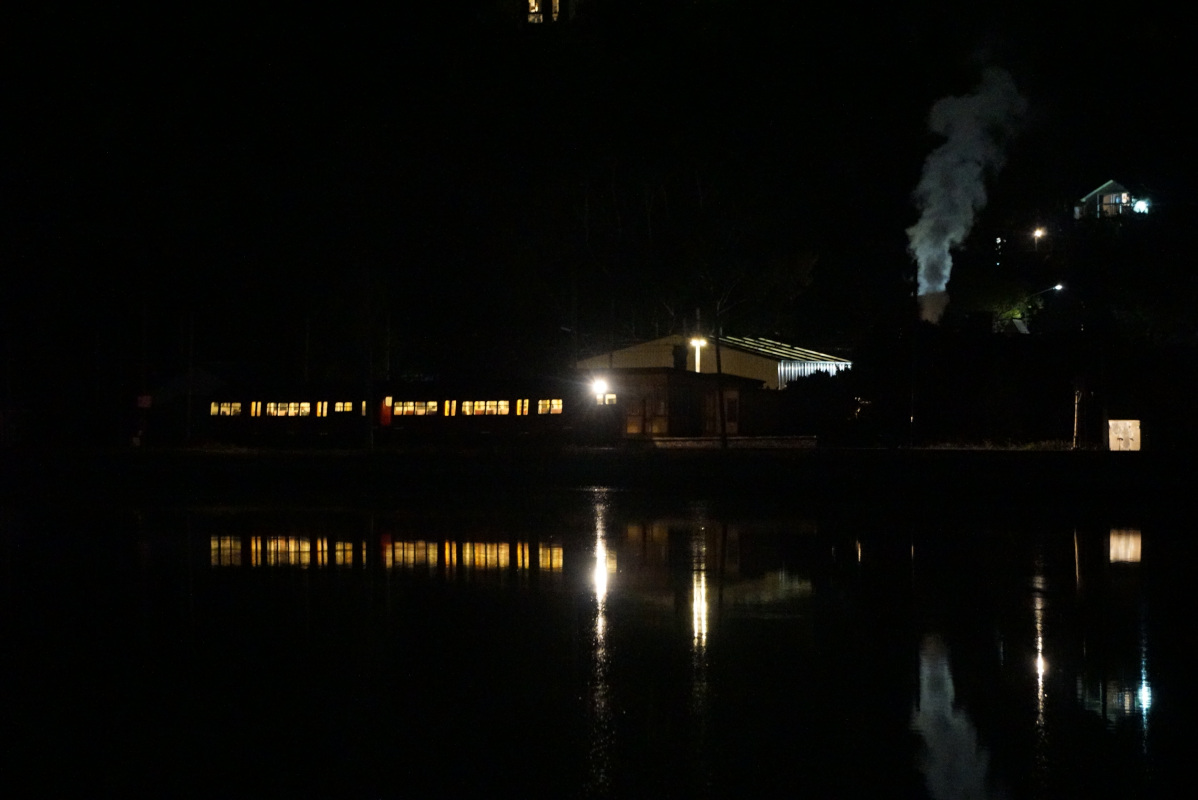 The lights of the electric multiple unit are reflected in the waters of the Heathcote Estuary, as the train gets ready for departure from Ferrymead Station.
The steam from Kitson steam tram No. 7 can also be seen.
[May 2026].
The lights of the electric multiple unit are reflected in the waters of the Heathcote Estuary, as the train gets ready for departure from Ferrymead Station.
The steam from Kitson steam tram No. 7 can also be seen.
[May 2026].
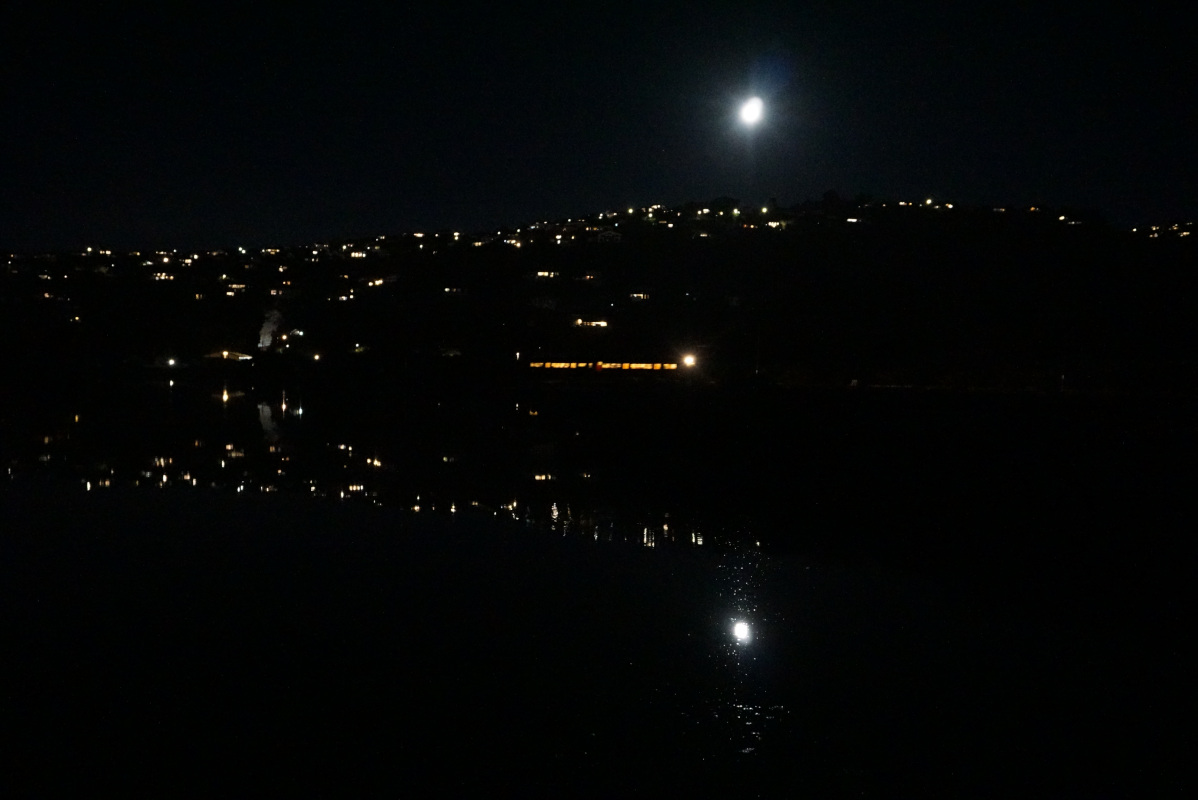 The moon has risen above Mt Pleasant and is reflected in the waters of the Heathcote Estuary together with the lights of many houses.
D 163 and DM 27 are trundling along the line to Moorhouse Station.
[May 2026].
The moon has risen above Mt Pleasant and is reflected in the waters of the Heathcote Estuary together with the lights of many houses.
D 163 and DM 27 are trundling along the line to Moorhouse Station.
[May 2026].
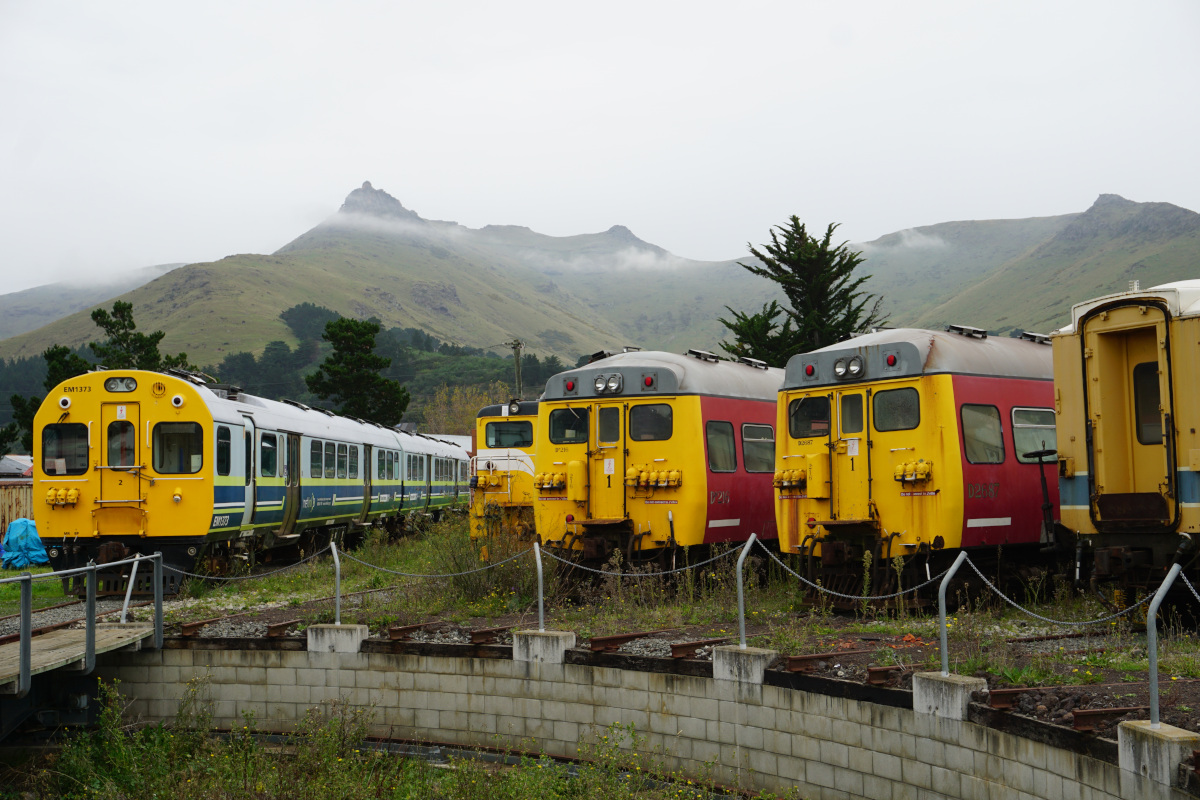 There are more former Wellington electric vehicles at Ferrymead.
Electric multiple unit vehicles Dm 216 and D2687 belong to the National Railway Museum of New Zealand.
Electric locomotive EO 45 also was used in Wellington for several years.
EM 1373 and ET 3373 entered service in Wellington in 1982 and were part of the Ganz-Mavag fleet that dominated suburban trains there for decades.
[May 2023].
There are more former Wellington electric vehicles at Ferrymead.
Electric multiple unit vehicles Dm 216 and D2687 belong to the National Railway Museum of New Zealand.
Electric locomotive EO 45 also was used in Wellington for several years.
EM 1373 and ET 3373 entered service in Wellington in 1982 and were part of the Ganz-Mavag fleet that dominated suburban trains there for decades.
[May 2023].
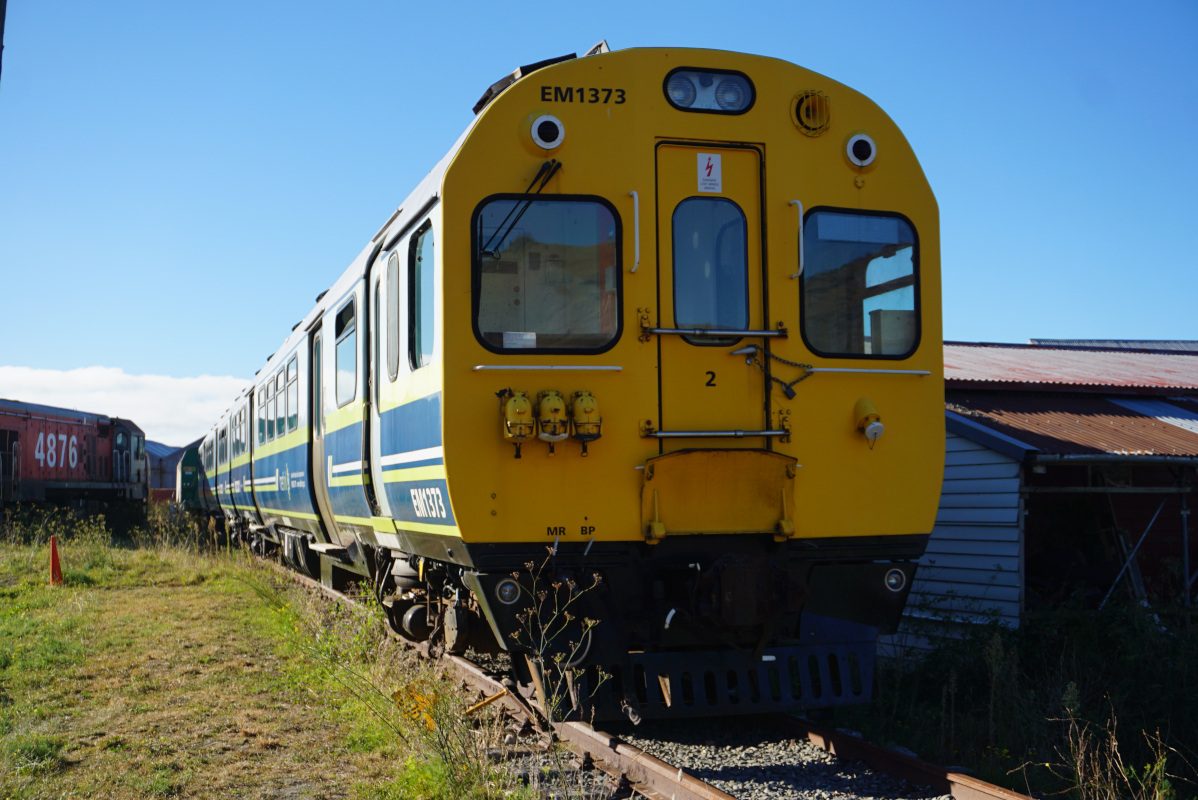 EM 1373 and ET 3373 were the only unit to be refurbished to a new design in 2010, known as Super Ganz.
More units were meant to be refurbished, but the Greater Wellington Regional Council decided to purchase new trains from Hyundai-Rotem instead.
Recognising the importance of the Ganz-Mavag trains for Wellington, the Greater Wellington Regional Council donated the Super Ganz to the Canterbury Railway Society together with spare parts.
So far it has not been used on the railway.
[May 2026].
EM 1373 and ET 3373 were the only unit to be refurbished to a new design in 2010, known as Super Ganz.
More units were meant to be refurbished, but the Greater Wellington Regional Council decided to purchase new trains from Hyundai-Rotem instead.
Recognising the importance of the Ganz-Mavag trains for Wellington, the Greater Wellington Regional Council donated the Super Ganz to the Canterbury Railway Society together with spare parts.
So far it has not been used on the railway.
[May 2026].
 On the occasion of the Otira Tunnel centenary,
a line-up of heritage electric rolling stock was displayed at the Ferrymead Railway.
From right to left: DM electric multiple unit that once worked in Wellington;
EC electric locomotive for the Christchurch suburban network;
EO electric locomotive for the Otira Tunnel in the Southern Alps;
EA electric locomotive for the Otira Tunnel from 1968, later used on the Wellington suburban network from 2008 to 2011;
ED electric locomotive for the Wellington suburban network, with this class also used briefly in the Otira Tunnel;
EW electric locomotive for the Wellington suburban network;
ET electric multiple unit for the Wellington suburban network;
PW 2 overhead inspection vehicle for the Otira Tunnel;
PW 1 overad inspection vehicle for the Otira Tunnel.
[Aug 2023].
On the occasion of the Otira Tunnel centenary,
a line-up of heritage electric rolling stock was displayed at the Ferrymead Railway.
From right to left: DM electric multiple unit that once worked in Wellington;
EC electric locomotive for the Christchurch suburban network;
EO electric locomotive for the Otira Tunnel in the Southern Alps;
EA electric locomotive for the Otira Tunnel from 1968, later used on the Wellington suburban network from 2008 to 2011;
ED electric locomotive for the Wellington suburban network, with this class also used briefly in the Otira Tunnel;
EW electric locomotive for the Wellington suburban network;
ET electric multiple unit for the Wellington suburban network;
PW 2 overhead inspection vehicle for the Otira Tunnel;
PW 1 overad inspection vehicle for the Otira Tunnel.
[Aug 2023].
 This is the side-on view of the vehicle display at the locomotive sheds near Moorhouse Station: DM multiple unit; EC locomotive; EO locomotive; EA locomotive; ED locomotive;
EW locomotive; ET multiple unit; PW 2; PW 1.
[Aug 2023].
This is the side-on view of the vehicle display at the locomotive sheds near Moorhouse Station: DM multiple unit; EC locomotive; EO locomotive; EA locomotive; ED locomotive;
EW locomotive; ET multiple unit; PW 2; PW 1.
[Aug 2023].
 A line-up of motive power that ran on the
Wellington suburban network.
To the left is Super Ganz, a two-car electric multiple unit supplied by Ganz-Mavag in 1982 and extensively refurbished in 2010.
The EW electric locomotives worked in suburban trains in Wellington from 1952 to 1990.
ED locomotives worked in Wellington from 1938 to 1981.
The EA class (later renamed EO) worked between Arthur's Pass and Otira from 1968 to 1997 and in Wellington from 2008 to 2011.
[Aug 2023].
A line-up of motive power that ran on the
Wellington suburban network.
To the left is Super Ganz, a two-car electric multiple unit supplied by Ganz-Mavag in 1982 and extensively refurbished in 2010.
The EW electric locomotives worked in suburban trains in Wellington from 1952 to 1990.
ED locomotives worked in Wellington from 1938 to 1981.
The EA class (later renamed EO) worked between Arthur's Pass and Otira from 1968 to 1997 and in Wellington from 2008 to 2011.
[Aug 2023].
 The inside view of the cab of EW 1806.
[Aug 2023].
The inside view of the cab of EW 1806.
[Aug 2023].
 Some of the rolling stock was also arranged for a night display.
ET 3375, EW 1806, ED 103, EO 45, DM 320 and EO 3 stand side by side.
[Aug 2023].
Some of the rolling stock was also arranged for a night display.
ET 3375, EW 1806, ED 103, EO 45, DM 320 and EO 3 stand side by side.
[Aug 2023].
 With red fronts in the night light. EW, DM and EO units at the Otira Tunnel centenary in Ferrymead.
[Aug 2023].
With red fronts in the night light. EW, DM and EO units at the Otira Tunnel centenary in Ferrymead.
[Aug 2023].
 The two overhead inspection vehicles for the
Otira Tunnel were also preserved at Ferrymead.
At the front is PW 2, also called Red Terror. It was built in 1934 as the General Manager's Inspection Car and rebuilt in 1941
as a overhead inspection car. It retired in 1997.
At the back is PW 1, also called Pie Cart. It was built in 1928 in England with the body work built at the Addington Workshops in Christchurch. It was used between Otira and Arthur's Pass until 1997.
[Aug 2023].
The two overhead inspection vehicles for the
Otira Tunnel were also preserved at Ferrymead.
At the front is PW 2, also called Red Terror. It was built in 1934 as the General Manager's Inspection Car and rebuilt in 1941
as a overhead inspection car. It retired in 1997.
At the back is PW 1, also called Pie Cart. It was built in 1928 in England with the body work built at the Addington Workshops in Christchurch. It was used between Otira and Arthur's Pass until 1997.
[Aug 2023].
 Diesel shunting tractors were introduced into New Zealand from 1924.
TR 111 was built in 1963 by A&G Price in Thames for New Zealand Railways and was in service for TranzRail until 2004.
Here, TR 111 shunts goods wagons in the Moorhouse Station yard.
[Aug 2023].
Diesel shunting tractors were introduced into New Zealand from 1924.
TR 111 was built in 1963 by A&G Price in Thames for New Zealand Railways and was in service for TranzRail until 2004.
Here, TR 111 shunts goods wagons in the Moorhouse Station yard.
[Aug 2023].
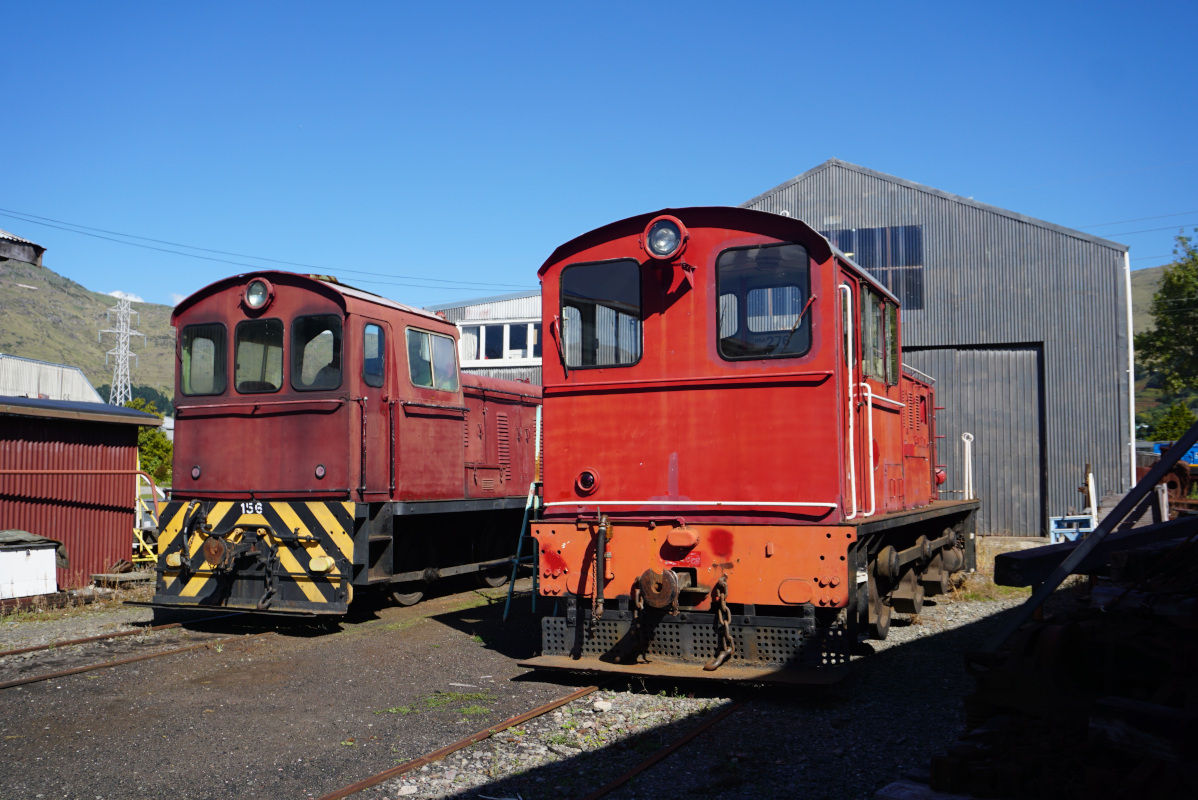 Another shunting tractor, TR 156, rests outside the workshop at Moorhouse Station.
This was built in Bagnall in 1957 and worked for New Zealand Railways until 1998,
before moving to the Canterbury Railway Society.
On the right is DSA 276, which was built by Mitsubishi Heavy Industries in 1967 and worked for New Zealand Railways until 1988.
The DSA locomotives are somewhat bigger than the TR class and had more powerful motors.
[Mar 2026].
Another shunting tractor, TR 156, rests outside the workshop at Moorhouse Station.
This was built in Bagnall in 1957 and worked for New Zealand Railways until 1998,
before moving to the Canterbury Railway Society.
On the right is DSA 276, which was built by Mitsubishi Heavy Industries in 1967 and worked for New Zealand Railways until 1988.
The DSA locomotives are somewhat bigger than the TR class and had more powerful motors.
[Mar 2026].
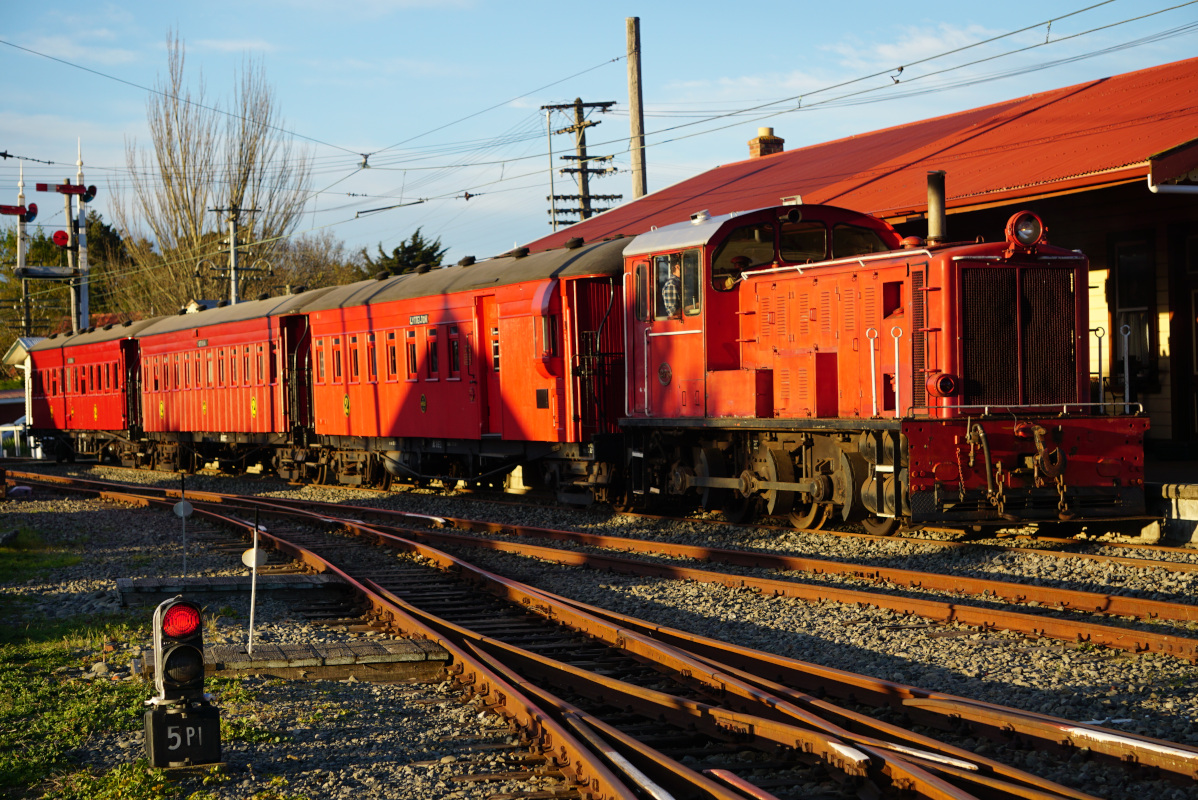 DSA 276 was also occasionally used to haul trains on the Ferrymead Railway.
After retiring form New Zealand Rail in 1988, it was then involved in track recovery on the closed Otago Central Railway, before coming to the Weka Pass Railway in 1992.
In 2025 it was moved to Ferrymead on loan for overhaul.
[Sep 2026].
DSA 276 was also occasionally used to haul trains on the Ferrymead Railway.
After retiring form New Zealand Rail in 1988, it was then involved in track recovery on the closed Otago Central Railway, before coming to the Weka Pass Railway in 1992.
In 2025 it was moved to Ferrymead on loan for overhaul.
[Sep 2026].
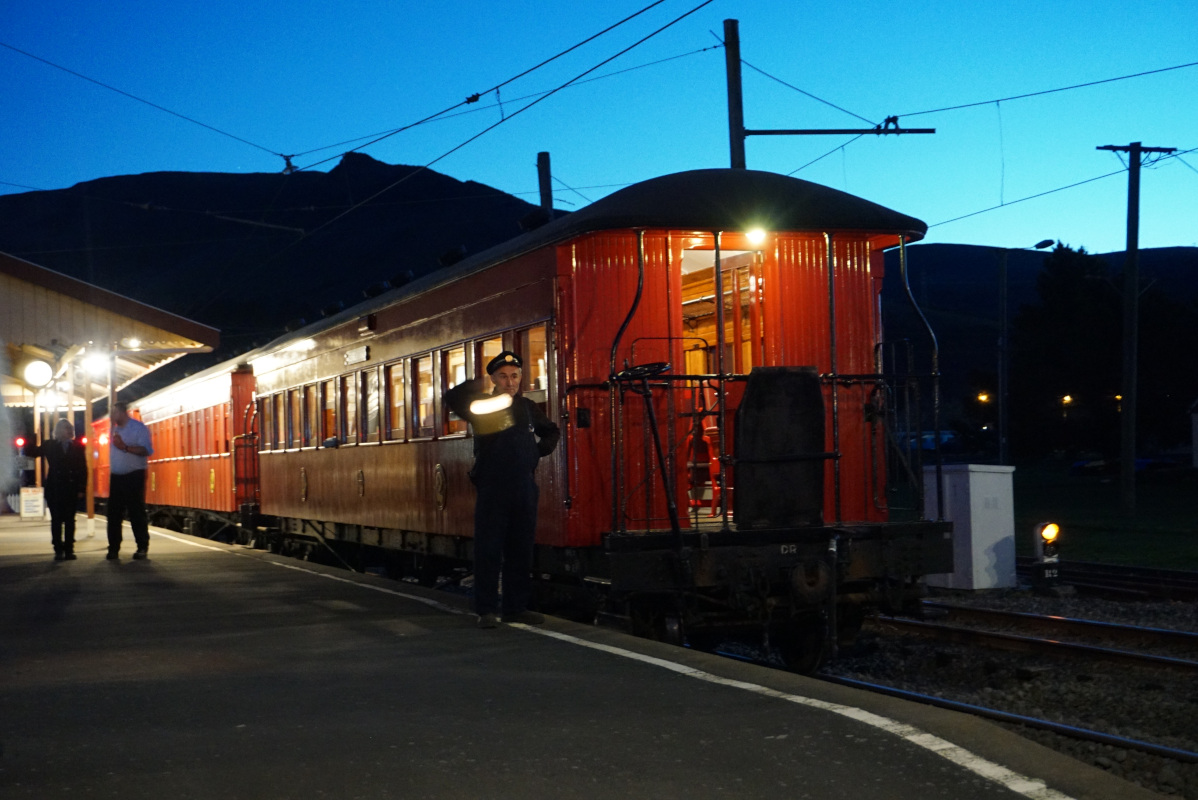 It gets dark early before daylight saving time begins in Christchurch.
The guard signals for DSA 276 to back onto her train at Moorhouse Station.
[Sep 2026].
It gets dark early before daylight saving time begins in Christchurch.
The guard signals for DSA 276 to back onto her train at Moorhouse Station.
[Sep 2026].
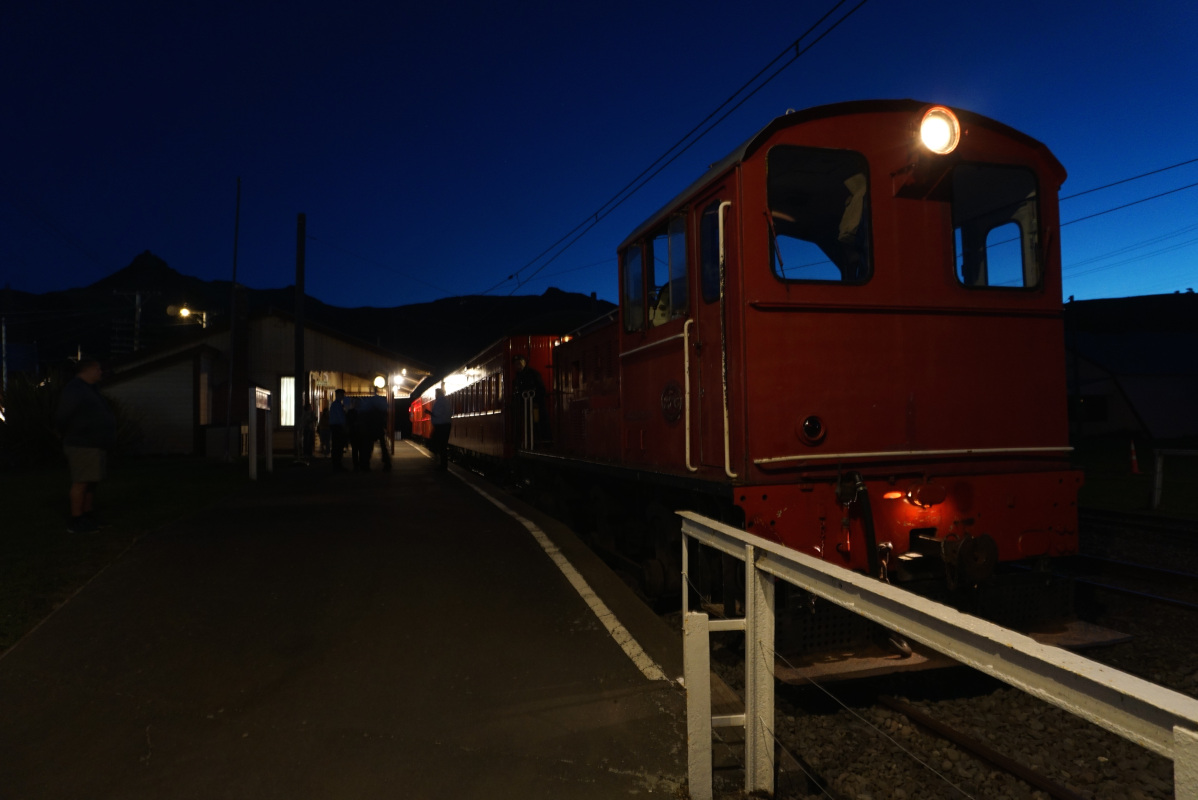 With cab leading, DSA 276 stands ready to depart Moorhouse Station with her train during the night market.
[Sep 2026].
With cab leading, DSA 276 stands ready to depart Moorhouse Station with her train during the night market.
[Sep 2026].
 The DE class was the first diesel-electric locomotive class introduced to New Zealand.
The first of the fifteen members of this class entered service in 1952.
[Sep 2022].
The DE class was the first diesel-electric locomotive class introduced to New Zealand.
The first of the fifteen members of this class entered service in 1952.
[Sep 2022].
 The DE class was supplied by English Electric.
DE 511 is owned by the Diesel Traction Group, based at Ferrymead.
This group owns examples of all English Electric diesels operated in New Zealand.
The locomotives are occasionally run on the Ferrymead Railway operated by the Canterbury Railway Society.
[Sep 2022].
The DE class was supplied by English Electric.
DE 511 is owned by the Diesel Traction Group, based at Ferrymead.
This group owns examples of all English Electric diesels operated in New Zealand.
The locomotives are occasionally run on the Ferrymead Railway operated by the Canterbury Railway Society.
[Sep 2022].
 The DE class was used for shunting, freight and passenger services.
In passenger service they were also used for suburban trains.
In 1953 a pair of DE class locomotives hauled the royal train of Queen Elizabeth through the North Island.
The photo shows DE 511 hauling a train from Ferrymead along the Heathcote Estuary.
[Sep 2022].
The DE class was used for shunting, freight and passenger services.
In passenger service they were also used for suburban trains.
In 1953 a pair of DE class locomotives hauled the royal train of Queen Elizabeth through the North Island.
The photo shows DE 511 hauling a train from Ferrymead along the Heathcote Estuary.
[Sep 2022].
 DE locomotives normally drove on the main line with the long hood leading.
The union made this a requirement, apparently for safety reasons, but also so that one-man crewing was not seen as a possibility.
On the Ferrymead Railway DE 511 is used in both directions.
Here it hauls a train past Moorhouse Station.
[Sep 2022].
DE locomotives normally drove on the main line with the long hood leading.
The union made this a requirement, apparently for safety reasons, but also so that one-man crewing was not seen as a possibility.
On the Ferrymead Railway DE 511 is used in both directions.
Here it hauls a train past Moorhouse Station.
[Sep 2022].
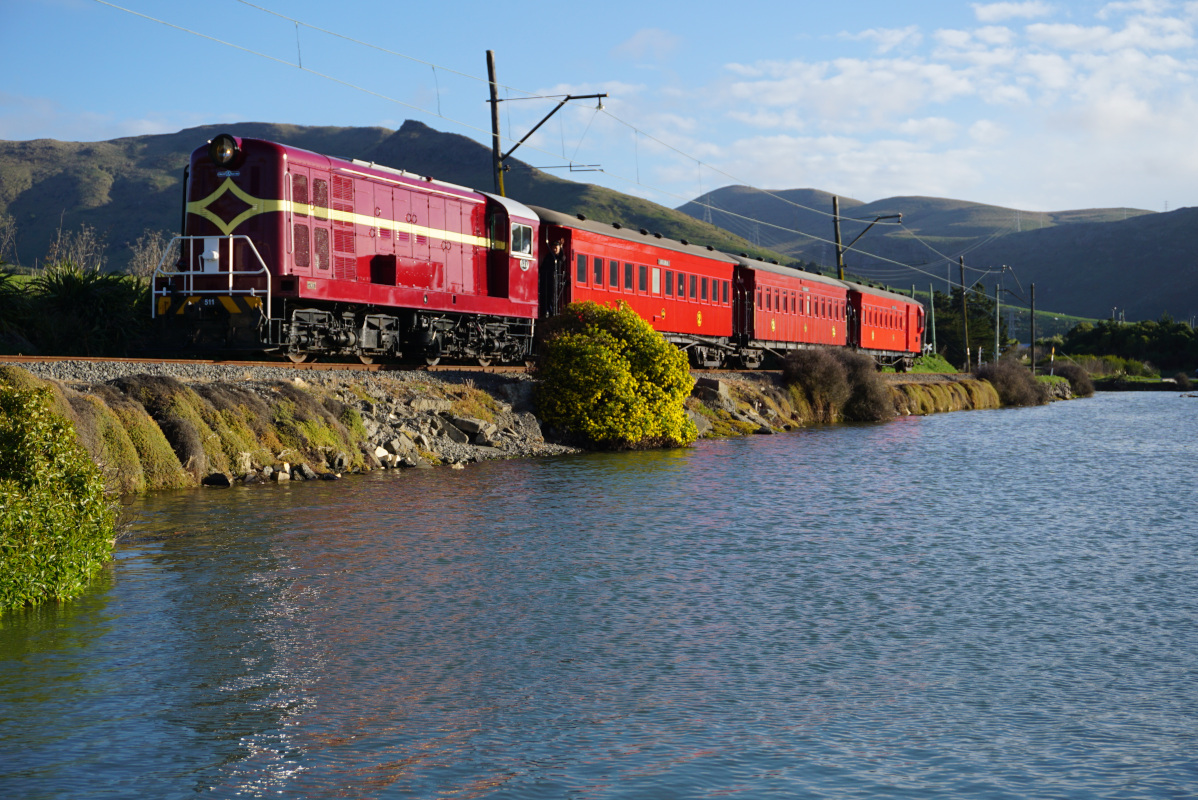 DE 511 hauls her train along the Heathcote Estuary towards Ferrymead Station.
That day not many visitors were at the night market and few passengers rode the railway.
Having a diesel operate the train meant that the cost of train running was far lower and therefore no loss was made that evening.
[Sep 2025].
DE 511 hauls her train along the Heathcote Estuary towards Ferrymead Station.
That day not many visitors were at the night market and few passengers rode the railway.
Having a diesel operate the train meant that the cost of train running was far lower and therefore no loss was made that evening.
[Sep 2025].
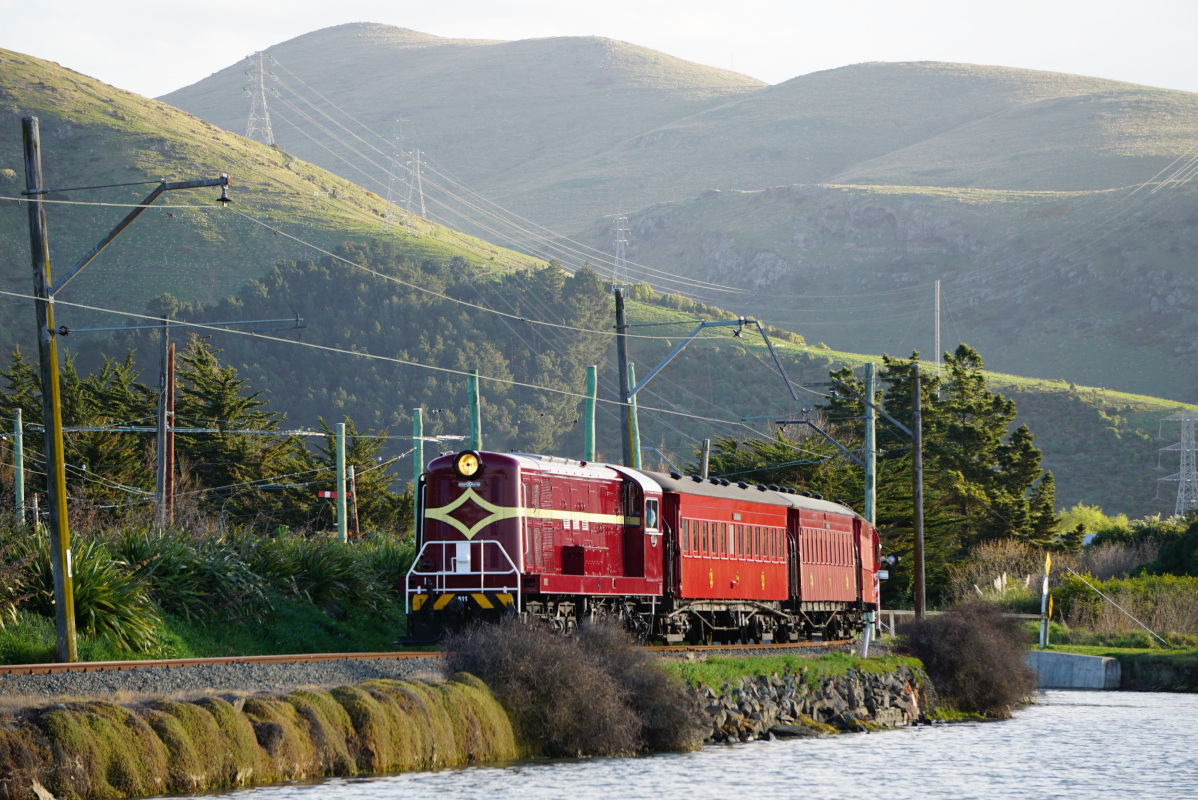 DE 511 travels along the Ferrymead Railway.
In the background are the electricity transmission lines that carry voltage to the Bromley substation,
connecting the large hydrodams to the city.
[Sep 2025].
DE 511 travels along the Ferrymead Railway.
In the background are the electricity transmission lines that carry voltage to the Bromley substation,
connecting the large hydrodams to the city.
[Sep 2025].
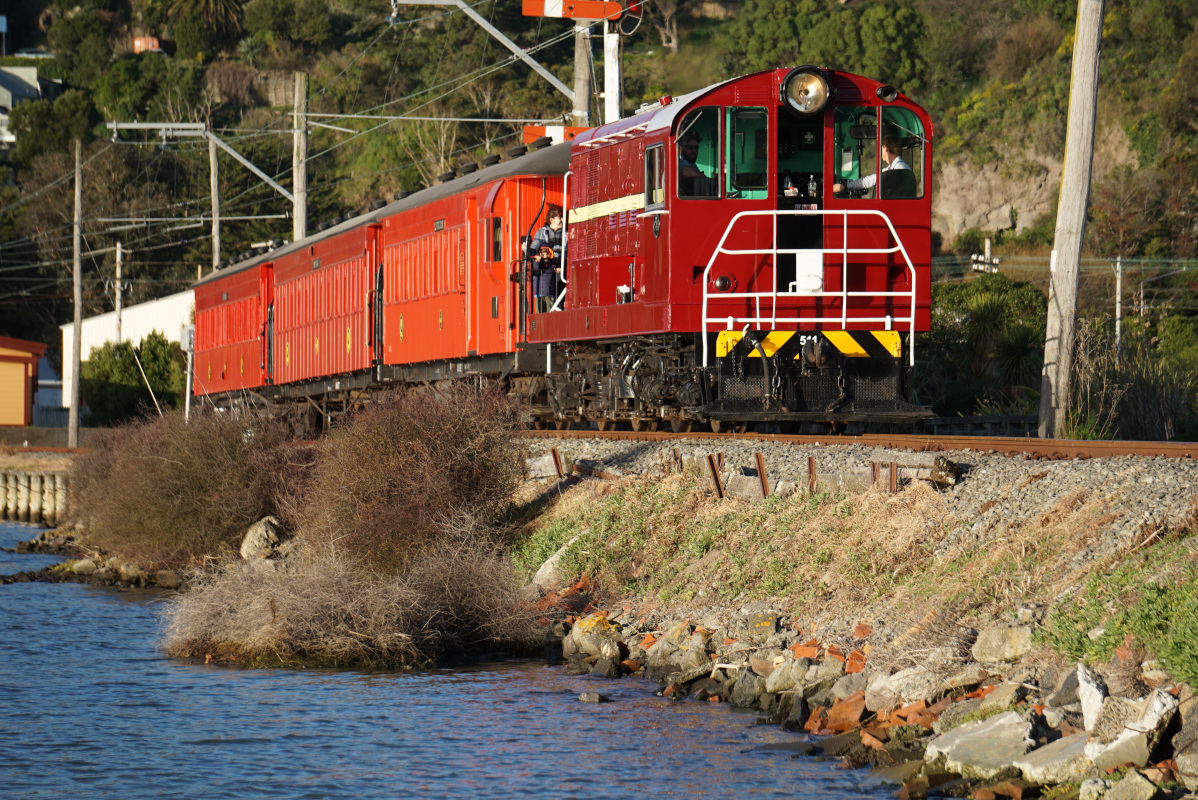 With the cab leading DE 511 hauls a train into the setting sun.
[Sep 2025].
With the cab leading DE 511 hauls a train into the setting sun.
[Sep 2025].
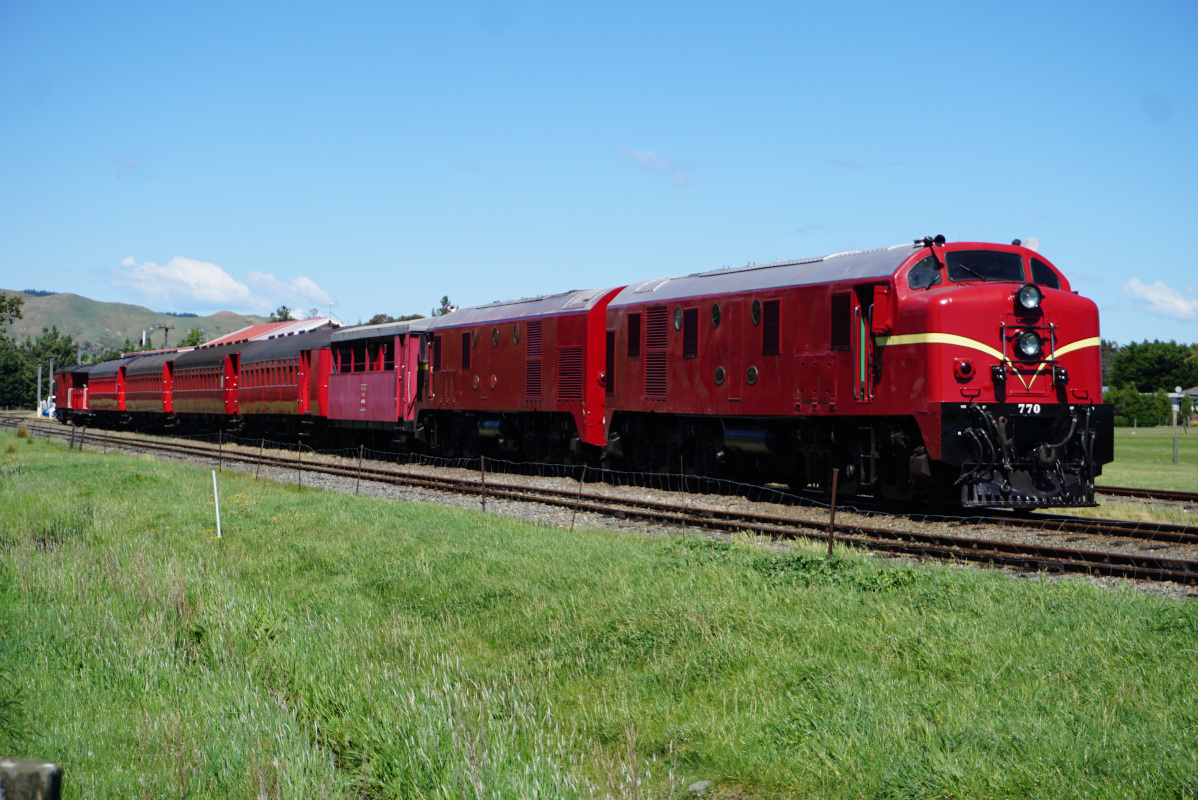 From 1955 onwards the DG class was introduced into service.
These short diesel-electric locomotives were normally operated in pairs.
They had a relatively light axle load of 11.6 tonnes and could also travel on lightly-laid branch lines.
Here DGs 770 and 791 stand with a heritage passenger train at Glenmark Station.
[Oct 2025].
From 1955 onwards the DG class was introduced into service.
These short diesel-electric locomotives were normally operated in pairs.
They had a relatively light axle load of 11.6 tonnes and could also travel on lightly-laid branch lines.
Here DGs 770 and 791 stand with a heritage passenger train at Glenmark Station.
[Oct 2025].
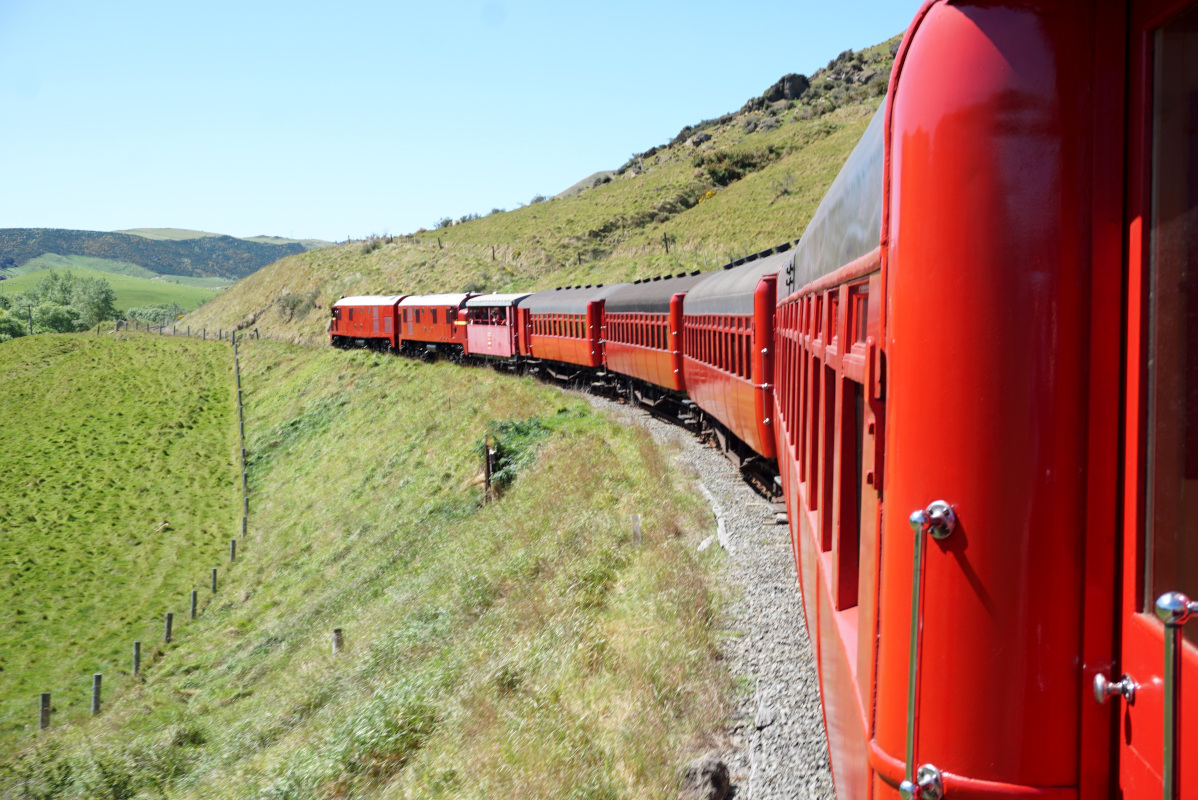 The two DG locomotives haul their train through one of the many curves of the Weka Pass Railway.
This is probably the most scenic, but also the most curvey section of the former Waiau Branch.
[Oct 2025].
The two DG locomotives haul their train through one of the many curves of the Weka Pass Railway.
This is probably the most scenic, but also the most curvey section of the former Waiau Branch.
[Oct 2025].
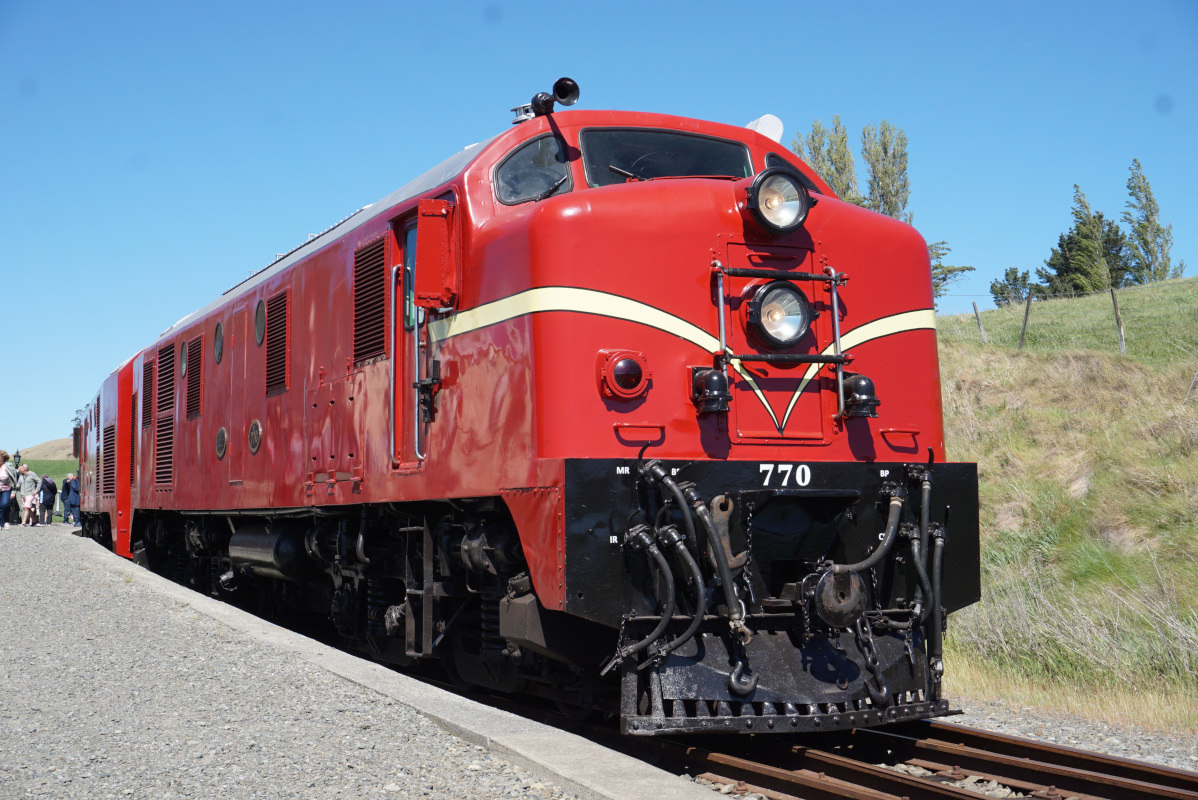 The DG class was initially used both in the North and South Islands.
With more DA class locomotives available in the North Island, they were all transferred to the South Island.
With their classic cab and full width body, they certainly looked better than many of the other diesel locomotives used in New Zealand.
Here DGs 770 and 791 have arrived in Waikari with their train.
[Oct 2025].
The DG class was initially used both in the North and South Islands.
With more DA class locomotives available in the North Island, they were all transferred to the South Island.
With their classic cab and full width body, they certainly looked better than many of the other diesel locomotives used in New Zealand.
Here DGs 770 and 791 have arrived in Waikari with their train.
[Oct 2025].
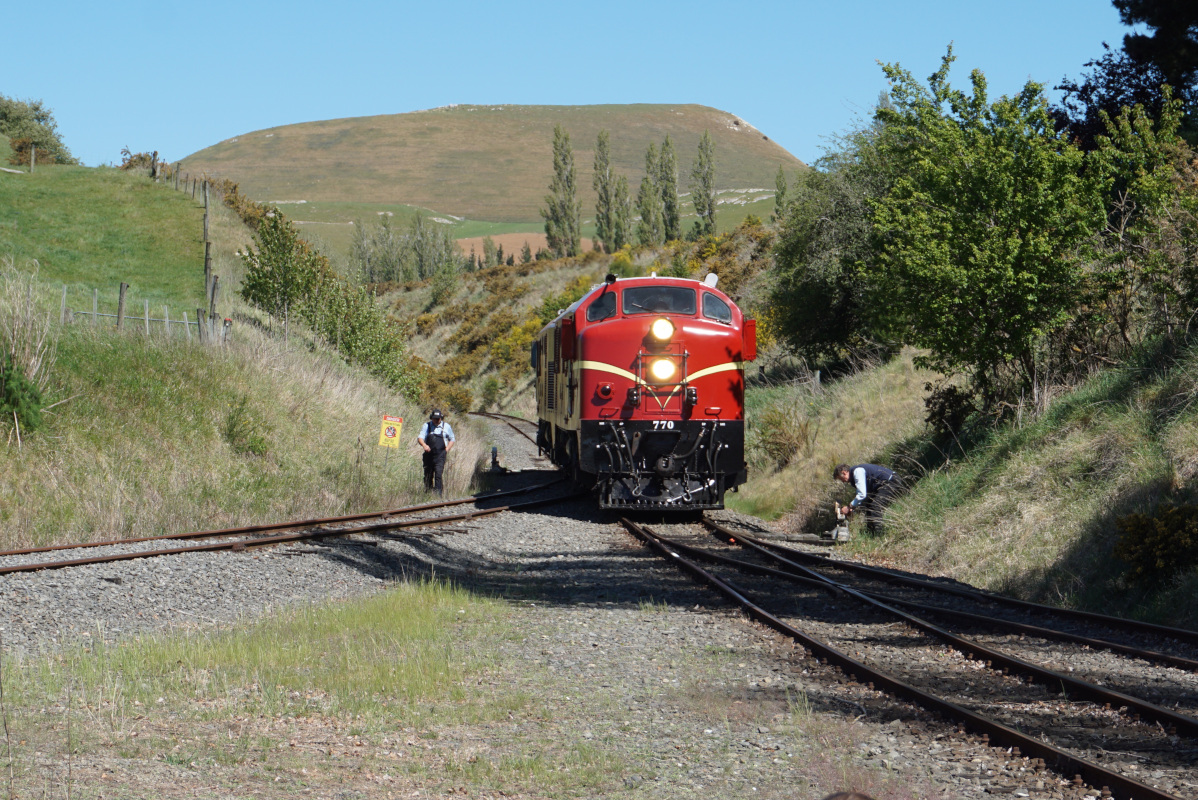 The line now stops at Waikari.
Originally, the preservation group wanted to keep the line all the way to Hawarden and the Huruni River,
but the Highway Board wanted to get rid of the railway crossing at Waikari, so that the line could only go so far.
The two DGs are running around their train in Waikari and are seen coming back to couple onto the carriages.
[Oct 2025].
The line now stops at Waikari.
Originally, the preservation group wanted to keep the line all the way to Hawarden and the Huruni River,
but the Highway Board wanted to get rid of the railway crossing at Waikari, so that the line could only go so far.
The two DGs are running around their train in Waikari and are seen coming back to couple onto the carriages.
[Oct 2025].
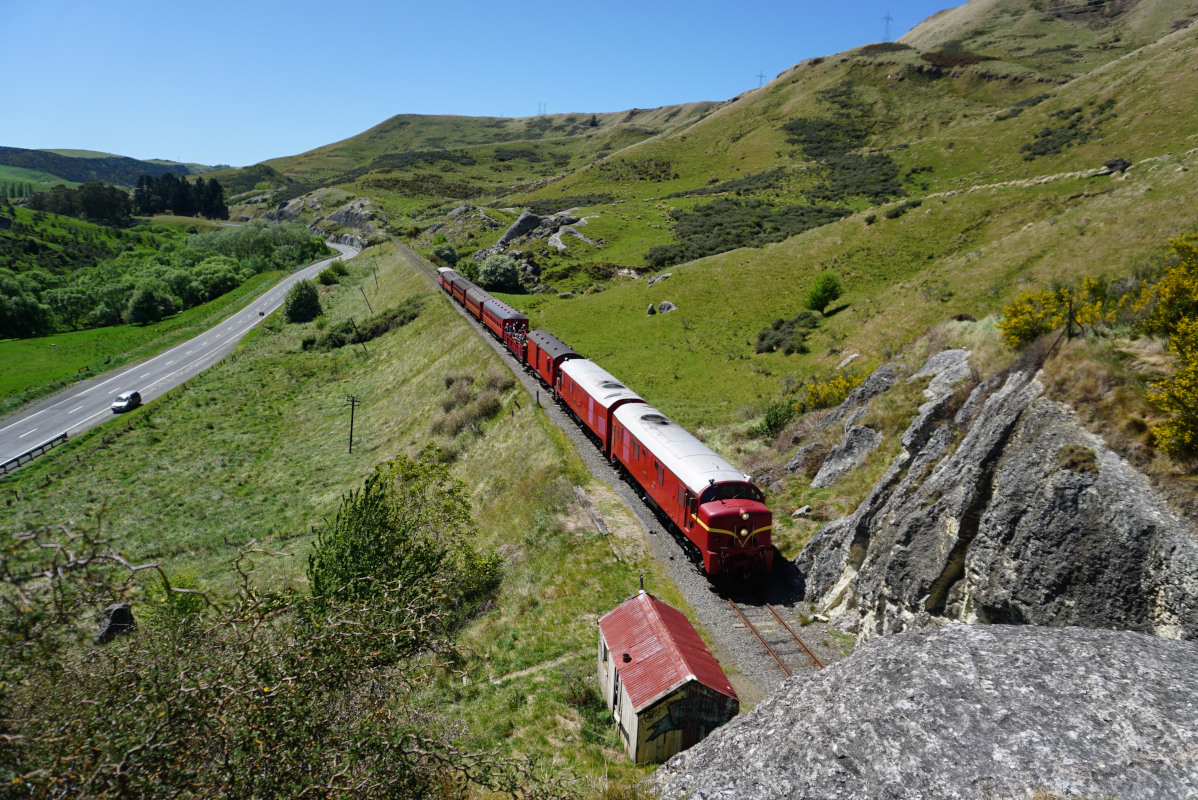 The last locomotives of the DG class were taken out of service in 1983.
The Weka Pass Railway was established in the same year to take over the railway line between Waipara and the Hurunui River.
The two locomotives have worked on the Weka Pass Railway ever since, particularly if no steam locomotive is available.
Here the train is near Frog Rock with the ganger's hut clearly visible.
[Oct 2025].
The last locomotives of the DG class were taken out of service in 1983.
The Weka Pass Railway was established in the same year to take over the railway line between Waipara and the Hurunui River.
The two locomotives have worked on the Weka Pass Railway ever since, particularly if no steam locomotive is available.
Here the train is near Frog Rock with the ganger's hut clearly visible.
[Oct 2025].
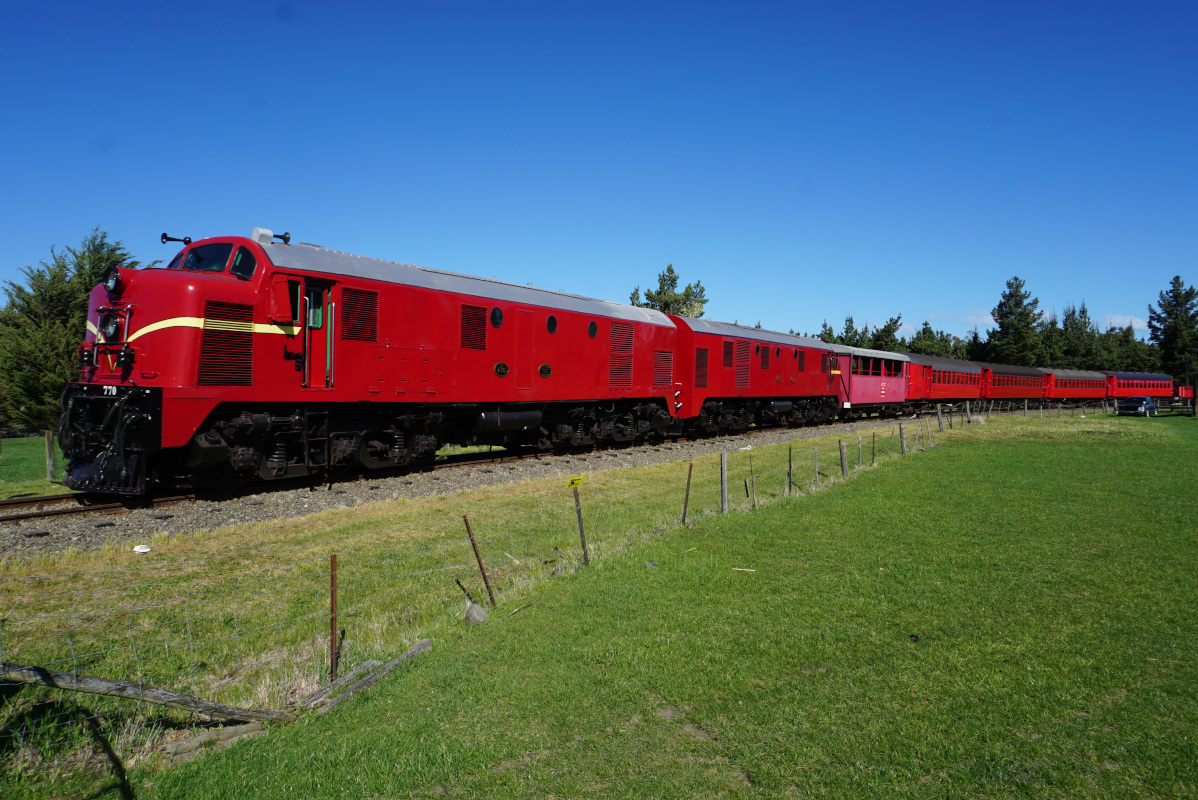 At the end of the day DG 770 and DG 791 push their train from Glenmark Station to the depot in Waipara.
[Oct 2025].
At the end of the day DG 770 and DG 791 push their train from Glenmark Station to the depot in Waipara.
[Oct 2025].
 DI 1102 is a diesel-electric locomotive that belongs to the Diesel Traction Group.
It operates here on one of the regular trains on the Ferrymead Railway and travels along the Heathcote Estuary.
[Aug 2022].
DI 1102 is a diesel-electric locomotive that belongs to the Diesel Traction Group.
It operates here on one of the regular trains on the Ferrymead Railway and travels along the Heathcote Estuary.
[Aug 2022].
 Five locomotives of the DI class were built by English Electric in Australia in 1966.
They operated in the South Island and in the Bay of Plenty region of the North Island.
They were withdrawn by 1989, partly due to the fact that with the high hood they were not suitable for single crewing.
This preserved DI heads a train with the long hood leading.
[Aug 2022].
Five locomotives of the DI class were built by English Electric in Australia in 1966.
They operated in the South Island and in the Bay of Plenty region of the North Island.
They were withdrawn by 1989, partly due to the fact that with the high hood they were not suitable for single crewing.
This preserved DI heads a train with the long hood leading.
[Aug 2022].
 DI 1102 arrives into Moorhouse Station in the Ferrymead Heritage Park with the long hood leading.
It exchanges the tablet with the signal box operator to enter the station limits.
[Aug 2022].
DI 1102 arrives into Moorhouse Station in the Ferrymead Heritage Park with the long hood leading.
It exchanges the tablet with the signal box operator to enter the station limits.
[Aug 2022].
 The Diesel Traction Group is an independent group based at the Ferrymead Heritage Park.
It restores heritage diesel locomotives built by English Electric and operates them together with other operators.
Here at Ferrymead DI 1102 is operated together with the Canterbury Railway Society.
It rounds the curve in front of the locomotive sheds near Moorhouse Station.
[Aug 2022].
The Diesel Traction Group is an independent group based at the Ferrymead Heritage Park.
It restores heritage diesel locomotives built by English Electric and operates them together with other operators.
Here at Ferrymead DI 1102 is operated together with the Canterbury Railway Society.
It rounds the curve in front of the locomotive sheds near Moorhouse Station.
[Aug 2022].
 DI 1102 also took part in the
Otira Tunnel centenial celebrations.
Here it is at the Truscotts Road level crossing with a goods train.
[Aug 2023].
DI 1102 also took part in the
Otira Tunnel centenial celebrations.
Here it is at the Truscotts Road level crossing with a goods train.
[Aug 2023].
 The diesel locomotive stands at Moorhouse Station with a passenger train.
[Aug 2023].
The diesel locomotive stands at Moorhouse Station with a passenger train.
[Aug 2023].
 DI 1102 went to the Weka Pass Railway to provide additional motive power while steam engine A 428 is out of service.
Here it is returning to Waipara with the afternoon train.
[Jun 2024].
DI 1102 went to the Weka Pass Railway to provide additional motive power while steam engine A 428 is out of service.
Here it is returning to Waipara with the afternoon train.
[Jun 2024].
 Another railway vehicle that was never used in standard revenue service in the South Island was the DA class diesel-electric locomotive.
DA 1431 and DA 1410 are hauling a tour train through Papanui on the main line between Christchurch and Picton.
This was their first trip to the South Island. They are owned by Steam Incorporated in Paekakariki near Wellington.
DA 1410 entered service in 1955, DA 1431 in 1957.
[May 2021].
Another railway vehicle that was never used in standard revenue service in the South Island was the DA class diesel-electric locomotive.
DA 1431 and DA 1410 are hauling a tour train through Papanui on the main line between Christchurch and Picton.
This was their first trip to the South Island. They are owned by Steam Incorporated in Paekakariki near Wellington.
DA 1410 entered service in 1955, DA 1431 in 1957.
[May 2021].
 DA 1431 came to the South Island again on another tour.
In between tour duties the train offered trips for locals.
On a Saturday it ran three return trips from Christchurch to Rangiora.
Here, DA 1431 is in Rangiora with a crowd of admirers around the engine, while the a guard checks everything is in order.
[Apr 2023].
DA 1431 came to the South Island again on another tour.
In between tour duties the train offered trips for locals.
On a Saturday it ran three return trips from Christchurch to Rangiora.
Here, DA 1431 is in Rangiora with a crowd of admirers around the engine, while the a guard checks everything is in order.
[Apr 2023].
 On the way north from Christchurch to Rangiora
the Canterbury Cruiser was hauled by DA 1431 with the long hood leading.
Here the train heads northwards through Papanui.
[Apr 2023].
On the way north from Christchurch to Rangiora
the Canterbury Cruiser was hauled by DA 1431 with the long hood leading.
Here the train heads northwards through Papanui.
[Apr 2023].
 Up until 1976 there were still suburban trains between Christchurch and Rangiora, even though those services had already been cut
back from earlier service patterns.
With the Canterbury Cruiser, DA 1431 brought these suburban trains back to life, even though
in the 20th century these trains would have been hauled by AB steam locomotives and later by DJ diesel locos.
Here the Canterbury Cruiser travels back to Christchurch past St Paul's Anglican Church in Papanui.
[Apr 2023].
Up until 1976 there were still suburban trains between Christchurch and Rangiora, even though those services had already been cut
back from earlier service patterns.
With the Canterbury Cruiser, DA 1431 brought these suburban trains back to life, even though
in the 20th century these trains would have been hauled by AB steam locomotives and later by DJ diesel locos.
Here the Canterbury Cruiser travels back to Christchurch past St Paul's Anglican Church in Papanui.
[Apr 2023].
 Later in the day DA 1431 is reflected in a flooded lineside drain as it passes through the autumn landscape in Papanui.
[Apr 2023].
Later in the day DA 1431 is reflected in a flooded lineside drain as it passes through the autumn landscape in Papanui.
[Apr 2023].
 DA 1431 arrives with a train from Picton in Christchurch.
The next day it hauled the Mountaineer train to Arthur's Pass from Christchurch.
[Feb 2024].
DA 1431 arrives with a train from Picton in Christchurch.
The next day it hauled the Mountaineer train to Arthur's Pass from Christchurch.
[Feb 2024].
 In 1979 the Traffic Monotoring System TMS was introduced and all rolling stock received new numbers.
The DA class got numbers 1 to 99 with an additional check digit, so that most DA locomotives had numbers with three digits.
DA 1431 was renumbered DA 345.
For some time DA 1431 ran again with its TMS number 345 in large numerals on the long hood and small numbers adjacent to the lights.
The old number remained on the headstock.
[Mar 2024].
In 1979 the Traffic Monotoring System TMS was introduced and all rolling stock received new numbers.
The DA class got numbers 1 to 99 with an additional check digit, so that most DA locomotives had numbers with three digits.
DA 1431 was renumbered DA 345.
For some time DA 1431 ran again with its TMS number 345 in large numerals on the long hood and small numbers adjacent to the lights.
The old number remained on the headstock.
[Mar 2024].
 Even though DC locomotives were still in regular KiwiRail service in 2025,
DC 4818 had been bought by the Glenbrook Vintage Railway near Auckland in 2023 and restored to its condition from the 1980s.
It was rented to Steam Incorporated and used for heritage excursions.
In February to March 2025, Steam Incorporated ran a few excursions in the South Island, particularly from Christchurch.
Here, DC 4818 arrives in Christchurch with an empty service, passing St Paul's Anglican Church in Papanui.
[Feb 2025].
Even though DC locomotives were still in regular KiwiRail service in 2025,
DC 4818 had been bought by the Glenbrook Vintage Railway near Auckland in 2023 and restored to its condition from the 1980s.
It was rented to Steam Incorporated and used for heritage excursions.
In February to March 2025, Steam Incorporated ran a few excursions in the South Island, particularly from Christchurch.
Here, DC 4818 arrives in Christchurch with an empty service, passing St Paul's Anglican Church in Papanui.
[Feb 2025].
 After running an excursion to Arthur's Pass,
DC 4818 brought the empty train to Waipara to store the consist at the Weka Pass Railway for a week.
Here the train is rounding a curve near Sefton, North Canterbury.
[Mar 2025].
After running an excursion to Arthur's Pass,
DC 4818 brought the empty train to Waipara to store the consist at the Weka Pass Railway for a week.
Here the train is rounding a curve near Sefton, North Canterbury.
[Mar 2025].
 Steam Incorporated also ran two excursions from Christchurch to Waikari, on the last section along the Weka Pass Railway.
Here the consist passes Frog Rock near the Weka Pass.
[Mar 2025].
Steam Incorporated also ran two excursions from Christchurch to Waikari, on the last section along the Weka Pass Railway.
Here the consist passes Frog Rock near the Weka Pass.
[Mar 2025].
 Here the train is on its return to Christchurch at the end of the first trip.
It passes over the Waipara River.
[Mar 2025].
Here the train is on its return to Christchurch at the end of the first trip.
It passes over the Waipara River.
[Mar 2025].
 DC 4818 hauls her train along the Weka Pass Railway.
This photo was taken from Frog Rock.
[Mar 2025].
DC 4818 hauls her train along the Weka Pass Railway.
This photo was taken from Frog Rock.
[Mar 2025].
 Both trains on the day were booked out.
It seems that Christchurch people like to go on train excursions.
[Mar 2025].
Both trains on the day were booked out.
It seems that Christchurch people like to go on train excursions.
[Mar 2025].
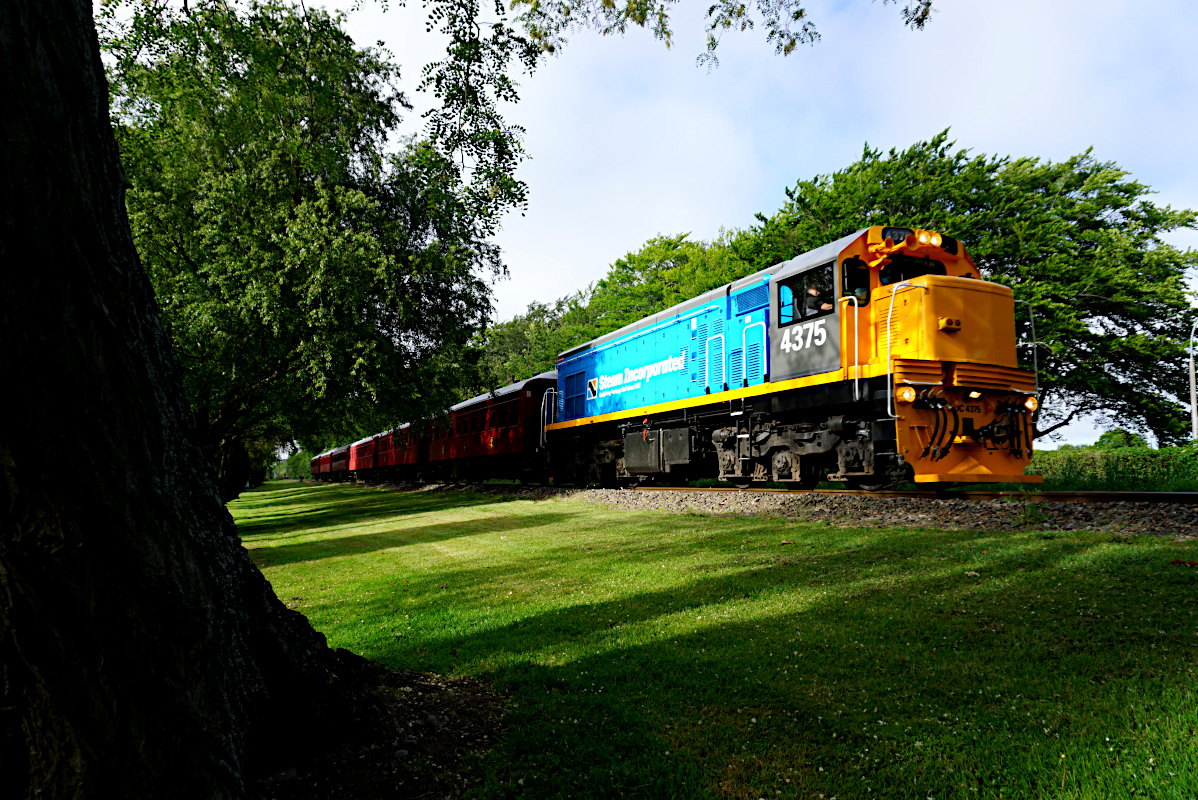 In 2025 Steam Incorporated finished restoration of DC 4375 in
the last New Zealand Rail colour scheme before privatisation.
While the NZR logo is there, the letters say Steam Incorporated.
[Nov 2025].
In 2025 Steam Incorporated finished restoration of DC 4375 in
the last New Zealand Rail colour scheme before privatisation.
While the NZR logo is there, the letters say Steam Incorporated.
[Nov 2025].
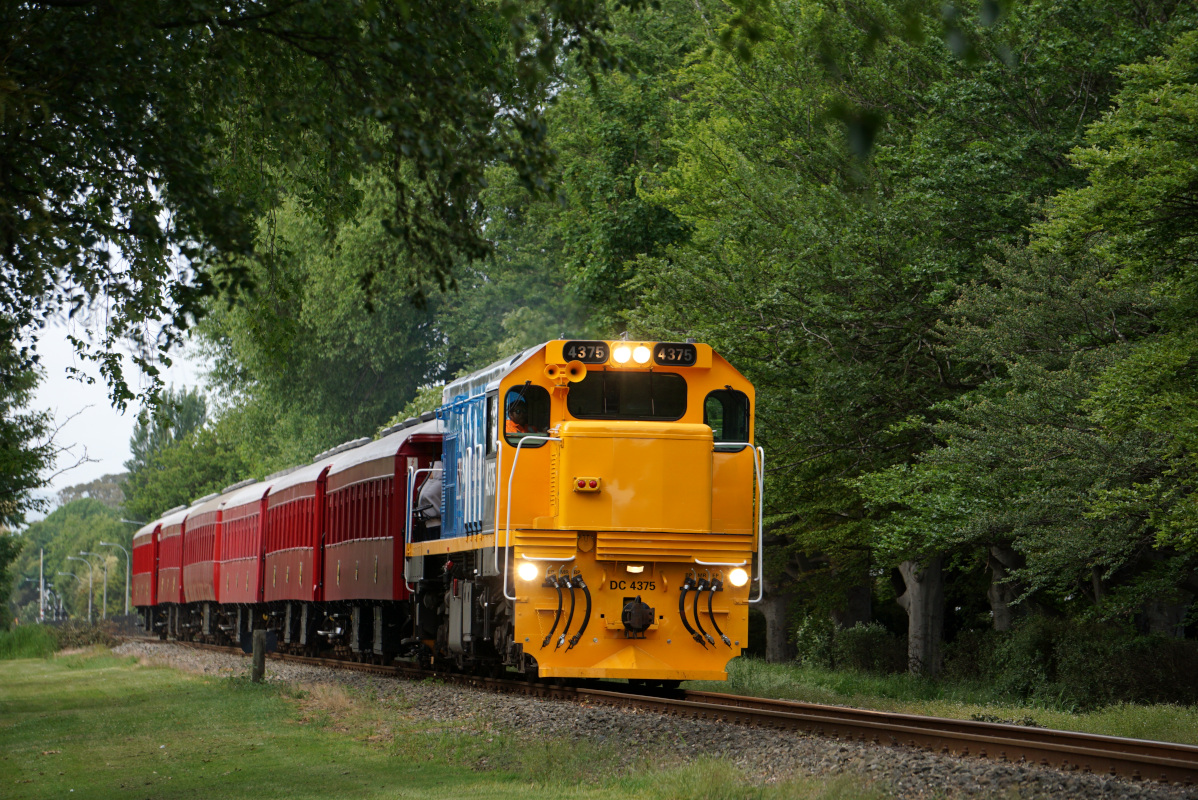 The train was leased to Pounamu Tourism, which operated trains in Marlborough and around Christchurch, mainly for cruise ship passengers.
Here DC 4375 is in charge of a public excursion train from Christchurch to Kaikoura.
Passengers were able to go to the Kaikoura Races over a long weekend.
[Nov 2025].
The train was leased to Pounamu Tourism, which operated trains in Marlborough and around Christchurch, mainly for cruise ship passengers.
Here DC 4375 is in charge of a public excursion train from Christchurch to Kaikoura.
Passengers were able to go to the Kaikoura Races over a long weekend.
[Nov 2025].
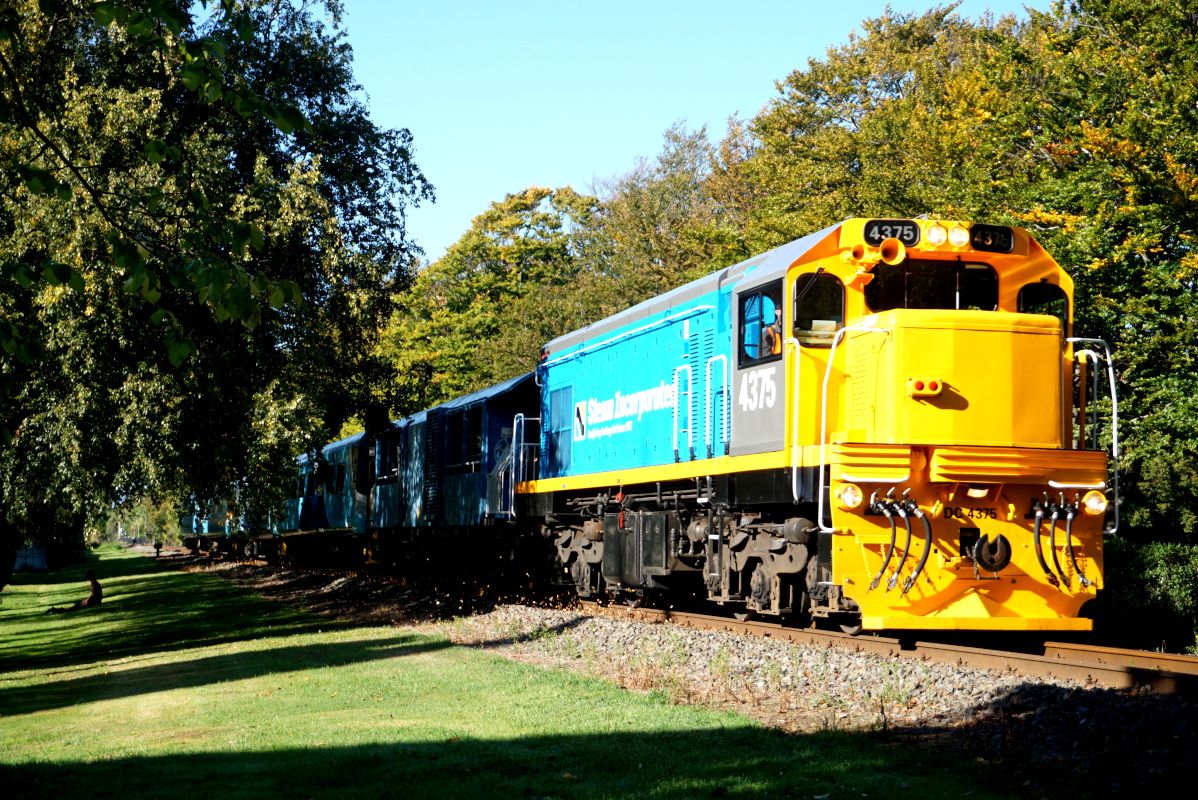 This time the train is on an excursion to the North Canterbury Wine and Food Festival at the Glenmark Reserve near Waipara.
Here DC 4375 powers through Papanui on a Sunday morning.
[Mar 2026].
This time the train is on an excursion to the North Canterbury Wine and Food Festival at the Glenmark Reserve near Waipara.
Here DC 4375 powers through Papanui on a Sunday morning.
[Mar 2026].