Here is steam locomotive No. 1 of Canterbury Railways, also called "Pilgrim", at Ferrymead.

Steam locomotive, Canterbury Railways no 1, at Ferrymead, Christchurch. Ref: 1/2-022793-F. Alexander Turnbull Library, Wellington, New Zealand. http://natlib.govt.nz/records/23047238
When the New Zealand government took over the responsibility for railway construction,
all railway lines were laid to the narrower national gauge of 1,067 mm.
 The first important class of steam locomotive built to operate on the national network was the F class.
Between 1872 and 1888 a total of 88 engines were constructed.
Here F 233 is seen in 1908.
The first important class of steam locomotive built to operate on the national network was the F class.
Between 1872 and 1888 a total of 88 engines were constructed.
Here F 233 is seen in 1908.
F Class locomotive, NZR 223, 0-6-0T. Godber, Albert Percy, 1875-1949 :Collection of albums, prints and negatives.
Ref: APG-0243-1/2-G. Alexander Turnbull Library, Wellington, New Zealand. /records/22851950
 F 13 was built in 1872 and entered service in 1873.
It received the name Peveril, after the novel Peveril of the Peak by Sir Walter Scott.
Other F class locomotives also received the names of famous fictional characters.
The locomotive is seen here at Moorhouse Station in Ferrymead Heritage Park. [Jan 2021].
F 13 was built in 1872 and entered service in 1873.
It received the name Peveril, after the novel Peveril of the Peak by Sir Walter Scott.
Other F class locomotives also received the names of famous fictional characters.
The locomotive is seen here at Moorhouse Station in Ferrymead Heritage Park. [Jan 2021].
 F 13 worked for New Zealand Government Railways or the Public Works Deparment until 1964.
It now works on the Ferrymead Railway in Christchurch and is operated by the Canterbury Railway Society.
[Jan 2021].
F 13 worked for New Zealand Government Railways or the Public Works Deparment until 1964.
It now works on the Ferrymead Railway in Christchurch and is operated by the Canterbury Railway Society.
[Jan 2021].
 F 13 at Ferrymead Station during high tide.
This was the end point of New Zealand's first steam railway.
Ships sailed up the Heathcote River Estuary and from here cargo and people were transported to Christchurch.
A ferry also crossed the river here.
[Jan 2021].
F 13 at Ferrymead Station during high tide.
This was the end point of New Zealand's first steam railway.
Ships sailed up the Heathcote River Estuary and from here cargo and people were transported to Christchurch.
A ferry also crossed the river here.
[Jan 2021].
 F 13 returns with a train to Moorhouse Station in Ferrymead.
On the left is a nice example of a crossing keeper hut.
The station was named after a former superintendent of the Province of Canterbury,
who was instrumental in the construction of the Lyttelton Tunnel.
Once the tunnel was complete, the railway to Ferrymead was no longer required.
[Jan 2021].
F 13 returns with a train to Moorhouse Station in Ferrymead.
On the left is a nice example of a crossing keeper hut.
The station was named after a former superintendent of the Province of Canterbury,
who was instrumental in the construction of the Lyttelton Tunnel.
Once the tunnel was complete, the railway to Ferrymead was no longer required.
[Jan 2021].
 F 13 travels along the Heathcote Estuary on an evening trip from Moorhouse Station to Ferrymead Station.
[May 2022].
F 13 travels along the Heathcote Estuary on an evening trip from Moorhouse Station to Ferrymead Station.
[May 2022].
 F 13 looks positively English as she travels back to Moorhouse Sation.
[May 2022].
F 13 looks positively English as she travels back to Moorhouse Sation.
[May 2022].
 During the night market at the Ferrymead Heritage Park a lot of people travel on the trains.
F 13 stands on Moorhouse Station ready for departure into the night.
[May 2022].
During the night market at the Ferrymead Heritage Park a lot of people travel on the trains.
F 13 stands on Moorhouse Station ready for departure into the night.
[May 2022].
 In the fading light F 13 travels along the Heathcote Estuary.
[Mar 2023].
In the fading light F 13 travels along the Heathcote Estuary.
[Mar 2023].
 F 13 stands ready with a freight train at Moorhouse Station.
[Aug 2023].
F 13 stands ready with a freight train at Moorhouse Station.
[Aug 2023].
 The F class locomotive hauls its goods train past the signal box.
[Aug 2023].
The F class locomotive hauls its goods train past the signal box.
[Aug 2023].
 On Labour weekend 2023 the 150th anniversary of F 13 was celebrated.
As the oldest operational locomotive in New Zealand, the steam engine hauled a special train of 19th century carriages
along the Ferrymead Railway.
Even a spur-winged plover watched the passing of the train.
[Oct 2023].
On Labour weekend 2023 the 150th anniversary of F 13 was celebrated.
As the oldest operational locomotive in New Zealand, the steam engine hauled a special train of 19th century carriages
along the Ferrymead Railway.
Even a spur-winged plover watched the passing of the train.
[Oct 2023].
 The mayor of Christchurch came to the celebrations and even a TV station turned up.
Then it was time for train photographers to take photos.
[Oct 2023].
The mayor of Christchurch came to the celebrations and even a TV station turned up.
Then it was time for train photographers to take photos.
[Oct 2023].
 This is the view from Mt Pleasant slopes, as F 13 travels along the Heathcote Estuary.
All three carriages were originally built in the 1870s in England.
[Oct 2023].
This is the view from Mt Pleasant slopes, as F 13 travels along the Heathcote Estuary.
All three carriages were originally built in the 1870s in England.
[Oct 2023].
 The F class loco Peveril also hauled some freight trains, here together with two D class tank engines at the rear.
[Oct 2023].
The F class loco Peveril also hauled some freight trains, here together with two D class tank engines at the rear.
[Oct 2023].
 At the end of the day a triple-header was organised, with three small steam engine hauling a freight train along the Ferrymead Railway.
[Oct 2023].
At the end of the day a triple-header was organised, with three small steam engine hauling a freight train along the Ferrymead Railway.
[Oct 2023].
 The three little steam engines were F 13, D 16, and D 140. All these locomotives were built in the late 19th century.
Such small tank engines were initially the common motive power for locomotives on New Zealand's narrow gauge railway.
[Oct 2023].
The three little steam engines were F 13, D 16, and D 140. All these locomotives were built in the late 19th century.
Such small tank engines were initially the common motive power for locomotives on New Zealand's narrow gauge railway.
[Oct 2023].
 F 13 is about to depart Moorhouse Station with a relatively long train of four carriages.
The capacity was required for the night market, when at times many people take the train.
[Mar 2024].
F 13 is about to depart Moorhouse Station with a relatively long train of four carriages.
The capacity was required for the night market, when at times many people take the train.
[Mar 2024].
 After F 13 has run around the train at the Ferrymead Station, the guard signals as it slowly approaches the train to couple onto the carriages.
[Oct 2024].
After F 13 has run around the train at the Ferrymead Station, the guard signals as it slowly approaches the train to couple onto the carriages.
[Oct 2024].
 In October 2024 the Canterbury Railway Society celebrates the 60th anniversary of its involvement with the Ferrymead site.
In 1964 some railway enthusiasts began to turn the paddocks and former, long neglected rail formation into a heritage railway operation.
[Oct 2024].
In October 2024 the Canterbury Railway Society celebrates the 60th anniversary of its involvement with the Ferrymead site.
In 1964 some railway enthusiasts began to turn the paddocks and former, long neglected rail formation into a heritage railway operation.
[Oct 2024].
 The boat trains to Lyttelton were at times hauled by little F class locomotives.
Here F 13 hauls a train along the Ferrymead Railway.
[Oct 2024].
The boat trains to Lyttelton were at times hauled by little F class locomotives.
Here F 13 hauls a train along the Ferrymead Railway.
[Oct 2024].
 Peveril F 13 leads another small steam engine, D 140, out of Moorhouse Station.
[Dec 2022].
Peveril F 13 leads another small steam engine, D 140, out of Moorhouse Station.
[Dec 2022].
 F 13 hauls a train together with D140 along the Heathcote River Estuary back towards Moorhouse Station.
[Oct 2021].
F 13 hauls a train together with D140 along the Heathcote River Estuary back towards Moorhouse Station.
[Oct 2021].
 On Labour Weekend [October] 2013 a large celebration took place at Ferrymead Heritage Park to celebrate 150 years railways
in New Zealand. Frequent trains ran on the railway line at Ferrymead. Special excursion trains, many steam-hauled, ran
to cities and towns near Christchurch, and KiwiRail also supported the celebrations.
Built in 1887, D140 was one of the oldest locomotives to take part in the sesquitennial [Oct 2013].
On Labour Weekend [October] 2013 a large celebration took place at Ferrymead Heritage Park to celebrate 150 years railways
in New Zealand. Frequent trains ran on the railway line at Ferrymead. Special excursion trains, many steam-hauled, ran
to cities and towns near Christchurch, and KiwiRail also supported the celebrations.
Built in 1887, D140 was one of the oldest locomotives to take part in the sesquitennial [Oct 2013].
 Here it departs Ferrymead station towards the Ferrymead Heritage Park.
The line runs alongside the estuary of the Heathcote and Avon Rivers.
Some of the piles from the original wharf, from which trains departed 150 years ago, can still be seen in the waters.
In the background are the port hills with Castle Rock prominently visible [Jul 2013].
Here it departs Ferrymead station towards the Ferrymead Heritage Park.
The line runs alongside the estuary of the Heathcote and Avon Rivers.
Some of the piles from the original wharf, from which trains departed 150 years ago, can still be seen in the waters.
In the background are the port hills with Castle Rock prominently visible [Jul 2013].
 The view towards D 140 from the train as it departs Ferrymead Station.[Jul 2013].
 There is even a picture of D140 in its early days. It had the maker's number "36", but was later classified as "140"
by the New Zealand Government Railways.
There is even a picture of D140 in its early days. It had the maker's number "36", but was later classified as "140"
by the New Zealand Government Railways.
D Class locomotive decorated with flags. Godber, Albert Percy, 1875-1949 :Collection of albums, prints and negatives. Ref: APG-0131-1/2-G. Alexander Turnbull Library, Wellington, New Zealand. http://natlib.govt.nz/records/22316928
 Now in service at the Ferrymead Heritage Railway D140 is preparing to depart from Moorhouse Station
at the Ferrymead Heritage Park. From here the trains depart to Ferrymead Station,
which stands at the site of the original station by the sea.
D 140 now has a wide funnel with spark arrestor.
[Jun 2013]
Now in service at the Ferrymead Heritage Railway D140 is preparing to depart from Moorhouse Station
at the Ferrymead Heritage Park. From here the trains depart to Ferrymead Station,
which stands at the site of the original station by the sea.
D 140 now has a wide funnel with spark arrestor.
[Jun 2013]
 That D locomotives had the wide funnel with spark arrestors is shown by this view of D240 from 1890.
Schnapper (Locomotive). Steam locomotive Schnapper, D class. Godber, Albert Percy, 1875-1949 :Collection of albums, prints and negatives. Ref: PAColl-3039-1-013. Alexander Turnbull Library, Wellington, New Zealand. http://natlib.govt.nz/records/22333639
 Meanwhile D140 is seen hauling its train past the signal box at Moorhouse Station towards Ferrymead Station [Jun 2013].
 D140 was out of service from 2013 to 2021.
For its return to service in October 2021 it ran together with F13 for a day.
The two small engines are seen at Ferrymead Station after they have run around their train and slowly move to couple onto the carriages.
[Oct 2021].
D140 was out of service from 2013 to 2021.
For its return to service in October 2021 it ran together with F13 for a day.
The two small engines are seen at Ferrymead Station after they have run around their train and slowly move to couple onto the carriages.
[Oct 2021].
 The two small engines haul a train together on the Ferrymead Railway.
The train would not have needed both engines. Each one is more than capable to haul the light train along the flat line.
But it's just a bit more impressive having two engines for this occassion. [Oct 2021].
The two small engines haul a train together on the Ferrymead Railway.
The train would not have needed both engines. Each one is more than capable to haul the light train along the flat line.
But it's just a bit more impressive having two engines for this occassion. [Oct 2021].
 D 140 and F 13 haul their train along the line that connects the Ferrymead Railway to the KiwiRail network.
That day trains ran around the triangle that encloses the railway sheds at Ferrymead.
[Oct 2021].
D 140 and F 13 haul their train along the line that connects the Ferrymead Railway to the KiwiRail network.
That day trains ran around the triangle that encloses the railway sheds at Ferrymead.
[Oct 2021].
 The two locomotives thunder around a curve in Ferrymead. [Oct 2021].
 D 140 hauls a train tender first along the Ferrymead Railway.
[Oct 2022].
D 140 hauls a train tender first along the Ferrymead Railway.
[Oct 2022].
 The D class steam locomotive arrives with a train at Moorhouse Station.
On Labour Weekend 2022, the Ferrymead Heritage Park held a the Ferrymead Extravaganza with two trains
and two trams operating, as well as many attractions included in the entrance fee.
The weather was brilliant on this spring day. [Oct 2022].
The D class steam locomotive arrives with a train at Moorhouse Station.
On Labour Weekend 2022, the Ferrymead Heritage Park held a the Ferrymead Extravaganza with two trains
and two trams operating, as well as many attractions included in the entrance fee.
The weather was brilliant on this spring day. [Oct 2022].
 D 140 leads F 13 out of the Ferrymead Heritage Park on the line towards Ferrymead Station.
[Dec 2022].
D 140 leads F 13 out of the Ferrymead Heritage Park on the line towards Ferrymead Station.
[Dec 2022].
 D 140 leads a train of 19th century carriages along the Ferrymead Railway.
[Oct 2024].
D 140 leads a train of 19th century carriages along the Ferrymead Railway.
[Oct 2024].
 The elderflowers along the railway line indicate that it is spring as D 140 hauls its train along the Heathcote River Estuary.
[Oct 2024].
The elderflowers along the railway line indicate that it is spring as D 140 hauls its train along the Heathcote River Estuary.
[Oct 2024].
 D 140 also participated on the occasion of the 60th anniversary of the Ferrymead Railway.
[Oct 2024].
D 140 also participated on the occasion of the 60th anniversary of the Ferrymead Railway.
[Oct 2024].
 Ferrymead Railway has quite a few well-restored old carriages.
From back to front:
F79, four-wheel guard's van, built in 1884 by the Midland Railway Company;
D 26, second and first-class four-wheel carriage, built in 1874;
A 222, second-class bogie carriage, built in 1880;
A 516, second-class bogie carriage with clerestory roof, built in 1896;
B 231, combined car / van, built in 1873.
[Oct 2024].
Ferrymead Railway has quite a few well-restored old carriages.
From back to front:
F79, four-wheel guard's van, built in 1884 by the Midland Railway Company;
D 26, second and first-class four-wheel carriage, built in 1874;
A 222, second-class bogie carriage, built in 1880;
A 516, second-class bogie carriage with clerestory roof, built in 1896;
B 231, combined car / van, built in 1873.
[Oct 2024].
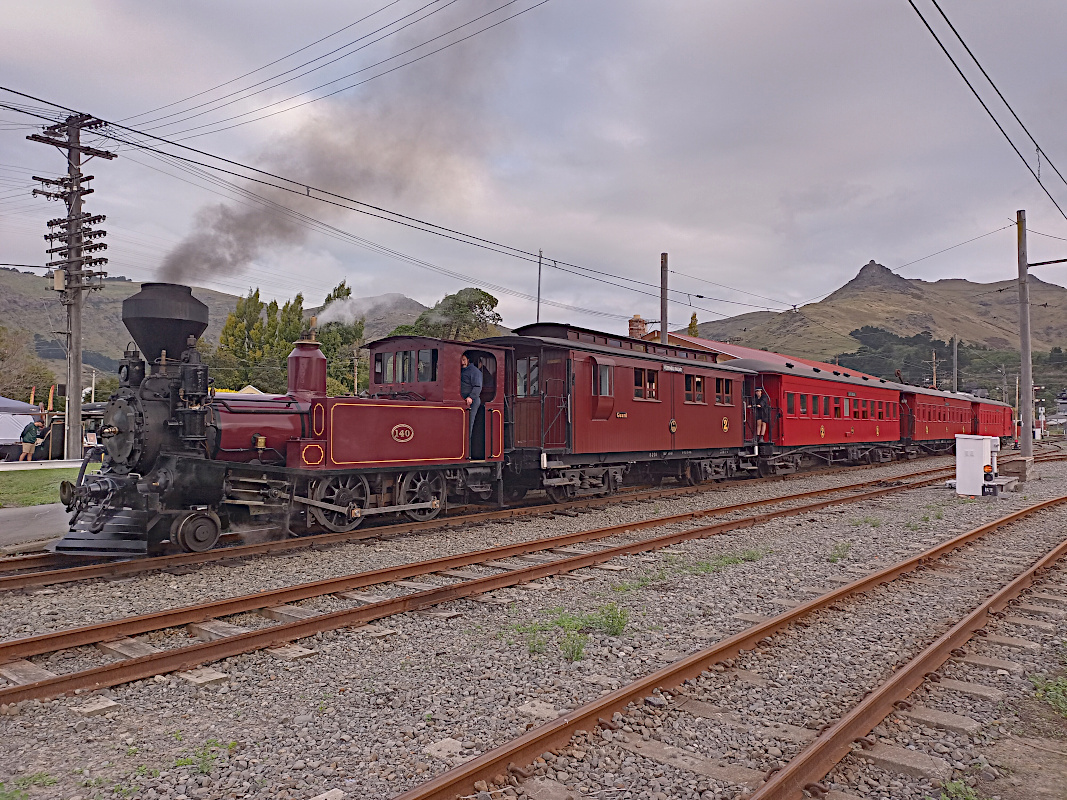 D 16 sits with its train at Moorhouse Station waiting for visitors to the monthly Ferrymead night market.
[Apr 2025].
D 16 sits with its train at Moorhouse Station waiting for visitors to the monthly Ferrymead night market.
[Apr 2025].
 D 140 was also involved in celebrating the 150 years of service of F 13.
Here it hauls a train with D 16 along the Ferrymead Railway. [Oct 2023].
D 140 was also involved in celebrating the 150 years of service of F 13.
Here it hauls a train with D 16 along the Ferrymead Railway. [Oct 2023].
 D 16 is preserved at the Pleasant Point Railway.
It visited the Ferrymead Railway for the Peveril celebrations.
Here D 140 hauls a mixed train together with D 16.
[Oct 2023].
D 16 is preserved at the Pleasant Point Railway.
It visited the Ferrymead Railway for the Peveril celebrations.
Here D 140 hauls a mixed train together with D 16.
[Oct 2023].
 D 140 was built in 1887 by Scott Brothers in Christchurch.
D 16 was built in 1878 by Neilson & Co in Scotland.
The differences between the two engines are clearly visible.
Most of these changed during the lives of the locomotives.
D 140 has a wide funnel with spark arrestors, while D 16 has a narrow funnel.
The cab of D 140 has three front windows, that of D 16 has only two.
The livery colour of the locomotives is different.
In addition, there are many smaller differences.
[Oct 2023].
D 140 was built in 1887 by Scott Brothers in Christchurch.
D 16 was built in 1878 by Neilson & Co in Scotland.
The differences between the two engines are clearly visible.
Most of these changed during the lives of the locomotives.
D 140 has a wide funnel with spark arrestors, while D 16 has a narrow funnel.
The cab of D 140 has three front windows, that of D 16 has only two.
The livery colour of the locomotives is different.
In addition, there are many smaller differences.
[Oct 2023].
 The two D locomotives haul a goods train together with F 13 along the Ferrymead Railway.
[Oct 2023].
The two D locomotives haul a goods train together with F 13 along the Ferrymead Railway.
[Oct 2023].
 A total of 34 class D locomotives were built:
17 by Neilson & Co from Glasgow, Scotland; 5 by Dubs & Co, also of Glasgow, Scotland; and 12 by Scott Brothers in Christchurch, New Zealand.
One of the locomotives built by Scott Brothers was never used by New Zealand's national railway, but only for the Napier Harbour Board.
D 16 leads D 140 along the Ferrymead Railway.
[Oct 2023].
A total of 34 class D locomotives were built:
17 by Neilson & Co from Glasgow, Scotland; 5 by Dubs & Co, also of Glasgow, Scotland; and 12 by Scott Brothers in Christchurch, New Zealand.
One of the locomotives built by Scott Brothers was never used by New Zealand's national railway, but only for the Napier Harbour Board.
D 16 leads D 140 along the Ferrymead Railway.
[Oct 2023].
 The little D locomotives served with New Zealand Railways until 1927,
but private operators snapped them up and continued to operate them for many years yet.
D 16 leads D 140 along the Ferrymead Railway.
[Oct 2023].
The little D locomotives served with New Zealand Railways until 1927,
but private operators snapped them up and continued to operate them for many years yet.
D 16 leads D 140 along the Ferrymead Railway.
[Oct 2023].
 D 16 also took charge of a few trains itself.
Here it brings a passenger train into Ferrymead Station.
This is the view from the Christchurch suburb Mt Pleasant.
[Oct 2023].
D 16 also took charge of a few trains itself.
Here it brings a passenger train into Ferrymead Station.
This is the view from the Christchurch suburb Mt Pleasant.
[Oct 2023].
 Crew from the Pleasant Point and Ferrymead Railways together took care of D 16 while it was at Ferrymead.
Here it takes on water near the waggon shed.
[Oct 2023].
Crew from the Pleasant Point and Ferrymead Railways together took care of D 16 while it was at Ferrymead.
Here it takes on water near the waggon shed.
[Oct 2023].
 D16 at its preservation home, the Pleasant Point Railway.
Here it sits at Keane's Crossing.
It is interesting to note that this engine does not have a spark arrestor, even though it is regularly fired by wood
on the Pleasant Point Railway these days [Mar 2008].
D16 at its preservation home, the Pleasant Point Railway.
Here it sits at Keane's Crossing.
It is interesting to note that this engine does not have a spark arrestor, even though it is regularly fired by wood
on the Pleasant Point Railway these days [Mar 2008].
 D18 departs from Keane's Crossing towards Pleasant Point on a fine winter day. [Jun 2016].
 The little D locomotive steams through the town of Pleasant Point.
This is the view from the passenger carriage, across the four-wheel freight wagon right behind the locomotive.
[Jun 2016].
The little D locomotive steams through the town of Pleasant Point.
This is the view from the passenger carriage, across the four-wheel freight wagon right behind the locomotive.
[Jun 2016].
 D18 with her train at Pleasant Point Station, about to push her train back to Keane's Crossing.
At the Pleasant Point Railway push-pull trains are operated, with a guard at one end maintaining a lookout
[Jun 2016].
D18 with her train at Pleasant Point Station, about to push her train back to Keane's Crossing.
At the Pleasant Point Railway push-pull trains are operated, with a guard at one end maintaining a lookout
[Jun 2016].
 But by this time the railway through Pleasant Point was closed.
Nevertheless, enthusiasts were working to preserve a small part of the branch line to Fairlie, which until 1968
was part of the rural area.
But by this time the railway through Pleasant Point was closed.
Nevertheless, enthusiasts were working to preserve a small part of the branch line to Fairlie, which until 1968
was part of the rural area.
Pleasant Point, Canterbury. Whites Aviation Ltd :Photographs. Ref: WA-71955-F. Alexander Turnbull Library, Wellington, New Zealand. http://natlib.govt.nz/records/22339561
Today the railway is not only a well-known visitor attraction in South Canterbury, but the one distinguishing factor
that marks out Pleasant Point.
 The pride of the Pleasant Point Railway is the steam locomotive Ab 669. Many a day it steams through the little town.
Here it sits at the Pleasant Point Railway Station beside the signal box. In the background is the Catholic Church,
which was affected by the 2011 Canterbury Earthquakes. [Jan 2013]
The pride of the Pleasant Point Railway is the steam locomotive Ab 669. Many a day it steams through the little town.
Here it sits at the Pleasant Point Railway Station beside the signal box. In the background is the Catholic Church,
which was affected by the 2011 Canterbury Earthquakes. [Jan 2013]
 The damaged Catholic church was demolished in July 2021.
A new, smaller church, was opened in October 2022.
It is visible in the background as Ab 699 stands beside Pleasant Point signal box.
[Dec 2024].
The damaged Catholic church was demolished in July 2021.
A new, smaller church, was opened in October 2022.
It is visible in the background as Ab 699 stands beside Pleasant Point signal box.
[Dec 2024].
 The signal box is only for display, with points set by hand. [Jan 2019].
 The railway now runs about 2km through Pleasant Point to the loco shed and station of Keanes Crossing just outside of
Pleasant Point.
Ab 699 arrives at the Pleasant Point Railway Station.
[Jan 1996].
The railway now runs about 2km through Pleasant Point to the loco shed and station of Keanes Crossing just outside of
Pleasant Point.
Ab 699 arrives at the Pleasant Point Railway Station.
[Jan 1996].
 One of the carriages is a first-class half-bird-cage carriage with nice leather seats.
This is the larger compartment at Christmas time.
[Dec 2024].
One of the carriages is a first-class half-bird-cage carriage with nice leather seats.
This is the larger compartment at Christmas time.
[Dec 2024].
 The locomotive is always at the Pleasant Point end of the train.
Ab 699 has just left Pleasant Point Station and pushes her train towards Keanes Crossing.
[Dec 2018].
The locomotive is always at the Pleasant Point end of the train.
Ab 699 has just left Pleasant Point Station and pushes her train towards Keanes Crossing.
[Dec 2018].
 The train is pushed through the central section of Pleasant Point with the guard's van leading.
The white light is on, and the guard has flags to indicate to the locomotive crew whether the way is clear,
particularly at railway crossings.
[Dec 2023].
The train is pushed through the central section of Pleasant Point with the guard's van leading.
The white light is on, and the guard has flags to indicate to the locomotive crew whether the way is clear,
particularly at railway crossings.
[Dec 2023].
 The train has left behind Pleasant Point behind and is now on the straight towards Keanes Crossing,
as Ab 699 pushes her carriages.
In the background are the Hunter Hills.
[Jan 2019].
The train has left behind Pleasant Point behind and is now on the straight towards Keanes Crossing,
as Ab 699 pushes her carriages.
In the background are the Hunter Hills.
[Jan 2019].
 On the Pleasant Point Railway the steam engines are fired with wood.
At first I was disappointed that there wasn't the characteristic coal smell. But somehow I later enjoyed the woody smell.
And it makes sense: no great tractive effort is required on the flat Pleasant Point Railway and the steam engine
can easily handle the train with a wood fire. It's a local, renewable resource, too.
Wood is loaded onto Ab 699 at Keanes Crossing.
[Dec 2023].
On the Pleasant Point Railway the steam engines are fired with wood.
At first I was disappointed that there wasn't the characteristic coal smell. But somehow I later enjoyed the woody smell.
And it makes sense: no great tractive effort is required on the flat Pleasant Point Railway and the steam engine
can easily handle the train with a wood fire. It's a local, renewable resource, too.
Wood is loaded onto Ab 699 at Keanes Crossing.
[Dec 2023].
 At Keanes Crossing visitors can look at various displays before catching the train back to Pleasant Point.
Ab 699 sits at Keanes Crossing with the crew inspecting the fire box.
Somehow the locomotive was not steaming well that day.
Ab 699 had been out of service from the middle of 2013 until late 2018,
while its boiler was repaired and inspected.
[Jan 2019].
At Keanes Crossing visitors can look at various displays before catching the train back to Pleasant Point.
Ab 699 sits at Keanes Crossing with the crew inspecting the fire box.
Somehow the locomotive was not steaming well that day.
Ab 699 had been out of service from the middle of 2013 until late 2018,
while its boiler was repaired and inspected.
[Jan 2019].
Ab 699 departs Keanes Crossing with a train of green carriages on a fine summer's day.
 Note the split wood in the background. [Jan 2013].
 Like the J, Jb, and Ja classes, Ab steam locomotives had Vanderbilt tenders.
These tenders are cylindrical with the fuel carried towards the front and the water at the back of the tender.
[Dec 2023].
Like the J, Jb, and Ja classes, Ab steam locomotives had Vanderbilt tenders.
These tenders are cylindrical with the fuel carried towards the front and the water at the back of the tender.
[Dec 2023].
 The train accelerates from Keanes Crossing.
The Pleasant Point Railway tries to recreate the glory of New Zealand Railways in the early 20th century.
[Dec 2023].
The train accelerates from Keanes Crossing.
The Pleasant Point Railway tries to recreate the glory of New Zealand Railways in the early 20th century.
[Dec 2023].
 On a nice summer day Ab 699 hauls her train through Pleasant Point.
The train slows down as it approaches the station.
[Dec 2024].
On a nice summer day Ab 699 hauls her train through Pleasant Point.
The train slows down as it approaches the station.
[Dec 2024].
 On a nice summer day Ab 699 hauls her train through Pleasant Point.
The train slows down as it approaches the station.
[Dec 2024].
On a nice summer day Ab 699 hauls her train through Pleasant Point.
The train slows down as it approaches the station.
[Dec 2024].
 In 2008 the Railway had an event commemorating 40 years since the closure of the Fairlie branch line.
The original headboard of the last run still existed and was placed on Ab699.
For that event the locomotive was renumbered to commemorate Ab718, the locomotive that lead the last train from Fairlie.
[Mar 2008].
In 2008 the Railway had an event commemorating 40 years since the closure of the Fairlie branch line.
The original headboard of the last run still existed and was placed on Ab699.
For that event the locomotive was renumbered to commemorate Ab718, the locomotive that lead the last train from Fairlie.
[Mar 2008].

 As it had been a rainy day with some mist still swirling around, I was able to take some good night shots.
In this picture at Keanes Crossing, not only the Ab, but also the little D steam engine and the diesel shunting tractor
are visible. [Mar 2008]
As it had been a rainy day with some mist still swirling around, I was able to take some good night shots.
In this picture at Keanes Crossing, not only the Ab, but also the little D steam engine and the diesel shunting tractor
are visible. [Mar 2008]
From the other side the view had just as much atmosphere. The short train was about to steam into the night. [Mar 2008]

 The little ganger's house is part of the station infrastructure and sometimes gets used to control
shunting movements in and out of the station. [Mar 2008]
The little ganger's house is part of the station infrastructure and sometimes gets used to control
shunting movements in and out of the station. [Mar 2008]
At the end of the night, the train stopped for some time at Pleasant Point Railway Station for a final photo shoot. An old delivery vehicle backed onto the platform to make the scene from days gone by complete. [Mar 2008]
 The Ab class was a development of the A class locomotives.
The A class locomotives were the first major class of tender locomotives designed and built in New Zealand.
They were constructed by the NZR Addington workshops and A & G Price in Thames between 1906 and 1914.
The Ab class was a development of the A class locomotives.
The A class locomotives were the first major class of tender locomotives designed and built in New Zealand.
They were constructed by the NZR Addington workshops and A & G Price in Thames between 1906 and 1914.
 Here an A class locomotive stands at Glenmark Station in Waipara, ready to depart on a night run.
[Jun 2021].
Here an A class locomotive stands at Glenmark Station in Waipara, ready to depart on a night run.
[Jun 2021].
The Weka Pass Railway operates for 13 km on the formation of the old Waiau branch between Waipara and Waikari. Every winter it runs a night train from Glenmark Station to Waikari and back. [Jun 2021].
 A 428 was built by A & G Price in 1909.
It worked for many years on the West Coast of the South Island
and was also in service to repair the damage to the track after the Inangahua Earthquake in 1968.
A 428 was withdrawn in 1969 and stored in Greymouth until 1983.
After being transferred to the Weka Pass Railway, it started operation on this line in 1993.
A 428 was built by A & G Price in 1909.
It worked for many years on the West Coast of the South Island
and was also in service to repair the damage to the track after the Inangahua Earthquake in 1968.
A 428 was withdrawn in 1969 and stored in Greymouth until 1983.
After being transferred to the Weka Pass Railway, it started operation on this line in 1993.
 A 428 is about to steam into the night with its train from Glenmark Station.
[Jun 2021].
A 428 is about to steam into the night with its train from Glenmark Station.
[Jun 2021].
A 428 has arrived at Waikari Station. As the other members of the class, A 428 was originally built as a four-cylinder compound locomotive. Between 1941 and 1949 all A class locomotives were converted to simple expansion two-cylinder locomotives. This made maintenance of the locomotives easier. [Jun 2021].
 The A class locomotives had the traditional square tenders.
While initially too small for long-distance work, the tenders for these locomotives were rebuilt from 1930 onwards
to increase coal and water capacity.
The A class locomotives had the traditional square tenders.
While initially too small for long-distance work, the tenders for these locomotives were rebuilt from 1930 onwards
to increase coal and water capacity.
 A 428 at Waikari has uncoupled from the train and has moved forward.
A Weka Pass Railway worker is setting the points, so that the locomotive can run round its train.
[Jun 2021].
A 428 at Waikari has uncoupled from the train and has moved forward.
A Weka Pass Railway worker is setting the points, so that the locomotive can run round its train.
[Jun 2021].
A 428 sits in the dark at the head of its train in Waikari. It will travel back to Glenmark Station tender first. [Jun 2021].
 After finishing a daytime run, A 428 sits at the head of her train
at Glenmark Station in Waipara.
[Jul 2022].
After finishing a daytime run, A 428 sits at the head of her train
at Glenmark Station in Waipara.
[Jul 2022].

A 428 steams it up as she rounds a curve with a train on the Weka Pass Railway. This photo was taken during the customary photo run-by. [Jul 2022].
 The steam locomotive has uncoupled from
the train at Waikari and now runs round the train to haul the carriages in the other direction.
The motor trolley can be seen in the back shunt at Waikari.
This is as far as the line goes today, about 12.5 km from Waipara.
[Jul 2022].
The steam locomotive has uncoupled from
the train at Waikari and now runs round the train to haul the carriages in the other direction.
The motor trolley can be seen in the back shunt at Waikari.
This is as far as the line goes today, about 12.5 km from Waipara.
[Jul 2022].

Running tender first, A 428 hauls the train back down the line towards Waipara. The square tender is quite noticeable in this photo. [Jul 2022].
 This is the view of the locomotive from the train,
as A 428 trundles back down the line towards Waipara.
[Jul 2022].
This is the view of the locomotive from the train,
as A 428 trundles back down the line towards Waipara.
[Jul 2022].

Running tender first, The steam train travels through the North Canterbury countryside. A 428 is a regular on the Weka Pass Railway, but was due for a major boiler overhaul in 2023. [Jul 2022].
 The first locomotive class named A were little tank engines.
A 64 was built in 1873 by Dubs & Co, Glasgow, Scotland.
It is now at the Plains Railway in Tinwald, Ashburton.
[Oct 2022].
The first locomotive class named A were little tank engines.
A 64 was built in 1873 by Dubs & Co, Glasgow, Scotland.
It is now at the Plains Railway in Tinwald, Ashburton.
[Oct 2022].

Two stored tank locomotives at the Ferrymead Railway. W 192 was the first locomotive built by New Zealand Railways. It was built at the Addington Workshops in 1889. WD 357 was built in 1901 by the Baldwin Locomotive Works, USA. Both locomotives require some major work to run again. [Oct 2023].
 In the 1960s the very first train on the renewed Ferrymead Railway was hauled by WD 357.
Even though it was not operational at the 60th anniversary of the railway in 2024, it was hauled along the railway line by other locomotives to celebrate the occasion.
Here it is beside the Moorhouse signal box.
[Oct 2024].
In the 1960s the very first train on the renewed Ferrymead Railway was hauled by WD 357.
Even though it was not operational at the 60th anniversary of the railway in 2024, it was hauled along the railway line by other locomotives to celebrate the occasion.
Here it is beside the Moorhouse signal box.
[Oct 2024].
 WD 357 stood on display on the siding at Ferrymead Station with the train it hauled all those years ago:
a high side wagon and F 624, a Rewanui Incline guard's van.
[Oct 2024].
WD 357 stood on display on the siding at Ferrymead Station with the train it hauled all those years ago:
a high side wagon and F 624, a Rewanui Incline guard's van.
[Oct 2024].
 The Public Works Department ordered some small steam locomotives directly from manufacturers in England.
Fowler 548 was built by John Fowler & Co in 1925.
The Public Works Department ordered some small steam locomotives directly from manufacturers in England.
Fowler 548 was built by John Fowler & Co in 1925.
 These engines were on-sold to private companies in the 1930s.
Fowler 548 came to a sawmill on the West Coast.
[Apr 2021].
These engines were on-sold to private companies in the 1930s.
Fowler 548 came to a sawmill on the West Coast.
[Apr 2021].
Fowler 548 now operates passenger trains at the Canterbury Steam Preservation Society or Steam Scene. It is at McLeans Island west of Christchurch. This was formerly an island in the Waimakariri River, but the river has long been diverted and the area is now part of the Canterbury Plains. There is 1.2 km long loop track around the perimeter of the property around which trains operate. [Apr 2021].
 Only the frame is from Fowler 548.
Much of the other gear is from Fowler 550, while the boiler is from Fowler 549.
Only the frame is from Fowler 548.
Much of the other gear is from Fowler 550, while the boiler is from Fowler 549.
 Some parts would have had to be manufactured new, so that not much of the original locomotive remains.
[Apr 2021].
Some parts would have had to be manufactured new, so that not much of the original locomotive remains.
[Apr 2021].
The railway at McLeans Island is meant to reflect a bush tramway. However, here in Canterbury it is a lot drier than in many of the areas where bush tramways operated, particularly the West Coast. The railway here runs through pine trees and over flat ground. [Apr 2021].
 Occasionally Steam Scene operates Night Runs with both miniature and full-size trains operating in the late afternoon and well into the evening.
Fowler 548 hauls the two carriages along the track.
[May 2024].
Occasionally Steam Scene operates Night Runs with both miniature and full-size trains operating in the late afternoon and well into the evening.
Fowler 548 hauls the two carriages along the track.
[May 2024].

The little locomotive takes on some water before it sets out on another run through the night. A goods wagon with fire wood stands on the siding next to the train. [May 2024].
 It hauled freight and passenger trains, ran on main lines and branch lines.
This is not the best photo, but gives an impression of the everyday railway scene in the 1920s.
It hauled freight and passenger trains, ran on main lines and branch lines.
This is not the best photo, but gives an impression of the everyday railway scene in the 1920s.
An Ab class steam locomotive near the Glen, Dunedin, circa 1926.. Godber, Albert Percy, 1875-1949 :Collection of albums, prints and negatives. Ref: APG-1327-1/2-G. Alexander Turnbull Library, Wellington, New Zealand. /records/22843169

Today, some steam excursions are also run on the main line. Here an Ab once common throughout the whole of the railway network and described as "maid for all work" hauls a train along the beach south of Timaru. [Oct 2004]
 In the days of steam, Timaru was a busy station. While a new station building now has replaced the old wooden one,
many of the buildings in the area are still there today.
In the days of steam, Timaru was a busy station. While a new station building now has replaced the old wooden one,
many of the buildings in the area are still there today.
 The most prominent building is the Evans Atlas Flour Milling Co Ltd
visible in the background.
The most prominent building is the Evans Atlas Flour Milling Co Ltd
visible in the background.
Timaru Railway Station. Radcliffe, Frederick George, 1863-1923 : New Zealand post card negatives. Ref: 1/2-006877-G. Alexander Turnbull Library, Wellington, New Zealand. http://natlib.govt.nz/records/23012525
About 90 years later this picture shows the new railway station with the old flour mill in the background. A Jb locomotive with a special train from Dunedin to Christchurch sits at the platform in Timaru. [Oct 2005].
 No regular trains stop here any more, only the occassional special still makes
use of the facilities. Nevertheless, buses still stop at the station and the cafe is
well known for its funky food. Jb1236 waits in Timaru, while the passengers have gone on a side trip to the
Pleasant Point Museum Railway. One of the loco crew seems to want to have a look at the
engine from the distance. [Oct 2007]
No regular trains stop here any more, only the occassional special still makes
use of the facilities. Nevertheless, buses still stop at the station and the cafe is
well known for its funky food. Jb1236 waits in Timaru, while the passengers have gone on a side trip to the
Pleasant Point Museum Railway. One of the loco crew seems to want to have a look at the
engine from the distance. [Oct 2007]

As part of the 150th anniversary of railways in New Zealand, another steam excursion made it to Timaru. A Ja locomotive is seen rounding the curve from Caroline Bay to the Timaru Railway Station. Because I had set the wrong exposure, I had to manipulate the picture somewhat. The best effect was still by presenting it in black and white [Oct 2013].

 This goods shed still stands in a field at Waihao Downs, the terminus of the former Waimate branch.
The line to Waihao Downs was closed in 1953, the line to Waimate in 1966. [Nov 2007]
This goods shed still stands in a field at Waihao Downs, the terminus of the former Waimate branch.
The line to Waihao Downs was closed in 1953, the line to Waimate in 1966. [Nov 2007]
This view of Methven Railway Station, North Canterbury, in the early 20th century, may give an impression
of life around small country stations. It was part of small town life. The Methven branch was closed in 1976,
well after passenger train operations on the line had ceased.
Methven railway station and train. Evening post (Newspaper. 1865-2002) :Photographic negatives and prints of the Evening Post newspaper. Ref: PAColl-5482-010.
Alexander Turnbull Library, Wellington, New Zealand. http://natlib.govt.nz/records/22651926

 A short section of track is now operated from Tinwald Domain by the Plains Railway.
They also operate a Ja locomotive. In the past these Ja's hauled fast express trains across the Canterbury Plains.
Now this engine gives a spectacular display on the short Tinwald line. [May 2008]
A short section of track is now operated from Tinwald Domain by the Plains Railway.
They also operate a Ja locomotive. In the past these Ja's hauled fast express trains across the Canterbury Plains.
Now this engine gives a spectacular display on the short Tinwald line. [May 2008]
The Ja has left the platform and rounds the curve to the open fields. [May 2008].
 Diesel railcar Rm 50 waits at the other platform. [Nov 2023].

Ja 1260 thunders along the straight of the Plains Railway. A headboard was attached to the front of the locomotive to commemorate the 50 years operation of the Plains Railway. [Nov 2023].
 Nevertheless, Ja 1260 seems to operate a branch railway train here.
It pushes its train along the Plains Railway back towards the station.
[Nov 2023].
Nevertheless, Ja 1260 seems to operate a branch railway train here.
It pushes its train along the Plains Railway back towards the station.
[Nov 2023].

Later that day Ja 1260 hauled a train together with K 88 along the Plains Railway. [Nov 2023].
 In this picture K 88 "Washington" hauled a double header with Ja 1260 on the Plains Railway. [May 2008].

The fine wooden cab, rebuilt after the engine was rescued from a riverbed, can be seen in this picture. Yes, it was rainy that day. In the background is the church of St. Philip and St. James. [May 2008].
 It looked far more flamboyant than any of the other steam locomtives active in New Zealand.
K 88 backs onto its train at the Plains Railway.
[Nov 2023].
It looked far more flamboyant than any of the other steam locomtives active in New Zealand.
K 88 backs onto its train at the Plains Railway.
[Nov 2023].

K 88 departs the Plains railway station during the 50th anniversary celebrations of the Plains Railway. The locomotive was in New Zealand Railways service until 1928. It was then dumped in the Oreti River in Southland to protect the river bank. From there it was retrieved in 1974 for restoration. [Nov 2023].
 There's probably not much left of the original locomotive with many parts replaced over the years.
Nevertheless, the overall appearance and functionality has remained.
[Nov 2023].
There's probably not much left of the original locomotive with many parts replaced over the years.
Nevertheless, the overall appearance and functionality has remained.
[Nov 2023].

Further west a stand of eucalyptus trees surrounds the Plains Railway track. As part of the 50th celebrations of the Plains Railway K 88 puffs into the country. [Nov 2023].

 But one class member was part of the 150th anniversary celebrations and hauled several trains on the Ferrymead Railway.
Here it is seen switching to the other side of its train at Ferrymead Station. [Oct 2013].
But one class member was part of the 150th anniversary celebrations and hauled several trains on the Ferrymead Railway.
Here it is seen switching to the other side of its train at Ferrymead Station. [Oct 2013].
Ka 942 hauls its train into Ferrymead Station. Even though it worked most of its life on the North Island Main Trunk, the engine has come to the home of railways in New Zealand. [Oct 2013].