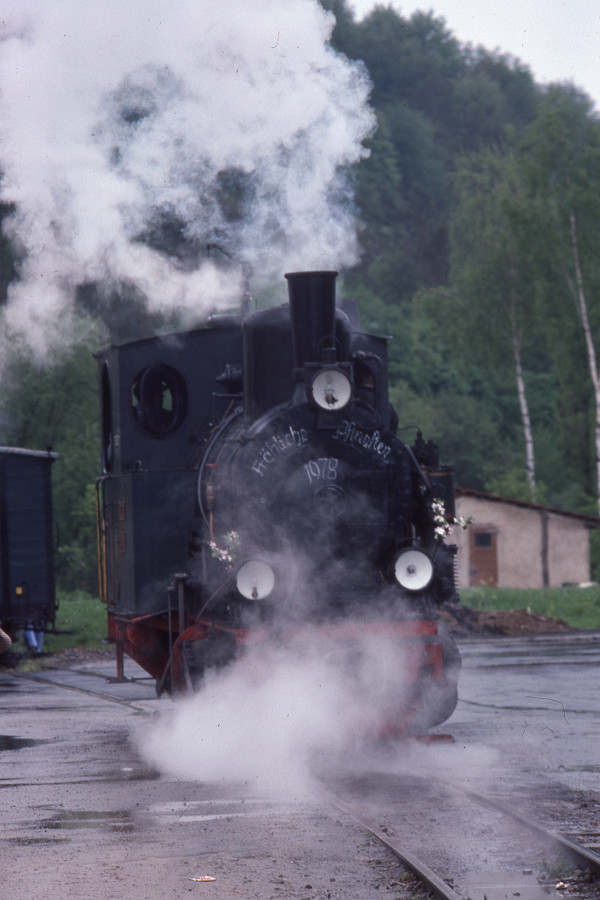
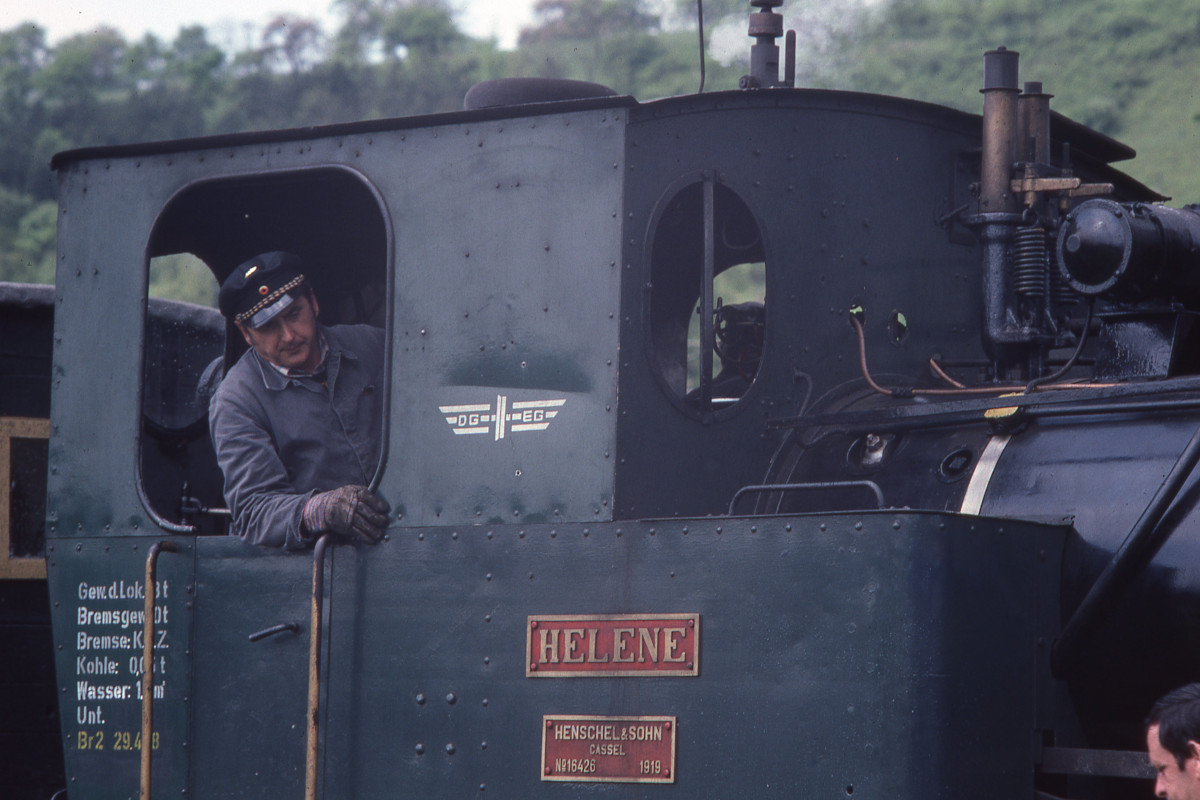
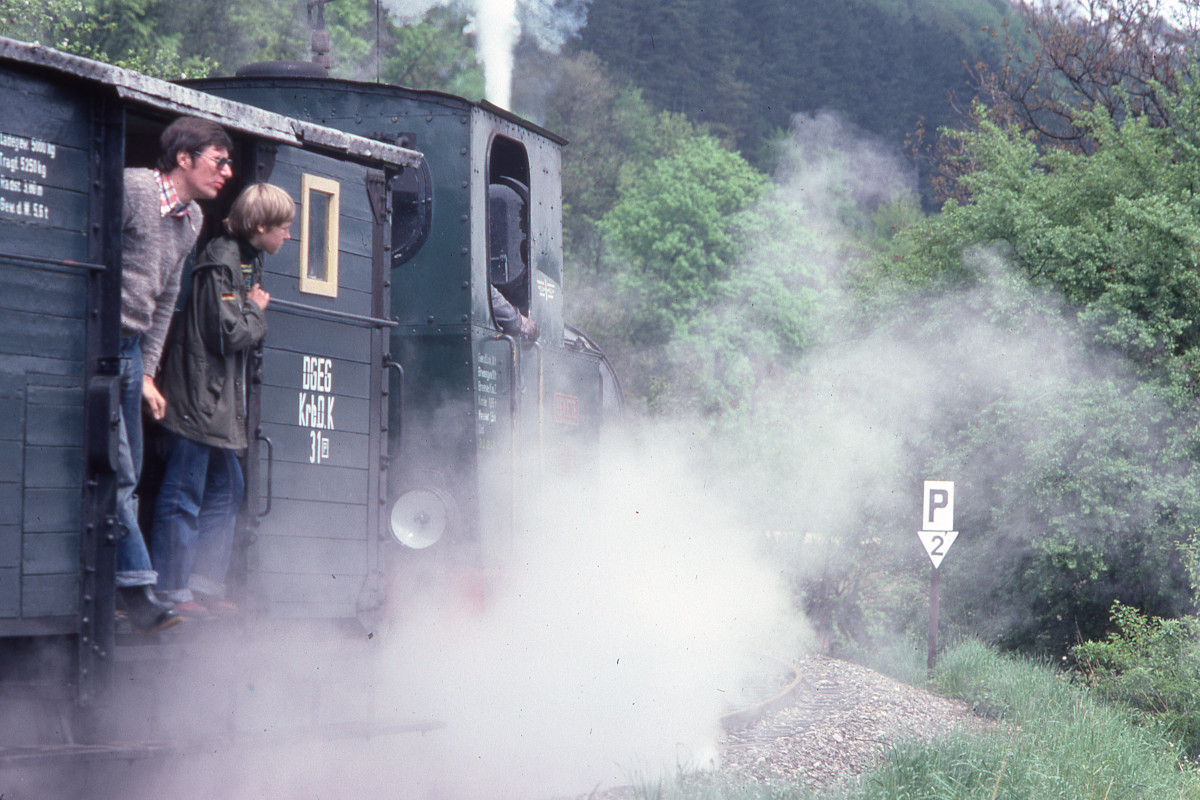

 Locomotive 11 of the Hohenzollerischen Landesbahn has just arrived in Sigmaringen country station with a special train from Gammertingen.
[Apr 1983].
Locomotive 11 of the Hohenzollerischen Landesbahn has just arrived in Sigmaringen country station with a special train from Gammertingen.
[Apr 1983].
 A class 212 diesel loco of the Deutsche Bundesbahn haul a steam class 52 steam engine, once owned by Austrian Federal Railways,
and a class 23 steam engine, once operated by the German Federal Railway, through the Lauchert Valley.
Both steam locomotives belonged to EUROVAPOR of Switzerland and therefore have a carriage of the Swiss Südostbahn.
My father took the photo from the Nägelesfelsen.
I can still remember that I slid off the rock cliffs there and could just grab the rails, rather than plunging into the valley.
My brother hauled me up again.
[Apr 1983].
A class 212 diesel loco of the Deutsche Bundesbahn haul a steam class 52 steam engine, once owned by Austrian Federal Railways,
and a class 23 steam engine, once operated by the German Federal Railway, through the Lauchert Valley.
Both steam locomotives belonged to EUROVAPOR of Switzerland and therefore have a carriage of the Swiss Südostbahn.
My father took the photo from the Nägelesfelsen.
I can still remember that I slid off the rock cliffs there and could just grab the rails, rather than plunging into the valley.
My brother hauled me up again.
[Apr 1983].
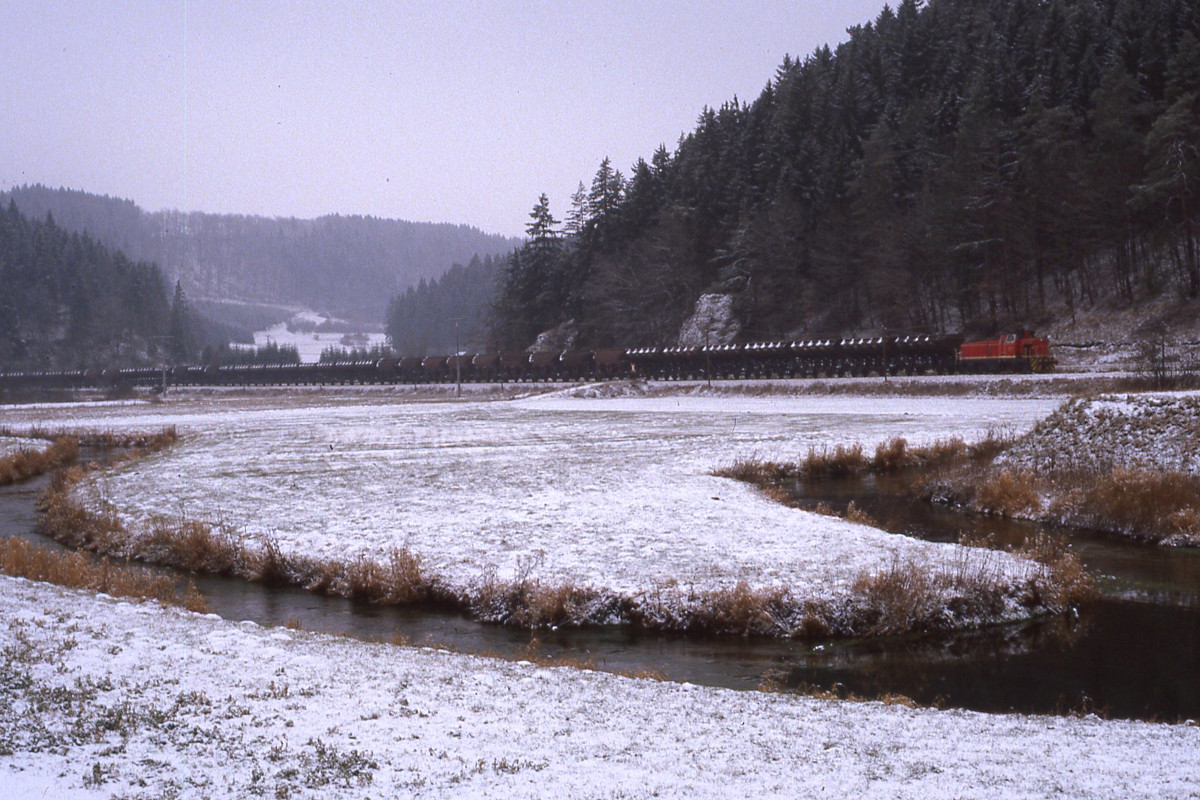 On the highlands of the Swabian Alb a long gravel train of the Hohenzollerische Landesbahn travels through the winter landscape.
[Dec 1984].
On the highlands of the Swabian Alb a long gravel train of the Hohenzollerische Landesbahn travels through the winter landscape.
[Dec 1984].
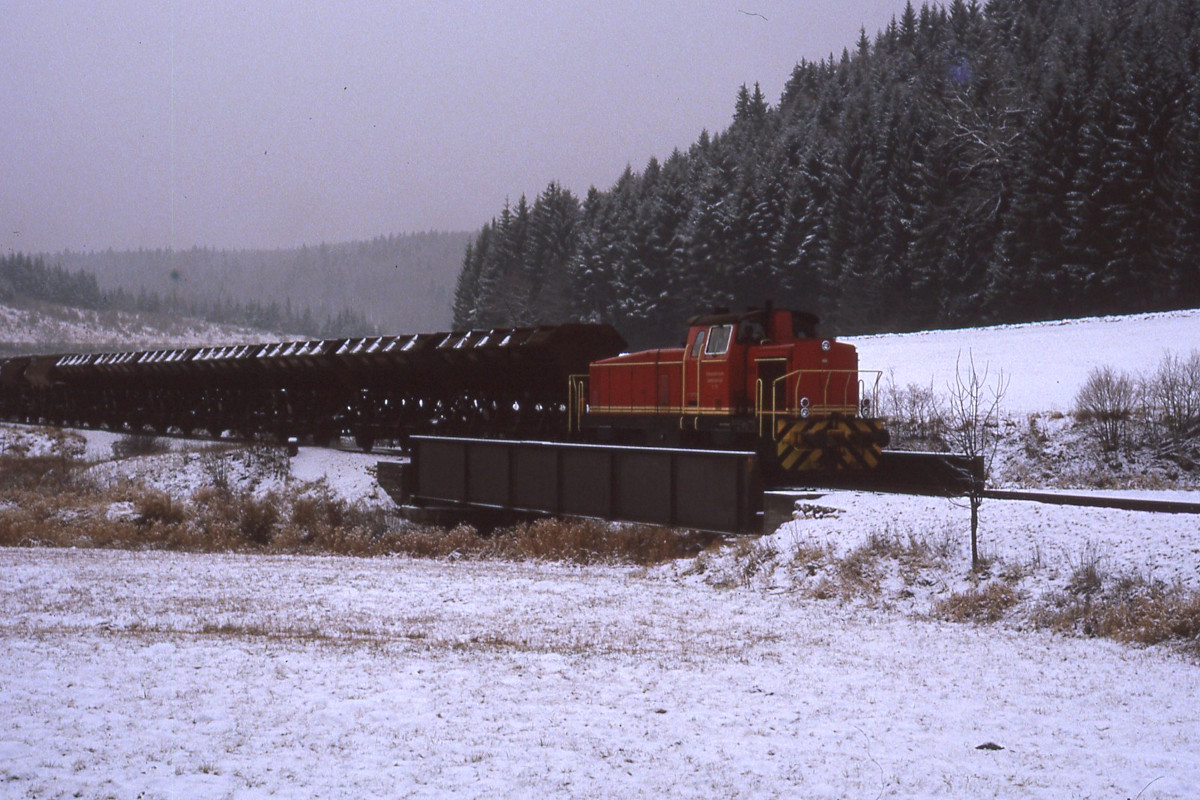 The train was hauled by a Class V119 locomotive built by Kraus-Maffei. The train crosses the river Lauchert just south of Gammertingen.
[Dec 1984].
The train was hauled by a Class V119 locomotive built by Kraus-Maffei. The train crosses the river Lauchert just south of Gammertingen.
[Dec 1984].
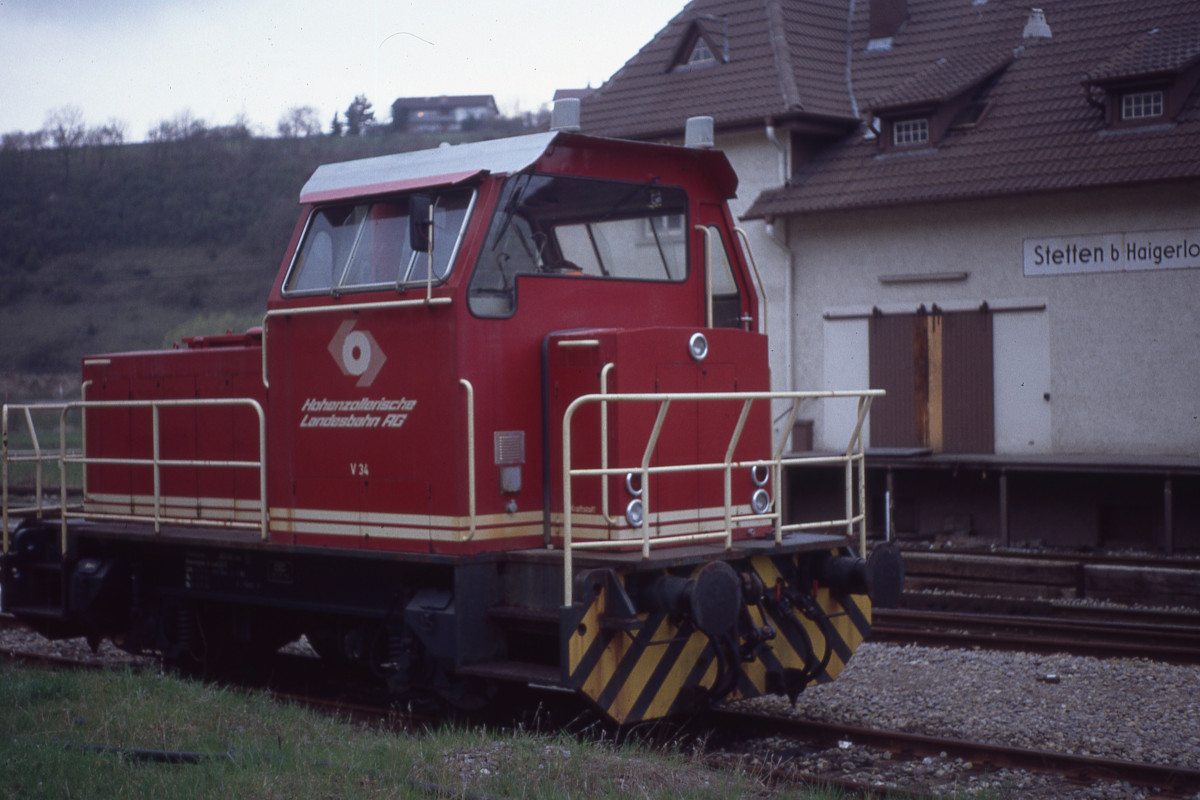 Shunting locomotive V 34 was delivered by Gmeinder to Hohenzollerische Landesbahn in 1985.
Here it is in the station Stetten bei Haigerloch.
[Apr 1992].
Shunting locomotive V 34 was delivered by Gmeinder to Hohenzollerische Landesbahn in 1985.
Here it is in the station Stetten bei Haigerloch.
[Apr 1992].
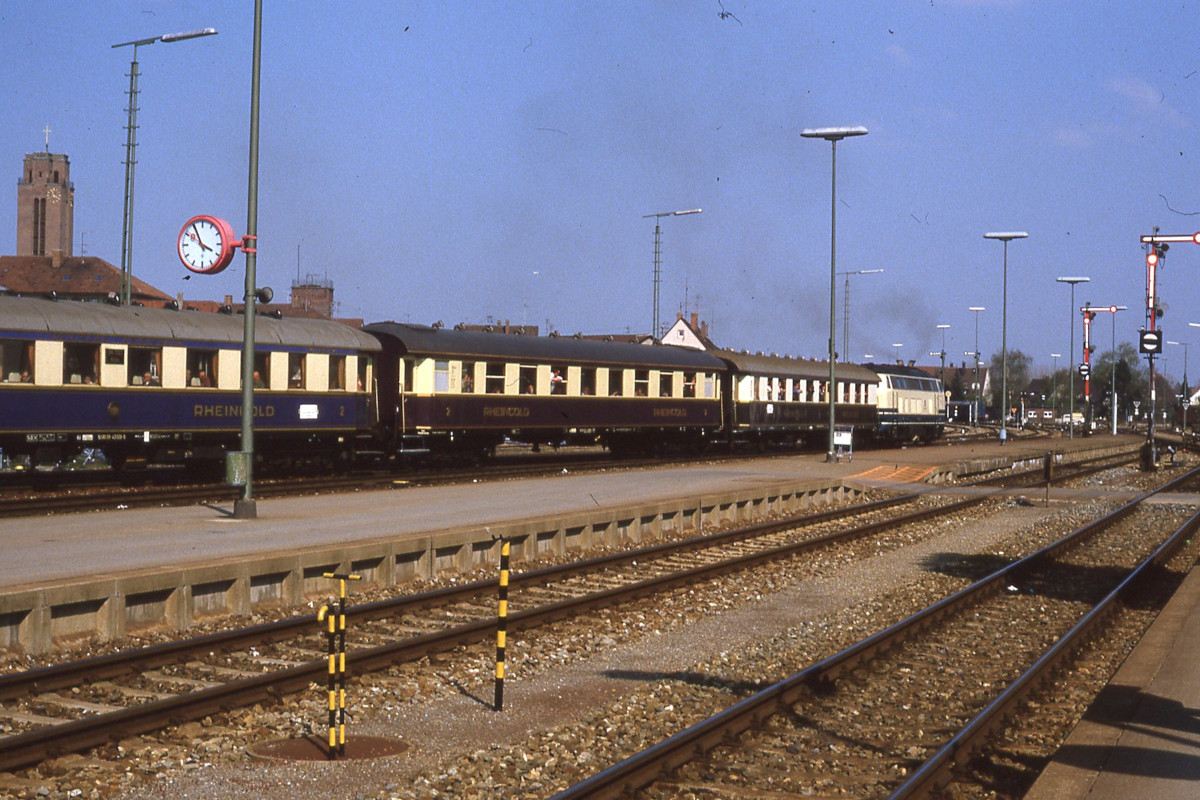 The 150th anniversary of railways in Germany was celebrated in 1985.
Beside many other occasions there was also a station festival in Friedrichshafen.
Here a Class 218 diesel-hydraulic locomotive leaves the station with the Rheingold heritage train.
[1985].
The 150th anniversary of railways in Germany was celebrated in 1985.
Beside many other occasions there was also a station festival in Friedrichshafen.
Here a Class 218 diesel-hydraulic locomotive leaves the station with the Rheingold heritage train.
[1985].
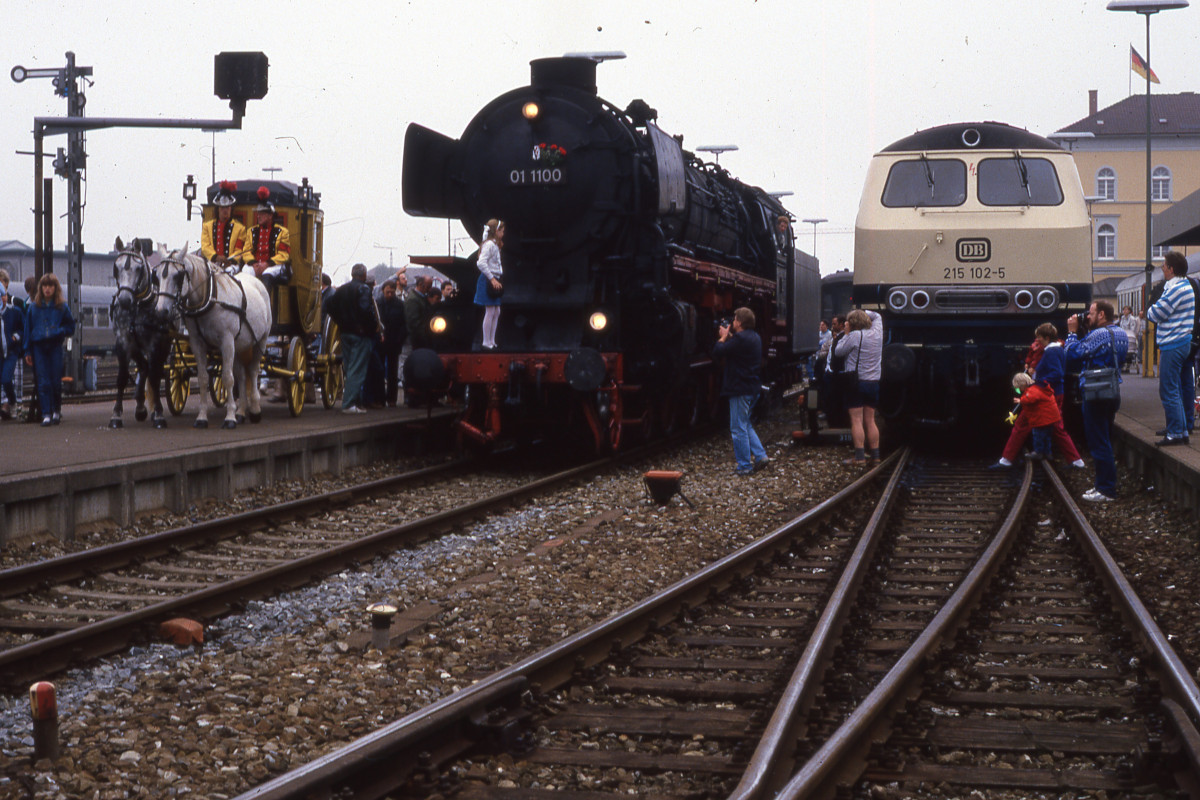 In October 1988 there was a steam locomotive event in Friedrichshafen.
As part of that there was a lineup of a postal coach, a steam locomotive and a diesel loco.
This was probably meant to show technical progress across the years.
[Oct 1988].
In October 1988 there was a steam locomotive event in Friedrichshafen.
As part of that there was a lineup of a postal coach, a steam locomotive and a diesel loco.
This was probably meant to show technical progress across the years.
[Oct 1988].
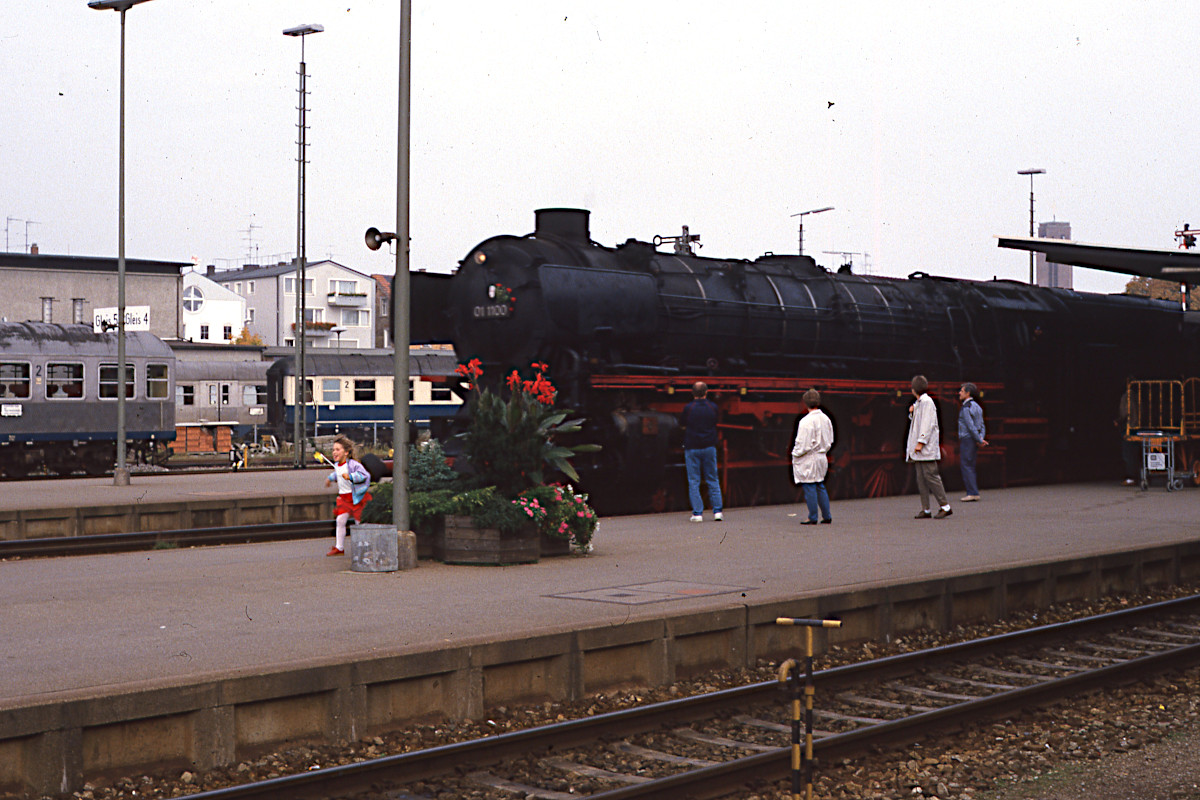 Passenger express locomotive 01 1100 also participated.
This was the first engine of its class to be modified to burn fuel oil.
The locomotive arrives with a train in Friedrichshafen.
[Oct 1988].
Passenger express locomotive 01 1100 also participated.
This was the first engine of its class to be modified to burn fuel oil.
The locomotive arrives with a train in Friedrichshafen.
[Oct 1988].
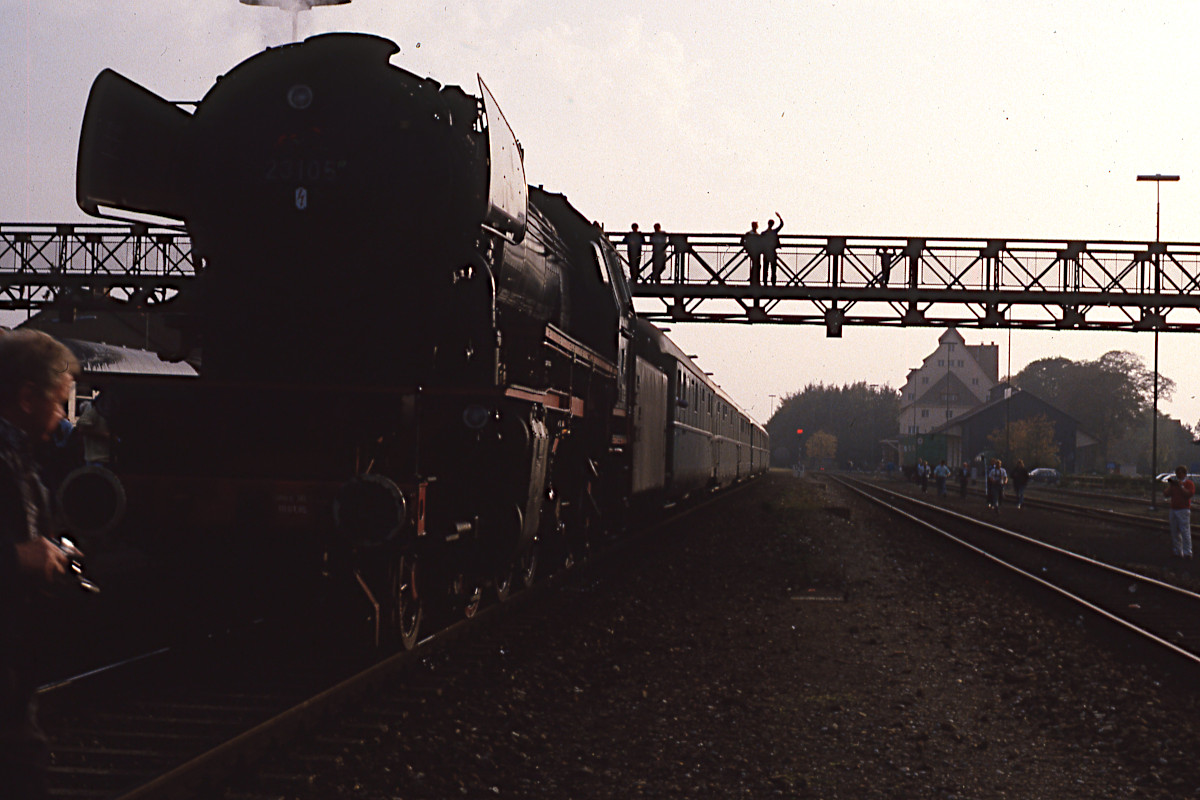 The passenger train locomotive 23 105 also took part in the event.
It was the last steam locomotive built for the German Federal Railway in 1959.
Here it has arrived with a train from Friedrichshafen in Ravensburg.
[Oct 1988].
The passenger train locomotive 23 105 also took part in the event.
It was the last steam locomotive built for the German Federal Railway in 1959.
Here it has arrived with a train from Friedrichshafen in Ravensburg.
[Oct 1988].
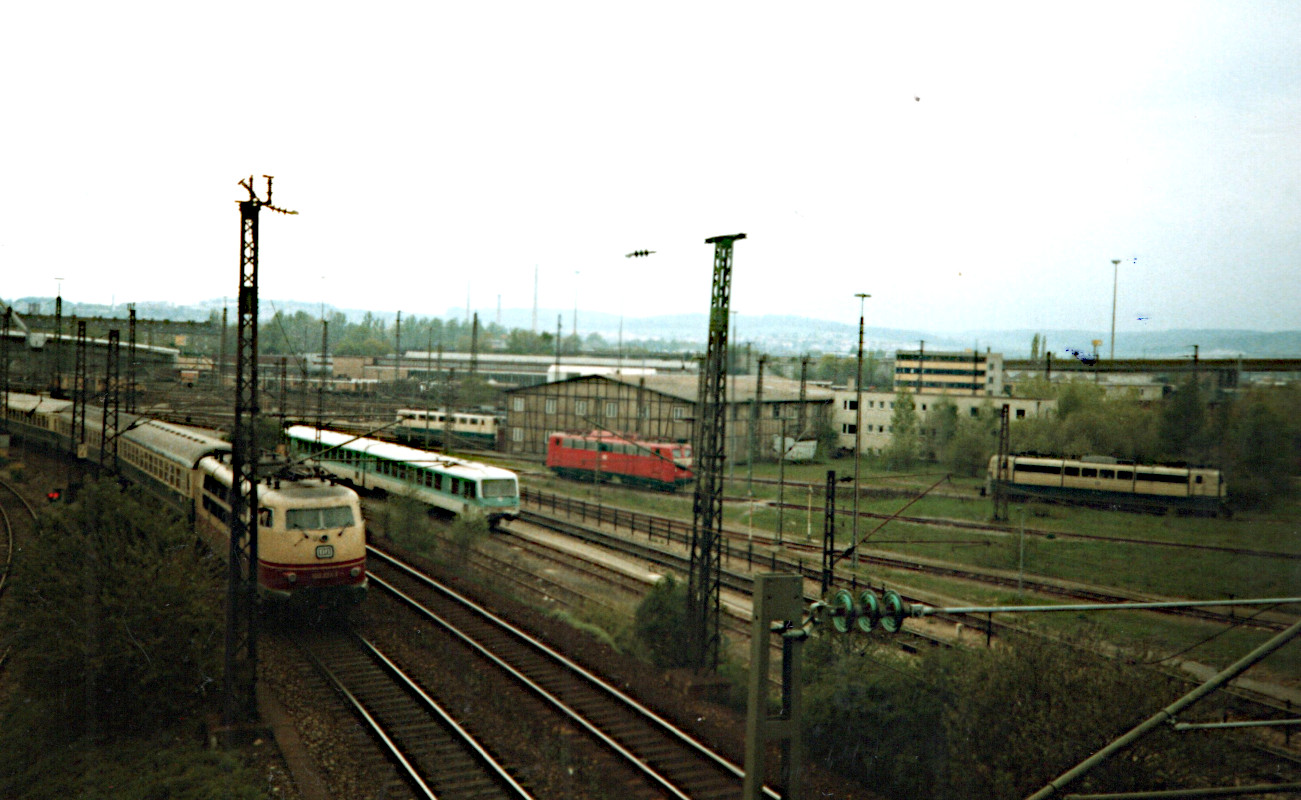 A Deutsche Bundesbahn Class 103 electric express train locomotive leaves Ulm with an InterCity train.
In the background are electric locomotives in the old blue-beige livery and the new raspberry-red livery.
A Class 628 diesel railcar in the new mint-teal livery was also parked up on a siding.
[May 1989].
A Deutsche Bundesbahn Class 103 electric express train locomotive leaves Ulm with an InterCity train.
In the background are electric locomotives in the old blue-beige livery and the new raspberry-red livery.
A Class 628 diesel railcar in the new mint-teal livery was also parked up on a siding.
[May 1989].
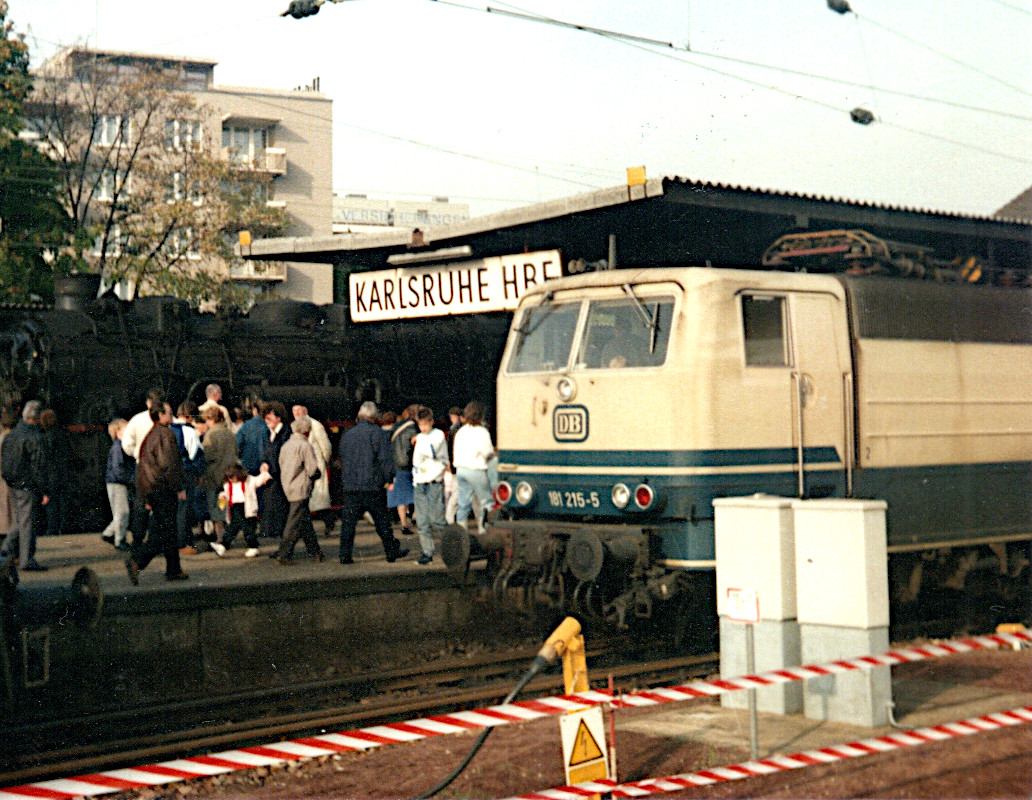 In late September / early October 1990 the 150th anniversary of railways in Baden was celebrated with festivities in Karlsruhe.
This included a display of locomotives in Karlsruhe main station.
Multi-system locomotive 151 215-5 of the Deutsche Bundesbahn and steam locomotive 58 311 built in Karlsruhe were also part of the festivities.
[Sep 1990].
In late September / early October 1990 the 150th anniversary of railways in Baden was celebrated with festivities in Karlsruhe.
This included a display of locomotives in Karlsruhe main station.
Multi-system locomotive 151 215-5 of the Deutsche Bundesbahn and steam locomotive 58 311 built in Karlsruhe were also part of the festivities.
[Sep 1990].
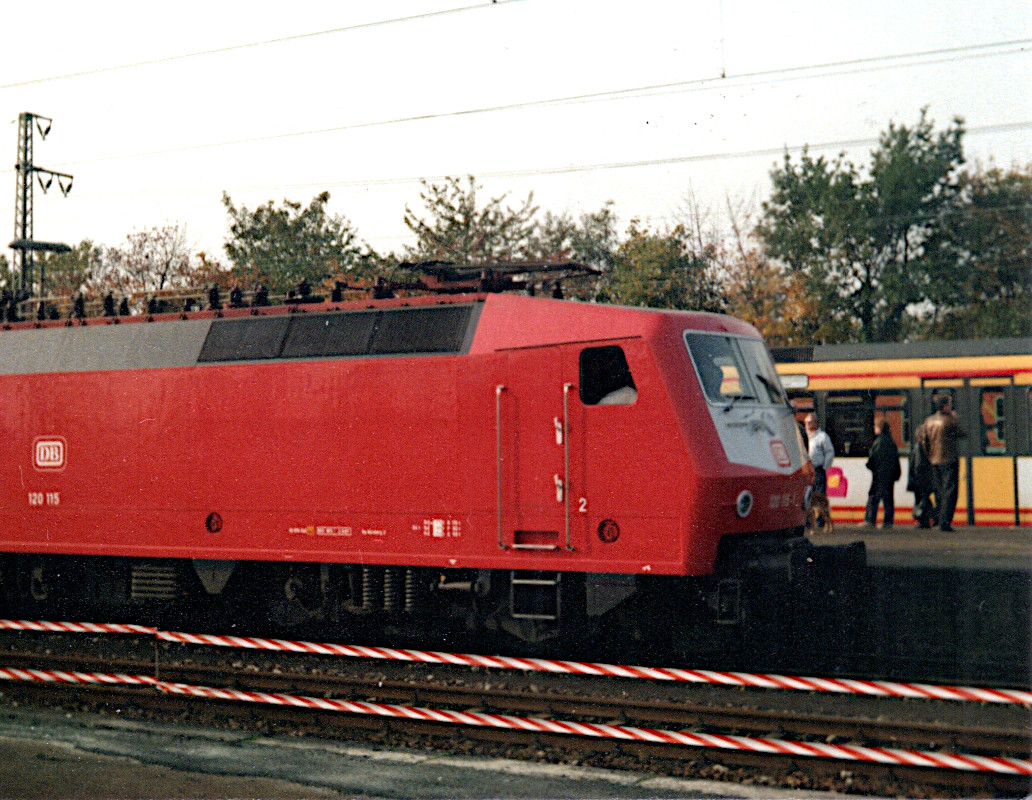 A new Class 120 electric locomotive was also on display.
This was built as a universal locomotive for all types of trains.
This class was mainly used for InterRegio trains.
[Sep 1990].
A new Class 120 electric locomotive was also on display.
This was built as a universal locomotive for all types of trains.
This class was mainly used for InterRegio trains.
[Sep 1990].
 The InterCity Experimental was delivered in 1985 to develop high speed trains in Germany and show the public what a
high speed train might look like.
The train was never used in ordinary revenue service.
For the 150th anniversary of the railways of Baden the ICE was displayed in Karlsruhe together with other
rail vehicles, such as the class 012 steam engine.
[1990].
The InterCity Experimental was delivered in 1985 to develop high speed trains in Germany and show the public what a
high speed train might look like.
The train was never used in ordinary revenue service.
For the 150th anniversary of the railways of Baden the ICE was displayed in Karlsruhe together with other
rail vehicles, such as the class 012 steam engine.
[1990].
 This rare 627-railcar has just arrived in Aulendorf from Tübingen.
It has just second class seating and is used on branch lines in Southern Germany. [1990]
This rare 627-railcar has just arrived in Aulendorf from Tübingen.
It has just second class seating and is used on branch lines in Southern Germany. [1990]
 In the 1980s the German Railway introduced the new version of the diesel railcar class 628.
Near Bissinging on the Schwäbische Alb I took this out-of-focus photo of one of these railcars.
[1992].
In the 1980s the German Railway introduced the new version of the diesel railcar class 628.
Near Bissinging on the Schwäbische Alb I took this out-of-focus photo of one of these railcars.
[1992].
 Regretably
I did not have a good camera during my younger years when I lived in Germany,
and I had even more to learn about taking pictures than I do now. That means that
a good picture is very rare. I was however an ardent railway enthusiast with a small
camera, so that I just had to take a few photos.
A class 110 electric locomotive leads a passenger train near Westerstetten.
[Oct 1991].
Regretably
I did not have a good camera during my younger years when I lived in Germany,
and I had even more to learn about taking pictures than I do now. That means that
a good picture is very rare. I was however an ardent railway enthusiast with a small
camera, so that I just had to take a few photos.
A class 110 electric locomotive leads a passenger train near Westerstetten.
[Oct 1991].
 The 103 class was the classic German express engine from the 70s to the 90s.
With its sleek style, powerful motor and high speed capacity, it represented the
very best of German locomotive design. Here it rounds a curve in Westerstetten,
where I used to go trainspotting, with an InterCity in tow. While the loco
is still in the old red and beige TEE livery, the carriages carry the then new
InterCity livery.[Oct 1991]
The 103 class was the classic German express engine from the 70s to the 90s.
With its sleek style, powerful motor and high speed capacity, it represented the
very best of German locomotive design. Here it rounds a curve in Westerstetten,
where I used to go trainspotting, with an InterCity in tow. While the loco
is still in the old red and beige TEE livery, the carriages carry the then new
InterCity livery.[Oct 1991]
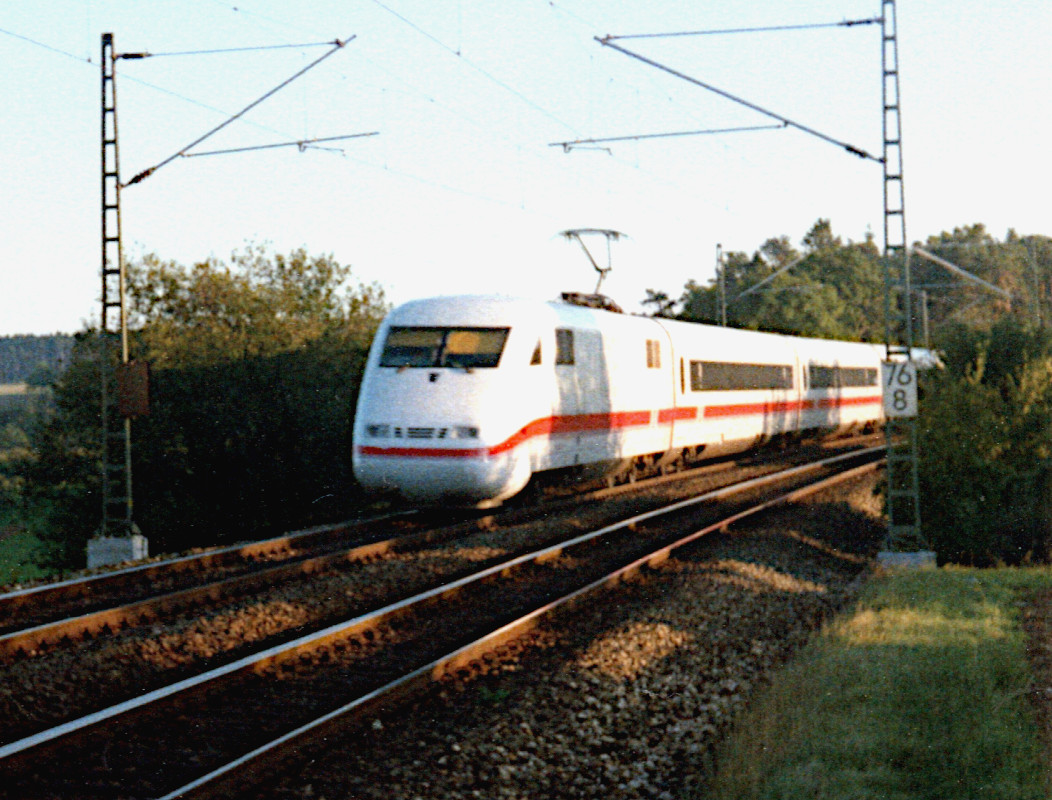 The new ICE Class 401 series, now known as InterCityExpress, entered regular service from June 1991 onwards.
Here a Class 401 ICE travels across the Swabian Alb, a hilly region in South Germany.
On this line the ICE could not really use its high speed capacity.
[Oct 1991].
The new ICE Class 401 series, now known as InterCityExpress, entered regular service from June 1991 onwards.
Here a Class 401 ICE travels across the Swabian Alb, a hilly region in South Germany.
On this line the ICE could not really use its high speed capacity.
[Oct 1991].
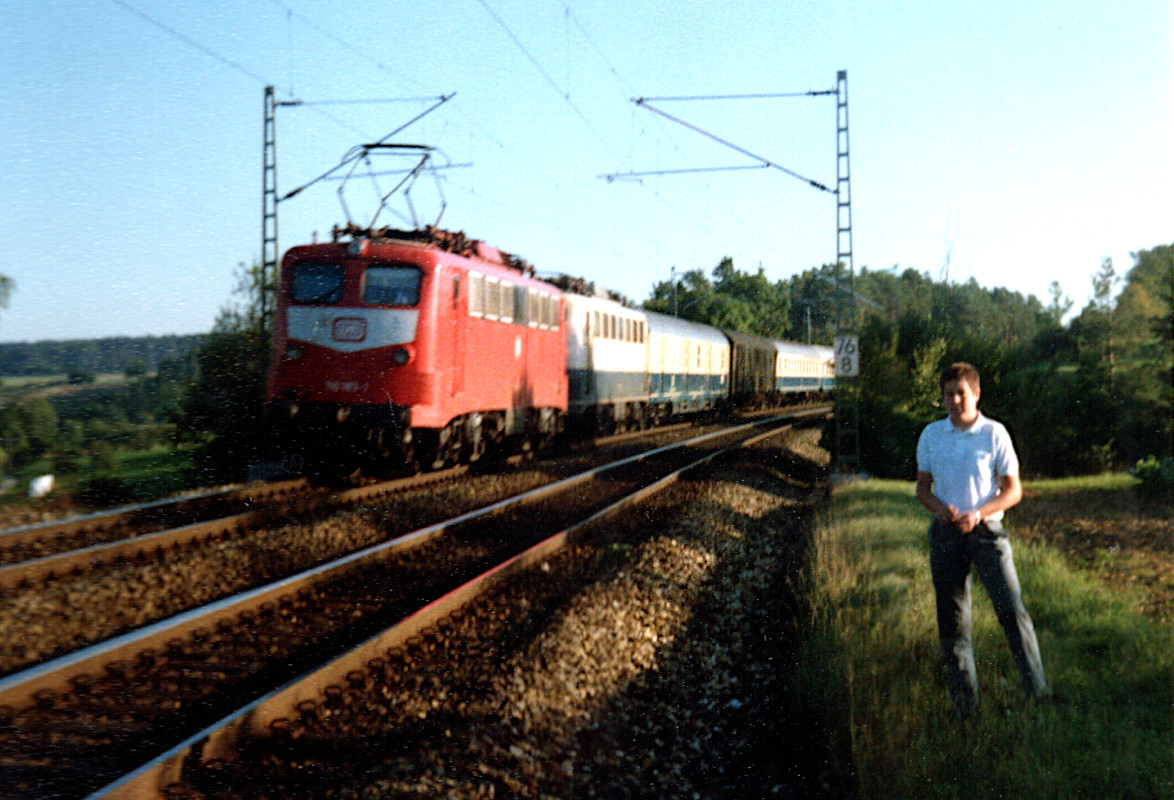 As a young railway enthusiast I'm on the photo myself.
On 3rd October 1991, the Day of German Unity, I was in Westerstetten for trainspotting.
A through train (Eilzug) with two Class 110 locomotives in different liveries, a postal van and a luggage van passed me here.
Today, Westerstetten Station is at this location.
[Oct 1991].
As a young railway enthusiast I'm on the photo myself.
On 3rd October 1991, the Day of German Unity, I was in Westerstetten for trainspotting.
A through train (Eilzug) with two Class 110 locomotives in different liveries, a postal van and a luggage van passed me here.
Today, Westerstetten Station is at this location.
[Oct 1991].
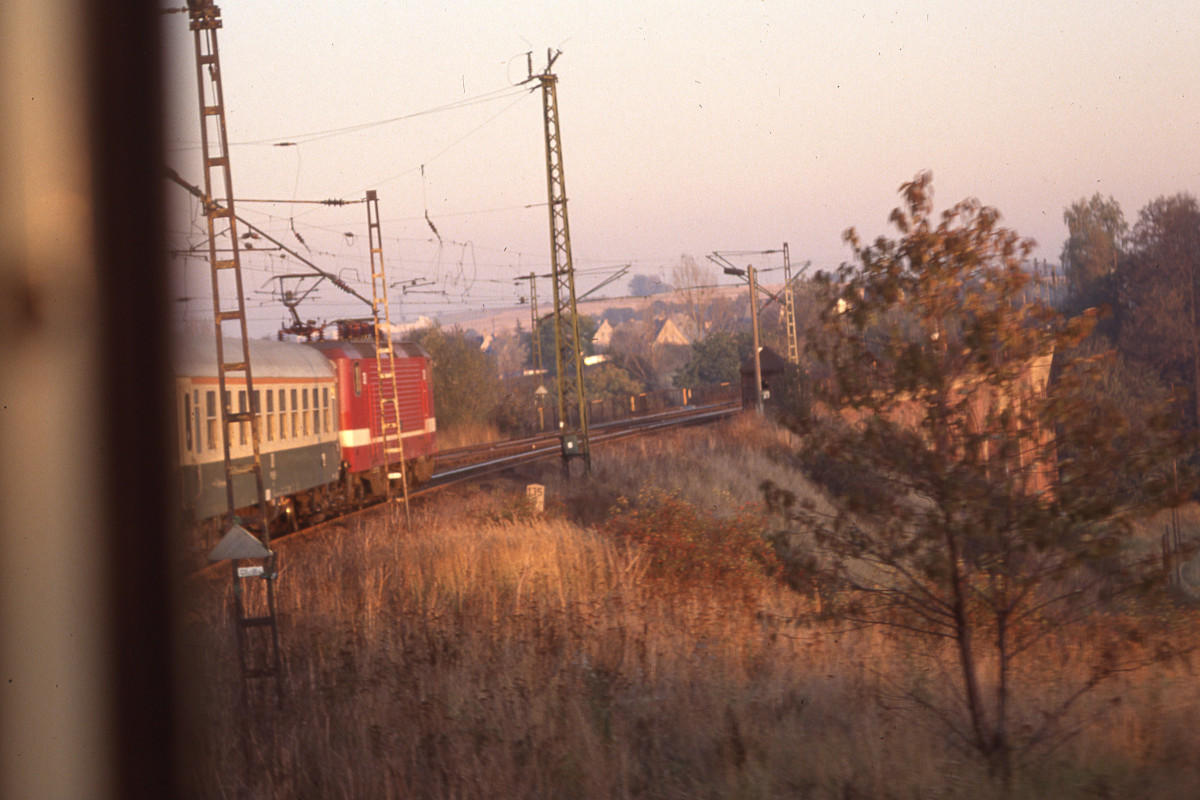 We visited the Eastern part of Germany in 1991.
A Class 243 electric locomotive hauled the long-distance train with carriages by Deutsche Reichsbahn as we entered the former East Germany.
[Oct 1991].
We visited the Eastern part of Germany in 1991.
A Class 243 electric locomotive hauled the long-distance train with carriages by Deutsche Reichsbahn as we entered the former East Germany.
[Oct 1991].
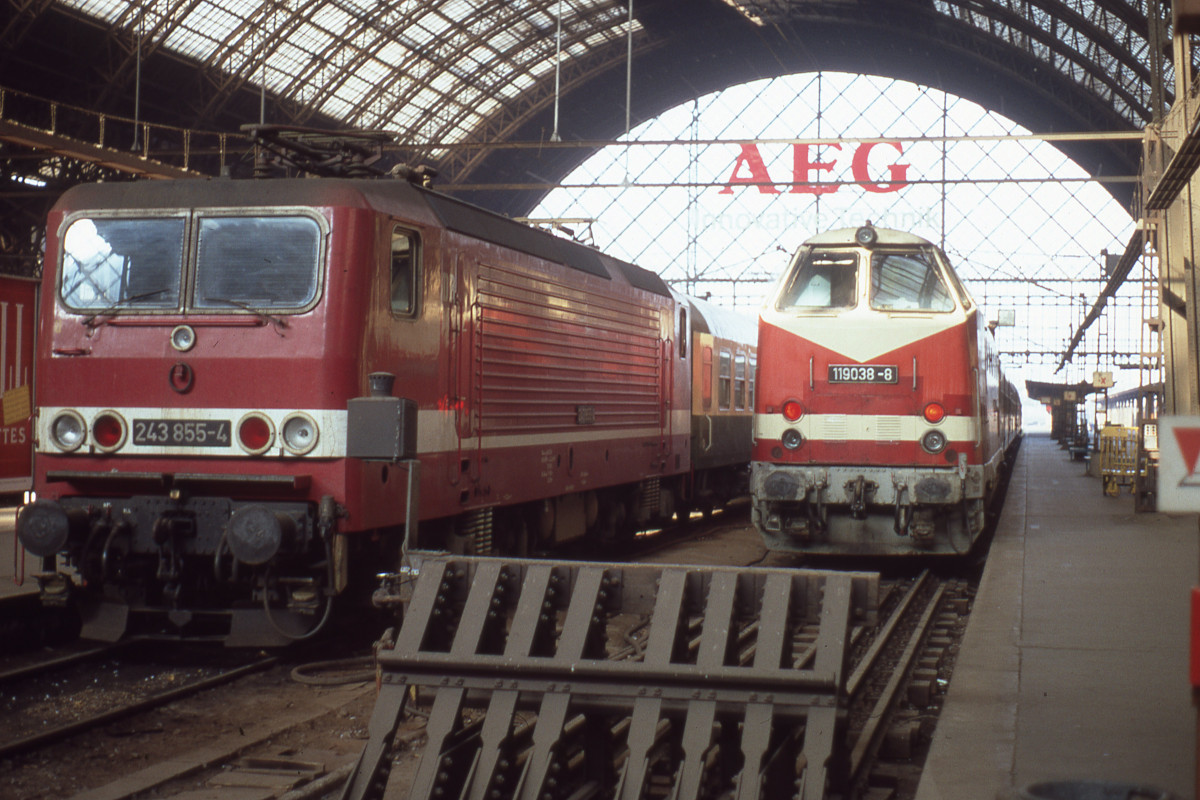 A Class 243 electric locomotive and a Class diesel loco stand in Dresden Main Station.
The numbering scheme of the Deutsche Reichsbahn differed from that of the Deutsche Bundesbahn.
Here in East Germany diesel locos began with the digit 1, while electric locos started with the digit 2.
[Oct 1991].
A Class 243 electric locomotive and a Class diesel loco stand in Dresden Main Station.
The numbering scheme of the Deutsche Reichsbahn differed from that of the Deutsche Bundesbahn.
Here in East Germany diesel locos began with the digit 1, while electric locos started with the digit 2.
[Oct 1991].
 The narrow gauge line between Radebeul and Radeburg was still operated by steam locomotives.
This is still the case today.
[Oct 1991].
The narrow gauge line between Radebeul and Radeburg was still operated by steam locomotives.
This is still the case today.
[Oct 1991].
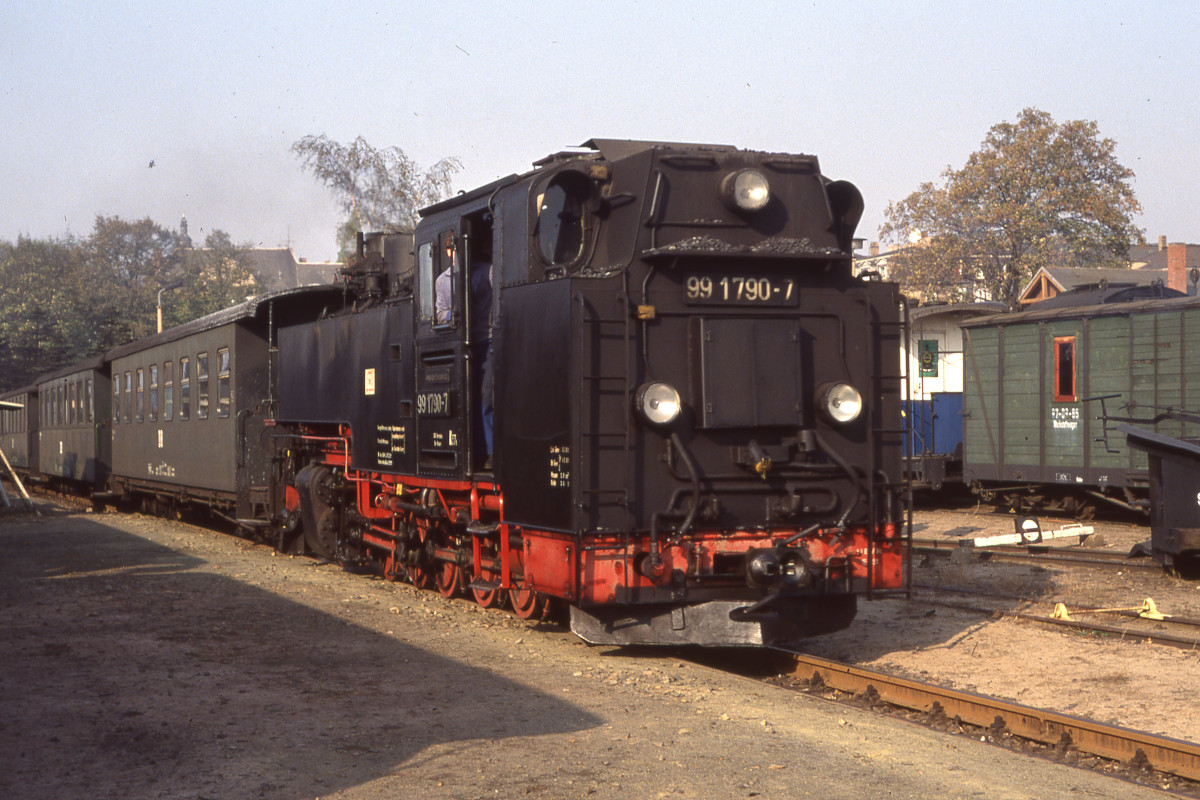 The Class 99.79 steam engines were built from 1952 to 1957 for 750 mm narrow gauge lines in Saxony.
They have been operating on this line since 1969,
At that time they were still operating for the Deutsche Reichsbahn.
[Oct 1991].
The Class 99.79 steam engines were built from 1952 to 1957 for 750 mm narrow gauge lines in Saxony.
They have been operating on this line since 1969,
At that time they were still operating for the Deutsche Reichsbahn.
[Oct 1991].
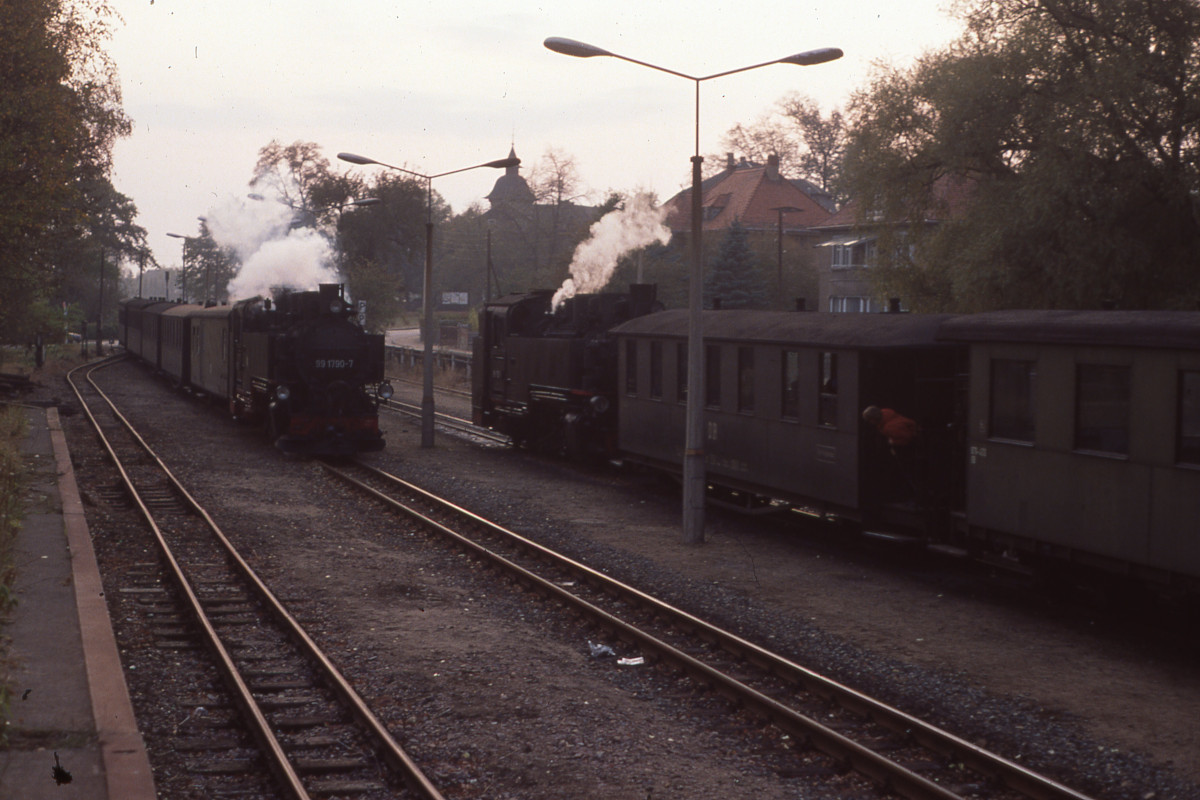 Two trains meet in Moritzburg station.
This happened here several times each day across the decades.
[Oct 1991].
Two trains meet in Moritzburg station.
This happened here several times each day across the decades.
[Oct 1991].
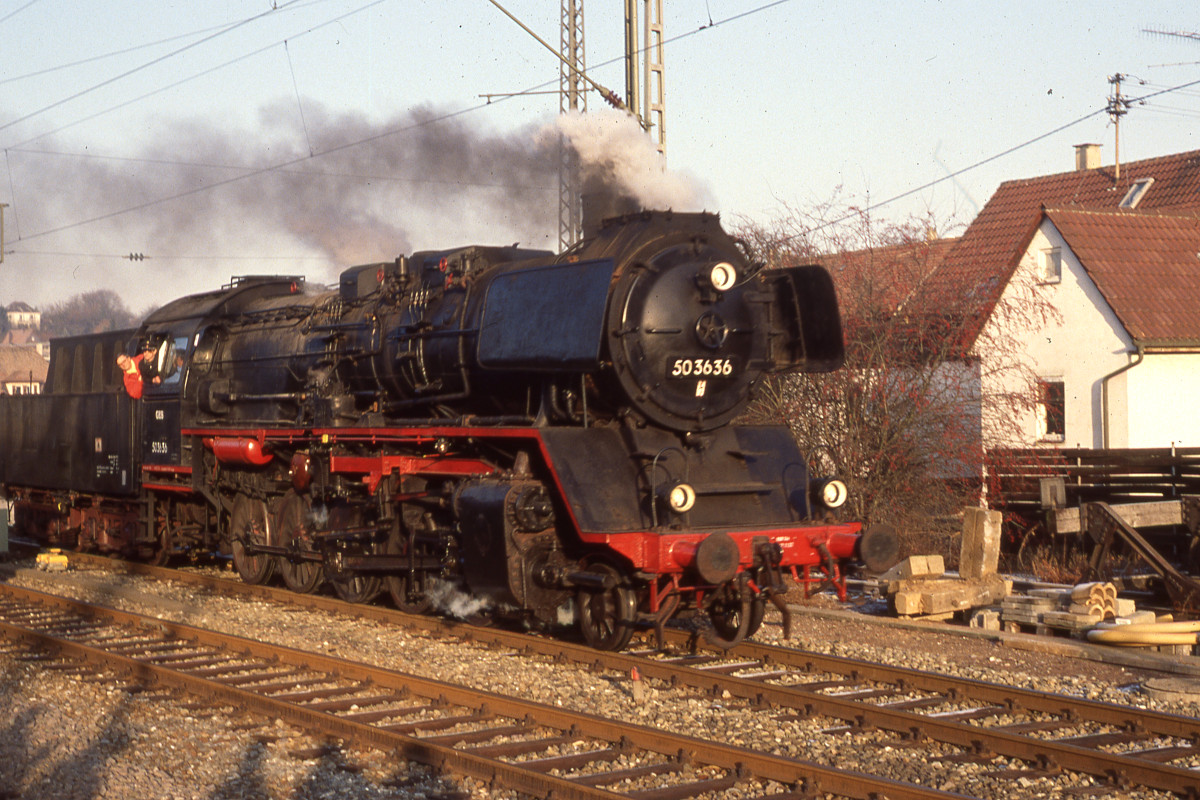 A Class 50 steam engine passes the platform in Nürtingen to couple onto its train to Neuffen.
This freight engine class entered service for the Deutsche Reichsbahn from 1939 onwards.
Locomotive 50 3636 was in service for the Deutsche Reichsbahn in East Germany until 10 December 1991.
Two days later it hauled a heritage train in West Germany.
[Dec 1991].
A Class 50 steam engine passes the platform in Nürtingen to couple onto its train to Neuffen.
This freight engine class entered service for the Deutsche Reichsbahn from 1939 onwards.
Locomotive 50 3636 was in service for the Deutsche Reichsbahn in East Germany until 10 December 1991.
Two days later it hauled a heritage train in West Germany.
[Dec 1991].
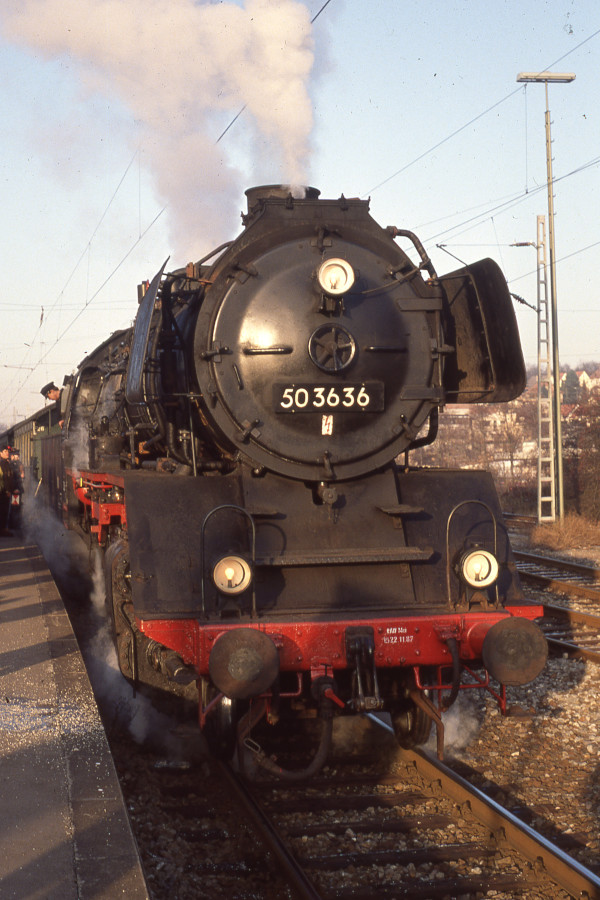 Locomotive 50 3636 was fitted with a new boiler and funnel in 1960.
The loco stands at the head of its train shortly before departure from Nürtingen.
[Dec 1991].
Locomotive 50 3636 was fitted with a new boiler and funnel in 1960.
The loco stands at the head of its train shortly before departure from Nürtingen.
[Dec 1991].
 At a time when the classic railbus was already becoming rare, this unit
was seen on a Saturday in Seckach, waiting for its duty to begin on Monday morning. [Apr 1992]
At a time when the classic railbus was already becoming rare, this unit
was seen on a Saturday in Seckach, waiting for its duty to begin on Monday morning. [Apr 1992]
 A class 795 railbus arrives in Altshausen on its way from Sigmaringen to Aulendorf.
[May 1992].
A class 795 railbus arrives in Altshausen on its way from Sigmaringen to Aulendorf.
[May 1992].
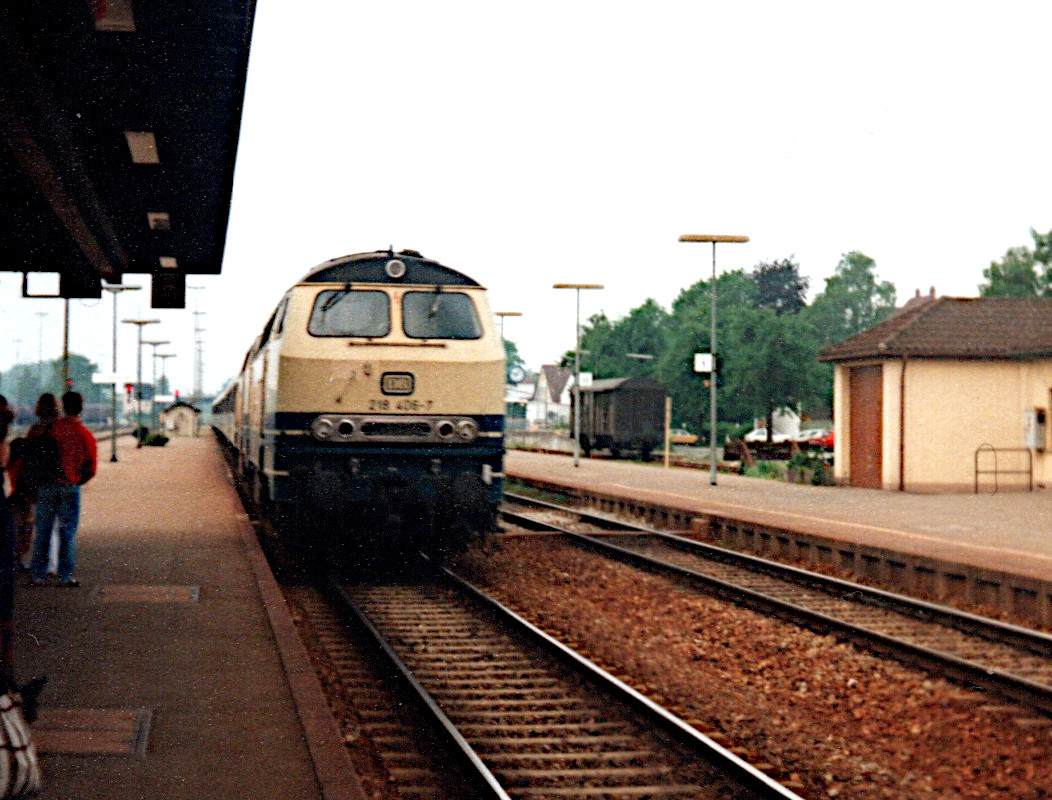 This was the typical train for me during my childhood: diesel-hydraulic locomotives at arrival in Aulendorf.
Two Class 218 locomotives haul an InterRegio train.
[May 1992].
This was the typical train for me during my childhood: diesel-hydraulic locomotives at arrival in Aulendorf.
Two Class 218 locomotives haul an InterRegio train.
[May 1992].
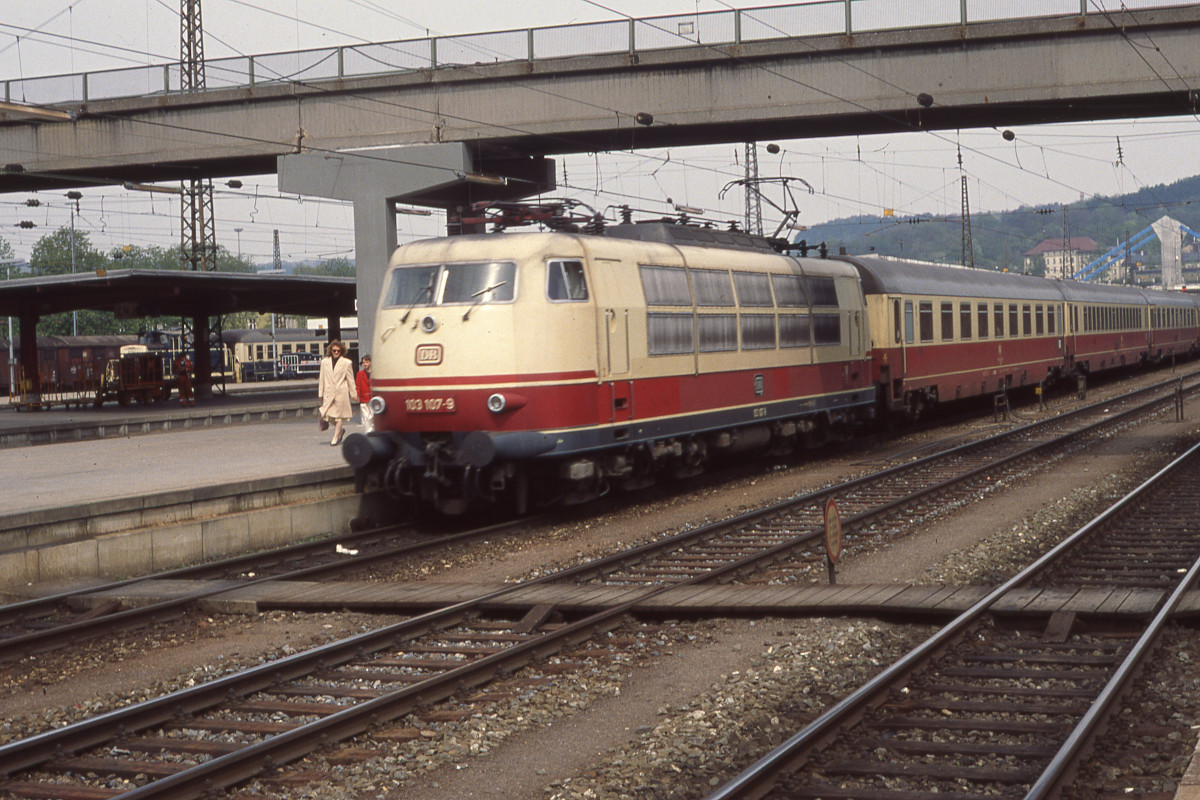 Class 103 electric locomotives also feature heavily in my memories.
This class hauled D-Zug, InterCity and InterRegio trains.
Here 103 107-9 arrived with an InterCity train in Ulm.
[Mai 1992].
Class 103 electric locomotives also feature heavily in my memories.
This class hauled D-Zug, InterCity and InterRegio trains.
Here 103 107-9 arrived with an InterCity train in Ulm.
[Mai 1992].
 In 2000 Hermann Frank was in Germany and also took a few railway photos.
On 1 January 1994 the Deutsche Bundesbahn from the former West Germany and the Deutsche Reichsbahn from the former
East Germany merged to form Deutsche Bahn.
The new logo also was a merging of the former logos.
In new livery and with the new logo class 110 electric locomotive hauls a train in Hochspeyer.
[2000].
In 2000 Hermann Frank was in Germany and also took a few railway photos.
On 1 January 1994 the Deutsche Bundesbahn from the former West Germany and the Deutsche Reichsbahn from the former
East Germany merged to form Deutsche Bahn.
The new logo also was a merging of the former logos.
In new livery and with the new logo class 110 electric locomotive hauls a train in Hochspeyer.
[2000].
 Locomotives from the former Easter Germany were now also seen in West Germany.
After relying on diesel and steam power for many years the Deutsche Reichsbahn of
East Germany started electrification on a large scale in the 1980s. The engine developed
for this was the mixed traffic loco class 243. It was built in large numbers,
even after the unification of Germany and now bears the number 143.
This class 143 engine is seen in Hochspeyer with a rake of double-storey carriages.
[2000].
Locomotives from the former Easter Germany were now also seen in West Germany.
After relying on diesel and steam power for many years the Deutsche Reichsbahn of
East Germany started electrification on a large scale in the 1980s. The engine developed
for this was the mixed traffic loco class 243. It was built in large numbers,
even after the unification of Germany and now bears the number 143.
This class 143 engine is seen in Hochspeyer with a rake of double-storey carriages.
[2000].
 Deutsche Bahn also placed in service some new vehicles, such as this class 643 diesel railcar.
It is based on the Bombardier Talent series.
One of the railcars is seen in Bad Münster.
[2000].
Deutsche Bahn also placed in service some new vehicles, such as this class 643 diesel railcar.
It is based on the Bombardier Talent series.
One of the railcars is seen in Bad Münster.
[2000].
 Deutsche Bahn introduced push-pull operations for long distance trains in 1995.
Before that push-pull trains had only been used for local traffic in Germany.
The driving trailers were rebuilt from relatively new carriages and had a very distinctive front.
One of these driving trailers is seen in Mühlacker.
[2000].
Deutsche Bahn introduced push-pull operations for long distance trains in 1995.
Before that push-pull trains had only been used for local traffic in Germany.
The driving trailers were rebuilt from relatively new carriages and had a very distinctive front.
One of these driving trailers is seen in Mühlacker.
[2000].
 The Karlsruhe modell became well known by linking trams and railway together.
Light rail vehicles were equipped to operate on both railway lines and local tram lines, providing
seamless connections between the surrounding area and Karlsruhe and other nearby cities and towns.
Here a multi-system train of the AVG in Pforzheim.
In the background a class 628 diesel railcar can be seen in its original livery.
[2000].
The Karlsruhe modell became well known by linking trams and railway together.
Light rail vehicles were equipped to operate on both railway lines and local tram lines, providing
seamless connections between the surrounding area and Karlsruhe and other nearby cities and towns.
Here a multi-system train of the AVG in Pforzheim.
In the background a class 628 diesel railcar can be seen in its original livery.
[2000].
 Here's a visitor from Italy in Stuttgart.
Cisalpino operated international trains between Italy through Switzerland to Germany.
It was a joint company between the Swiss SBB and the Italian FS.
These class 470 Pendolino trains were built in Italy by Fiat and were not reliable.
[2000].
Here's a visitor from Italy in Stuttgart.
Cisalpino operated international trains between Italy through Switzerland to Germany.
It was a joint company between the Swiss SBB and the Italian FS.
These class 470 Pendolino trains were built in Italy by Fiat and were not reliable.
[2000].
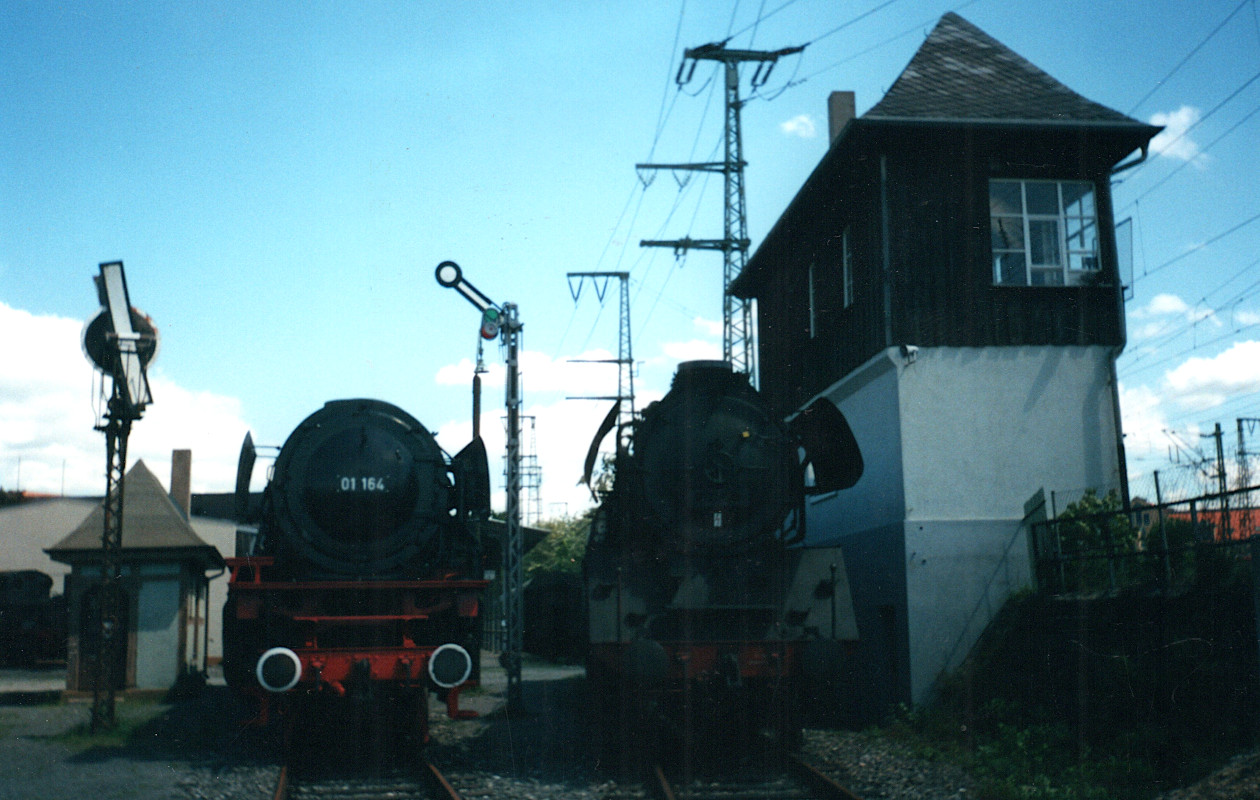 In 2002 I returned to Germnany for the first time.
On that occasion I was at the DB-Museum in Nuremberg.
Two steam locomotives stand side by side, one of them Class 01, the other Class 50, as it was rebuilt by the Deutsche Reichsbahn.
[May 2002].
In 2002 I returned to Germnany for the first time.
On that occasion I was at the DB-Museum in Nuremberg.
Two steam locomotives stand side by side, one of them Class 01, the other Class 50, as it was rebuilt by the Deutsche Reichsbahn.
[May 2002].
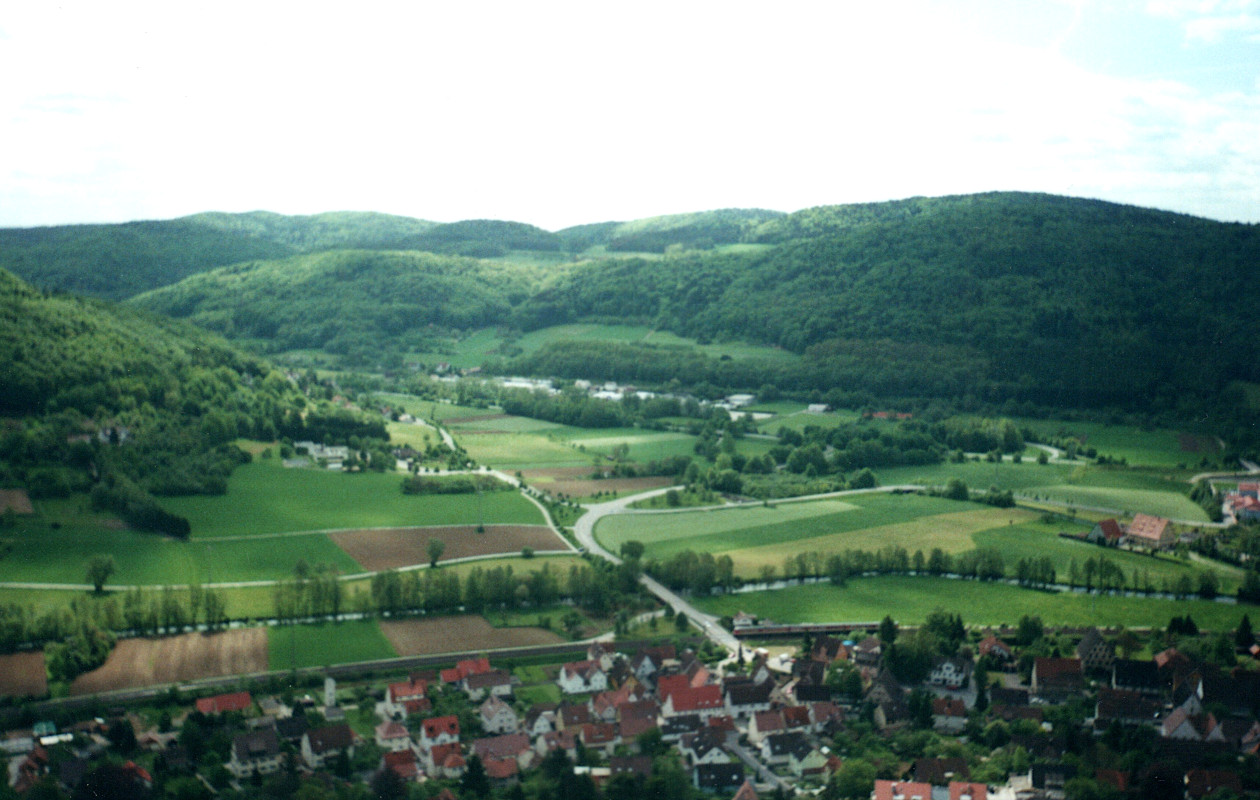 The railway line from Nuremberg to north-east Bavaria and East Germany passes through the Pegnitz Valley.
From the heights on the shores one has a good view of the trains travelling along the valley.
Here is a train near the river Pegnitz.
[May 2002].
The railway line from Nuremberg to north-east Bavaria and East Germany passes through the Pegnitz Valley.
From the heights on the shores one has a good view of the trains travelling along the valley.
Here is a train near the river Pegnitz.
[May 2002].
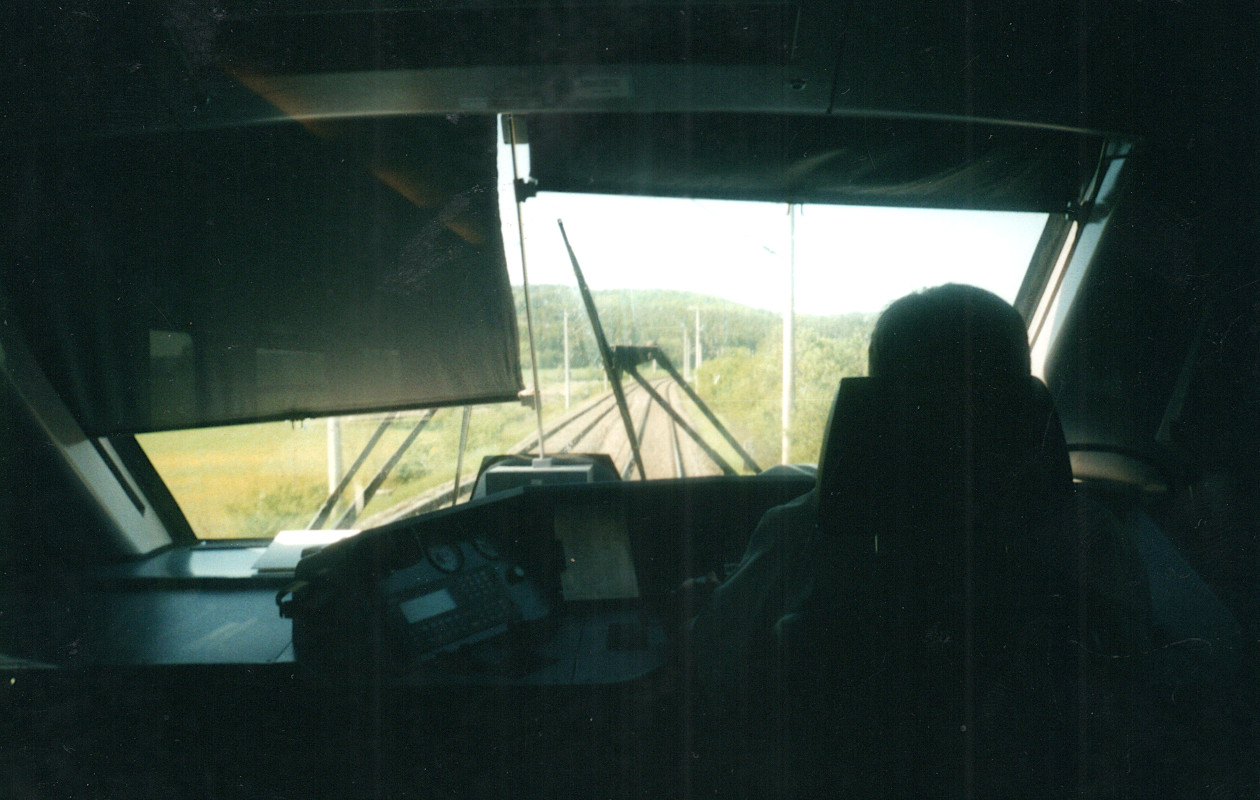 During the journey with the InterCity train from Nuremberg to Stuttgart a driving trailer was at the head of the train.
I was able to look over the shoulder of the engine driver.
[May 2002].
During the journey with the InterCity train from Nuremberg to Stuttgart a driving trailer was at the head of the train.
I was able to look over the shoulder of the engine driver.
[May 2002].
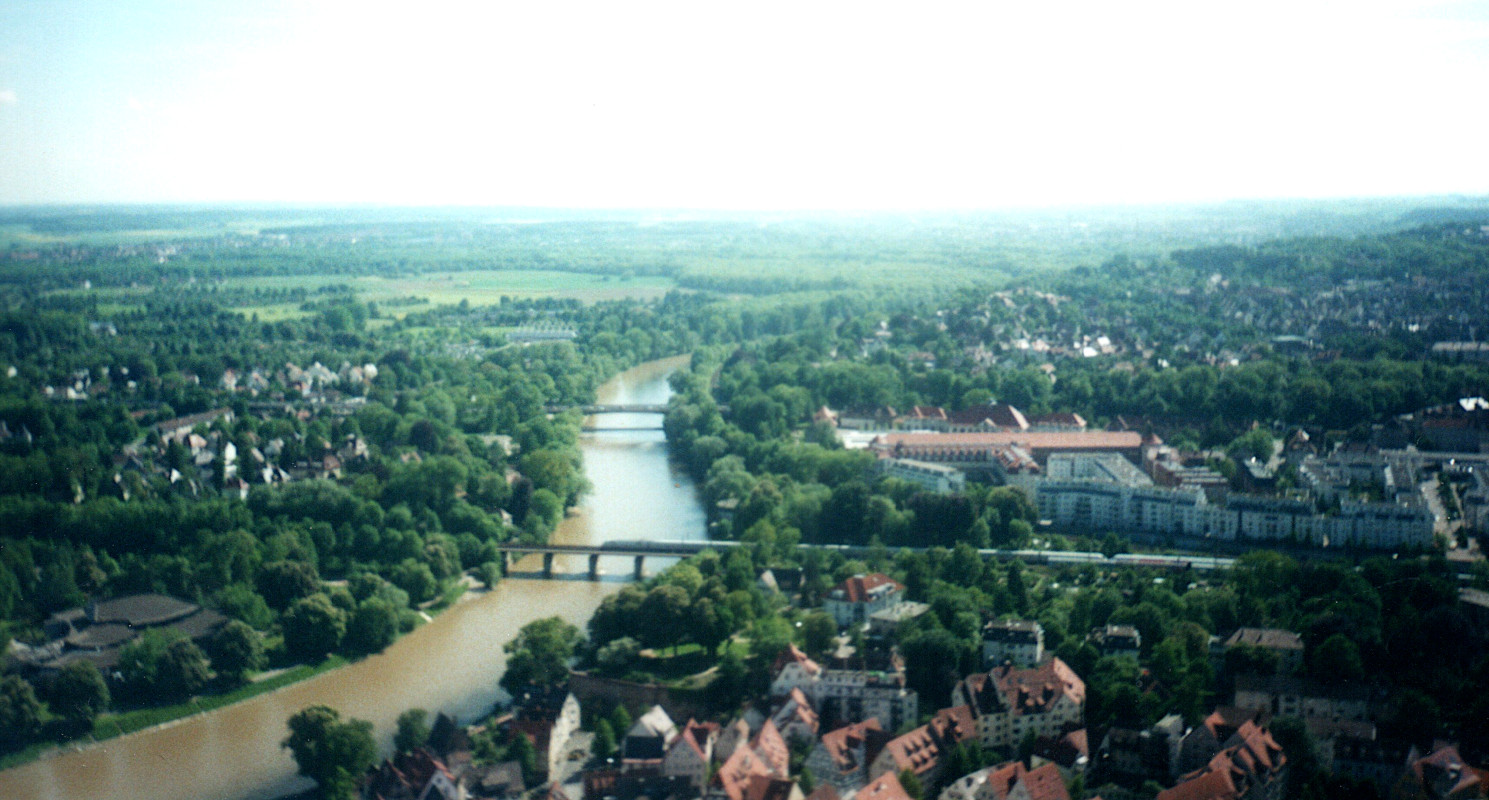 From the church tower of the Ulm Minster, the highest church tower of the world, there's a good view over the city of Ulm and adjacent area.
I also saw a train of twin ICE-3 units crossing the bridge across the Danube from Ulm to Neu-Ulm.
[May 2002].
From the church tower of the Ulm Minster, the highest church tower of the world, there's a good view over the city of Ulm and adjacent area.
I also saw a train of twin ICE-3 units crossing the bridge across the Danube from Ulm to Neu-Ulm.
[May 2002].
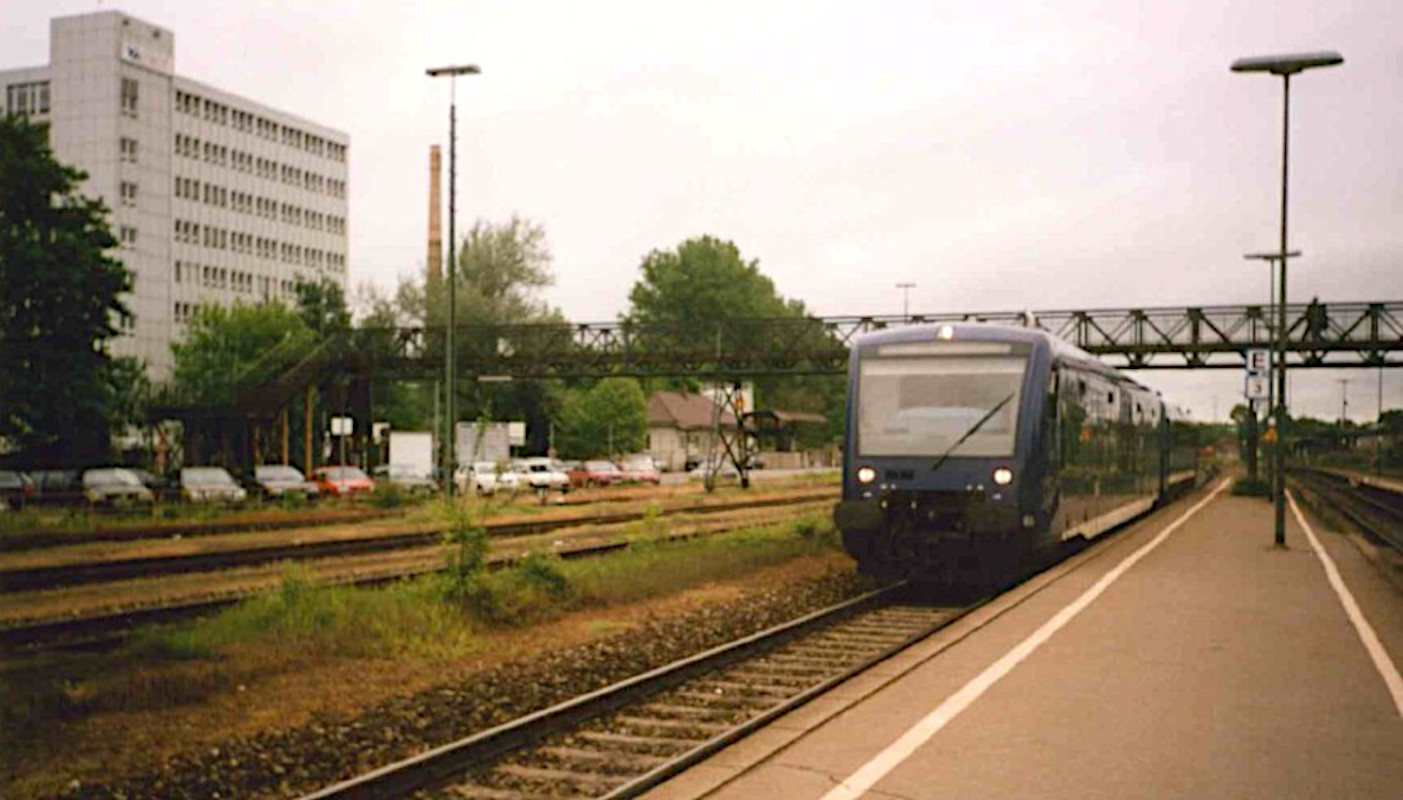 In 1993 a new railway company began operating in Oberschwaben - the Bodensee-Oberschwaben-Bahn (BOB).
When I lived there, there were talks and initial planning, but not the realisation of all that planning.
I have never really experienced it, even though it was a childhood dream having such a railway company nearby.
A BOB train, consisting of a RegioSprinter railcar and NE 81 railcars, arrives in Ravensburg.
[May 2002].
In 1993 a new railway company began operating in Oberschwaben - the Bodensee-Oberschwaben-Bahn (BOB).
When I lived there, there were talks and initial planning, but not the realisation of all that planning.
I have never really experienced it, even though it was a childhood dream having such a railway company nearby.
A BOB train, consisting of a RegioSprinter railcar and NE 81 railcars, arrives in Ravensburg.
[May 2002].
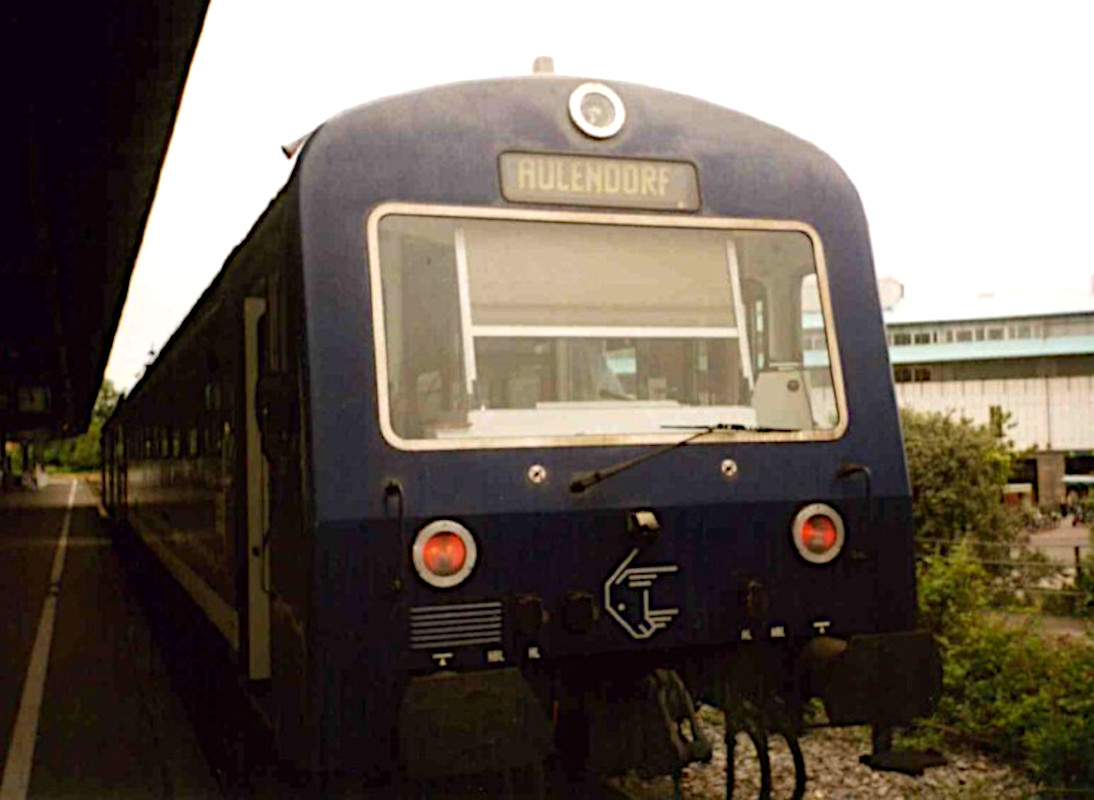 NE 81 railcars were built from 1981 onwards by Waggon Union in Berlin.
The BOB railcars were delivered in 1983 to the Hohenzollerische Landesbahn.
They were operated at the BOB together with the RegioSprinter railcars.
Here is one of the NE 81 railcars at the station Friedrichshafen Hafen, from where it is about to depart to Aulendorf.
[May 2002].
NE 81 railcars were built from 1981 onwards by Waggon Union in Berlin.
The BOB railcars were delivered in 1983 to the Hohenzollerische Landesbahn.
They were operated at the BOB together with the RegioSprinter railcars.
Here is one of the NE 81 railcars at the station Friedrichshafen Hafen, from where it is about to depart to Aulendorf.
[May 2002].
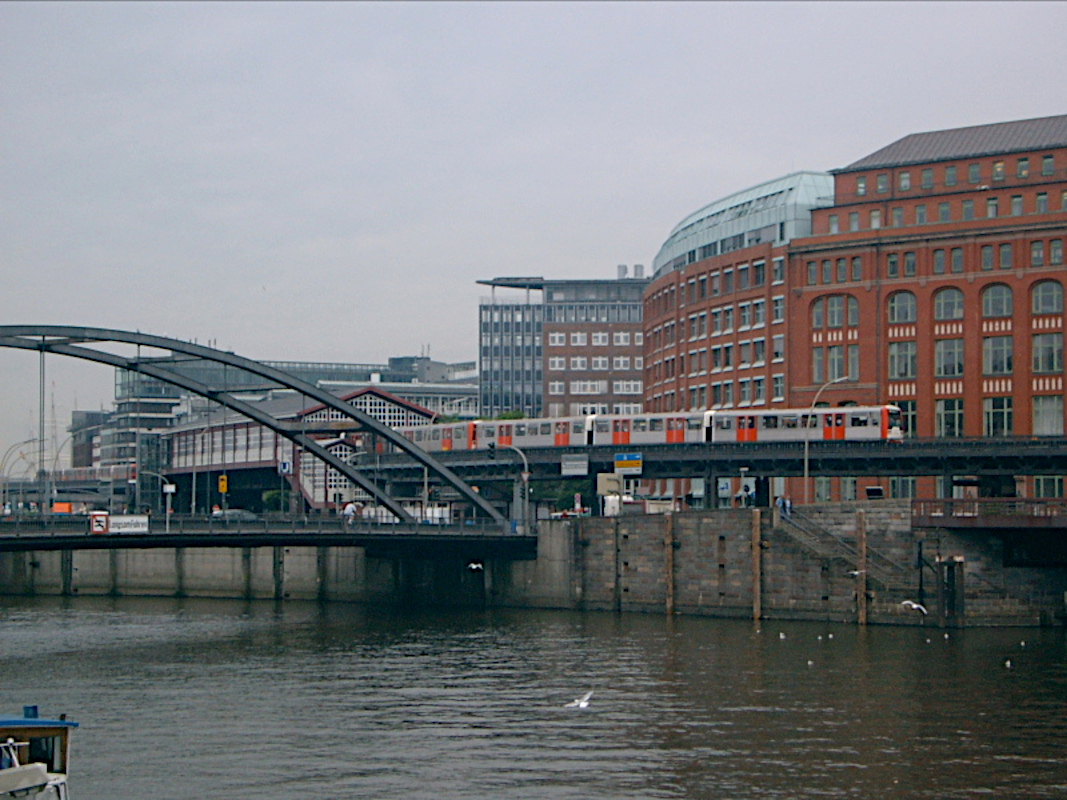
 The U-Bahn transports people around central Hamburg. It's just not that clear what the U
stands for, as in large parts the U-Bahn actually travels on girders above the
streets. The famous church of St Michael provides a fitting backdrop to a train on
its round near the river Elbe. [Jul 2005]
The U-Bahn transports people around central Hamburg. It's just not that clear what the U
stands for, as in large parts the U-Bahn actually travels on girders above the
streets. The famous church of St Michael provides a fitting backdrop to a train on
its round near the river Elbe. [Jul 2005]
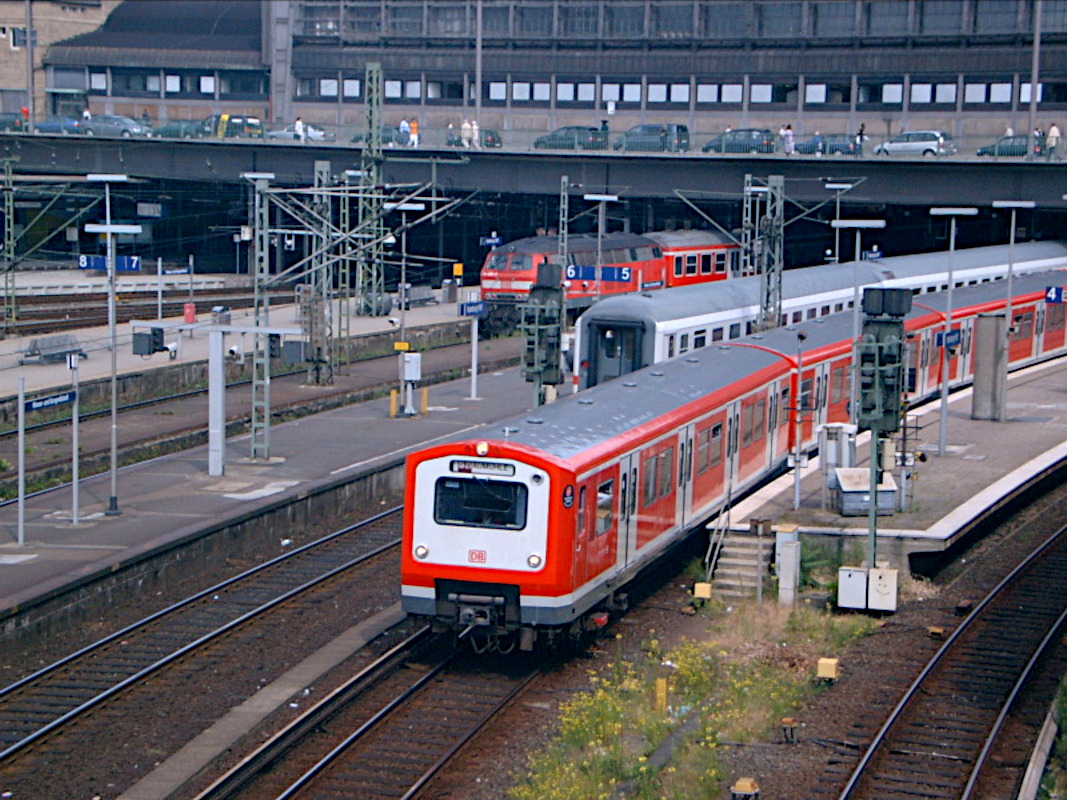 The S-Bahn connects the suburbs of Hamburg.
Here is a Class 472 train in Hamburg Main Station.
These units were produced in two series, the first one between 1974 and 1976, the second between 1982 and 1984.
[Jul 2005].
The S-Bahn connects the suburbs of Hamburg.
Here is a Class 472 train in Hamburg Main Station.
These units were produced in two series, the first one between 1974 and 1976, the second between 1982 and 1984.
[Jul 2005].
 In many other cities in Germany, S-Bahn trains
draw electricity from overhead catenary lines, but in Hamburg it is supplied through
a third rail. In recent years Deutsche Bahn, the operator of Hamburg's S-Bahn has
invested in new rolling stock. A Class 474 train approaches Neugraben in the south of Hamburg.
[Jul 2005]
In many other cities in Germany, S-Bahn trains
draw electricity from overhead catenary lines, but in Hamburg it is supplied through
a third rail. In recent years Deutsche Bahn, the operator of Hamburg's S-Bahn has
invested in new rolling stock. A Class 474 train approaches Neugraben in the south of Hamburg.
[Jul 2005]
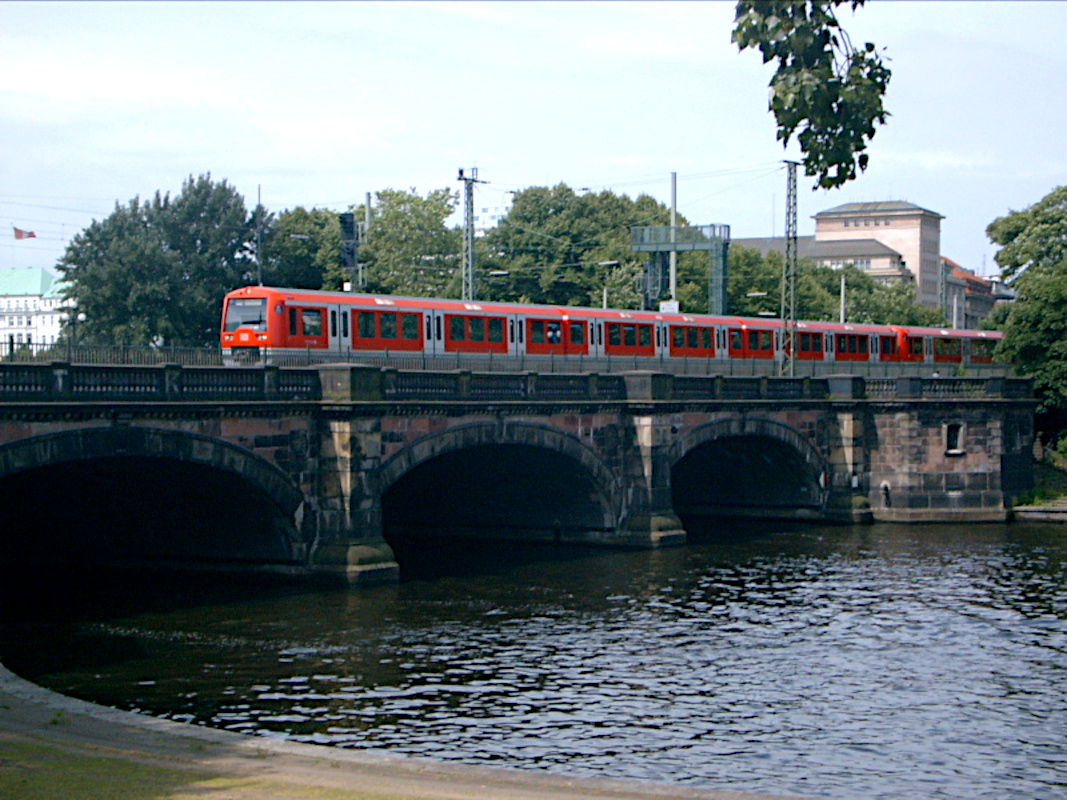 From 1996 onwards German Railways received new modern Class 474 railcars for the Hamburg S-Bahn.
A train consisting of two units crosses the River Alster.
[Jul 2005].
From 1996 onwards German Railways received new modern Class 474 railcars for the Hamburg S-Bahn.
A train consisting of two units crosses the River Alster.
[Jul 2005].
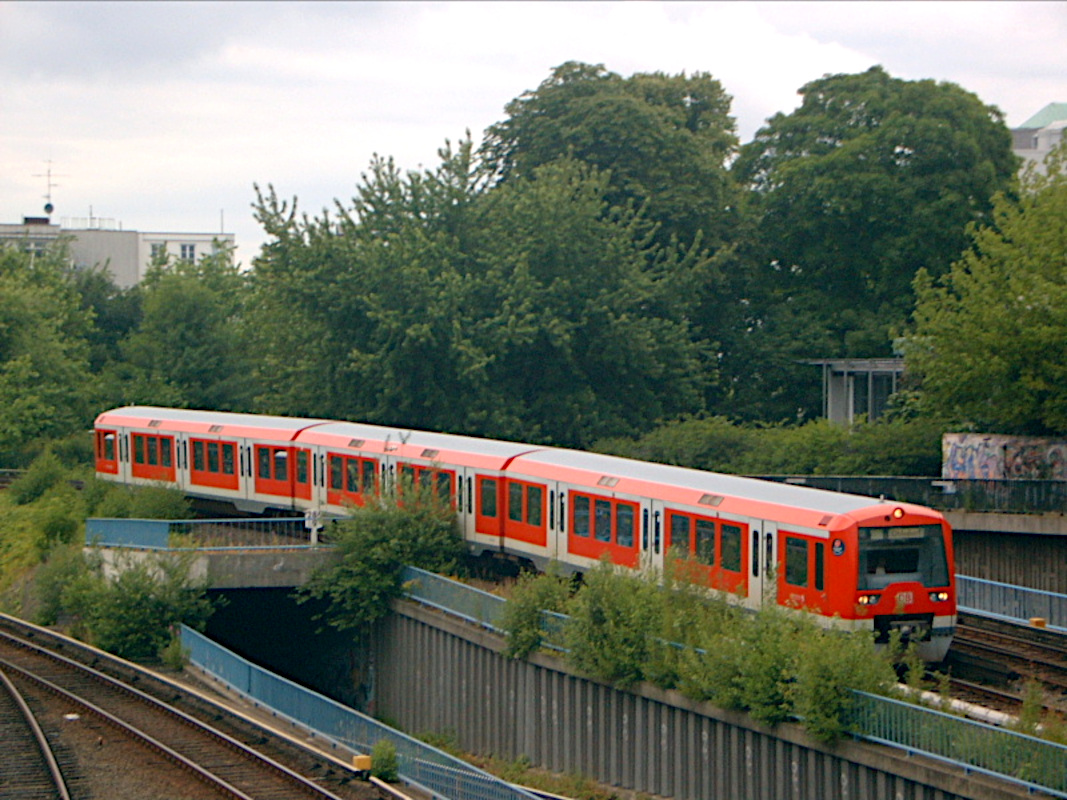 Together U-Bahn and S-Bahn provide a good core network for Hamburg and surrounding districts.
A Class 474 railcar near Hamburg Main Station.
[Jul 2005].
Together U-Bahn and S-Bahn provide a good core network for Hamburg and surrounding districts.
A Class 474 railcar near Hamburg Main Station.
[Jul 2005].
 As many of the lines around Hamburg are not electrified most regional traffic is handled
by diesel-hydraulic locomotives with push-pull consists. These regional express
trains connect the urban area of Hamburg with the towns and rural areas in the
wider region. Here a class 218 loco brings her train into the station of
the historic town of Buxtehude. [Jul 2005]
As many of the lines around Hamburg are not electrified most regional traffic is handled
by diesel-hydraulic locomotives with push-pull consists. These regional express
trains connect the urban area of Hamburg with the towns and rural areas in the
wider region. Here a class 218 loco brings her train into the station of
the historic town of Buxtehude. [Jul 2005]
 Around 1800 the writer Matthias Claudius lived here. From 1771 to 1775 he was
editor of the magazine Wandsbecker Bothe. A critic of modernity he nevertheless
engaged with the ideas of his time. He combined an emphasis on family life and
a celebration of the simple with a questioning mind that did not readily
accept new certainties.
Around 1800 the writer Matthias Claudius lived here. From 1771 to 1775 he was
editor of the magazine Wandsbecker Bothe. A critic of modernity he nevertheless
engaged with the ideas of his time. He combined an emphasis on family life and
a celebration of the simple with a questioning mind that did not readily
accept new certainties. A class 218 accelerates her train out of the station of Wandsbek towards Hamburg. [Jul 2005]
 Some regional trains are also hauled by electric locomotives. When I was in
Hamburg, the Nord-Ostsee-Bahn (NOB) had taken over regional expresses
between Hamburg and Padborg (Denmark) via Flensburg. Previously they were operated
by FLEX, but when this venture went bankrupt, NOB took over
the rolling stock and continued the service. The trains now also included
some older carriages. The class 185 engine was developed for Deutsche Bahn, but is
now built for railways throughout Europe. [Jul 2005]
Some regional trains are also hauled by electric locomotives. When I was in
Hamburg, the Nord-Ostsee-Bahn (NOB) had taken over regional expresses
between Hamburg and Padborg (Denmark) via Flensburg. Previously they were operated
by FLEX, but when this venture went bankrupt, NOB took over
the rolling stock and continued the service. The trains now also included
some older carriages. The class 185 engine was developed for Deutsche Bahn, but is
now built for railways throughout Europe. [Jul 2005]
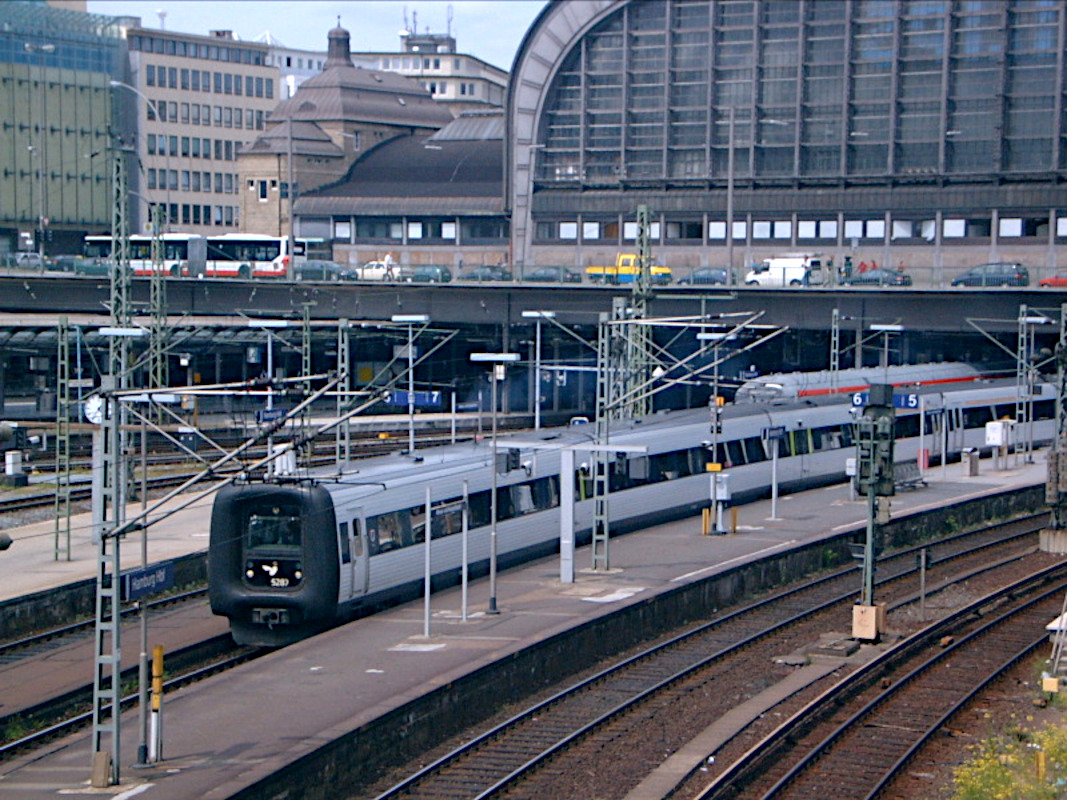 Diesel trains were also used on some long-distance routes, for example this IC3 train belonging to the Danish State Railways DSB.
It is leaving Hamburg Main Station towards Denmark.
This type of train also operated in Israel - see my page on railways in Israel.
[Jul 2005].
Diesel trains were also used on some long-distance routes, for example this IC3 train belonging to the Danish State Railways DSB.
It is leaving Hamburg Main Station towards Denmark.
This type of train also operated in Israel - see my page on railways in Israel.
[Jul 2005].
 In those days class 101 locomotives hauled the majority of InterCity trains. They replaced
the classic 103 locos. Here an InterCity crosses the bridge over the river Alster in
Hamburg. [Jul 2005]
In those days class 101 locomotives hauled the majority of InterCity trains. They replaced
the classic 103 locos. Here an InterCity crosses the bridge over the river Alster in
Hamburg. [Jul 2005]
 On dedicated high speed lines these trains can accelerate to over 250 km/h. Still
on some of the older lines these trains cannot fully utilise their capabilities.
The line between Stuttgart and Ulm over the Schwäbische Alb still dates from
the 19th century and is not suitable for high speed running with many curves and steep
gradients. Here a train of two ICE-2 units (class 402) is climbing up the ramp near Geislingen
to get over the mountain range. [Jul 2005]
On dedicated high speed lines these trains can accelerate to over 250 km/h. Still
on some of the older lines these trains cannot fully utilise their capabilities.
The line between Stuttgart and Ulm over the Schwäbische Alb still dates from
the 19th century and is not suitable for high speed running with many curves and steep
gradients. Here a train of two ICE-2 units (class 402) is climbing up the ramp near Geislingen
to get over the mountain range. [Jul 2005]
 The InterCity Express heading in the oppossite direction is made up of two ICE-3 units (class 403).
One can clearly hear the wheel flanges guiding the trainset round the curves as it
descends towards Geislingen.
The InterCity Express heading in the oppossite direction is made up of two ICE-3 units (class 403).
One can clearly hear the wheel flanges guiding the trainset round the curves as it
descends towards Geislingen.
These new units have the power distributed over the entire train, so that not only the driving unit is motorised, as in the older sets. [Jul 2005]
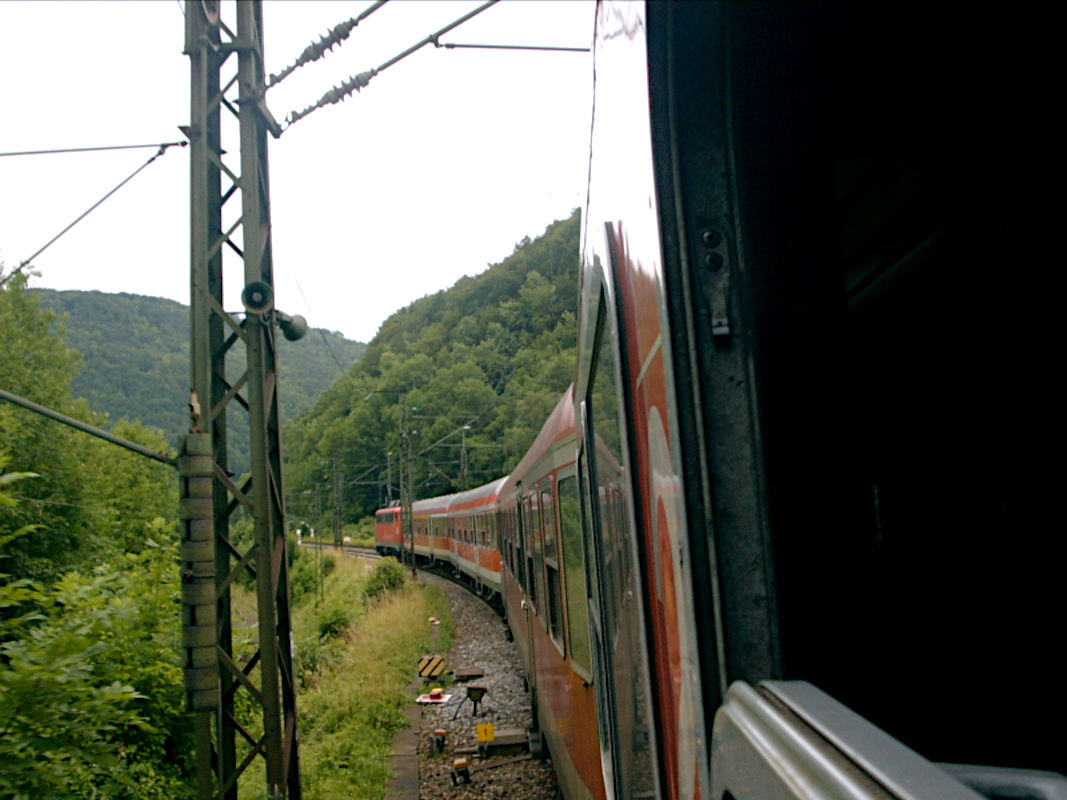

 For heavy freight trains the ramp at Geislingen can still be a real barrier.
Some trains even require a banker.
But the powerful class 151 loco can manage to haul lighter trains up the gradient
by itself. Here one of the class leads a train up the ramp. The engine already
sports the new Railion logo. This subsidiary of Deutsche Bahn operated freight
trains in Germany and beyond for some years. [Jul 2005]
For heavy freight trains the ramp at Geislingen can still be a real barrier.
Some trains even require a banker.
But the powerful class 151 loco can manage to haul lighter trains up the gradient
by itself. Here one of the class leads a train up the ramp. The engine already
sports the new Railion logo. This subsidiary of Deutsche Bahn operated freight
trains in Germany and beyond for some years. [Jul 2005]
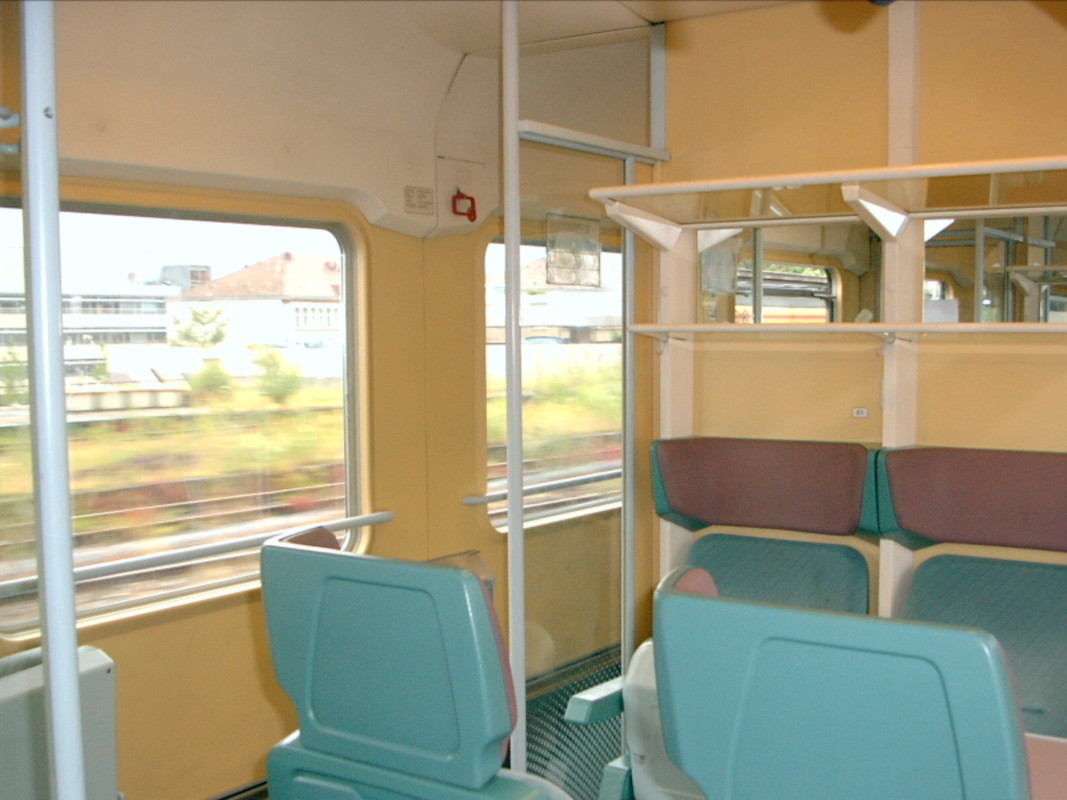
 A class 143 loco has just arrived in Lauda, pushing her regional express from
Stuttgart to Nuremberg. It's notable that even in this important junction, there are
now underpasses, but people walk across the railway lines to reach the different platforms.
A station employee closes a bar across the walkway if a train is expected. [Jul 2005]
A class 143 loco has just arrived in Lauda, pushing her regional express from
Stuttgart to Nuremberg. It's notable that even in this important junction, there are
now underpasses, but people walk across the railway lines to reach the different platforms.
A station employee closes a bar across the walkway if a train is expected. [Jul 2005]
 The main series of this class was developed in the 1980s. The railcars consist of a motor
unit (class 628) and a driving trailer (class 928).
Two units coupled together arrive in Crailsheim.
[Jul 2005].
The main series of this class was developed in the 1980s. The railcars consist of a motor
unit (class 628) and a driving trailer (class 928).
Two units coupled together arrive in Crailsheim.
[Jul 2005].
 By now the Class 628 railcars have the red local livery of Deutsche Bahn.
These are air-conditioned racilars, have seating
in both 1st and 2nd class and a luggage compartment.
By now the Class 628 railcars have the red local livery of Deutsche Bahn.
These are air-conditioned racilars, have seating
in both 1st and 2nd class and a luggage compartment.
Two trains meet in Schrozberg on the line between Crailsheim and Lauda. [Jul 2005].
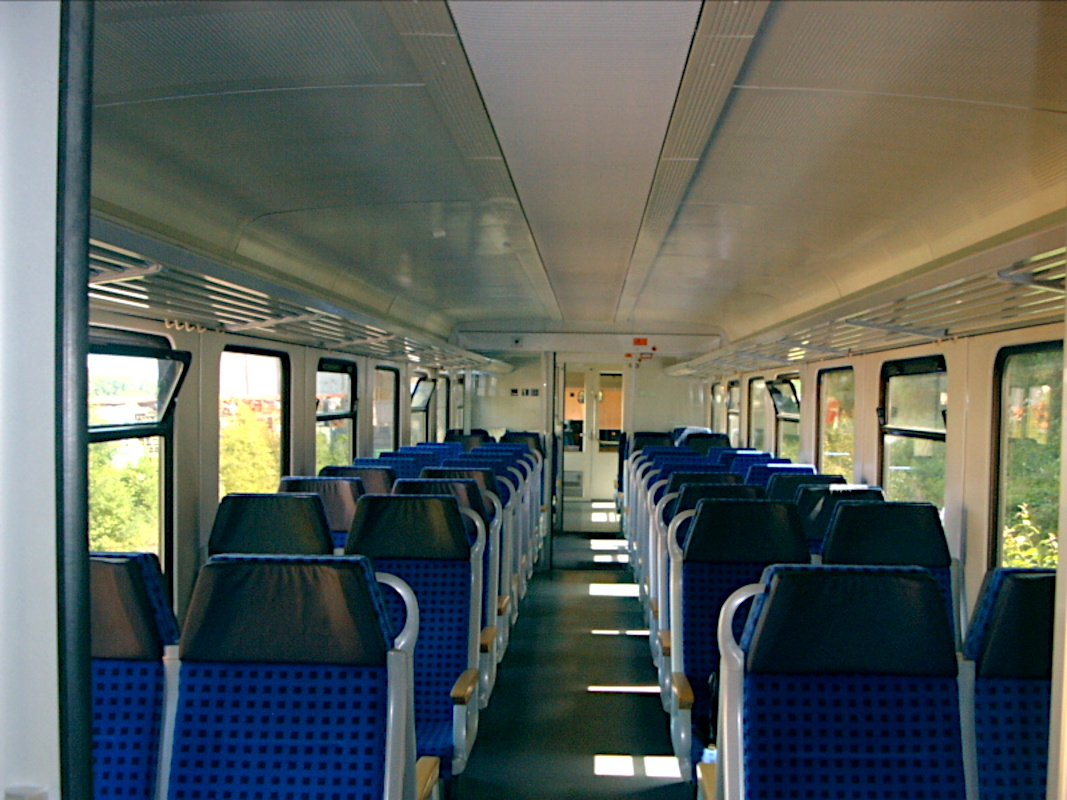 The interior of many Class 628 railcars was also brought up to new standards.
Many received the DB design with white sides and blue seats.
[Jul 2005].
The interior of many Class 628 railcars was also brought up to new standards.
Many received the DB design with white sides and blue seats.
[Jul 2005].
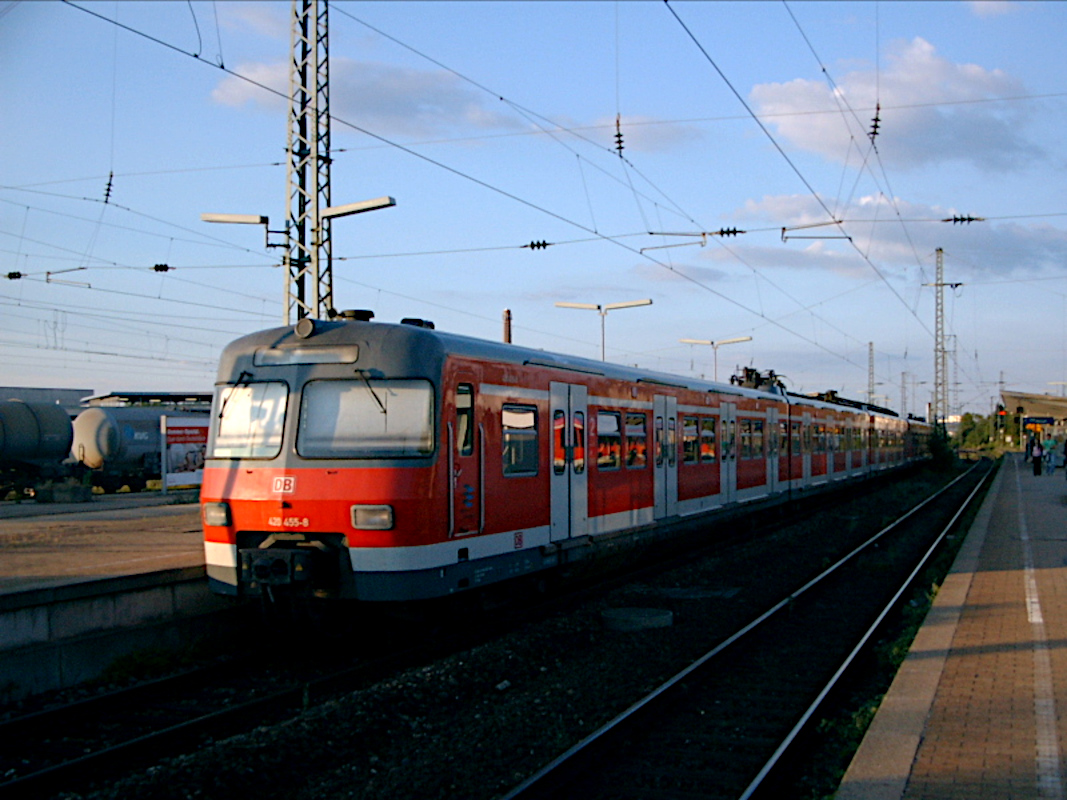 The newer S-Bahn systems in Germany normally use trains that get their electricity from overhead catenary at the normal voltage.
Class 420 trains were used at the S-Bahn in Munich, Stuttgart and Frankfurt.
A Class 420 train is in Bietigheim-Bissingen in the colours of Deutsche Bahn.
[Jul 2005].
The newer S-Bahn systems in Germany normally use trains that get their electricity from overhead catenary at the normal voltage.
Class 420 trains were used at the S-Bahn in Munich, Stuttgart and Frankfurt.
A Class 420 train is in Bietigheim-Bissingen in the colours of Deutsche Bahn.
[Jul 2005].
 Closer to big cities an even better system has been developed using electric tram-type railcars.
Called the Karlsruhe modell this light rail system uses tram lines running on streets
in the city and conventional railway lines in the country. This gives good speed and
access. The vehicles used usually operate on dual voltage, with DC current in the city
and AC on the regional lines.
Here is a train in Heilbronn. [Jul 2005].
Closer to big cities an even better system has been developed using electric tram-type railcars.
Called the Karlsruhe modell this light rail system uses tram lines running on streets
in the city and conventional railway lines in the country. This gives good speed and
access. The vehicles used usually operate on dual voltage, with DC current in the city
and AC on the regional lines.
Here is a train in Heilbronn. [Jul 2005].

One of the longest light rail lines is between Baden-Baden to Heilbronn via Karlsruhe. It goes through various town and city centres, over main lines and branch lines to link all this into a frequent, accessible rail network. One of the trains on this line is stopping at the station of Schwaigern near Heilbronn. This old country station is now an important light rail stop.
I used to live in the top floor of this railway station for a few months. Already as a toddler, I apparently displayed my enthusiasm for the railway by watching the trains pass down below. [Jul 2005]
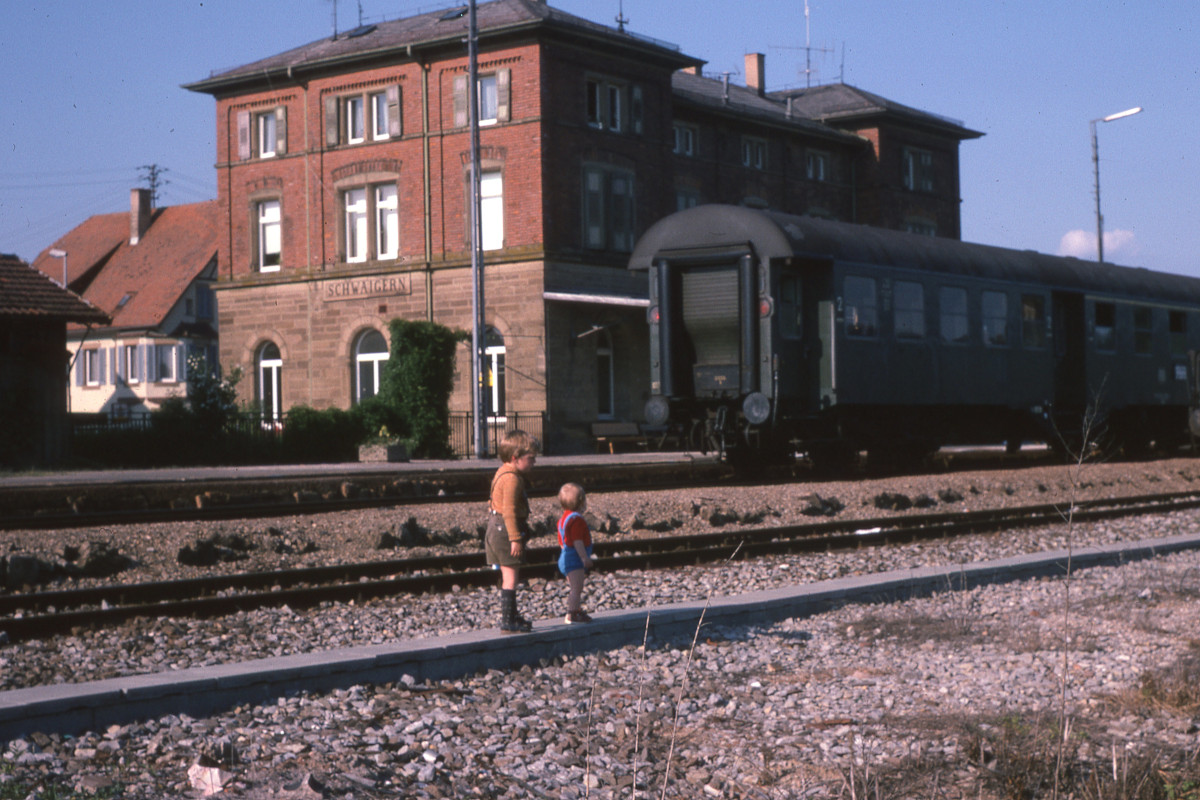 And here is a photo that shows my brother and me near the station of Schwaigern.
At that time there were fewer trains.
They were diesel-hauled and this one had the standard refurbished carriages.
[Jun 1978].
And here is a photo that shows my brother and me near the station of Schwaigern.
At that time there were fewer trains.
They were diesel-hauled and this one had the standard refurbished carriages.
[Jun 1978].
The depot of the Dampfbahn Kochertal is in Crailsheim. From there it operates
museum trains on nearby lines.

This class 50 engine leaves Crailsheim with a train of empty heritage railway stock
heading for Schorndorf. The next day it will shuttle on the branch line between Schorndorf
and Rudersberg. [Jul 2005]
 Here it is the next day near Rudersberg. With a train full of families and enthusiasts
it has just crossed the road to Rudersberg and pulls into the station. [Jul 2005]
Here it is the next day near Rudersberg. With a train full of families and enthusiasts
it has just crossed the road to Rudersberg and pulls into the station. [Jul 2005]
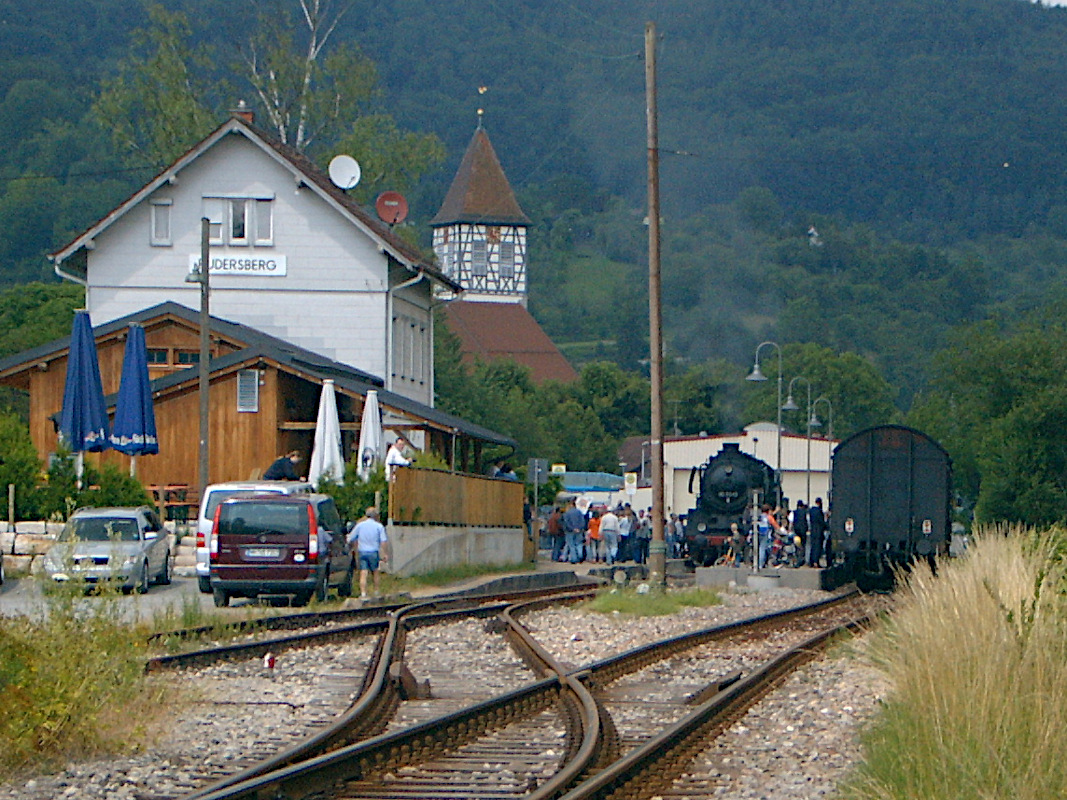 Rudersberg Station with steam locomotive.
In the background is the tower of St John's Church, at which my grandfater was the pastor for many years.
[Jul 2005].
Rudersberg Station with steam locomotive.
In the background is the tower of St John's Church, at which my grandfater was the pastor for many years.
[Jul 2005].
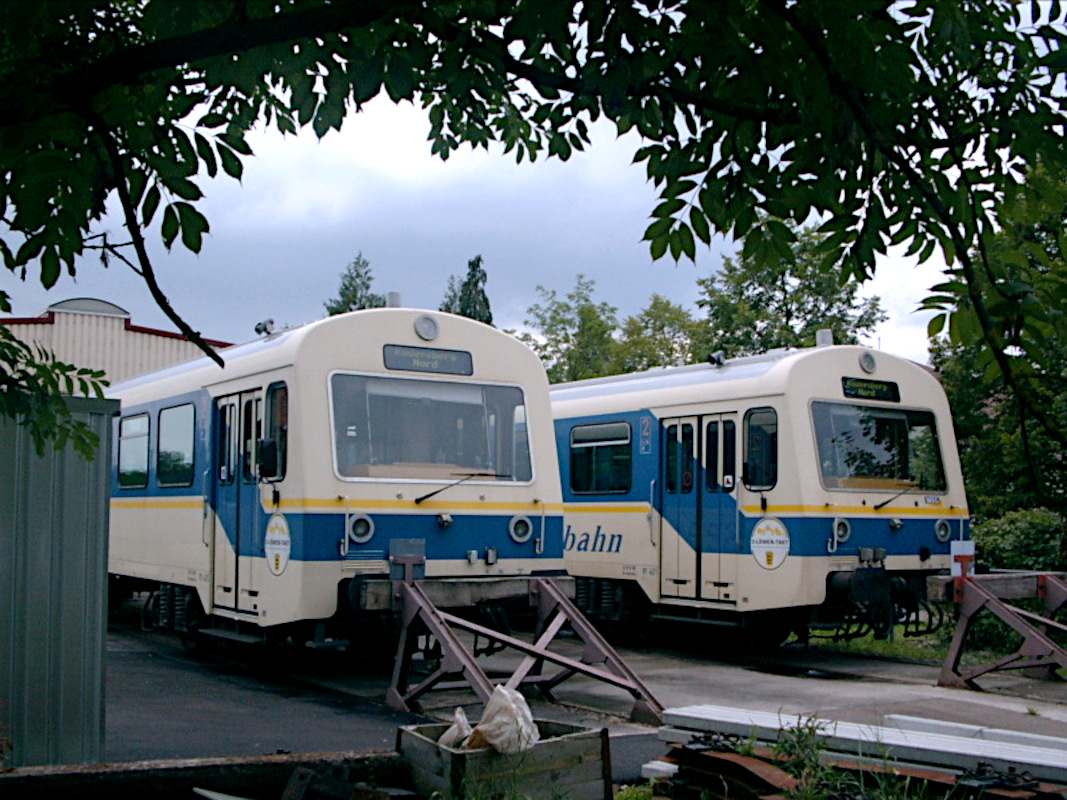 Since 1995 regular trains are running again on the Wieslauf Valley Railway between Schorndorf and Rudersberg.
These NE 81 railcars were operated by WEG.
This is the depot in Rudersberg.
[Jul 2005].
Since 1995 regular trains are running again on the Wieslauf Valley Railway between Schorndorf and Rudersberg.
These NE 81 railcars were operated by WEG.
This is the depot in Rudersberg.
[Jul 2005].
 When we lived in Switzerland, we sometimes came to Germany.
Unfortunately most railway photos from that time are quick shots on railway stations.
These SBB InterCity trains connected Zürich and Stuttgart.
Between Zürich and Singen they were hauled by SBB class Re 4/4 (420 or 421) locomotives.
A class 421 locomotive has uncoupled from the carriages in Singen.
[Apr 2015].
When we lived in Switzerland, we sometimes came to Germany.
Unfortunately most railway photos from that time are quick shots on railway stations.
These SBB InterCity trains connected Zürich and Stuttgart.
Between Zürich and Singen they were hauled by SBB class Re 4/4 (420 or 421) locomotives.
A class 421 locomotive has uncoupled from the carriages in Singen.
[Apr 2015].
 This class Re 4/4 (420) awaits the arrival of the InterCity from Stuttgart in Singen.
The Swiss Cross on the front of the loco clearly shows that from here onwards, the Swiss are in charge.
[Jan 2016].
This class Re 4/4 (420) awaits the arrival of the InterCity from Stuttgart in Singen.
The Swiss Cross on the front of the loco clearly shows that from here onwards, the Swiss are in charge.
[Jan 2016].
 Between Singen and Stuttgart German locomotives towed the InterCity trains.
Often these were old engines in their final years, not seen on many other trains.
This DB class 115 electric locomotive was known as class 110 for most of its life.
[Apr 2015].
Between Singen and Stuttgart German locomotives towed the InterCity trains.
Often these were old engines in their final years, not seen on many other trains.
This DB class 115 electric locomotive was known as class 110 for most of its life.
[Apr 2015].
 Locomotives of classes 101, 110, 111, 120 and 181 still travelled between Stuttgart and Singen.
Together with the comfortable carriages and the beautiful landscape travelling on this railway line was a pleasure,
though not the fastest connection.
A class 115 (previously 110) locomotive in the colours of the motor express (which carried holiday makers with their vehicles)
stands at the head of the InterCity to Zürich in Stuttgart.
[Jan 2014].
Locomotives of classes 101, 110, 111, 120 and 181 still travelled between Stuttgart and Singen.
Together with the comfortable carriages and the beautiful landscape travelling on this railway line was a pleasure,
though not the fastest connection.
A class 115 (previously 110) locomotive in the colours of the motor express (which carried holiday makers with their vehicles)
stands at the head of the InterCity to Zürich in Stuttgart.
[Jan 2014].
 The regional trains between Stuttgart and Singen had more recent rolling stock.
A class 146 locomotive is about to depart Singen with the RegionalExpress.
[Apr 2015].
The regional trains between Stuttgart and Singen had more recent rolling stock.
A class 146 locomotive is about to depart Singen with the RegionalExpress.
[Apr 2015].
 Local rail transport has often improved significantly in Germany in recent decades,
largely due to government support.
Trains between Schorndorf and Rudersberg are operated by the Württembergische Eisenbahngesellschaft (WEG).
A RegioSprinter railcar in Schorndorf.
[Jan 2014].
Local rail transport has often improved significantly in Germany in recent decades,
largely due to government support.
Trains between Schorndorf and Rudersberg are operated by the Württembergische Eisenbahngesellschaft (WEG).
A RegioSprinter railcar in Schorndorf.
[Jan 2014].
 Deutsche Bundesbahn introduced the class 111 between 1974 and 1984.
The locomotives continued in service for many years, mostly hauling regional trains.
A class 111 in front of her train to Stuttgart in Aalen.
[Jan 2016].
Deutsche Bundesbahn introduced the class 111 between 1974 and 1984.
The locomotives continued in service for many years, mostly hauling regional trains.
A class 111 in front of her train to Stuttgart in Aalen.
[Jan 2016].
 A class 628 railcar arrives in Aalen with a local service to Ulm.
[Jan 2016].
A class 628 railcar arrives in Aalen with a local service to Ulm.
[Jan 2016].
 That's the view onto the line from a class 628 railcar.
The train is travelling along the line between Aalen and Ulm.
[Jan 2016].
That's the view onto the line from a class 628 railcar.
The train is travelling along the line between Aalen and Ulm.
[Jan 2016].
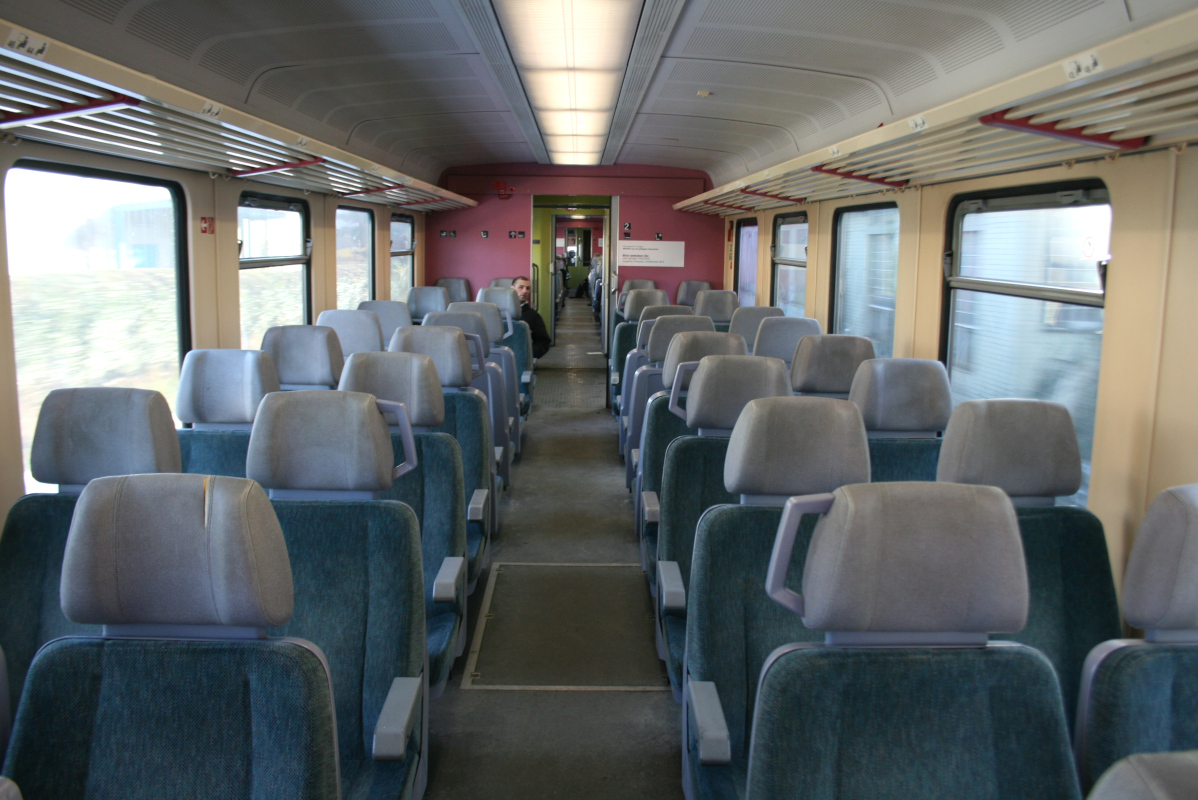 Einige der 628-Triebwagen hatten noch die Inneneinrichtung aus den 1980er Jahren, mit rosoroten Wänden und himmelblauen, weichen Sitzen.
[Jan 2016].
Einige der 628-Triebwagen hatten noch die Inneneinrichtung aus den 1980er Jahren, mit rosoroten Wänden und himmelblauen, weichen Sitzen.
[Jan 2016].
 In Ulm we even saw a class 103 locomotive, which today is part of the heritage fleet.
It had brought a train from Stuttgart and was about to return engine-only.
[Jan 2014].
In Ulm we even saw a class 103 locomotive, which today is part of the heritage fleet.
It had brought a train from Stuttgart and was about to return engine-only.
[Jan 2014].
 The ferry between Romanshorn nach Friedrichshafen also connects the passenger rail systems of Switzerland and Germany.
A RegioSprinter railcar of the Bodensee-Oberschwaben-Bahn arrives in Friedrichshafen Harbour Station.
The logo with the goat is a reference to a famous local song about a goat on the railway, called
Auf der schwäb´schen Eisebahne.
[Feb 2015].
The ferry between Romanshorn nach Friedrichshafen also connects the passenger rail systems of Switzerland and Germany.
A RegioSprinter railcar of the Bodensee-Oberschwaben-Bahn arrives in Friedrichshafen Harbour Station.
The logo with the goat is a reference to a famous local song about a goat on the railway, called
Auf der schwäb´schen Eisebahne.
[Feb 2015].
 The Bodensee-Oberschwaben-Bahn uses RegioSprinter railcars to offer services between Friedrichshafen and Aulendorf.
The new railway company began operation in 1993 and was an initiative of local government.
Several smaller stations were reopened and the frequency was so high that bus services on the main route were no longer
required. Instead buses now provide feeder services to the railway.
[Feb 2015].
The Bodensee-Oberschwaben-Bahn uses RegioSprinter railcars to offer services between Friedrichshafen and Aulendorf.
The new railway company began operation in 1993 and was an initiative of local government.
Several smaller stations were reopened and the frequency was so high that bus services on the main route were no longer
required. Instead buses now provide feeder services to the railway.
[Feb 2015].
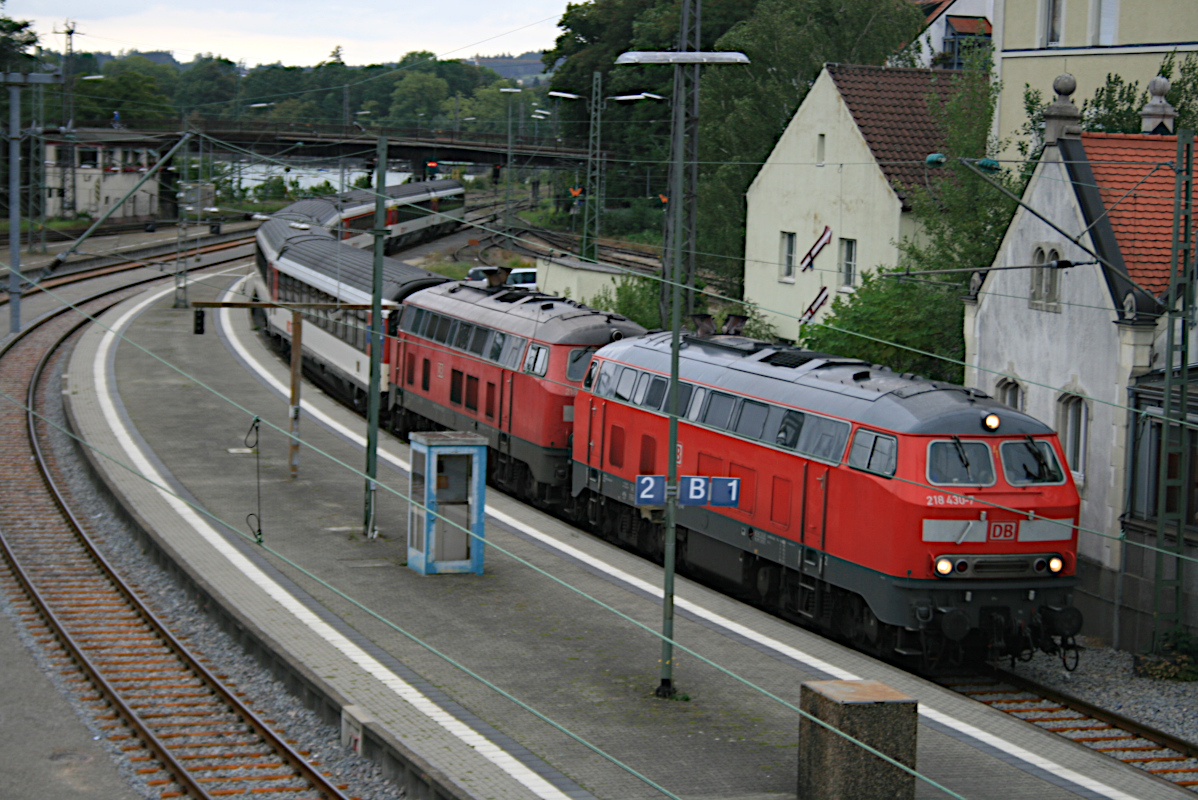 A further railway connection between Germany and Switzerland passes through Lindau and Austria.
A EuroCity from Munich arrives with two class 218 diesel locos in the island station of Lindau.
There a SBB electric locomotive will take over the train and bring the train through Bregenz (Austria) and St. Gallen to Zurich.
From December 2020 these carriage trains were replaced by the electric multiple units ASTORO, as the railway line on the German side had finally been electrified.
Since then, the EuroCity trains no longer go to Lindau Main Station, but instead stop in Lindau-Reutin.
[Aug 2015].
A further railway connection between Germany and Switzerland passes through Lindau and Austria.
A EuroCity from Munich arrives with two class 218 diesel locos in the island station of Lindau.
There a SBB electric locomotive will take over the train and bring the train through Bregenz (Austria) and St. Gallen to Zurich.
From December 2020 these carriage trains were replaced by the electric multiple units ASTORO, as the railway line on the German side had finally been electrified.
Since then, the EuroCity trains no longer go to Lindau Main Station, but instead stop in Lindau-Reutin.
[Aug 2015].
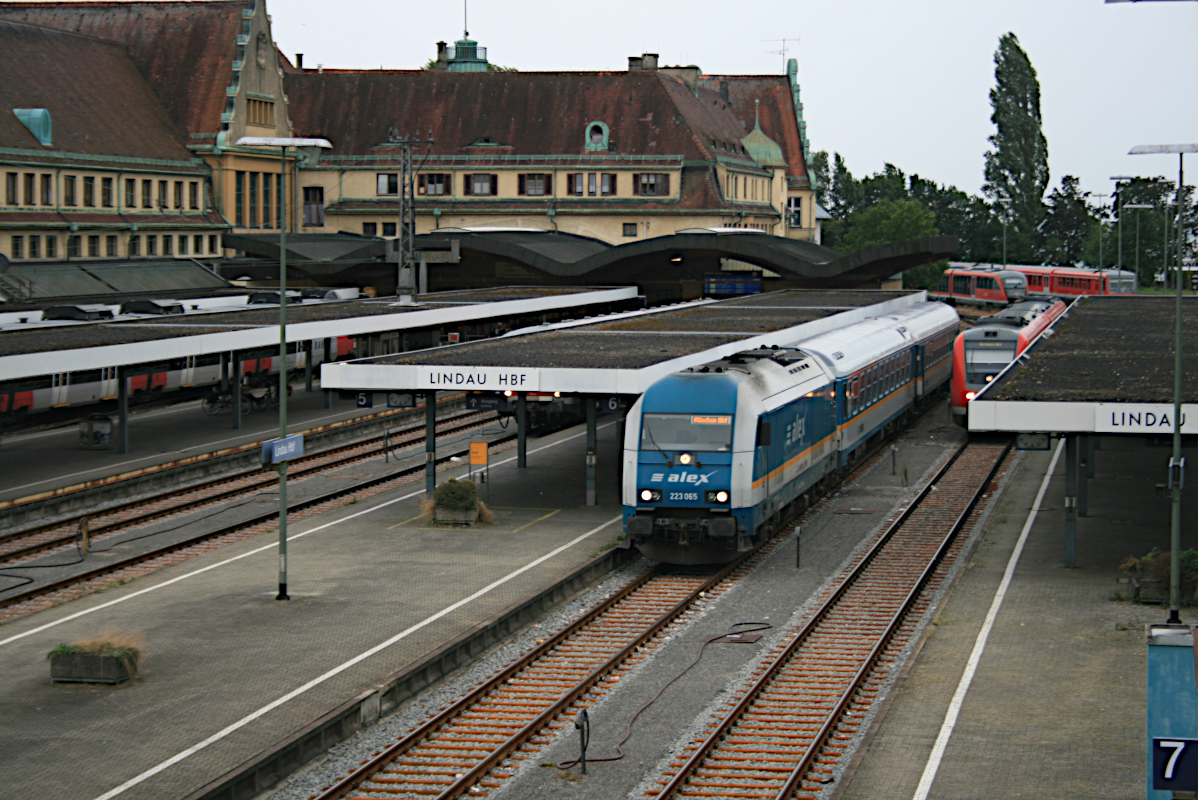 From 2007 to 2020 ALEX Süd trains operated from Lindau and Oberstdorf to Munich via Immenstadt.
This service was the successor to the Allgäu-Express, a train service that operated between 2003 and 2007.
The ALEX trains were operated by the Länderbahn.
Here in the Allgäu the trains were hauled by Siemens Eurorunner locomotives (Class 232).
An ALEX Süd train is about to depart Lindau Main Station.
Beside it is a DB Class 612 tilting diesel train.
Behind it there are some more Deutsche Bahn diesel raicars.
A Class 643 (Talent) and Class 628 railcar are visible.
To the left is an electric Talent electric multiple unit of the Austrian ÖBB.
[Aug 2015].
From 2007 to 2020 ALEX Süd trains operated from Lindau and Oberstdorf to Munich via Immenstadt.
This service was the successor to the Allgäu-Express, a train service that operated between 2003 and 2007.
The ALEX trains were operated by the Länderbahn.
Here in the Allgäu the trains were hauled by Siemens Eurorunner locomotives (Class 232).
An ALEX Süd train is about to depart Lindau Main Station.
Beside it is a DB Class 612 tilting diesel train.
Behind it there are some more Deutsche Bahn diesel raicars.
A Class 643 (Talent) and Class 628 railcar are visible.
To the left is an electric Talent electric multiple unit of the Austrian ÖBB.
[Aug 2015].
 The most important connection between the German and Swiss railways is in Basel.
An ICE train has arrived in Basel Baden Station.
From there it will continue to Basel SBB and then to Interlaken.
Basel Baden Station is the station on the north side of the Rhine on Swiss territory,
but is operated by the German Railways, Deutsche Bahn.
[Jan 2016].
The most important connection between the German and Swiss railways is in Basel.
An ICE train has arrived in Basel Baden Station.
From there it will continue to Basel SBB and then to Interlaken.
Basel Baden Station is the station on the north side of the Rhine on Swiss territory,
but is operated by the German Railways, Deutsche Bahn.
[Jan 2016].
 Regional trains to Germany depart from Basel Baden Station.
This class 611 tilting train is about to depart from Basel Baden Station as InterRegioExpress to Ulm.
Initially it will travel along the northern side of the Rhine river to Singen.
It will then continue along the northern shore of the Lake of Constance to Friedrichshafen,
and from there head north to Ulm.
On its journey it will cross the Swiss/German border several times.
[Jan 2016].
Regional trains to Germany depart from Basel Baden Station.
This class 611 tilting train is about to depart from Basel Baden Station as InterRegioExpress to Ulm.
Initially it will travel along the northern side of the Rhine river to Singen.
It will then continue along the northern shore of the Lake of Constance to Friedrichshafen,
and from there head north to Ulm.
On its journey it will cross the Swiss/German border several times.
[Jan 2016].
 About halfway between Basel and Singen there's another rail crossing from Switzerland to Germany.
At Waldshut trains cross the rhine on a railway bridge.
A class 560 railcar of the Swiss Railways (SBB) arrives in Waldshut.
[Nov 2015].
About halfway between Basel and Singen there's another rail crossing from Switzerland to Germany.
At Waldshut trains cross the rhine on a railway bridge.
A class 560 railcar of the Swiss Railways (SBB) arrives in Waldshut.
[Nov 2015].
 These class 641 railcars are used for local service by Deutsche Bahn in the southern region of Baden.
One of the railcars stands in Waldshut as connector train to Weizen.
[Oct 2015].
These class 641 railcars are used for local service by Deutsche Bahn in the southern region of Baden.
One of the railcars stands in Waldshut as connector train to Weizen.
[Oct 2015].
 In Weizen this train connects to the heritage railway that operates between Weizen and Blumberg.
Even though only few passengers have arrived on the connector train,
the steam train is full, and so is the station platform in Weizen.
[Oct 2015].
In Weizen this train connects to the heritage railway that operates between Weizen and Blumberg.
Even though only few passengers have arrived on the connector train,
the steam train is full, and so is the station platform in Weizen.
[Oct 2015].
 Locomotive 262 stands at the head of the heritage train in Weizen.
Crowds of people swarm around the train.
The steam engine was built in 1954 by Henschel for the Frankfurt-Königsteiner Eisenbahn (FKE).
[Oct 2015].
Locomotive 262 stands at the head of the heritage train in Weizen.
Crowds of people swarm around the train.
The steam engine was built in 1954 by Henschel for the Frankfurt-Königsteiner Eisenbahn (FKE).
[Oct 2015].
 The train during its stop at the small station of Lausheim-Blumegg.
Since 2014 heritage trains are operated on the central part of the Wutach Valley railway by the City of Blumberg.
Before that most trains were operated by a society with volunteers.
The City of Blumberg bought several old carriages in 2013, along with locomotive 262.
However, the locomotive only started operations in 2015 after it required major maintenance in Meiningen.
[Oct 2015].
The train during its stop at the small station of Lausheim-Blumegg.
Since 2014 heritage trains are operated on the central part of the Wutach Valley railway by the City of Blumberg.
Before that most trains were operated by a society with volunteers.
The City of Blumberg bought several old carriages in 2013, along with locomotive 262.
However, the locomotive only started operations in 2015 after it required major maintenance in Meiningen.
[Oct 2015].
 The railway is also called Sauschwänzlebahn or pig's tail railway.
On a map it looks as loopy as a pig's tail.
The line winds its way across loops, spirals, tunnels and bridges.
It was originally built for military purposes to avoid routing trains through Swiss territory.
Here the train cross the Biesenbach Viadukt.
[Oct 2015].
The railway is also called Sauschwänzlebahn or pig's tail railway.
On a map it looks as loopy as a pig's tail.
The line winds its way across loops, spirals, tunnels and bridges.
It was originally built for military purposes to avoid routing trains through Swiss territory.
Here the train cross the Biesenbach Viadukt.
[Oct 2015].
 Regualr train services operate from Blumberg-Zollhaus northwards.
Trains of the Hohenzollerischen Landesbahn connect here throughout the Black Forest.
This RegioSprinter railcar stands in Blumberg-Zollhaus station.
[Oct 2015].
Regualr train services operate from Blumberg-Zollhaus northwards.
Trains of the Hohenzollerischen Landesbahn connect here throughout the Black Forest.
This RegioSprinter railcar stands in Blumberg-Zollhaus station.
[Oct 2015].
 Meanwhile locomotive 262 takes on water.
In the afternoon it will haul another train to Weizen and return.
[Oct 2015].
Meanwhile locomotive 262 takes on water.
In the afternoon it will haul another train to Weizen and return.
[Oct 2015].
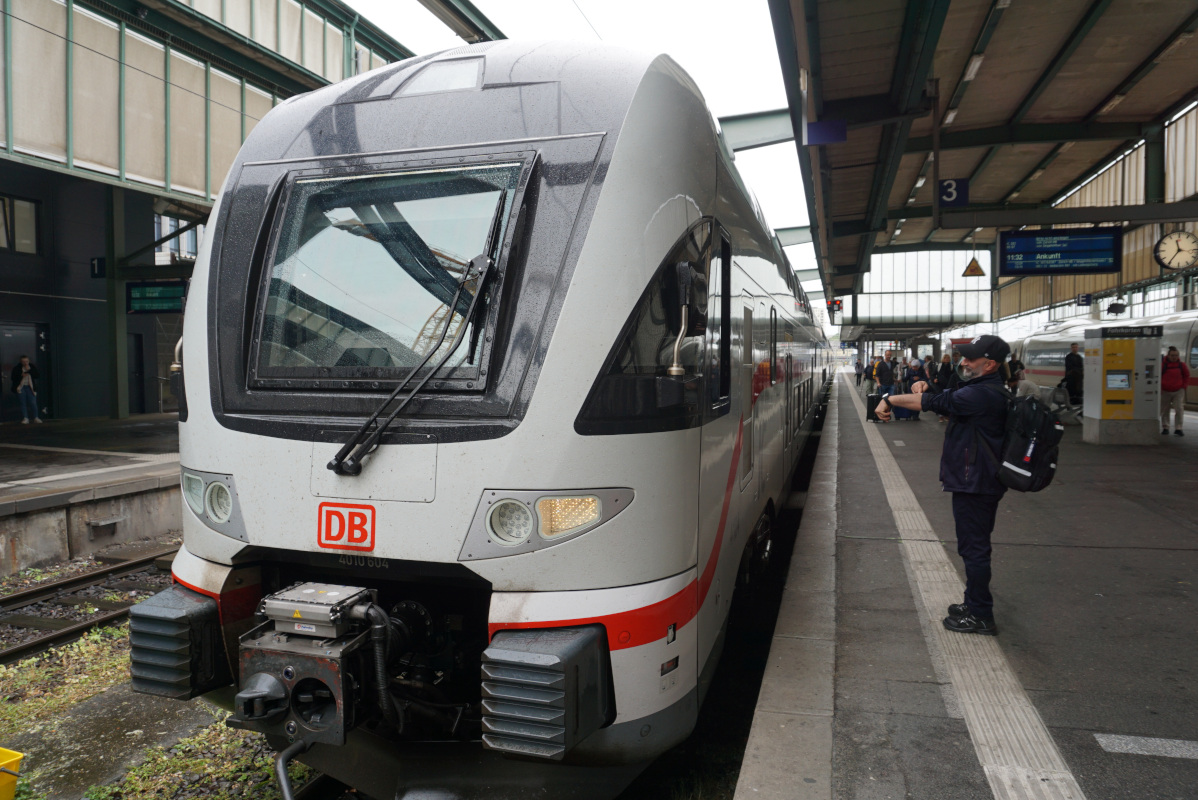 When we were briefly in Germany again in 2025, these Stadler KISS class 4010 trains operated as InterCity between Zürich und Stuttgart. Deutsche Bahn purchased 17 of these trains in 2019 from the Austrian Westbahn.
DB operated these trains until 2025 between Stuttgart and Zürich via Singen and Schaffhausen, before the trains were sold to the Austrian ÖBB.
One of the trains is seen here in Stuttgart.
[May 2025].
When we were briefly in Germany again in 2025, these Stadler KISS class 4010 trains operated as InterCity between Zürich und Stuttgart. Deutsche Bahn purchased 17 of these trains in 2019 from the Austrian Westbahn.
DB operated these trains until 2025 between Stuttgart and Zürich via Singen and Schaffhausen, before the trains were sold to the Austrian ÖBB.
One of the trains is seen here in Stuttgart.
[May 2025].
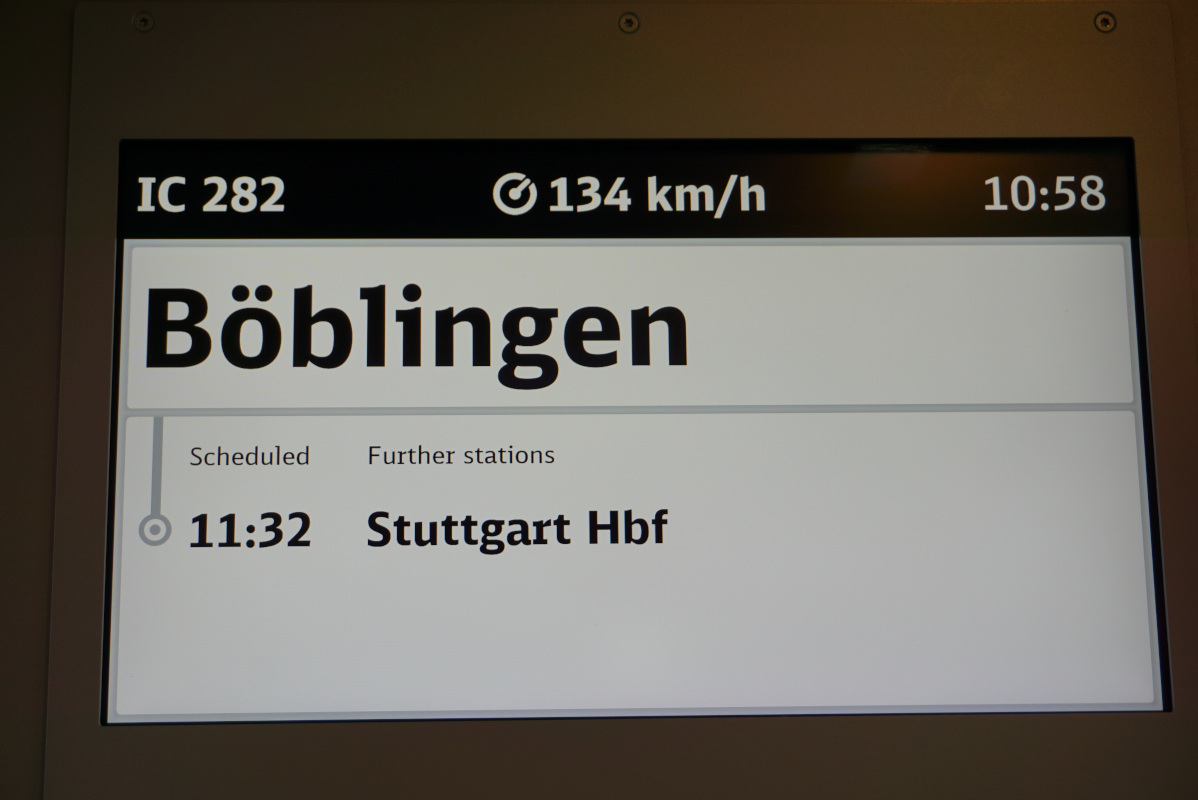 The KISS electric multiple units were able to drive relatively fast in the curvy Gäubahn.
This is the screen on one of the trains, which was to arrive on time in Stuttgart.
[May 2025].
The KISS electric multiple units were able to drive relatively fast in the curvy Gäubahn.
This is the screen on one of the trains, which was to arrive on time in Stuttgart.
[May 2025].
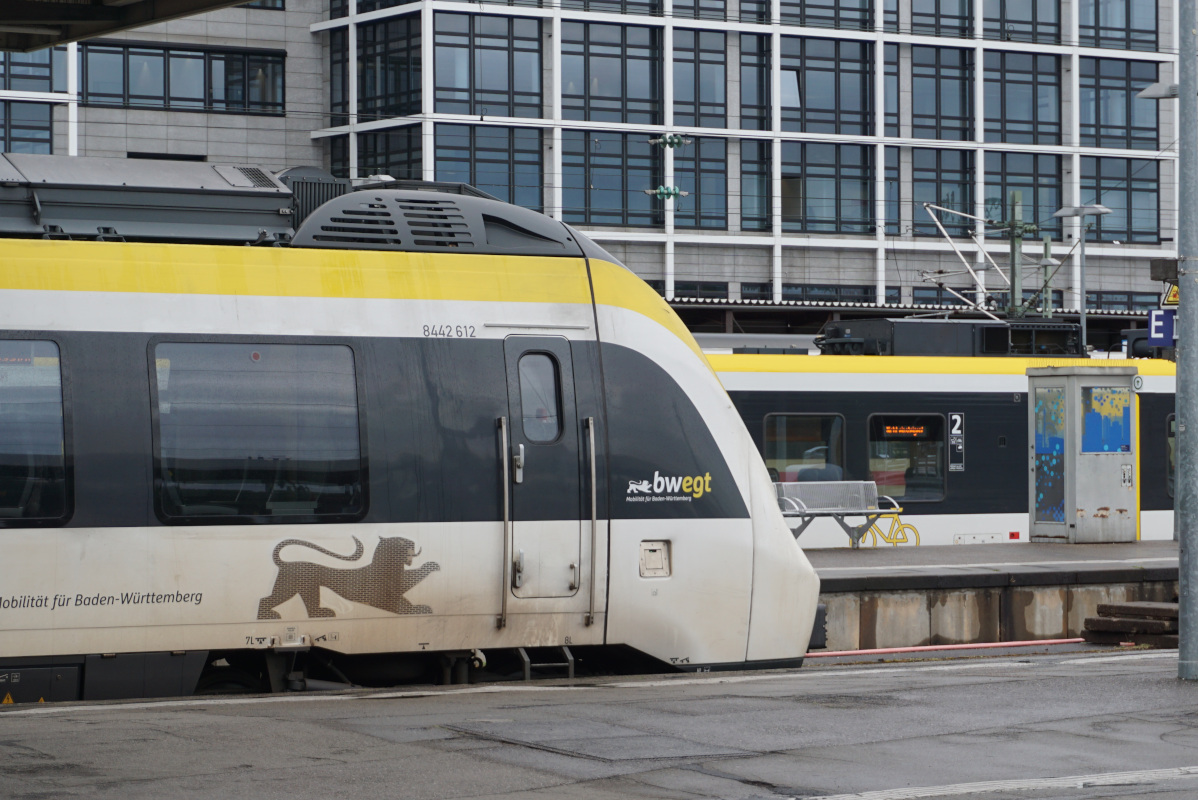 BWegt is the public transport authority of Baden-Württemberg, contracting services from transport operators.
Most local trains now have to sport the white-yellow-black livery with BWegt logo.
[May 2025].
BWegt is the public transport authority of Baden-Württemberg, contracting services from transport operators.
Most local trains now have to sport the white-yellow-black livery with BWegt logo.
[May 2025].
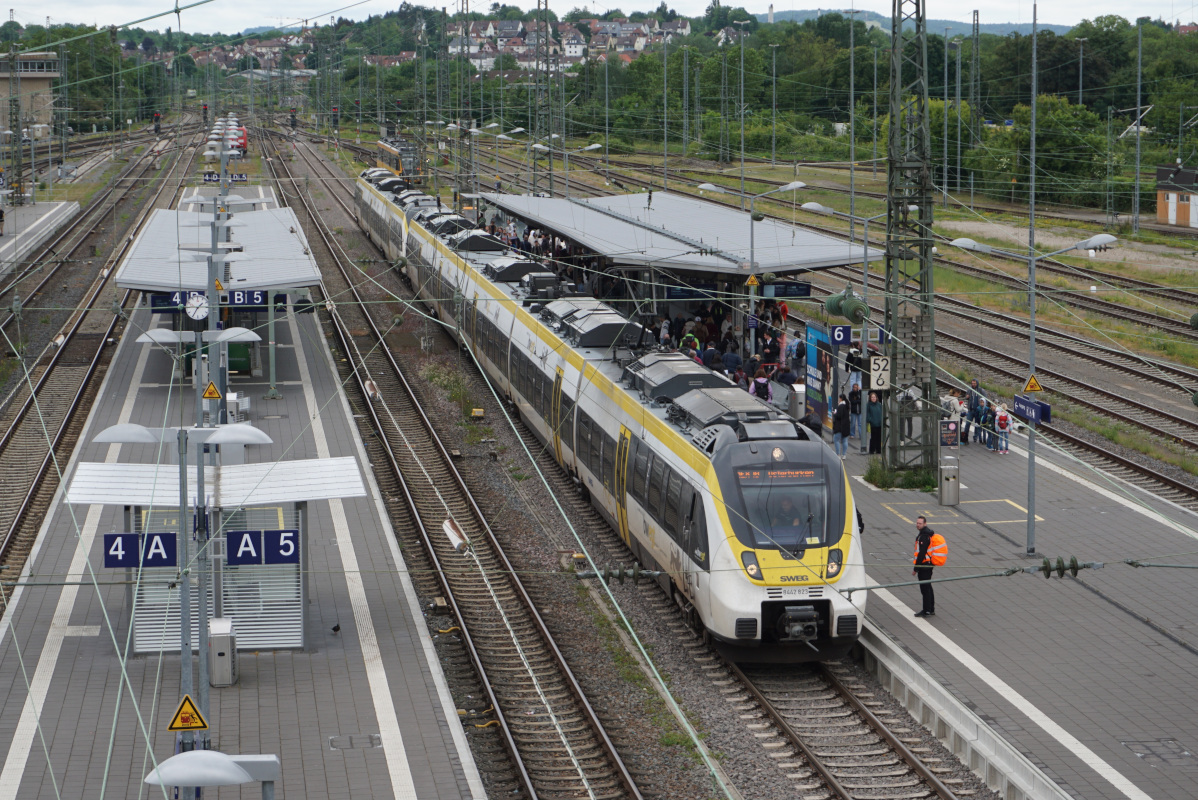 A MEX (MetropolExpress) from Stuttgart to Osterburken stops in Heilbronn.
The train consists of two Talent 3 Class 442 electric multiple units operated by SWEG (Südwestdeutsche Landesverkehrs GmbH).
The trains carry the livery of BWegt, but also the logo of SWEG.
[May 2025].
A MEX (MetropolExpress) from Stuttgart to Osterburken stops in Heilbronn.
The train consists of two Talent 3 Class 442 electric multiple units operated by SWEG (Südwestdeutsche Landesverkehrs GmbH).
The trains carry the livery of BWegt, but also the logo of SWEG.
[May 2025].
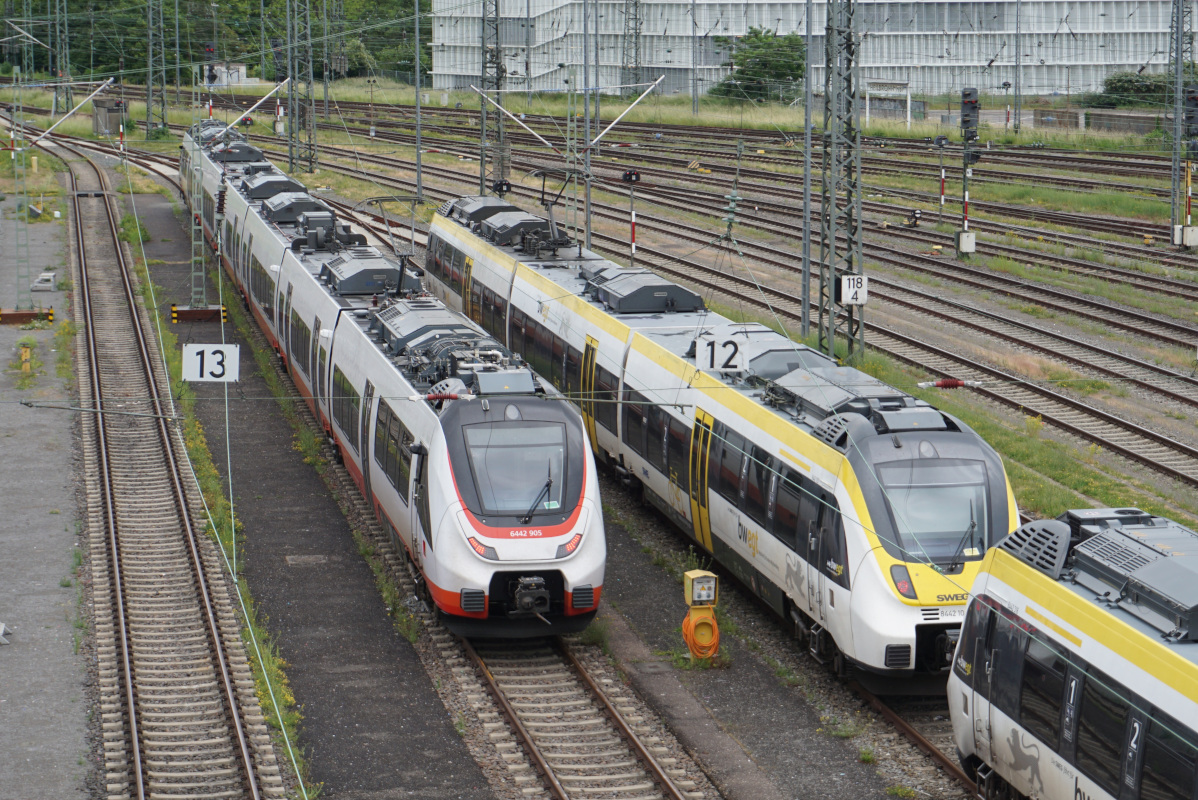 Bombardier won contracts for the supply of Talent 3 trains to Austria.
But there were considerable dealys in delivery and Bombardier could not obtain certification for the trains in Austria.
Because of that ÖBB and other Austrian operators did not accept the electric multiple units.
The Talent 3 units finally obtained certification in Germany and were leased to German operators.
In Heilbronn is a Talent 3 EMU in the red-white Austrian livery beside Talent 3 units in Baden-Württemberg livery.
[May 2025].
Bombardier won contracts for the supply of Talent 3 trains to Austria.
But there were considerable dealys in delivery and Bombardier could not obtain certification for the trains in Austria.
Because of that ÖBB and other Austrian operators did not accept the electric multiple units.
The Talent 3 units finally obtained certification in Germany and were leased to German operators.
In Heilbronn is a Talent 3 EMU in the red-white Austrian livery beside Talent 3 units in Baden-Württemberg livery.
[May 2025].
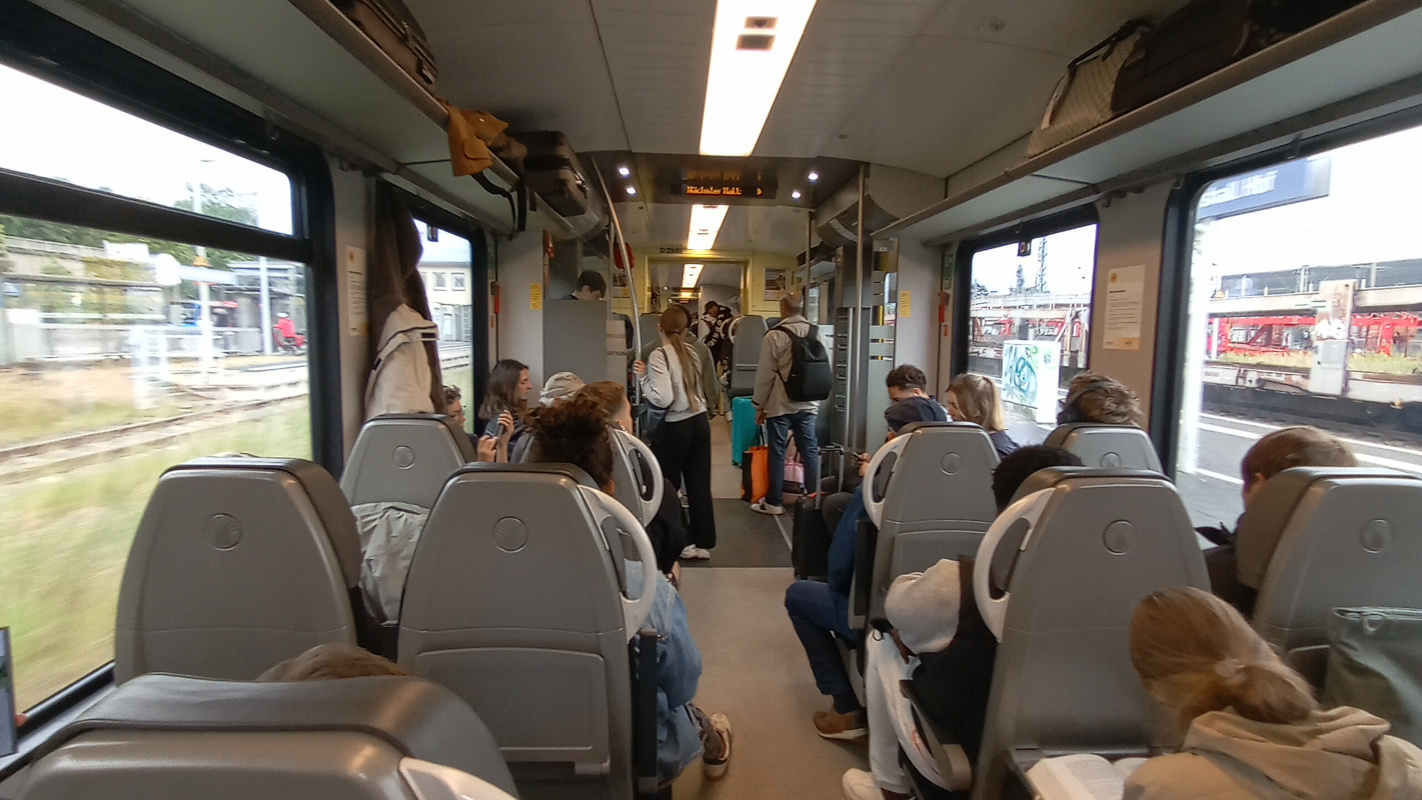 At the moment many trains in Germany are overfull not punctual.
Investment in infrastructure has been delayed for too long, while train frequency has been increased.
This is the interior of Talent 3 EMU as it travels as RegionalExpress to Würzburg.
[May 2025].
At the moment many trains in Germany are overfull not punctual.
Investment in infrastructure has been delayed for too long, while train frequency has been increased.
This is the interior of Talent 3 EMU as it travels as RegionalExpress to Würzburg.
[May 2025].
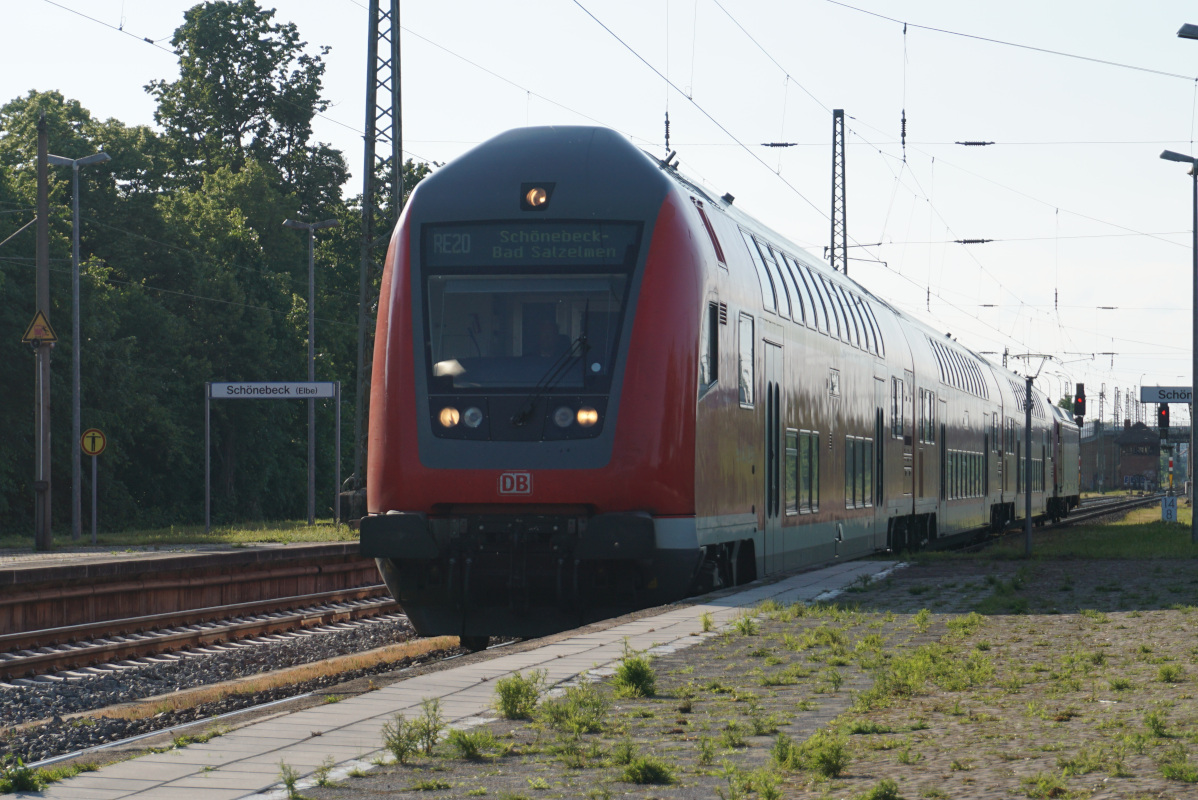 A RegionalExpress from Uelzen to Schönebeck-Bad Salzelmen arrives in Schönebeck, Saxony-Anhalt.
It uses twin deck carriages that are typical for regional trains in Germany, including here in East Germany.
[May 2025].
A RegionalExpress from Uelzen to Schönebeck-Bad Salzelmen arrives in Schönebeck, Saxony-Anhalt.
It uses twin deck carriages that are typical for regional trains in Germany, including here in East Germany.
[May 2025].
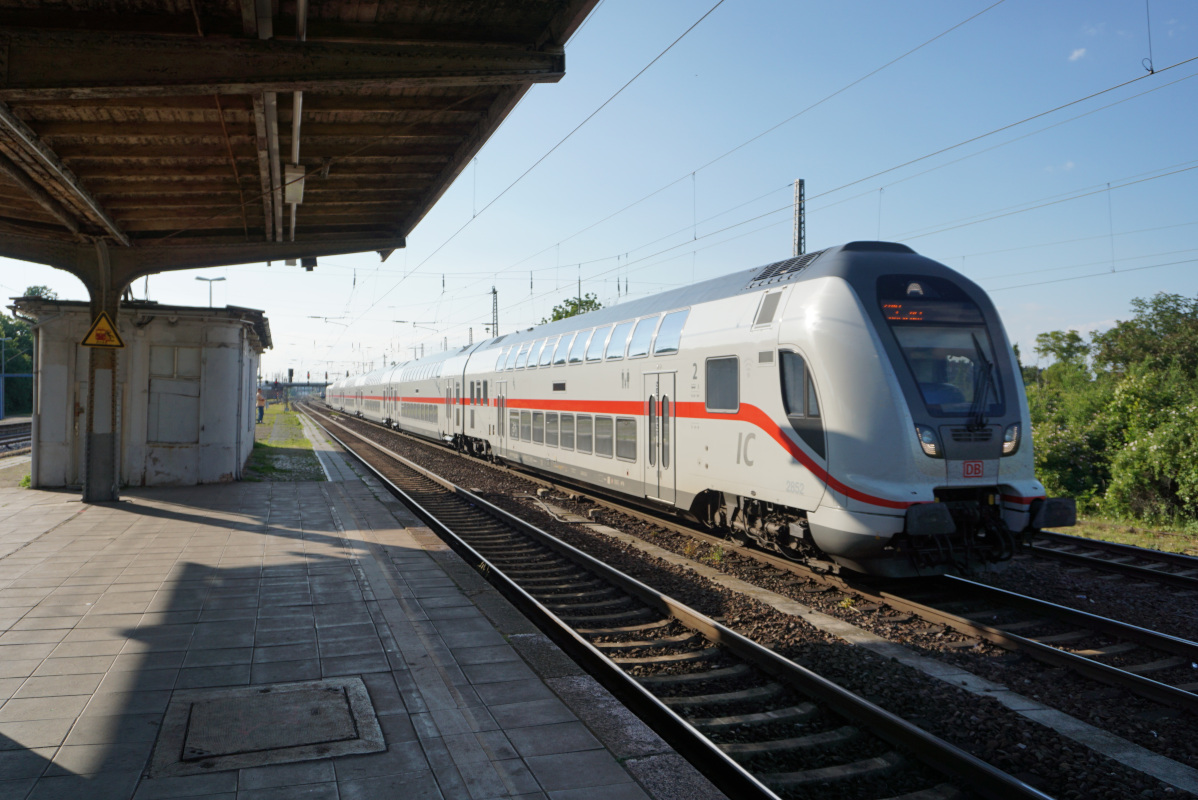 The InterCity twin deck carriages are quite similar, but in white.
An InterCity train passes through Schönebeck.
[May 2025].
The InterCity twin deck carriages are quite similar, but in white.
An InterCity train passes through Schönebeck.
[May 2025].
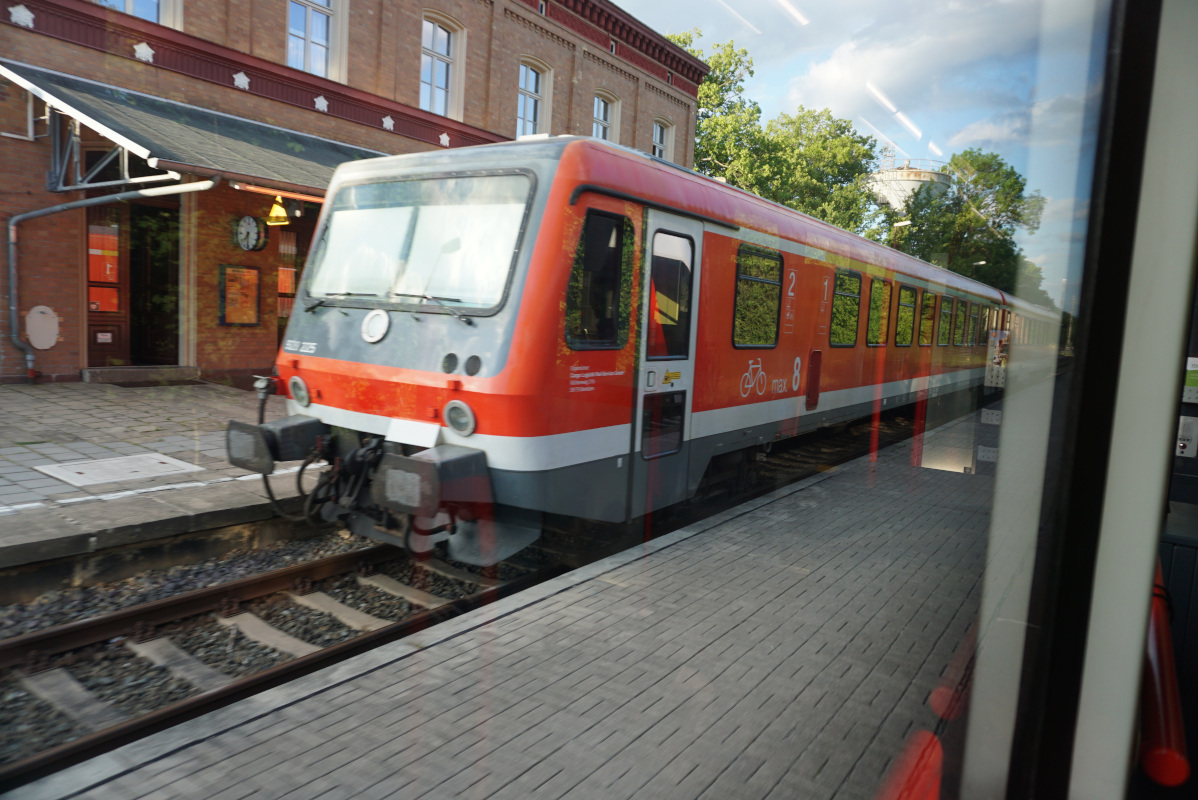 One could even meet Class 628 railcars in East Germany in the 21st century.
Here I took a photo of one of these railcars from another train.
[May 2025].
One could even meet Class 628 railcars in East Germany in the 21st century.
Here I took a photo of one of these railcars from another train.
[May 2025].
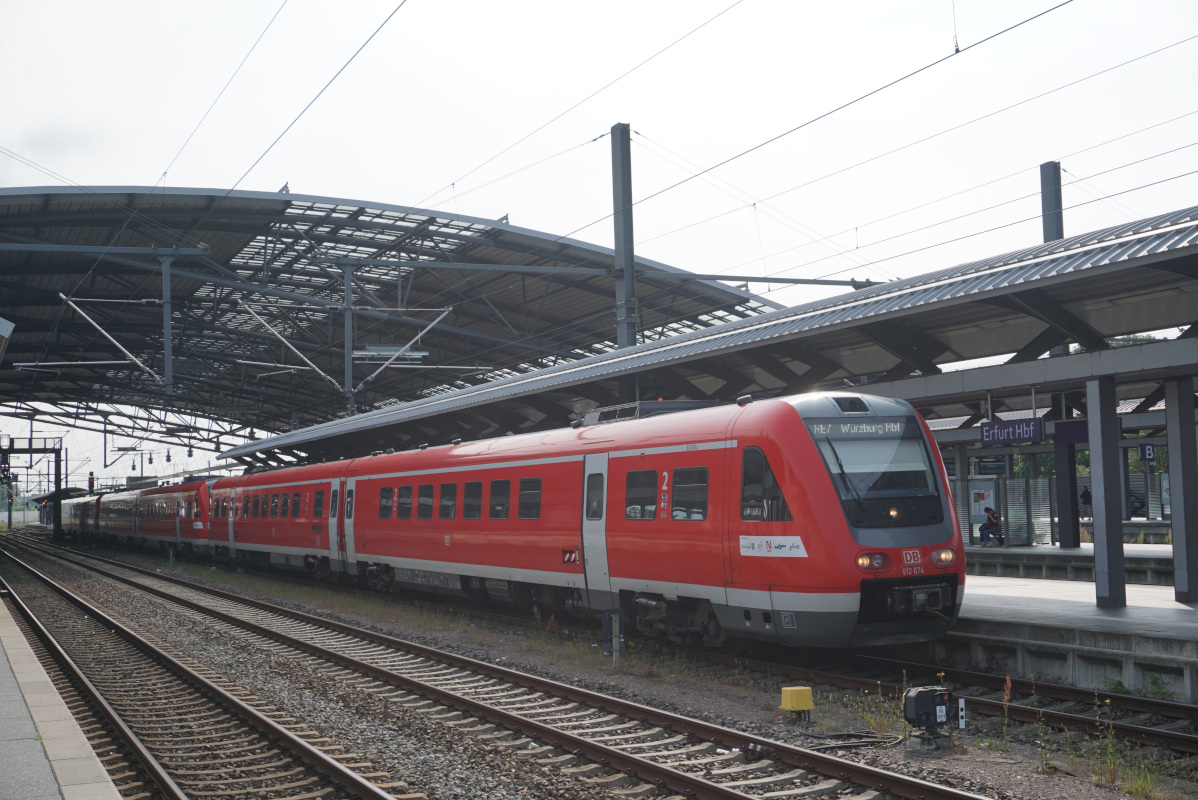 Twin Class 612 tilting railcars leave Erfurt Main Station towards Würzburg via Schweinfurt und Meinigen.
This RegionalExpress line is also known as the Mainfranken-Thüringen-Express.
[Jun 2025].
Twin Class 612 tilting railcars leave Erfurt Main Station towards Würzburg via Schweinfurt und Meinigen.
This RegionalExpress line is also known as the Mainfranken-Thüringen-Express.
[Jun 2025].
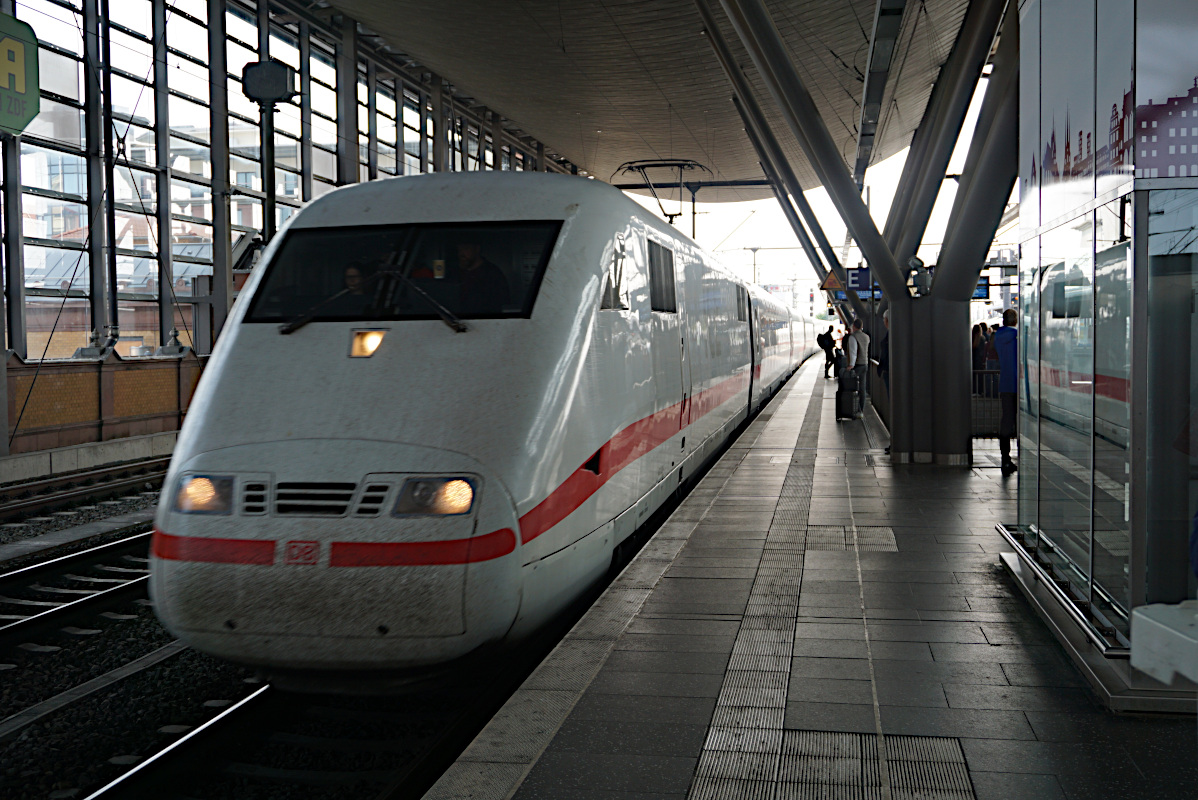 Class 401 ICE trains were still in service.
One of these arrives in Erfurt Main Station.
[Jun 2025].
Class 401 ICE trains were still in service.
One of these arrives in Erfurt Main Station.
[Jun 2025].
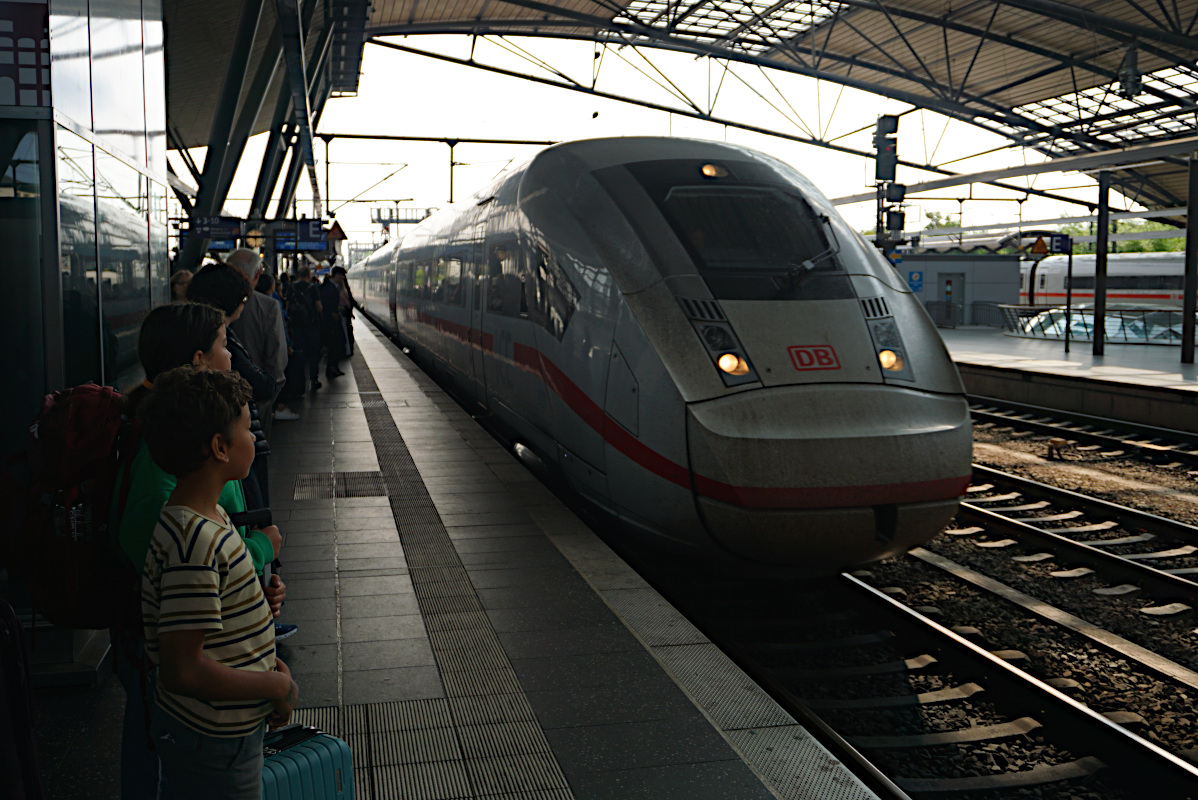 On the adjacent track arrives one of the newer Class 412 ICE train.
These trains can move more passengers, but are not as fast.
[Jun 2025].
On the adjacent track arrives one of the newer Class 412 ICE train.
These trains can move more passengers, but are not as fast.
[Jun 2025].
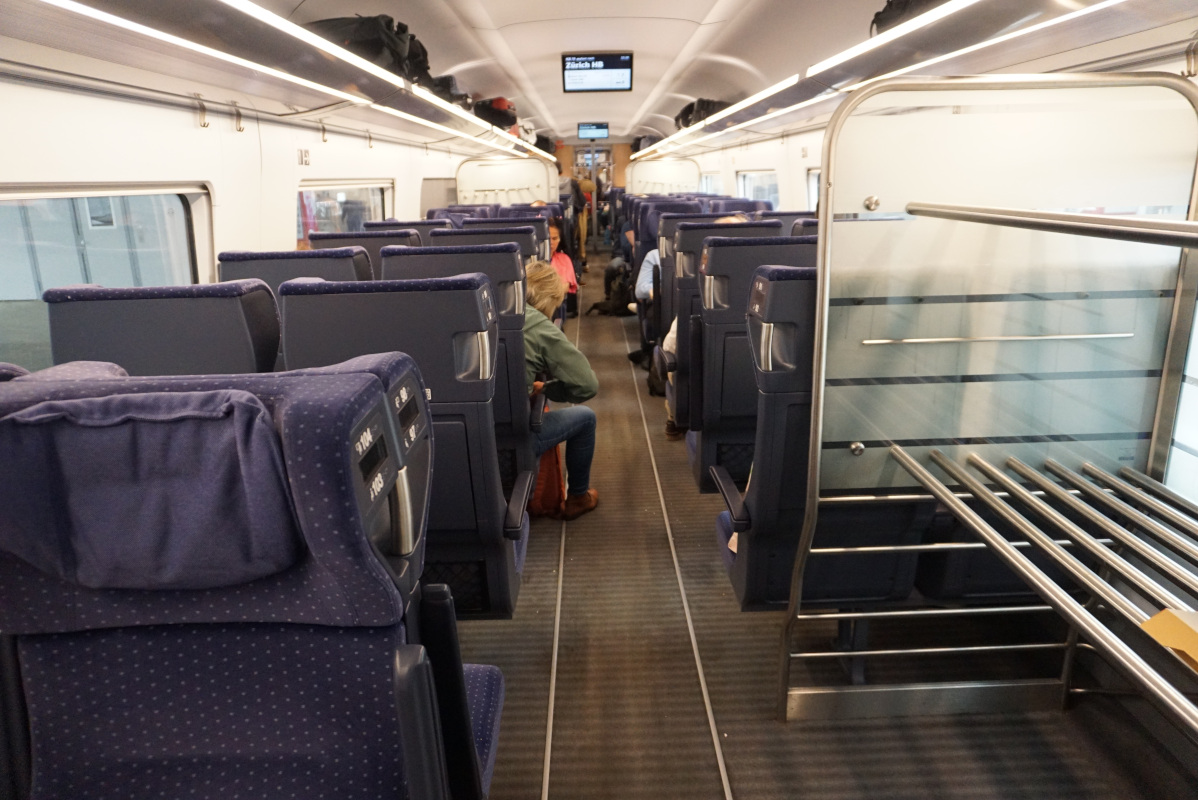 That's a view of the interior of an ICE 4 (Class 412).
This train only offers salon seating, with seats arranged in groups of two or four and some luggage racks.
[Jun 2025].
That's a view of the interior of an ICE 4 (Class 412).
This train only offers salon seating, with seats arranged in groups of two or four and some luggage racks.
[Jun 2025].
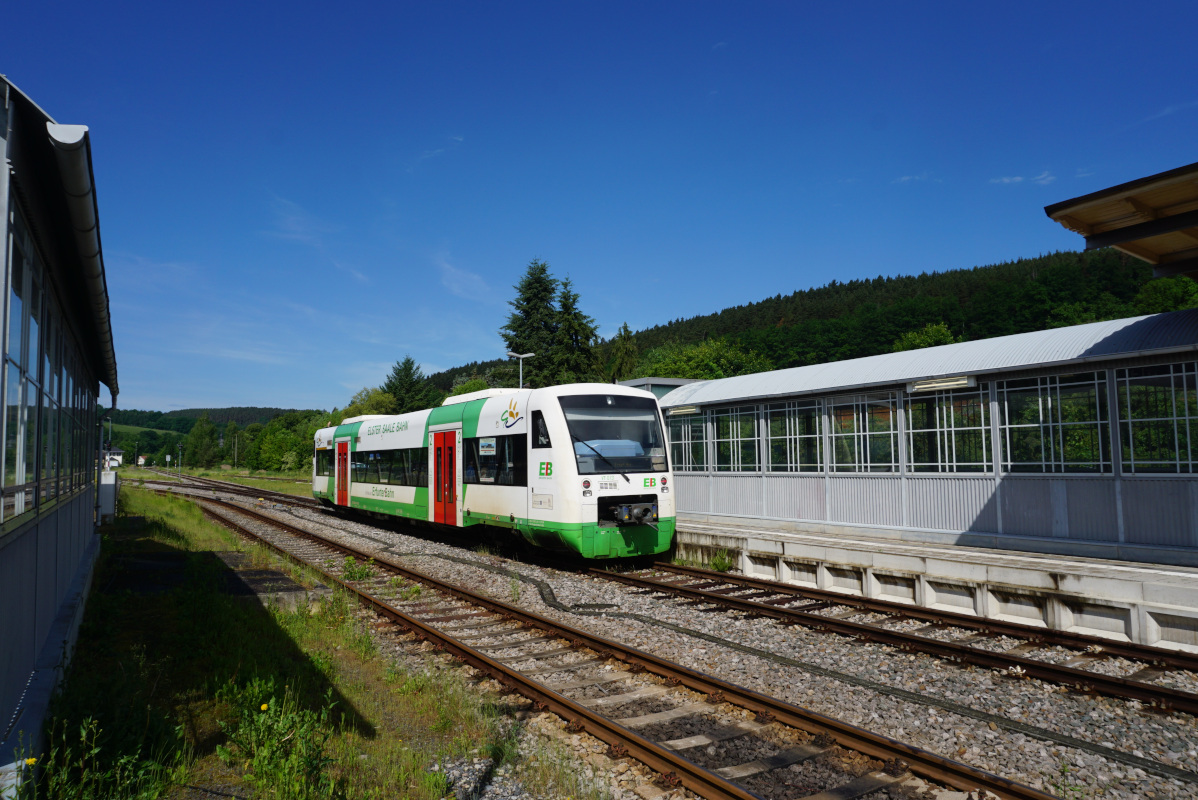 The Erfurter Bahn belongs to the City of Erfurt and operates industrial lines around Erfurt and local trains, particularly in Thuringia.
Here is a RegioSprinter of the Erfurter Bahn in Rottenbach.
[Jun 2025].
The Erfurter Bahn belongs to the City of Erfurt and operates industrial lines around Erfurt and local trains, particularly in Thuringia.
Here is a RegioSprinter of the Erfurter Bahn in Rottenbach.
[Jun 2025].
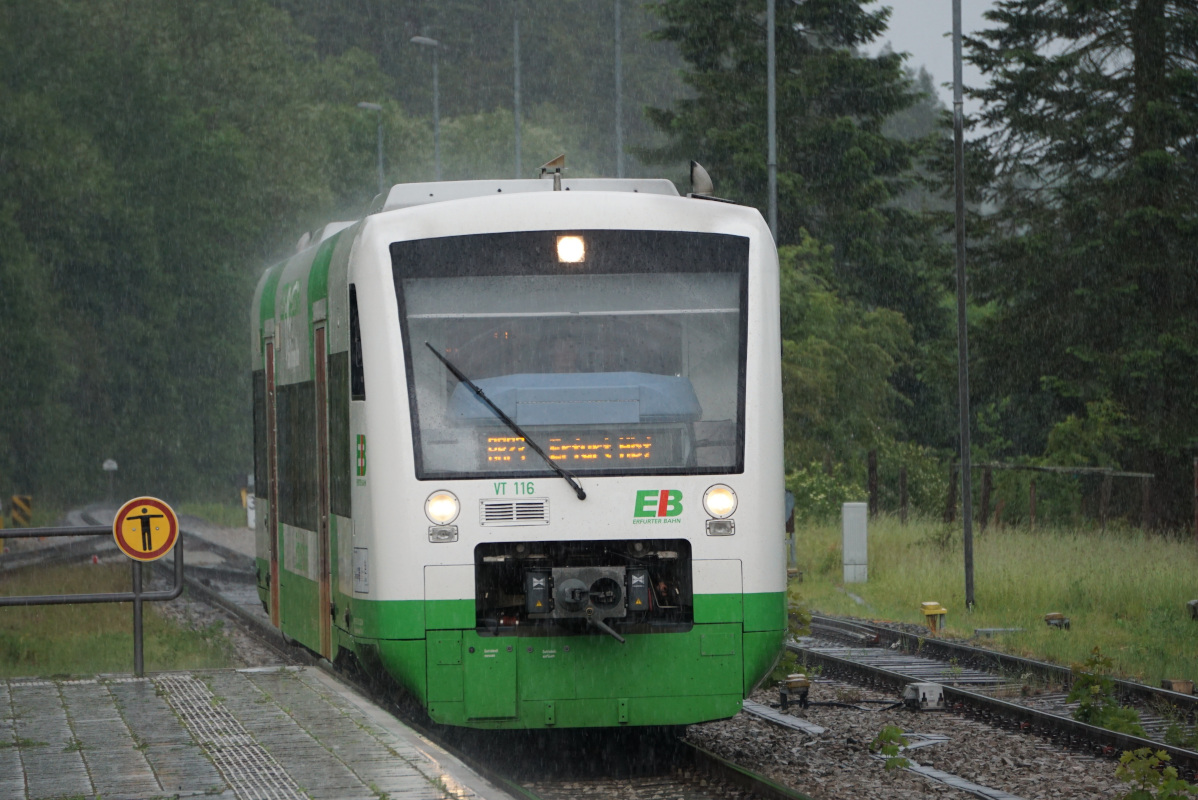 A RegioSprinter of Erfurter Bahn arrives in Rottenbach during heavy rain.
The train operates as RegionalBahn 23 from Saalfeld to Erfurt.
[Jun 2025].
A RegioSprinter of Erfurter Bahn arrives in Rottenbach during heavy rain.
The train operates as RegionalBahn 23 from Saalfeld to Erfurt.
[Jun 2025].
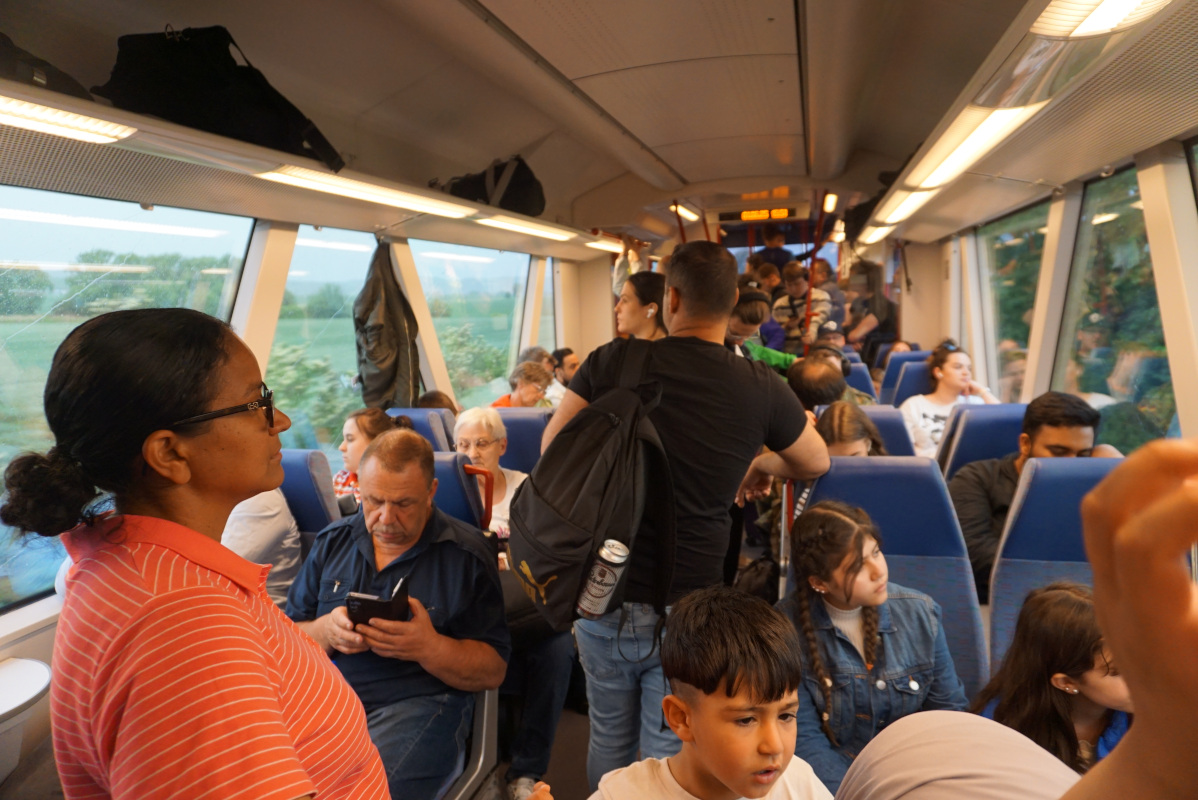 This Erfurter Bahn train was quite full.
Later on it filled up even more.
As in many other parts of Germany the small railcars are often not sufficient to handle demand.
[Jun 2025].
This Erfurter Bahn train was quite full.
Later on it filled up even more.
As in many other parts of Germany the small railcars are often not sufficient to handle demand.
[Jun 2025].
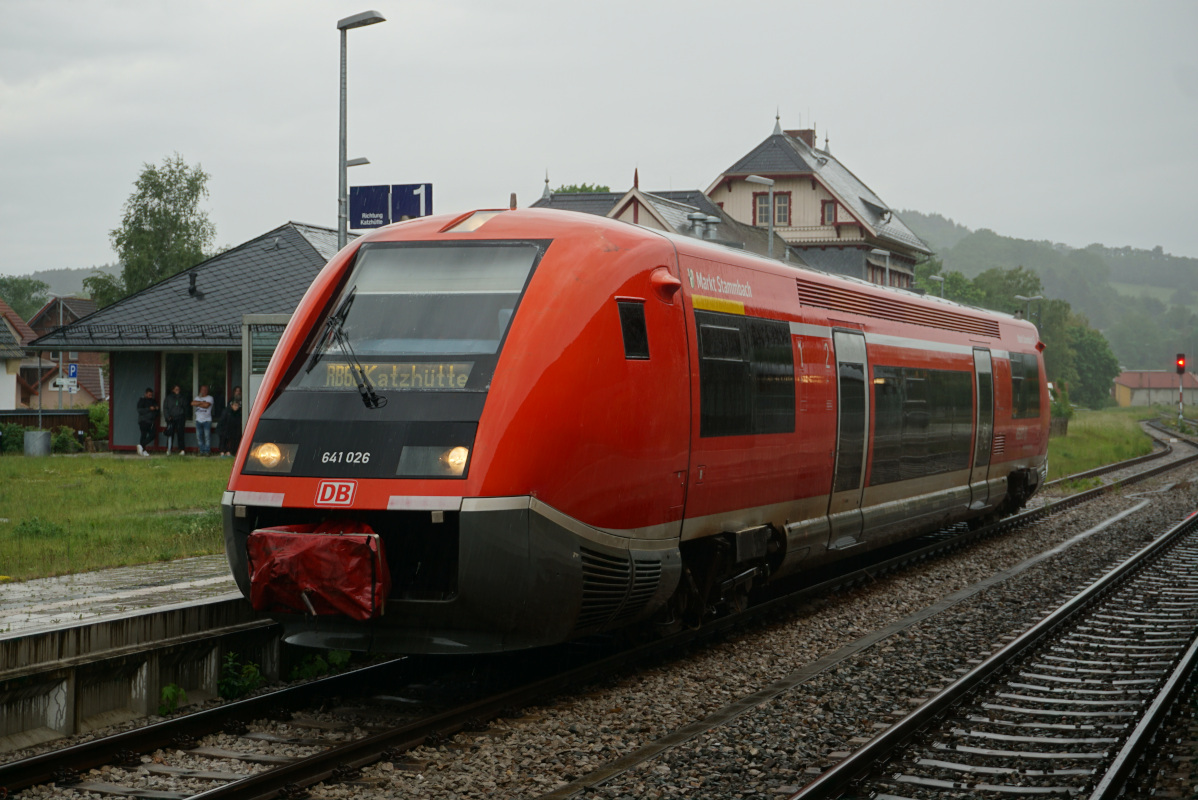 In Rottenbach there is a connection to the Schwarza Valley Railway to Katzhütte, a branch railway into the Thuringian Forest that is operated by Deutsche Bahn.
The relatively small Class 641 railcars are used on this line.
[Jun 2025].
In Rottenbach there is a connection to the Schwarza Valley Railway to Katzhütte, a branch railway into the Thuringian Forest that is operated by Deutsche Bahn.
The relatively small Class 641 railcars are used on this line.
[Jun 2025].
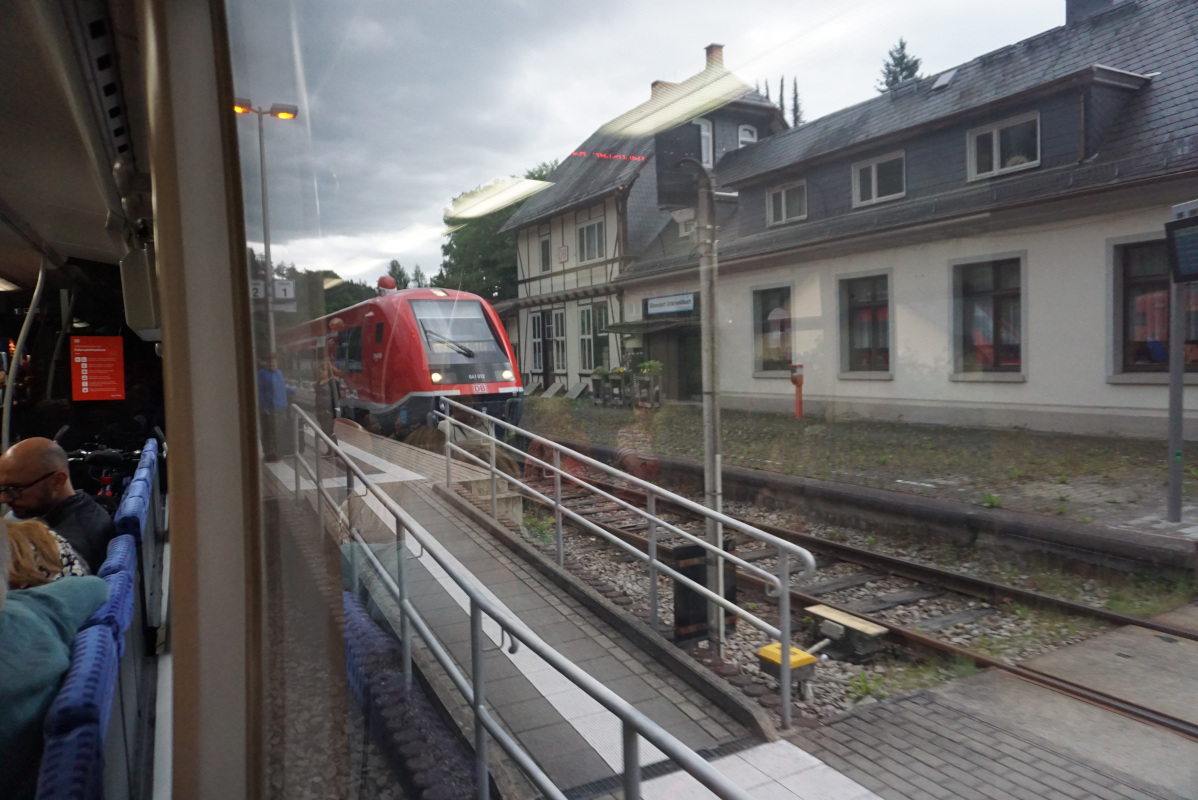 In Sitzendorf the trains cross every hour.
[Jun 2025].
In Sitzendorf the trains cross every hour.
[Jun 2025].
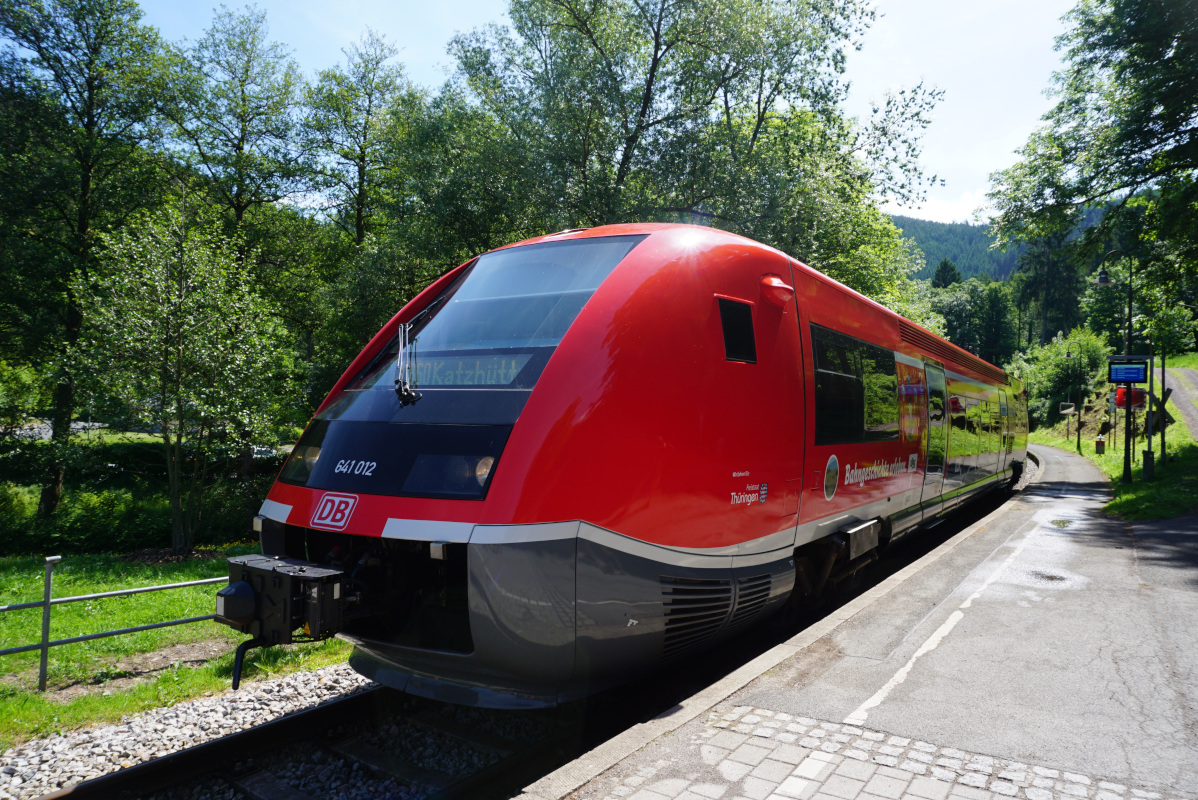 The Class 641 railcars are also called whale.
They were produced as a French-German cooperative project by rolling stock manufaturers De Dietrich Ferroviaire and Linke-Hofmann-Busch.
Both companies were later taken over by Alstom.
Deutsche Bahn received 40 railcars between 2001 and 2002.
The French railway SNCF got 331 railcars and the CFL of Luxembourg 6 railcars.
Here is such a railcar in Obstfelderschmiede.
[Jun 2025].
The Class 641 railcars are also called whale.
They were produced as a French-German cooperative project by rolling stock manufaturers De Dietrich Ferroviaire and Linke-Hofmann-Busch.
Both companies were later taken over by Alstom.
Deutsche Bahn received 40 railcars between 2001 and 2002.
The French railway SNCF got 331 railcars and the CFL of Luxembourg 6 railcars.
Here is such a railcar in Obstfelderschmiede.
[Jun 2025].
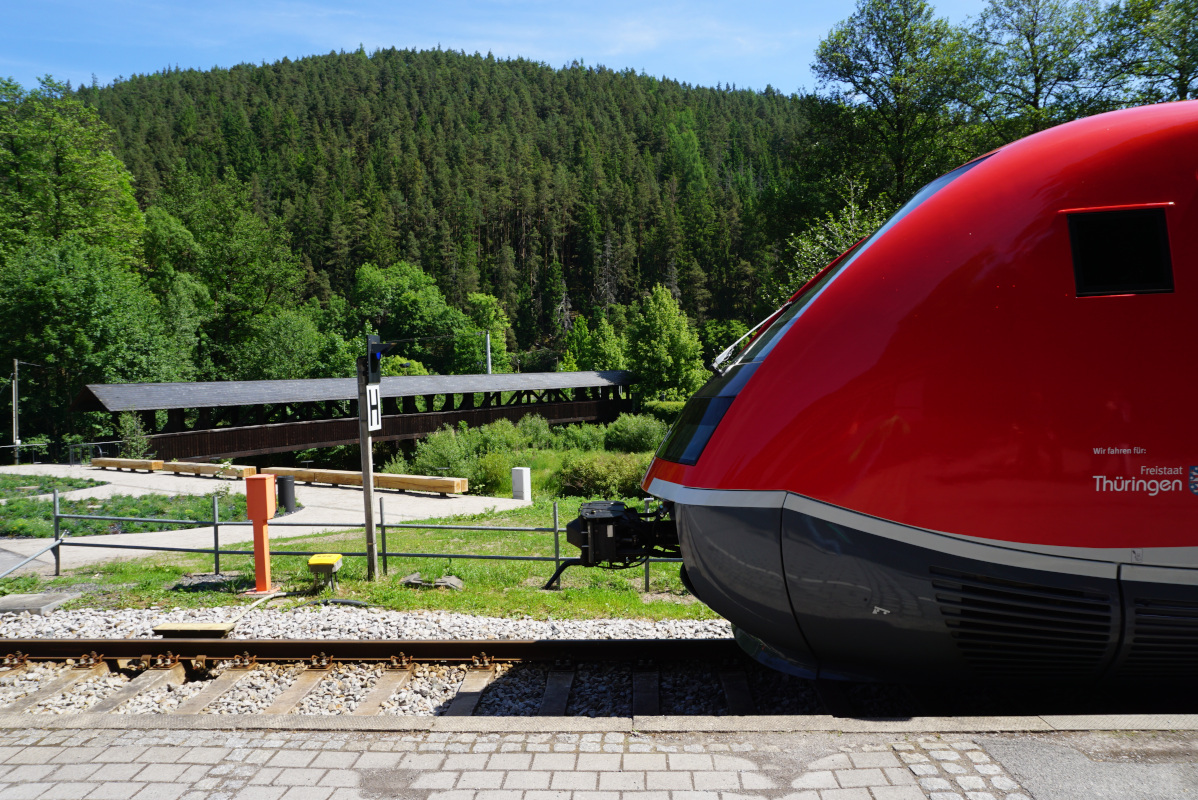 Many of the passengers only travel to Obstfelderschmiede.
Here there is good access to walking tracks, but even more important is the connection to the Thuringian moutanin railway.
In the background is a wooden bridge over the river Schwarza.
[Jun 2025].
Many of the passengers only travel to Obstfelderschmiede.
Here there is good access to walking tracks, but even more important is the connection to the Thuringian moutanin railway.
In the background is a wooden bridge over the river Schwarza.
[Jun 2025].
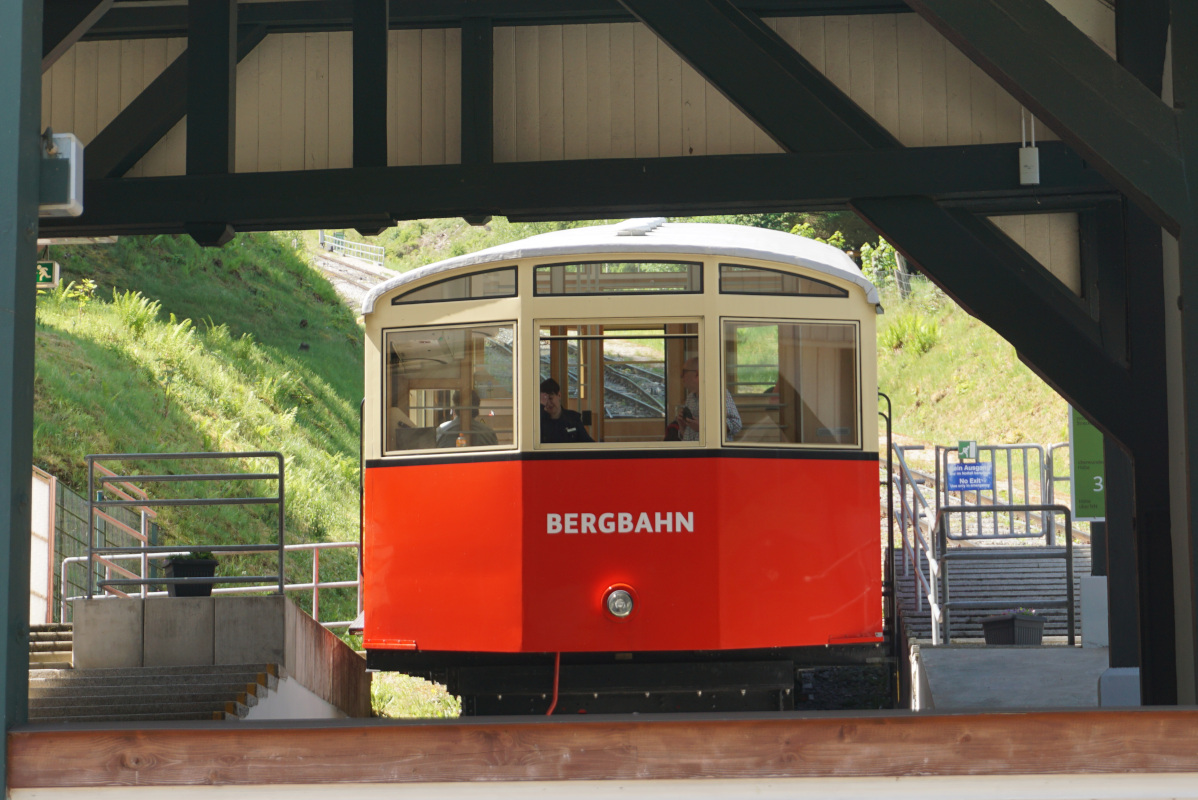 The Thuringian mountain railway is also called Oberweißbach mountain railway consists of a funicular in conjunction with a standard gauge electric railway line to Oberweißbach and Cursdorf.
The funicular has a broad gauge of 1800 mm.
It has a passenger carriage and a goods platform.
The passenger carriage arrives at the lower station of Obstfelderschmiede.
[Jun 2025].
The Thuringian mountain railway is also called Oberweißbach mountain railway consists of a funicular in conjunction with a standard gauge electric railway line to Oberweißbach and Cursdorf.
The funicular has a broad gauge of 1800 mm.
It has a passenger carriage and a goods platform.
The passenger carriage arrives at the lower station of Obstfelderschmiede.
[Jun 2025].
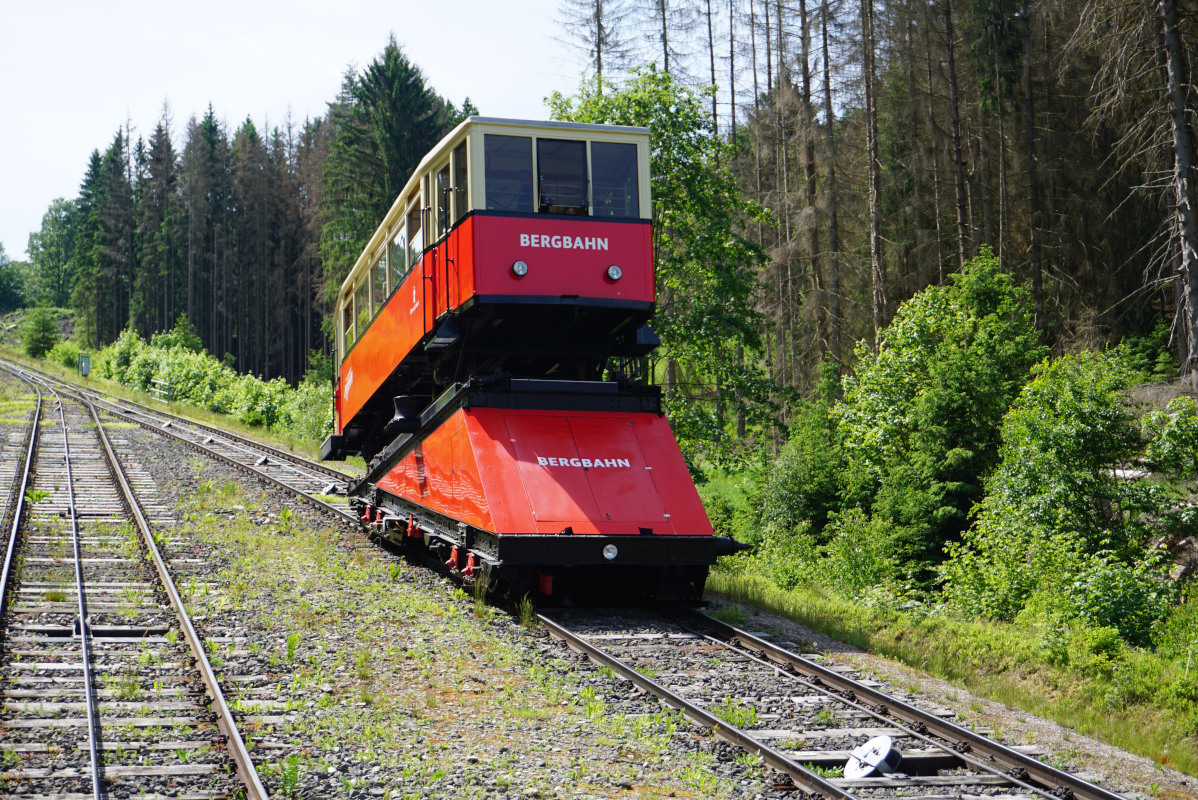 Previously the goods platform was used for the transport of freight wagons.
But now a passenger carriage is placed on the goods platform and it is also used to transport passengers.
In summer an open carriage is used.
[Jun 2025].
Previously the goods platform was used for the transport of freight wagons.
But now a passenger carriage is placed on the goods platform and it is also used to transport passengers.
In summer an open carriage is used.
[Jun 2025].
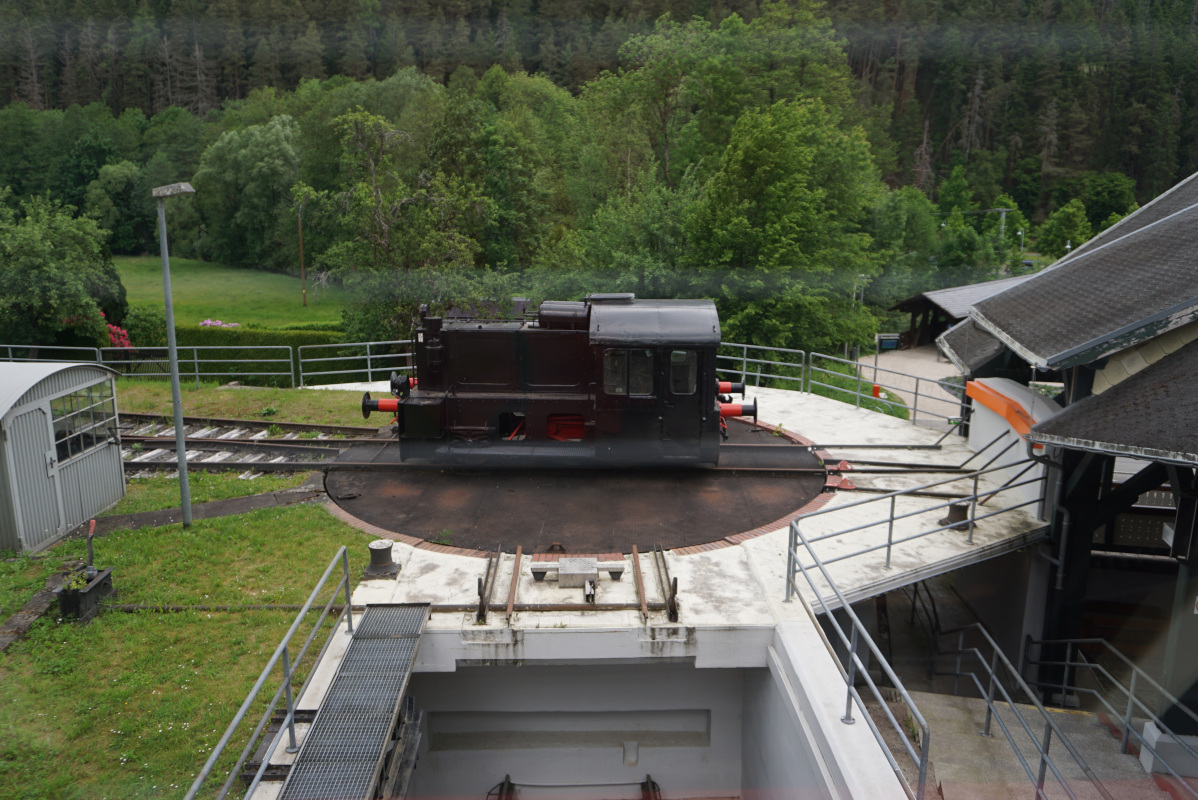 At the lower station there is a turntable, which was previously used to take freight wagons from the funicular to a siding of the Schwarza Valley Railway.
A Köf II shunting tractor stands on the turntable.
[Jun 2025].
At the lower station there is a turntable, which was previously used to take freight wagons from the funicular to a siding of the Schwarza Valley Railway.
A Köf II shunting tractor stands on the turntable.
[Jun 2025].
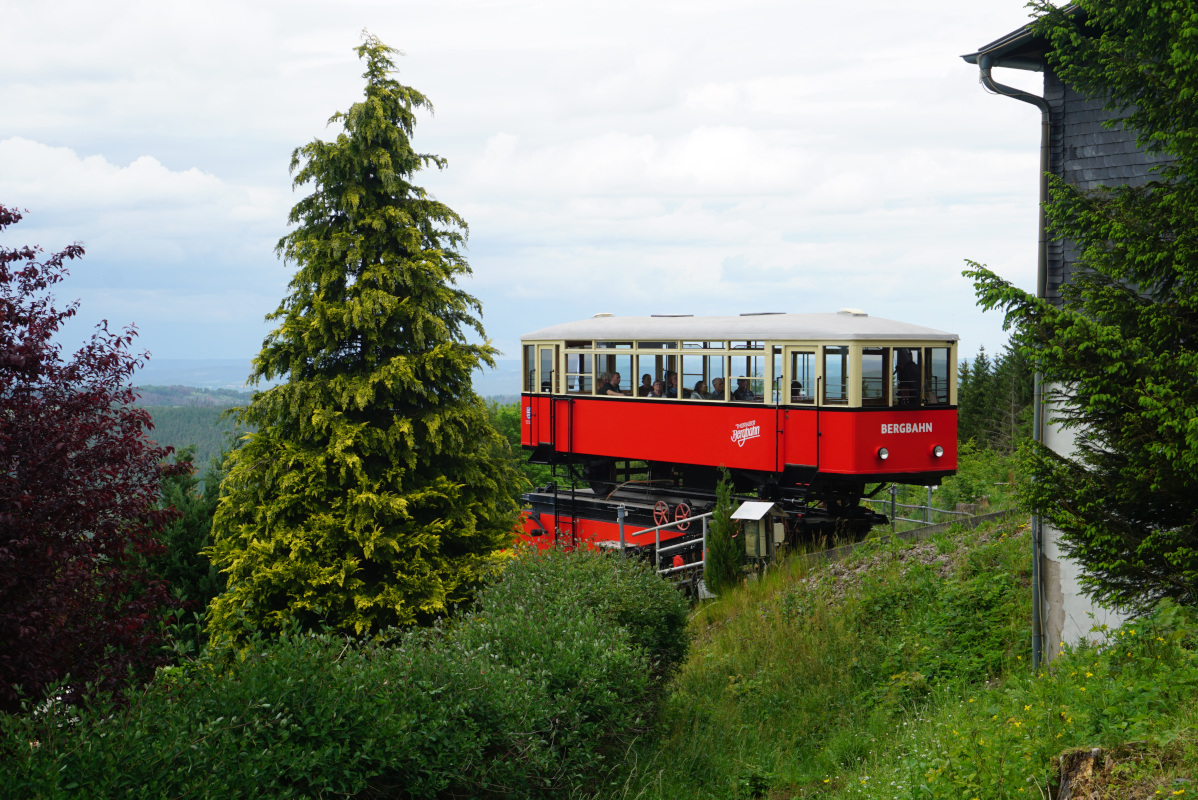 The funicular is 1351 m long and has an altitude difference of 323 m.
It has a 1:4 gradient.
The goods platform arrives with a passenger carriage at the top station Lichtenhain.
[Jun 2025].
The funicular is 1351 m long and has an altitude difference of 323 m.
It has a 1:4 gradient.
The goods platform arrives with a passenger carriage at the top station Lichtenhain.
[Jun 2025].
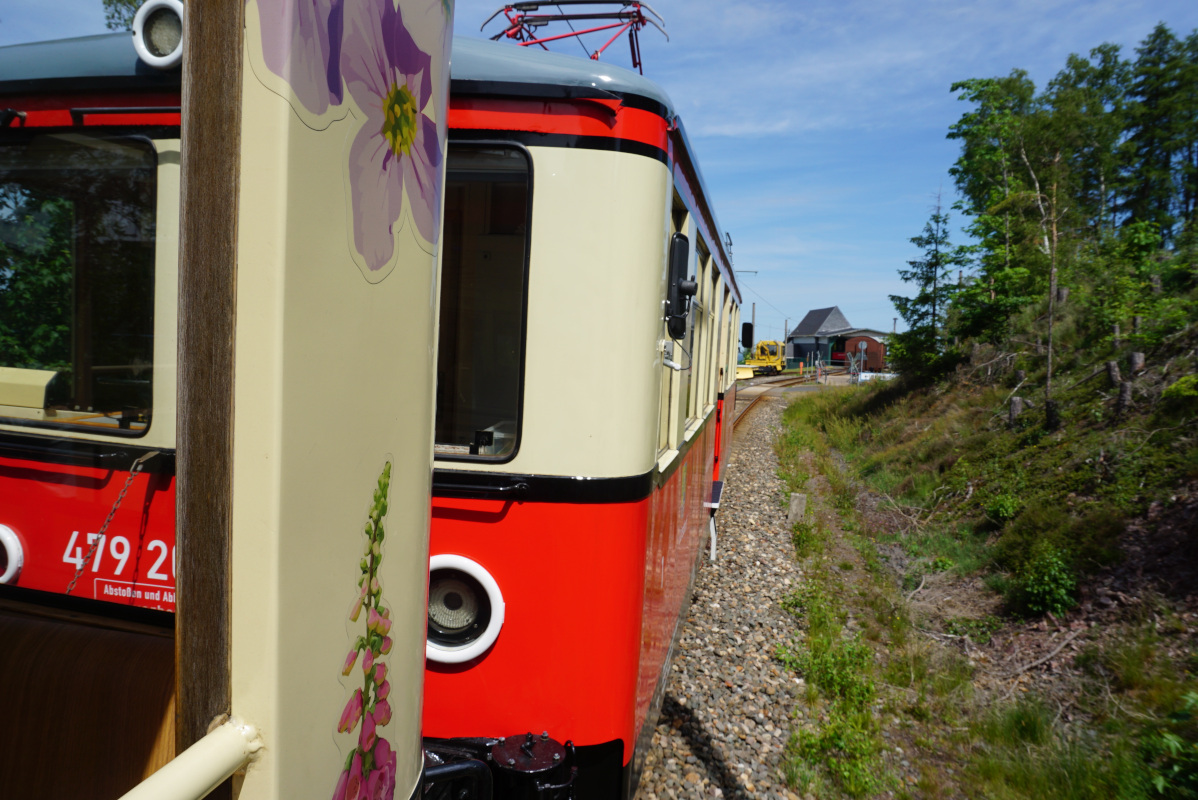 The electric level railway line runs across a high plateau from Lichtenhain to Cursdorf via Oberweißbach.
This is the view from the front carriage back towards railcar 479 203 shortly after departure from Lichtenhain.
[Jun 2025].
The electric level railway line runs across a high plateau from Lichtenhain to Cursdorf via Oberweißbach.
This is the view from the front carriage back towards railcar 479 203 shortly after departure from Lichtenhain.
[Jun 2025].
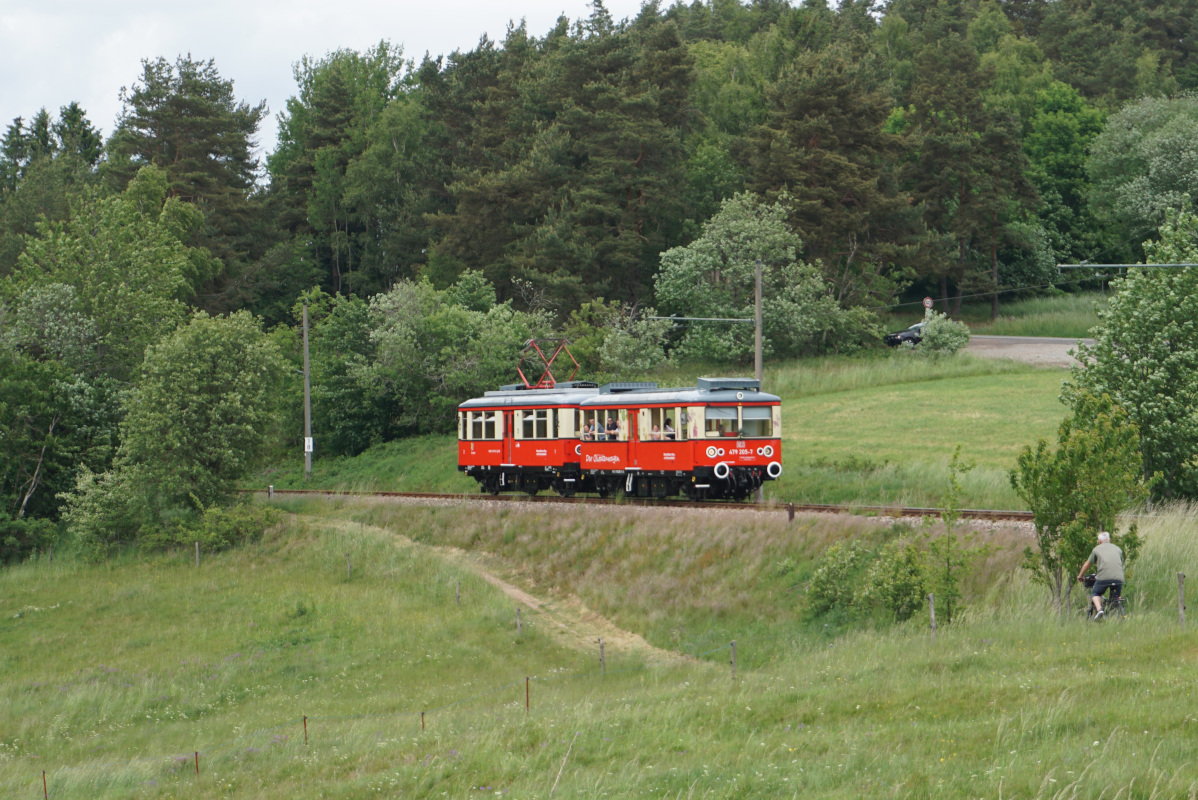 Three electric railcars were built as Class 279 in the years 1982 to 1984, with many standard Berlin S-Bahn parts.
Because in the Communist plan there was no provision for the construction of new railcars, these railcars were officially classed as reconstruction of older railcars, but only few parts of the older railcars were actually used.
By now they have the designation Class 479.
One such train travels near Lichtenhain.
[Jun 2025].
Three electric railcars were built as Class 279 in the years 1982 to 1984, with many standard Berlin S-Bahn parts.
Because in the Communist plan there was no provision for the construction of new railcars, these railcars were officially classed as reconstruction of older railcars, but only few parts of the older railcars were actually used.
By now they have the designation Class 479.
One such train travels near Lichtenhain.
[Jun 2025].
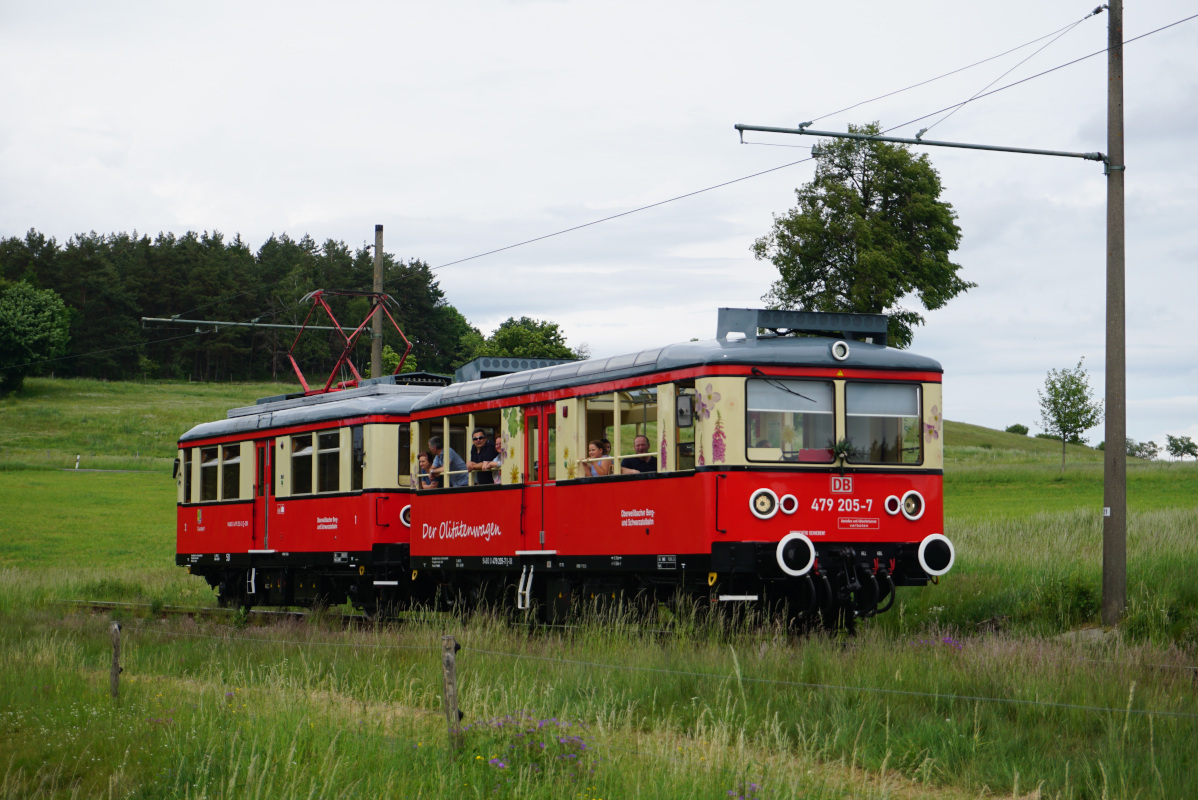 Railcar 479 205 was rebuilt in 2016.
It now has a glass roof, open sides, only one driving cab and no pantograph.
But it still has a motor and is supplied with electricity through the other railcar.
[Jun 2025].
Railcar 479 205 was rebuilt in 2016.
It now has a glass roof, open sides, only one driving cab and no pantograph.
But it still has a motor and is supplied with electricity through the other railcar.
[Jun 2025].
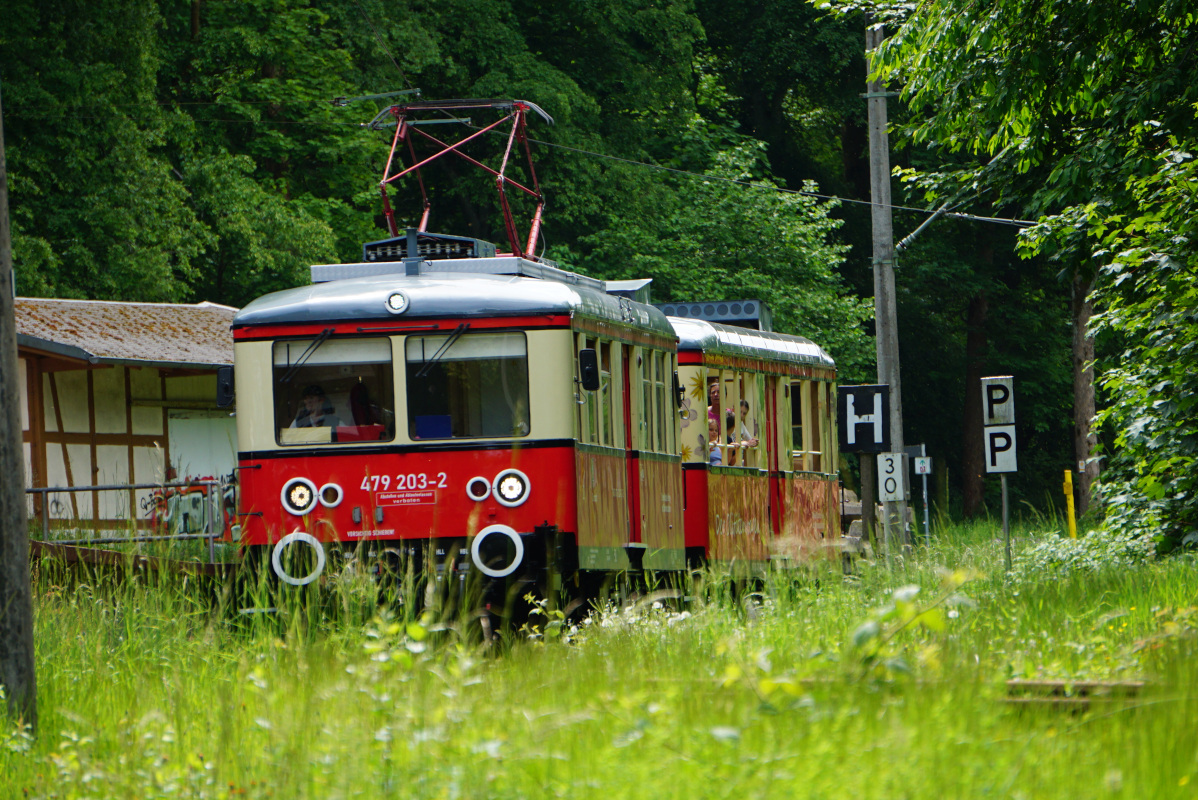 Trains of the Oberweißbacher Bergbahn operate every half an hour.
They need 8 minutes for the journey between Lichtenhain and Cursdorf.
Here is a train near Oberweißbach.
[Jun 2025].
Trains of the Oberweißbacher Bergbahn operate every half an hour.
They need 8 minutes for the journey between Lichtenhain and Cursdorf.
Here is a train near Oberweißbach.
[Jun 2025].
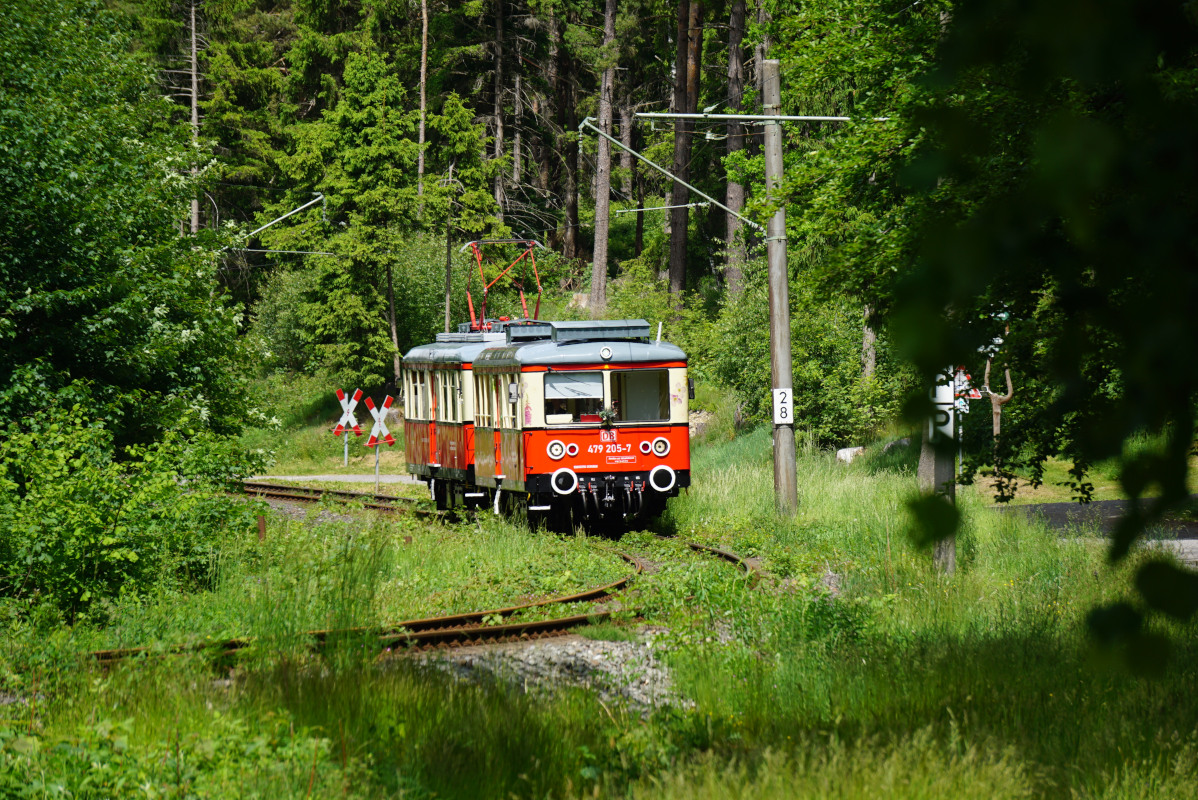 The Thuringian mountain railway was incorporated int the Deutsche Reichsbahn in 1949.
Since 1994 it is therefore part of the Deutsche Bahn.
Here in the Thuringian Forest it is quite pleasant to walk along the railway line.
[Jun 2025].
The Thuringian mountain railway was incorporated int the Deutsche Reichsbahn in 1949.
Since 1994 it is therefore part of the Deutsche Bahn.
Here in the Thuringian Forest it is quite pleasant to walk along the railway line.
[Jun 2025].
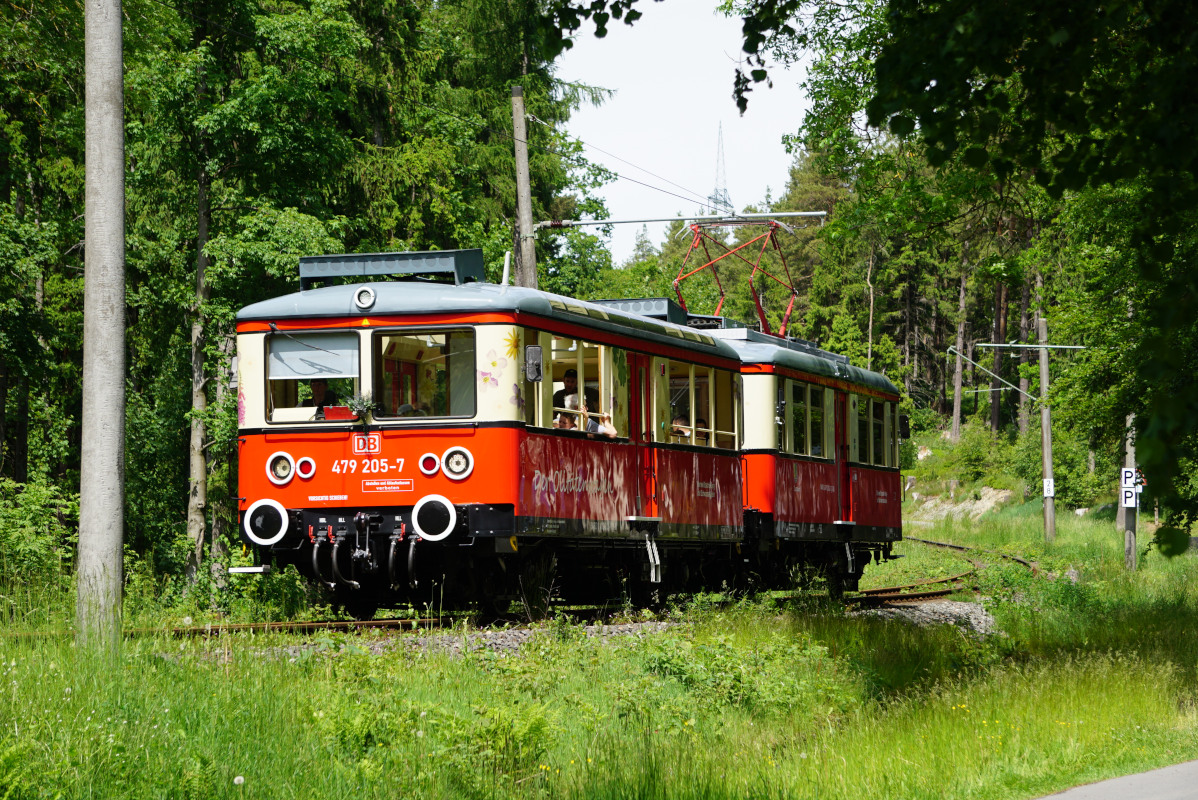 This train is on its way near Oberweißbach.
The small town with no more than 1,000 inhabitants has a church that accommodates 2,000 people.
The pulpit has space for 12 preachers.
Maybe the town could afford such a big church because it was quite wealthy through the trade of herbal essential oils.
[Jun 2025].
This train is on its way near Oberweißbach.
The small town with no more than 1,000 inhabitants has a church that accommodates 2,000 people.
The pulpit has space for 12 preachers.
Maybe the town could afford such a big church because it was quite wealthy through the trade of herbal essential oils.
[Jun 2025].
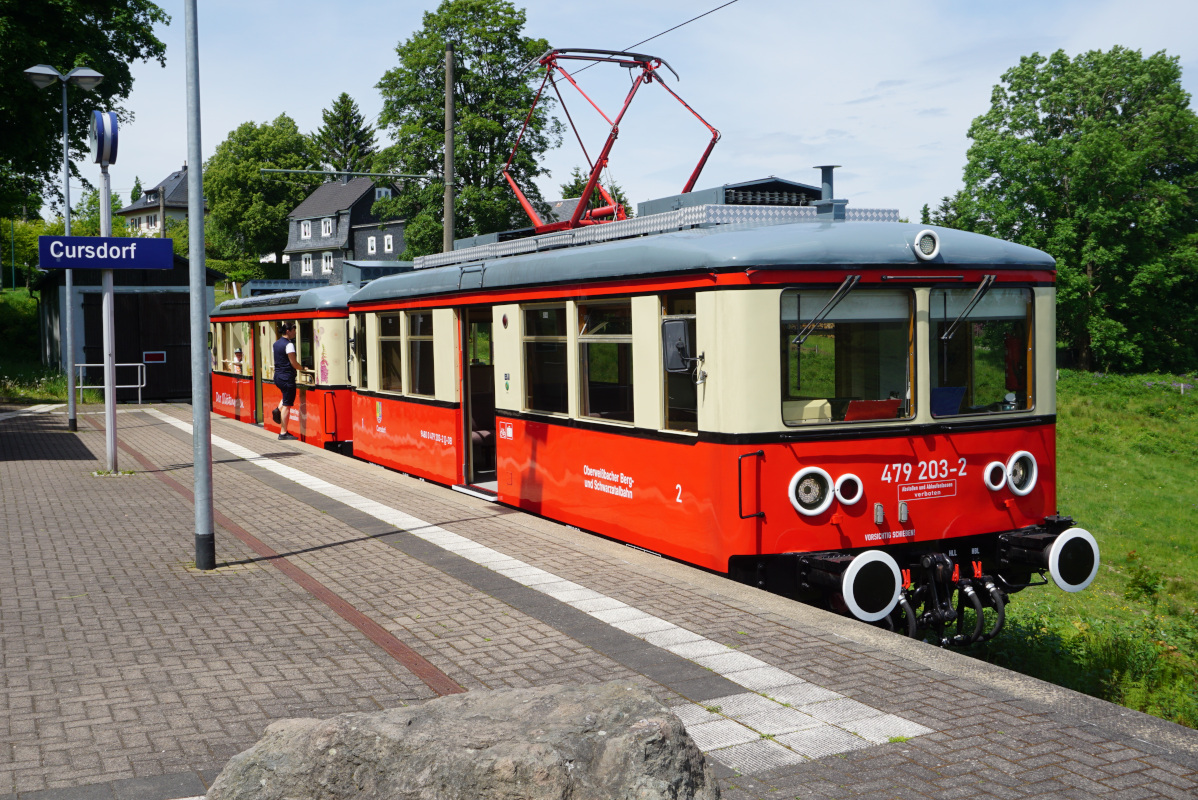 The railcars in the terminal station Cursdorf.
In the background a slate-covered house can be seen, as is typical in the Thuringian Forest.
Because the platforms are quite high the trains offer level boarding.
The train is about to depart for Lichtenhain.
[Jun 2025].
The railcars in the terminal station Cursdorf.
In the background a slate-covered house can be seen, as is typical in the Thuringian Forest.
Because the platforms are quite high the trains offer level boarding.
The train is about to depart for Lichtenhain.
[Jun 2025].