The Giessbach Railway was the first funicular railway in Europe opened particularly for leisure passengers.
It began operations in 1879.
The carriages from that time are still used.
[Apr 2015].

 The Giessbachbahn Railway connects the Giessbach Hotel with the landing bridge on Lake Brienz.
The hotel stands at an altitude of about 100m above the lake.
Near the landing bridge the Giessbach rushes into Lake Brienz.
[Apr 2016].
The Giessbachbahn Railway connects the Giessbach Hotel with the landing bridge on Lake Brienz.
The hotel stands at an altitude of about 100m above the lake.
Near the landing bridge the Giessbach rushes into Lake Brienz.
[Apr 2016].
 This is the view of Giessbach in summer, with hotel, funicular railway and landing bridge.
[Aug 2015].
This is the view of Giessbach in summer, with hotel, funicular railway and landing bridge.
[Aug 2015].
 That's the view in early spring before leaves appear on the trees.
The motor ship Brienz approaches Giessbach.
[Apr 2015].
That's the view in early spring before leaves appear on the trees.
The motor ship Brienz approaches Giessbach.
[Apr 2015].
 The Giessbach landing bridge.
To the right the covered walkway leads to the lower station of the funicular railway.
[Aug 2015].
The Giessbach landing bridge.
To the right the covered walkway leads to the lower station of the funicular railway.
[Aug 2015].
 The paddle steamer Lötschberg leaves the Glessbach landing bridge.
To the right is the station of the funicular railway.
[Jul 2015].
The paddle steamer Lötschberg leaves the Glessbach landing bridge.
To the right is the station of the funicular railway.
[Jul 2015].
 A carriage of the Giessbach railway waits in the lower station for the next trip.
The station's roof with the bend is quite visible.
[Apr 2015].
A carriage of the Giessbach railway waits in the lower station for the next trip.
The station's roof with the bend is quite visible.
[Apr 2015].
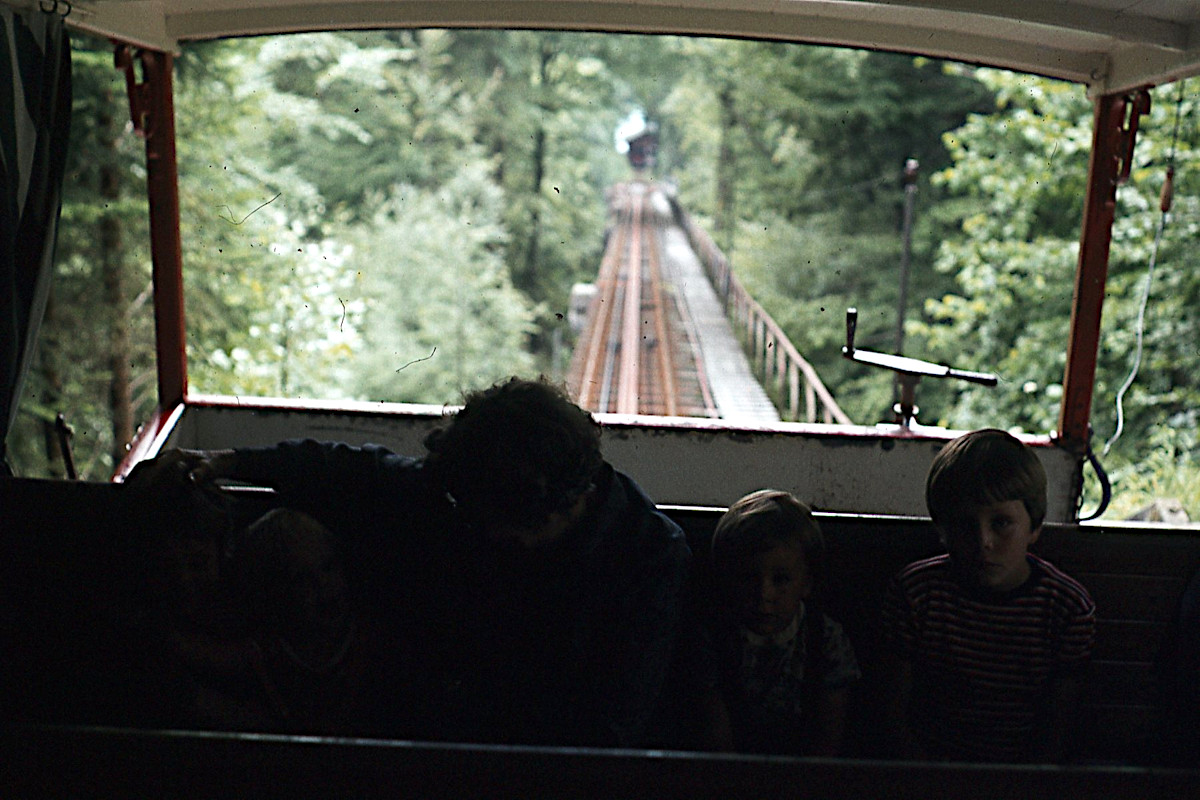 This is the view back towards the lower station from one of the cars of the funicular.
The line is straight and goes directly through the forest.
[Jul 1982].
This is the view back towards the lower station from one of the cars of the funicular.
The line is straight and goes directly through the forest.
[Jul 1982].
 In the middle of the 345m long funicular railway is crossing loop.
Looking up the hill, Carriage 1 always travels on the left, carriage 2 always on the right.
This is the view from carriage 1 towards carriage 2 during the trip.
[Jul 2015].
In the middle of the 345m long funicular railway is crossing loop.
Looking up the hill, Carriage 1 always travels on the left, carriage 2 always on the right.
This is the view from carriage 1 towards carriage 2 during the trip.
[Jul 2015].
 The upper part of the Giessbach Railway runs over several iron girder bridges that
together are 174m long.
The crossing loop also is on a bridge.
[May 2014].
The upper part of the Giessbach Railway runs over several iron girder bridges that
together are 174m long.
The crossing loop also is on a bridge.
[May 2014].
 The bridges carry the railway high above the forest floor and the Giessbach stream among the tree tops.
[May 2014].
The bridges carry the railway high above the forest floor and the Giessbach stream among the tree tops.
[May 2014].
 In summer the Giessbach Railway is fully framed by the green of the trees.
[Jul 2005].
In summer the Giessbach Railway is fully framed by the green of the trees.
[Jul 2005].
 The upper station of the Giessbach Railway is right beside the Giessbach Hotel, which was opened in 1875.
It lies like a castle above Lake Brienz.
[May 2014].
The upper station of the Giessbach Railway is right beside the Giessbach Hotel, which was opened in 1875.
It lies like a castle above Lake Brienz.
[May 2014].
 Carriage 1 in the upper half of Giessbach line.
[Apr 2015].
Carriage 1 in the upper half of Giessbach line.
[Apr 2015].
 This carriage is about to arrive at the upper station.
[Apr 2015].
This carriage is about to arrive at the upper station.
[Apr 2015].
 This is one of the many waterfalls of the Giessbach near the hotel.
[Apr 2016].
This is one of the many waterfalls of the Giessbach near the hotel.
[Apr 2016].
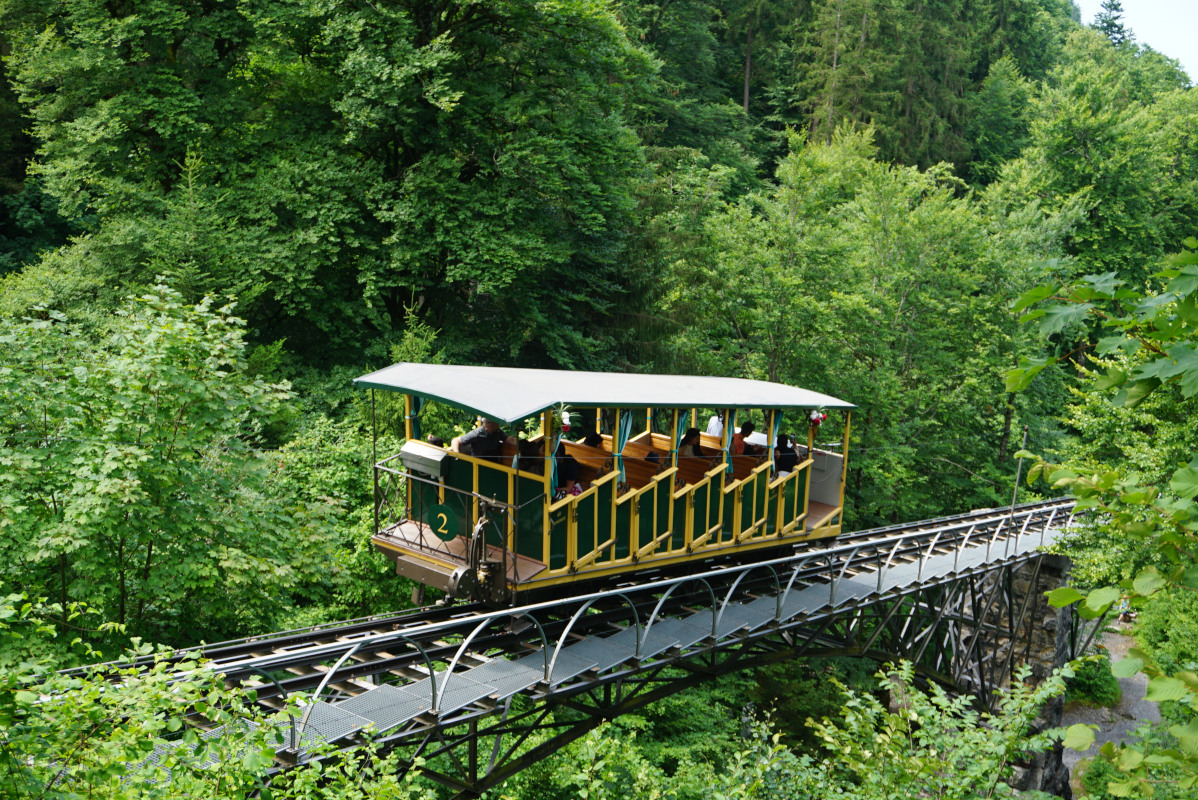 During revisions in 2019 and 2020 the cars received their original livery of green and ocre again.
That's the way they appeared during the 19th century before red became the colour of funiculars.
[Jul 2025].
During revisions in 2019 and 2020 the cars received their original livery of green and ocre again.
That's the way they appeared during the 19th century before red became the colour of funiculars.
[Jul 2025].
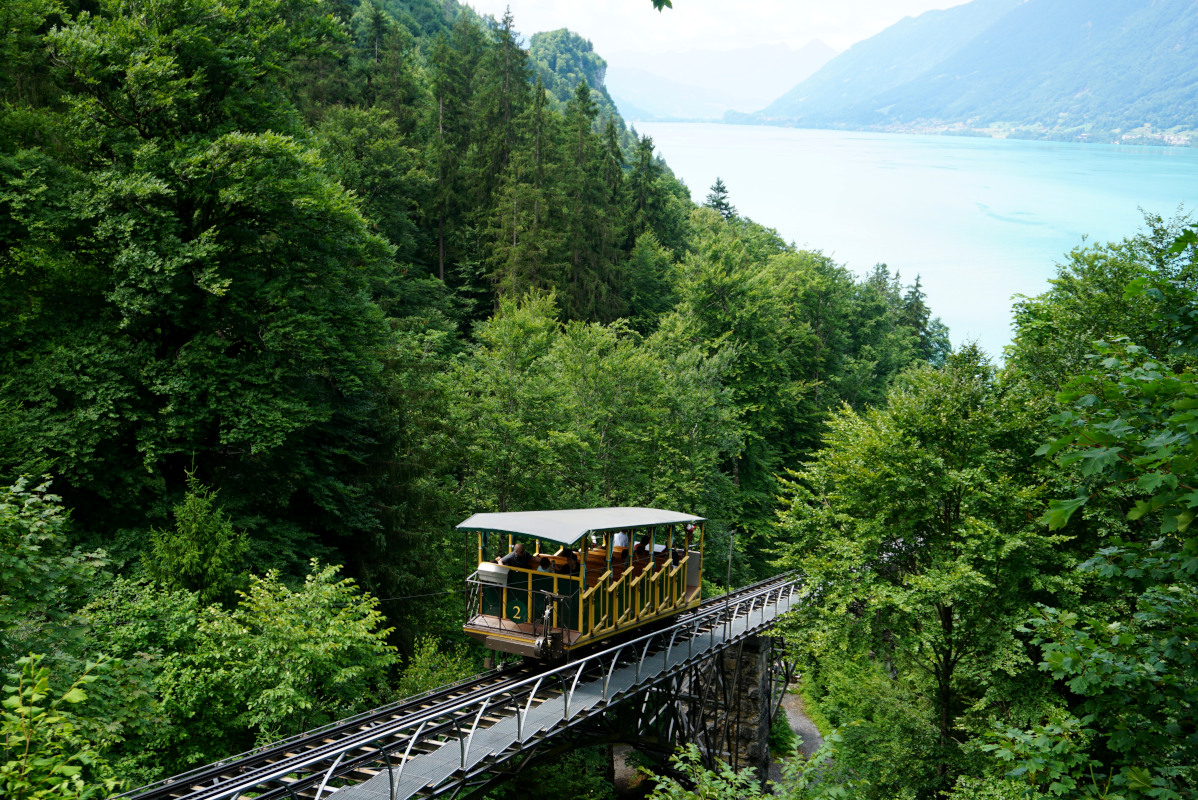 In the green colours the funicular blends into its environment and is not as contrasted as the former red cars.
One of the cars travels near the hotel station above Lake Brienz.
[Jul 2025].
In the green colours the funicular blends into its environment and is not as contrasted as the former red cars.
One of the cars travels near the hotel station above Lake Brienz.
[Jul 2025].
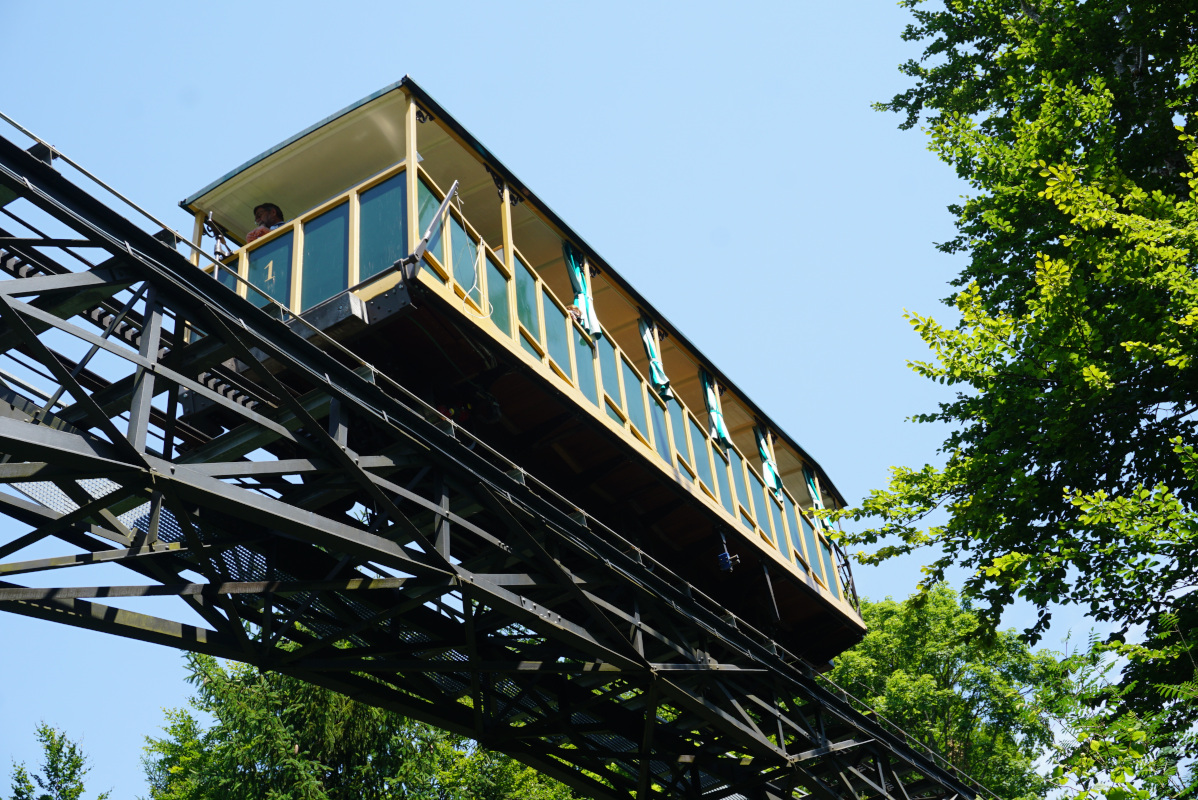 The Giessbach funicular still uses technology from the 19th century, which was quite pioneering then.
It was the first single-track funicular in the world and in the middle had points that were developed by the engineer Carl Roman Abt.
They were replaced in 1891 with a simpler, more robust version.
[Jul 2025].
The Giessbach funicular still uses technology from the 19th century, which was quite pioneering then.
It was the first single-track funicular in the world and in the middle had points that were developed by the engineer Carl Roman Abt.
They were replaced in 1891 with a simpler, more robust version.
[Jul 2025].
 The Harder Railway leads from Interlaken to Harder Kulm.
This is just below the summit of the local mountain and gives access to a restaurant with sweeping views.
One of the carriages in Interlaken.
[Apr 2016].
The Harder Railway leads from Interlaken to Harder Kulm.
This is just below the summit of the local mountain and gives access to a restaurant with sweeping views.
One of the carriages in Interlaken.
[Apr 2016].
 The Harder Railway is 1.4 km long.
It is operated by the Jungfraubahn Group.
Since 2008 a panorama carriage built by Gangloff is used.
This is the view through the roof of the panorama carriage.
[Apr 2016].
The Harder Railway is 1.4 km long.
It is operated by the Jungfraubahn Group.
Since 2008 a panorama carriage built by Gangloff is used.
This is the view through the roof of the panorama carriage.
[Apr 2016].
 The Niesen is a 2,362m high mountain and looks like a pyramid.
Not only due to its distinctive shape, but also the views from the top, it is a popular destination.
[Mar 2016].
The Niesen is a 2,362m high mountain and looks like a pyramid.
Not only due to its distinctive shape, but also the views from the top, it is a popular destination.
[Mar 2016].
 A funicular railway ascends the Niesen from Mülenen in two sections.
It was opened in 1910.
This is the view along the line from the station in Mülenen.
[May 2014].
A funicular railway ascends the Niesen from Mülenen in two sections.
It was opened in 1910.
This is the view along the line from the station in Mülenen.
[May 2014].
 In Mülenen the funicular railway crosses the River Kander right by the station.
[May 2014].
In Mülenen the funicular railway crosses the River Kander right by the station.
[May 2014].
 The first section is 2.1km, the second 1.4 km long.
Beside the railway are stairs,
which in the Guiness Book of Records are noted as the longest stairs in the world.
The stairs are normally closed to the public.
[May 2014].
The first section is 2.1km, the second 1.4 km long.
Beside the railway are stairs,
which in the Guiness Book of Records are noted as the longest stairs in the world.
The stairs are normally closed to the public.
[May 2014].
 Above the tree line the Niesen Railway passes through tunnels,
bridges and embankments up the slopes.
[May 2014].
Above the tree line the Niesen Railway passes through tunnels,
bridges and embankments up the slopes.
[May 2014].
 The summit terminal is inside a tunnel, probably also to protect the carriages and passenger from the weather.
A carriage has just arrived at the summit station.
[May 2014].
The summit terminal is inside a tunnel, probably also to protect the carriages and passenger from the weather.
A carriage has just arrived at the summit station.
[May 2014].
 The Niesen Railway near the summit.
[May 2014].
The Niesen Railway near the summit.
[May 2014].
 The Beatenbergbahn connects Beatenbucht on Lake Thun to the village of Beatenberg on the slopes of the mountain Niederhorn.
The funicular railway opened in 1889.
[Oct 2015].
The Beatenbergbahn connects Beatenbucht on Lake Thun to the village of Beatenberg on the slopes of the mountain Niederhorn.
The funicular railway opened in 1889.
[Oct 2015].
 Beatenbucht is not a village, but just the lakeside terminal of the Beatenberg Railway.
Here the funicular railway connects to ships on Lake Tun and bus line 21 Thun-Oberhofen-Gunten-Beatenbucht-Interlaken.
[Jan 2016].
Beatenbucht is not a village, but just the lakeside terminal of the Beatenberg Railway.
Here the funicular railway connects to ships on Lake Tun and bus line 21 Thun-Oberhofen-Gunten-Beatenbucht-Interlaken.
[Jan 2016].
 Beatenbucht Station.
To the left is an articulated Line 21 bus.
For many buses from Thun Beatenbucht is also the terminus, while others continue on to Interlaken.
[May 2014].
Beatenbucht Station.
To the left is an articulated Line 21 bus.
For many buses from Thun Beatenbucht is also the terminus, while others continue on to Interlaken.
[May 2014].
 The track curves around these rocks.
[May 2014].
The track curves around these rocks.
[May 2014].
 A carriage of the Beatenberg Railway arrives at the Beatenbucht terminal.
[Oct 2014].
A carriage of the Beatenberg Railway arrives at the Beatenbucht terminal.
[Oct 2014].
 The Beatenberg Railway near Beatenbucht.
In the background are Lake Thun, the towns of Spiez and Faulensee on the other side of the lake
and the Stockhorn mountain range.
[Oct 2014].
The Beatenberg Railway near Beatenbucht.
In the background are Lake Thun, the towns of Spiez and Faulensee on the other side of the lake
and the Stockhorn mountain range.
[Oct 2014].
 In 2005 the old carriages were replaced by new panorama carriages built by Gangloff.
[Oct 2014].
In 2005 the old carriages were replaced by new panorama carriages built by Gangloff.
[Oct 2014].
 That's the interior of the carriages.
[Mar 2015].
That's the interior of the carriages.
[Mar 2015].
 The Beatenberg Railway near the lower end of the line.
[Oct 2014].
The Beatenberg Railway near the lower end of the line.
[Oct 2014].
 A view from the funicular railway towards the lake and the Stockhorn Range.
[Aug 2014].
A view from the funicular railway towards the lake and the Stockhorn Range.
[Aug 2014].
 The carriages meet at the crossing point at the centre of the line.
[Mar 2015].
The carriages meet at the crossing point at the centre of the line.
[Mar 2015].
 The crossing loop at the centre of the line.
[Mar 2016].
The crossing loop at the centre of the line.
[Mar 2016].
 The Beatenberg Railway in the upper section of the line.
The railway operates every 20 minutes.
[Aug 2014].
The Beatenberg Railway in the upper section of the line.
The railway operates every 20 minutes.
[Aug 2014].
 The best view is from the lower end of the carriages.
This carriage has just left Beatenberg.
[Aug 2014].
The best view is from the lower end of the carriages.
This carriage has just left Beatenberg.
[Aug 2014].
 This carriage is about to arrive in Beatenberg.
The Thunersee-Beatenberg-Bahn has by now merged with the Niederhornbahn and has adopted the name in its presentation.
[Mar 2016].
This carriage is about to arrive in Beatenberg.
The Thunersee-Beatenberg-Bahn has by now merged with the Niederhornbahn and has adopted the name in its presentation.
[Mar 2016].
 In the background is the pyramidical mountain Niesen.
That's the view from Beatenberg station.
[Mar 2016].
In the background is the pyramidical mountain Niesen.
That's the view from Beatenberg station.
[Mar 2016].
 Beatenberg Station.
From here a gondola continues to the Niederhorn.
[Aug 2014].
Beatenberg Station.
From here a gondola continues to the Niederhorn.
[Aug 2014].
 Inside Beatenberg station.
The carriages have a tray to carry large items such as bicycles at the upper end.
[Mar 2016].
Inside Beatenberg station.
The carriages have a tray to carry large items such as bicycles at the upper end.
[Mar 2016].
 The gondola up the Niederhorn runs groups of three cabins.
It normally runs every 20 minutes, except during times of high demand, when it operates continually.
[May 2014].
The gondola up the Niederhorn runs groups of three cabins.
It normally runs every 20 minutes, except during times of high demand, when it operates continually.
[May 2014].
 The Niederhornbahn is used by many paragliders who start from the slopes near the summit of the Niederhorn.
[May 2014].
The Niederhornbahn is used by many paragliders who start from the slopes near the summit of the Niederhorn.
[May 2014].
 From 1885 to 1973 it was operated by water ballast.
Water was loaded in the upper carriage, which during its descent pulled the other carriage up the incline.
One of these old carriages now stands near the lower terminus.
[Aug 2015].
From 1885 to 1973 it was operated by water ballast.
Water was loaded in the upper carriage, which during its descent pulled the other carriage up the incline.
One of these old carriages now stands near the lower terminus.
[Aug 2015].
 The Marzili Funicular is only 105m long.
This is one of the modern carriages.
[Aug 2015].
The Marzili Funicular is only 105m long.
This is one of the modern carriages.
[Aug 2015].
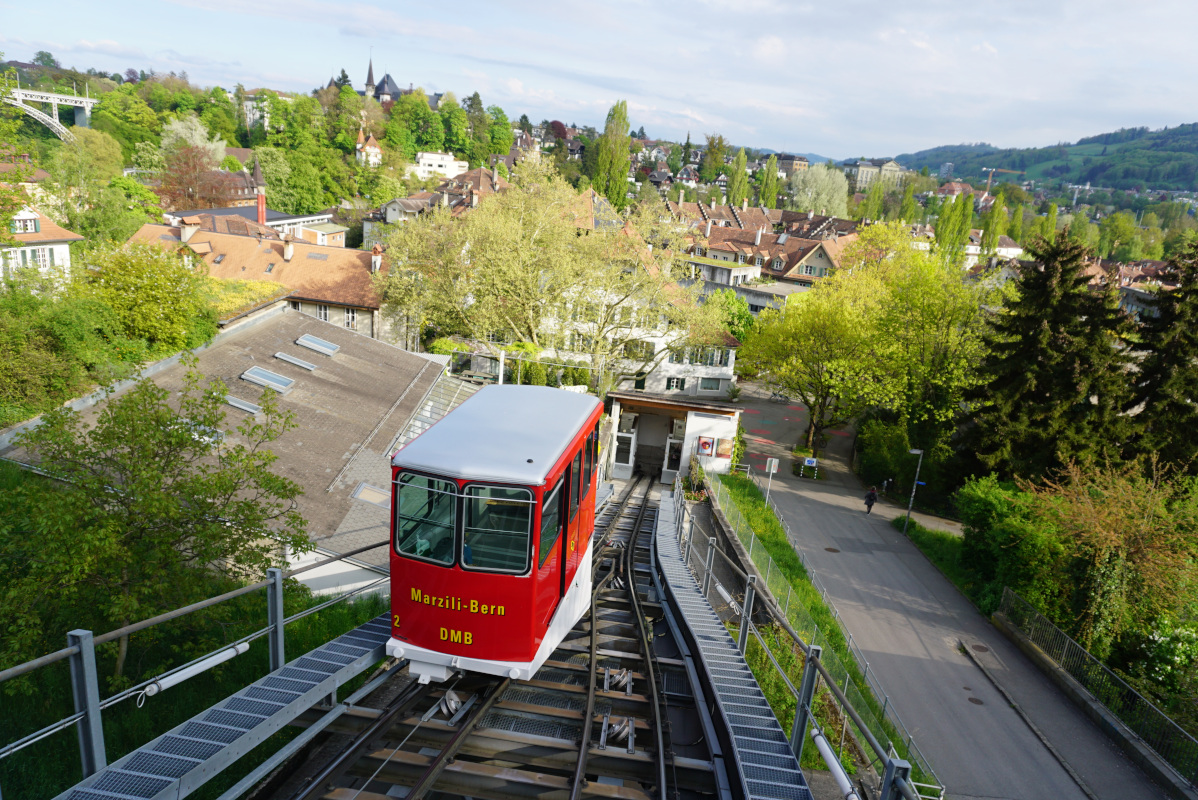 The newer cars were built in 1973.
The Marzili Funicular moves quite a lot of people, because the fare is included in many tickets.
Particularly in summer it is a good way to access the Marzilie outdoor pools.
[Apr 2025].
The newer cars were built in 1973.
The Marzili Funicular moves quite a lot of people, because the fare is included in many tickets.
Particularly in summer it is a good way to access the Marzilie outdoor pools.
[Apr 2025].
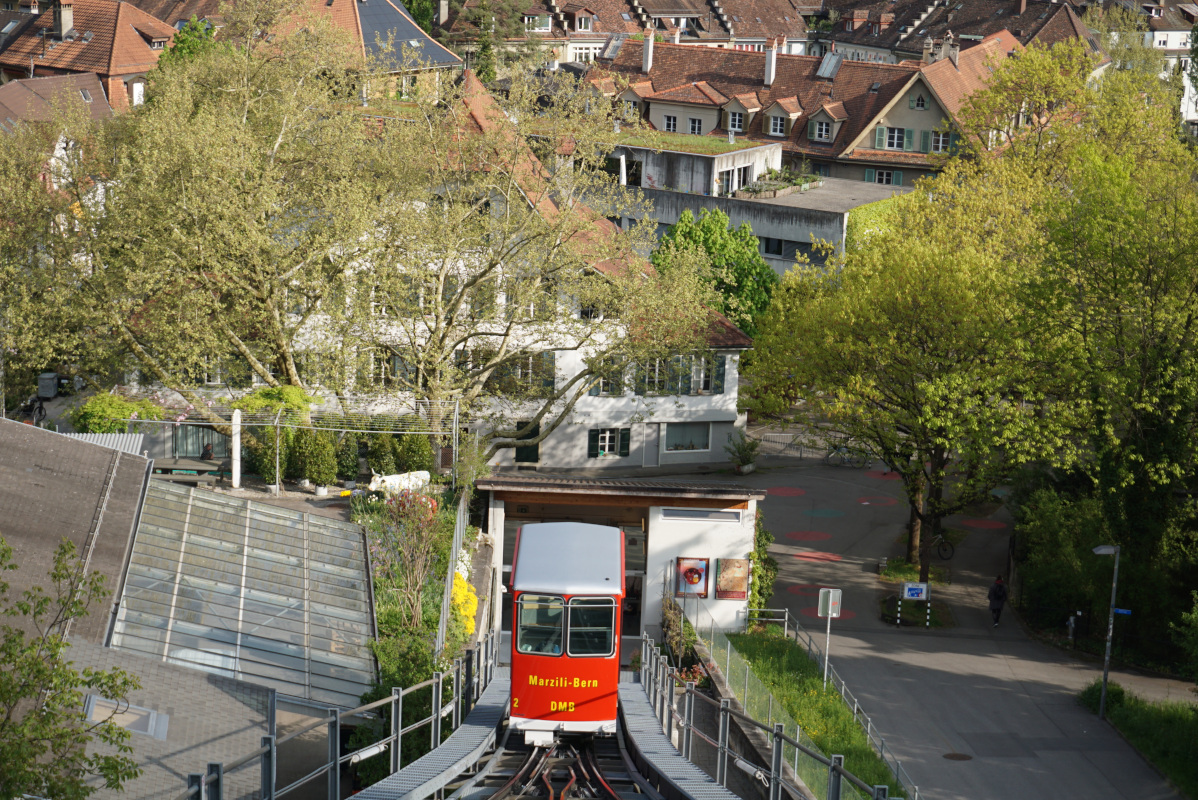 One of the cars is about to arrive at the lower station of the Marzili Funicular.
[Apr 2025].
One of the cars is about to arrive at the lower station of the Marzili Funicular.
[Apr 2025].
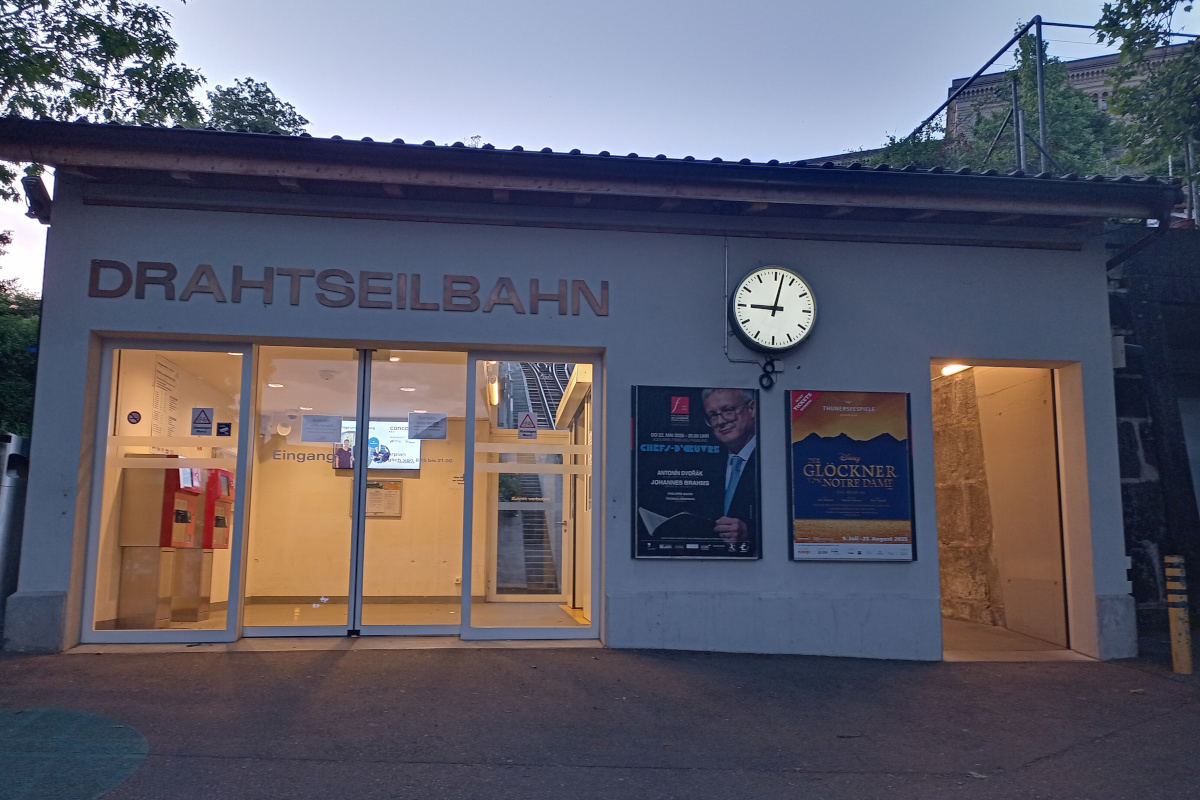 This is the lower station of the Marzili Funicular as seen from the street.
[May 2025].
This is the lower station of the Marzili Funicular as seen from the street.
[May 2025].
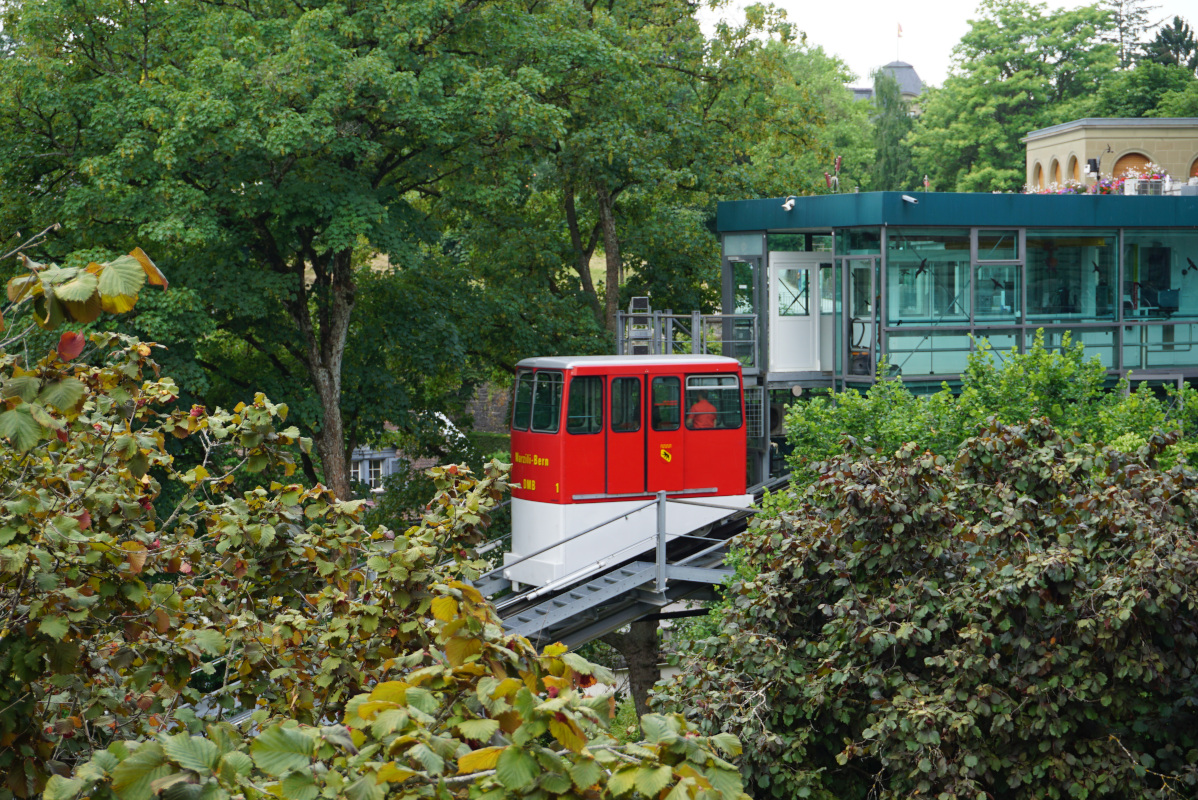 The upper station of the Marzili Funicular is between the federal house and the park Kleine Schanze and not far from the Bern Railway Station.
[Jun 2025].
The upper station of the Marzili Funicular is between the federal house and the park Kleine Schanze and not far from the Bern Railway Station.
[Jun 2025].
 The Gurten Funicular Railway runs from the suburb Wabern to the Gurten, the hill above Bern.
On this funicular railway modern carriages made by Gangloff are also used.
[Aug 2014].
The Gurten Funicular Railway runs from the suburb Wabern to the Gurten, the hill above Bern.
On this funicular railway modern carriages made by Gangloff are also used.
[Aug 2014].
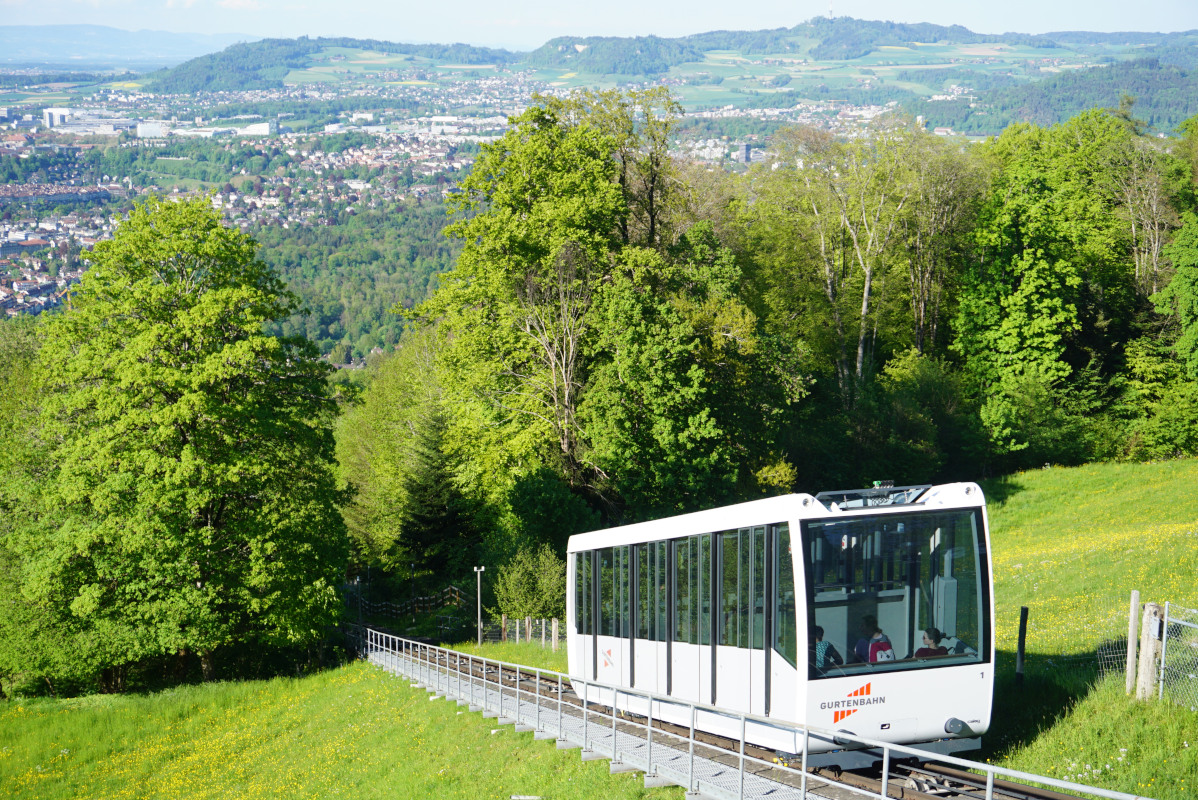 The fare for travelling on the Gurten Funicular is included in the local monthly pass, the nation-wide annual transport pass, national day passes, but not in local day passes or zone tickets.
Tourists can use the Bern-Ticket on the funicular.
The normal price of CHF 7.00 is not cheap.
[Apr 2025].
The fare for travelling on the Gurten Funicular is included in the local monthly pass, the nation-wide annual transport pass, national day passes, but not in local day passes or zone tickets.
Tourists can use the Bern-Ticket on the funicular.
The normal price of CHF 7.00 is not cheap.
[Apr 2025].
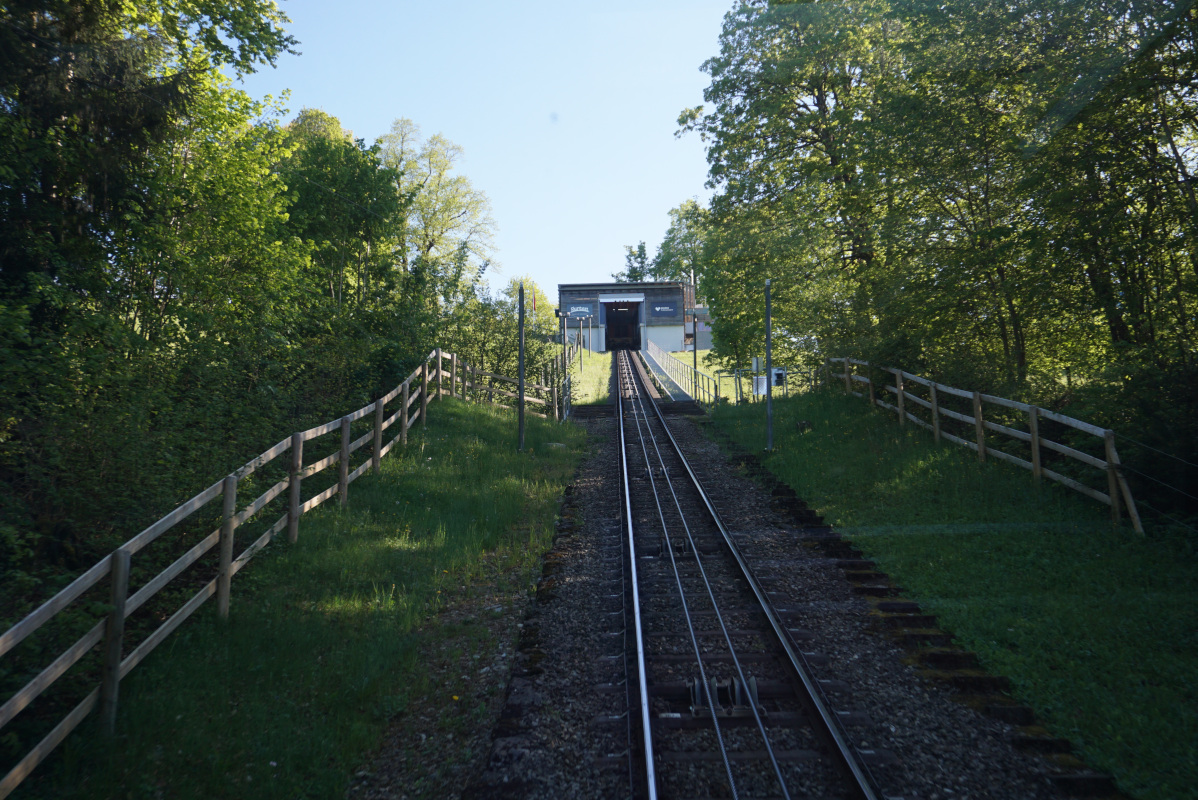 This is the view towards the top station from one of the funicular cars.
The Gurten funicular leads through forest and meadows up to the hill, from the city towards a rural park.
[Apr 2025].
This is the view towards the top station from one of the funicular cars.
The Gurten funicular leads through forest and meadows up to the hill, from the city towards a rural park.
[Apr 2025].
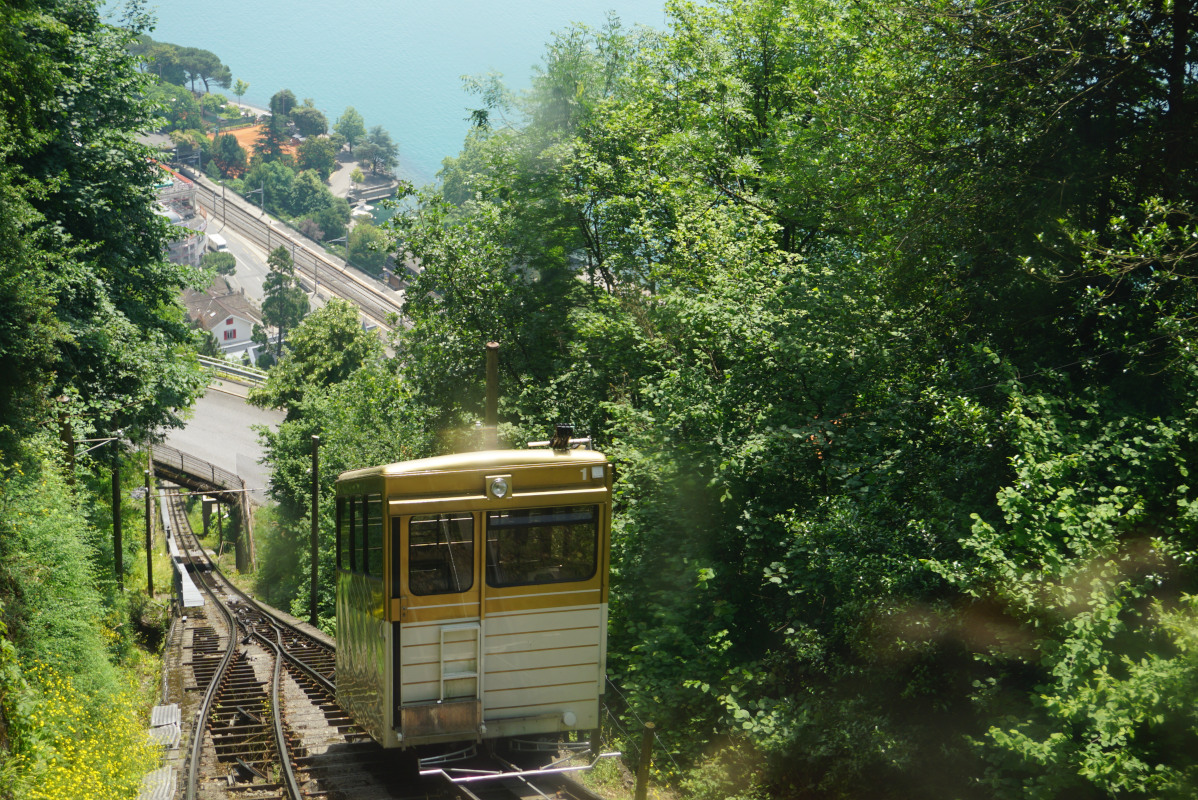 The Territet-Glion Funicular, in French Chemin de fer funiculaire Territet–Glion, is 640 m long and spans an altitude difference of 300 m.
It connects the village Glion with the shores of Lake Geneva.
The funicular was opened in 1883 as a water-balanced funicular and rebuilt to electric operation from 1974 to 1975.
During that rebuild new cars were introduced.
[Jun 2025].
The Territet-Glion Funicular, in French Chemin de fer funiculaire Territet–Glion, is 640 m long and spans an altitude difference of 300 m.
It connects the village Glion with the shores of Lake Geneva.
The funicular was opened in 1883 as a water-balanced funicular and rebuilt to electric operation from 1974 to 1975.
During that rebuild new cars were introduced.
[Jun 2025].
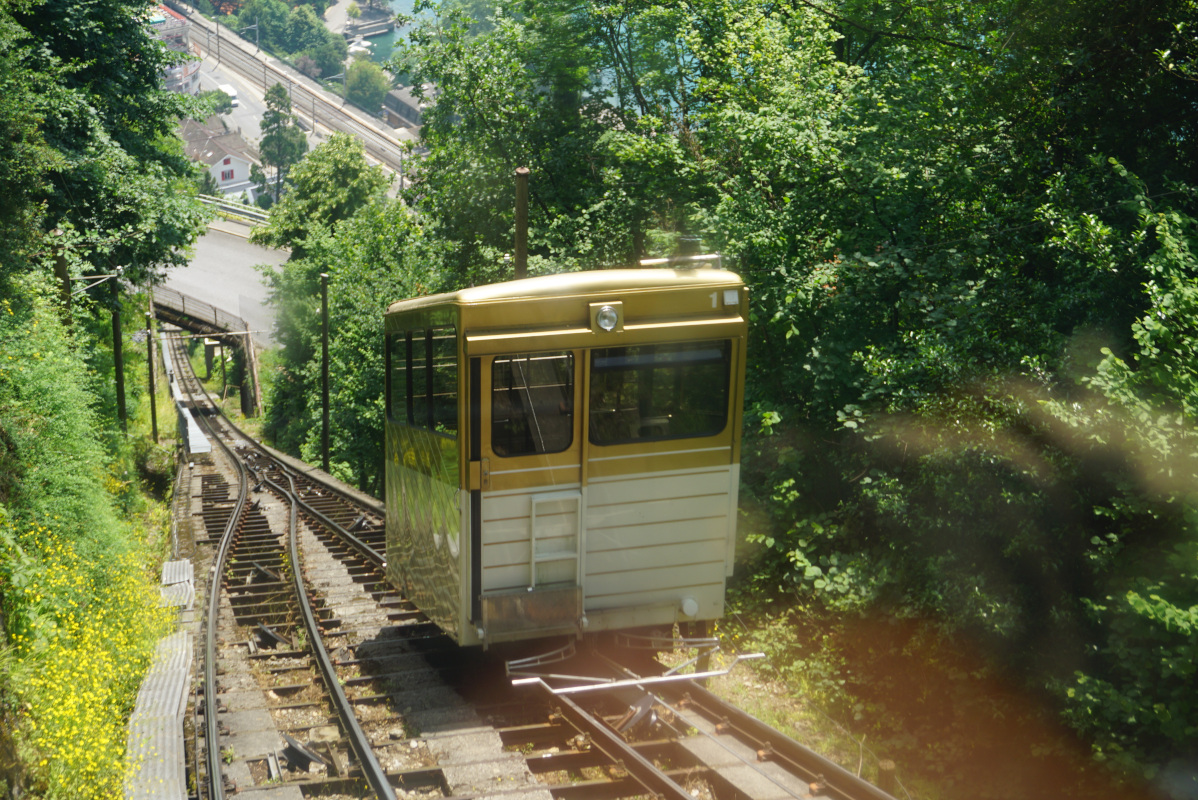 Glion became a resort with hotels and sanitariums in the 19th century.
Henri Nestlé, the founder of the food company Nestlé, moved to Glion in 1875 after he had sold his company.
He died there in 1890.
From 1892 to 1909 the funicular served to bring passengers to the rack railway from Glion to Caux and Rochers-de-Naye.
After that the rack railway was extended directly to Montreux.
[Jun 2025].
Glion became a resort with hotels and sanitariums in the 19th century.
Henri Nestlé, the founder of the food company Nestlé, moved to Glion in 1875 after he had sold his company.
He died there in 1890.
From 1892 to 1909 the funicular served to bring passengers to the rack railway from Glion to Caux and Rochers-de-Naye.
After that the rack railway was extended directly to Montreux.
[Jun 2025].
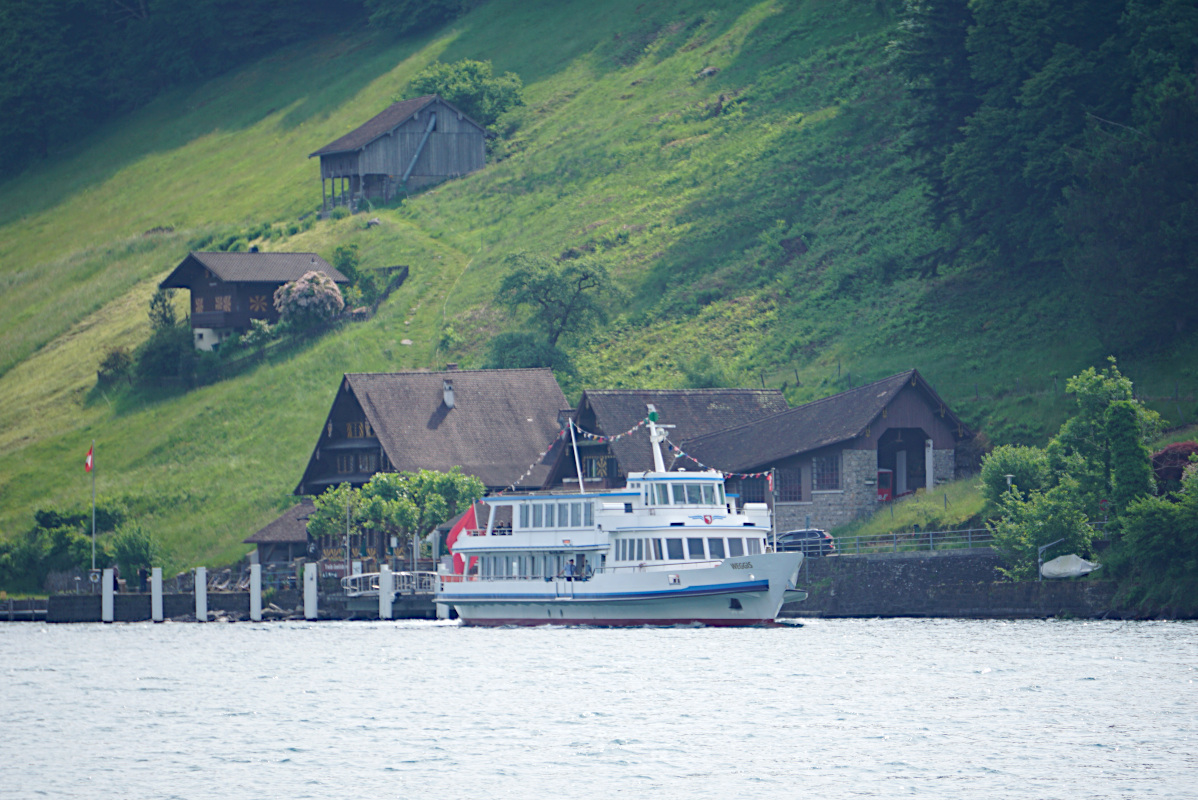 The Treib-Seelisberg Funicular connects the small village of Treib on Lake Lucerne with the pilgrimage area of Seelisberg. In Treib the lower station is directly beside the ship landing bridge and the famous Treib fisher house.
[May 2025].
The Treib-Seelisberg Funicular connects the small village of Treib on Lake Lucerne with the pilgrimage area of Seelisberg. In Treib the lower station is directly beside the ship landing bridge and the famous Treib fisher house.
[May 2025].
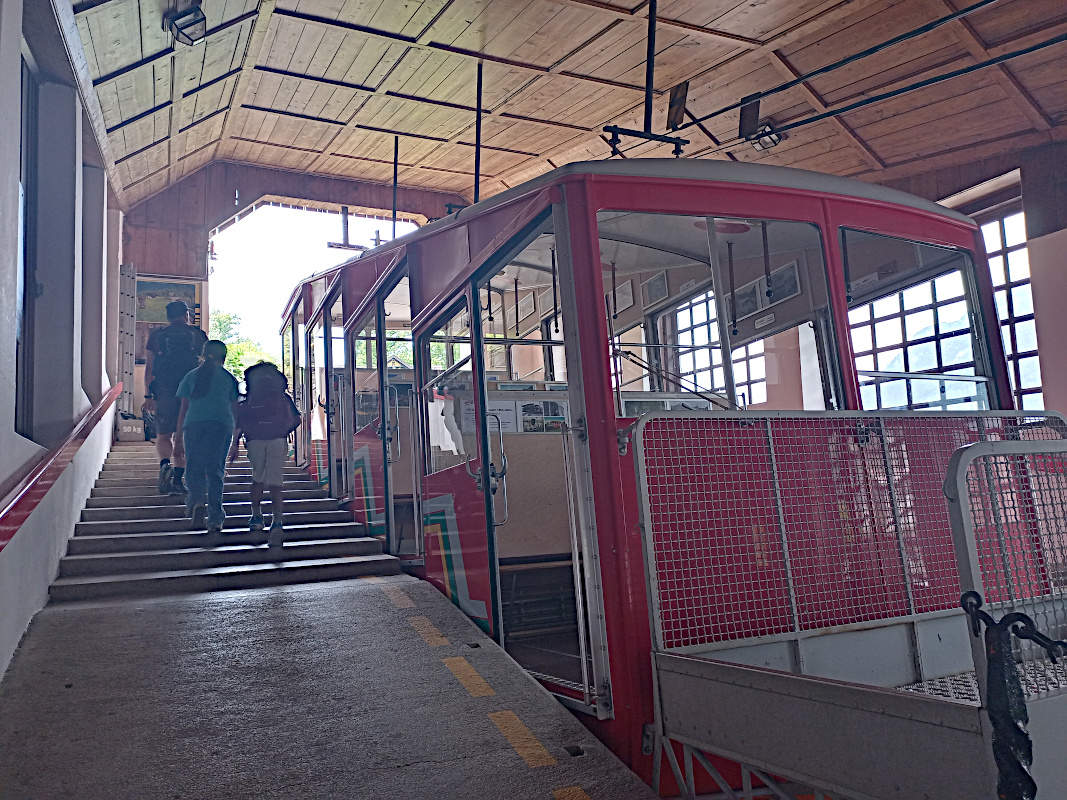 Just as in many other funicular stations, the Treib-Seelisberg-Bahn also has steps to access the compartments on the vehicle.
In the station there als are electrical connections under the roof to supply the batteries of the cars.
A few passengers in the lower station are looking for good places on board.
[May 2025].
Just as in many other funicular stations, the Treib-Seelisberg-Bahn also has steps to access the compartments on the vehicle.
In the station there als are electrical connections under the roof to supply the batteries of the cars.
A few passengers in the lower station are looking for good places on board.
[May 2025].
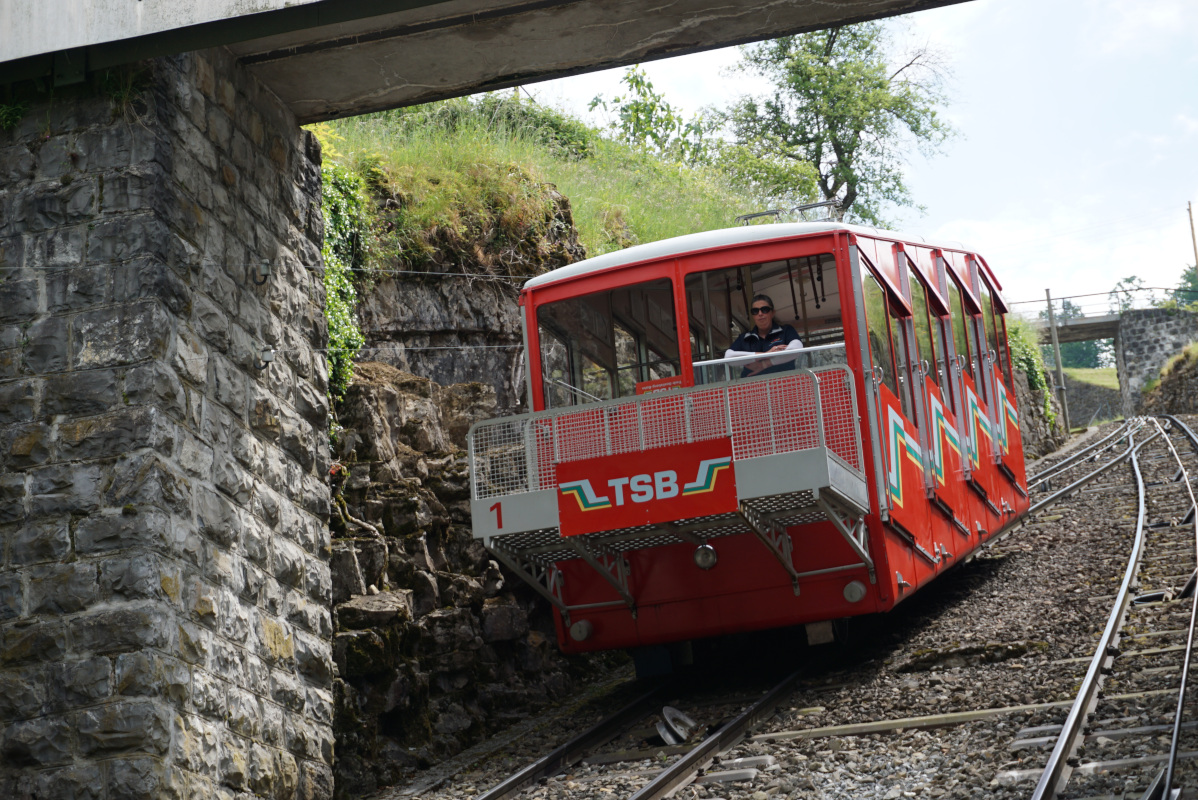 The funicular mostly operates every 20 minutes.
The Treib-Seelisberg-Bahn requires a crew member on each car and is not fully automatic.
The two cars meet at the central crossing loop.
[May 2025].
The funicular mostly operates every 20 minutes.
The Treib-Seelisberg-Bahn requires a crew member on each car and is not fully automatic.
The two cars meet at the central crossing loop.
[May 2025].
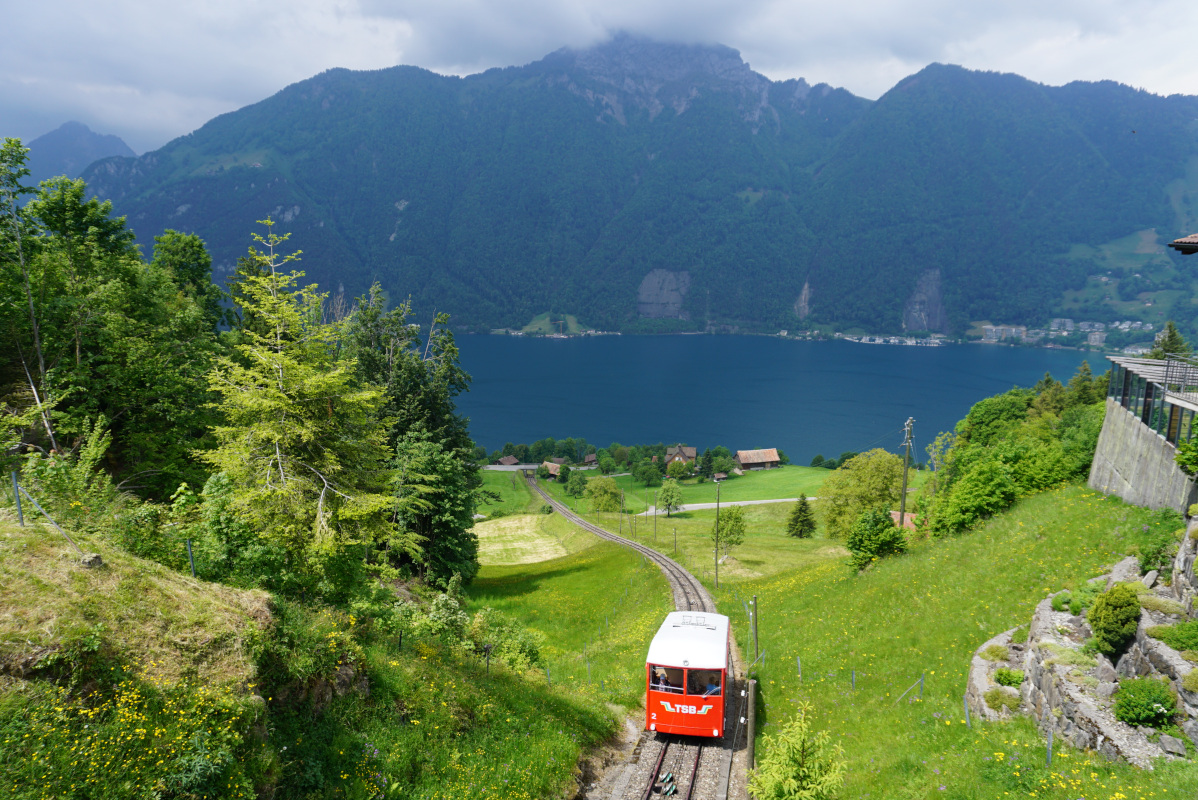 The Treib-Seelisberg Funicular travels high above Lake Lucerne with good views over the lake and the surrounding mountains.
The funicular is 1.15 km long and covers an altitude difference of 350 m.
[May 2025].
The Treib-Seelisberg Funicular travels high above Lake Lucerne with good views over the lake and the surrounding mountains.
The funicular is 1.15 km long and covers an altitude difference of 350 m.
[May 2025].
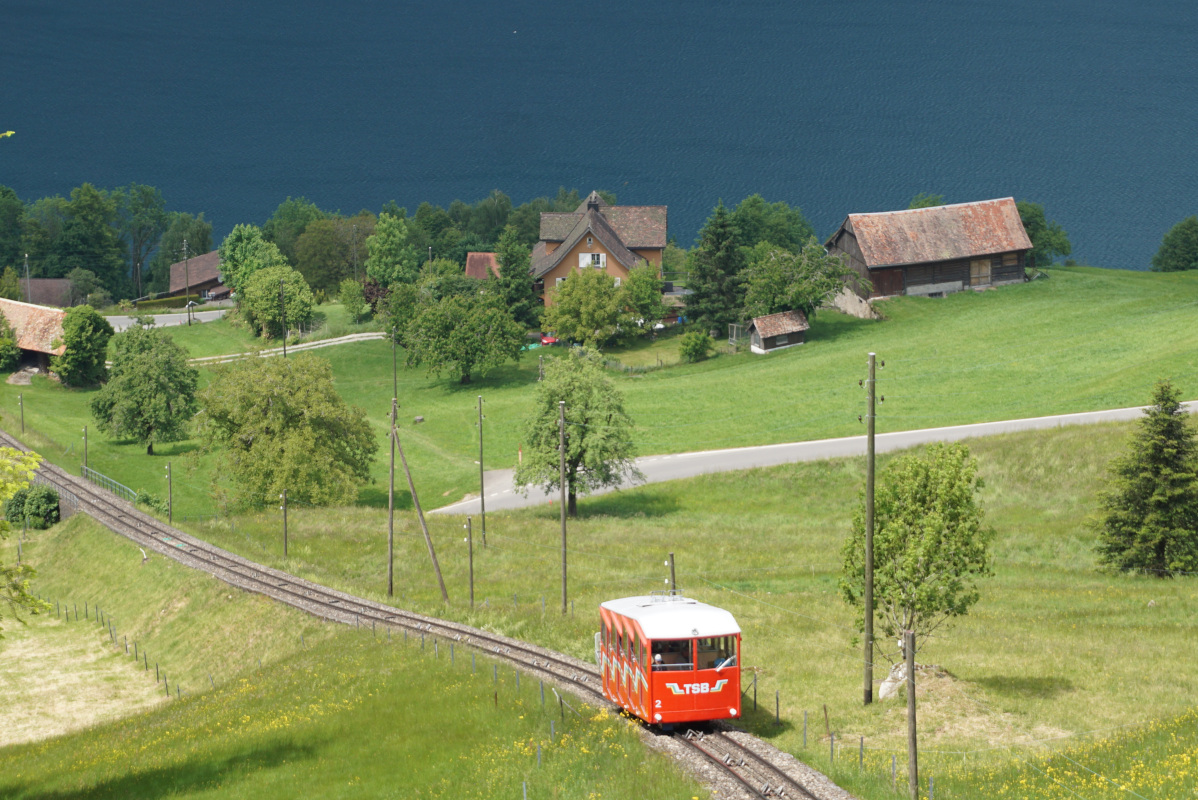 The Treib-Seelisberg Funicular is not straight as many other funiculars, but curves up the mountainside.
Apart from the pilgrimage church, Seelisberg is also known for the Grand Hotel Sonnenberg, which for several years was used by followers of an Indian Guru.
But he funicular among the Alpine meadows gives a typical Swiss appearance.
[May 2025].
The Treib-Seelisberg Funicular is not straight as many other funiculars, but curves up the mountainside.
Apart from the pilgrimage church, Seelisberg is also known for the Grand Hotel Sonnenberg, which for several years was used by followers of an Indian Guru.
But he funicular among the Alpine meadows gives a typical Swiss appearance.
[May 2025].
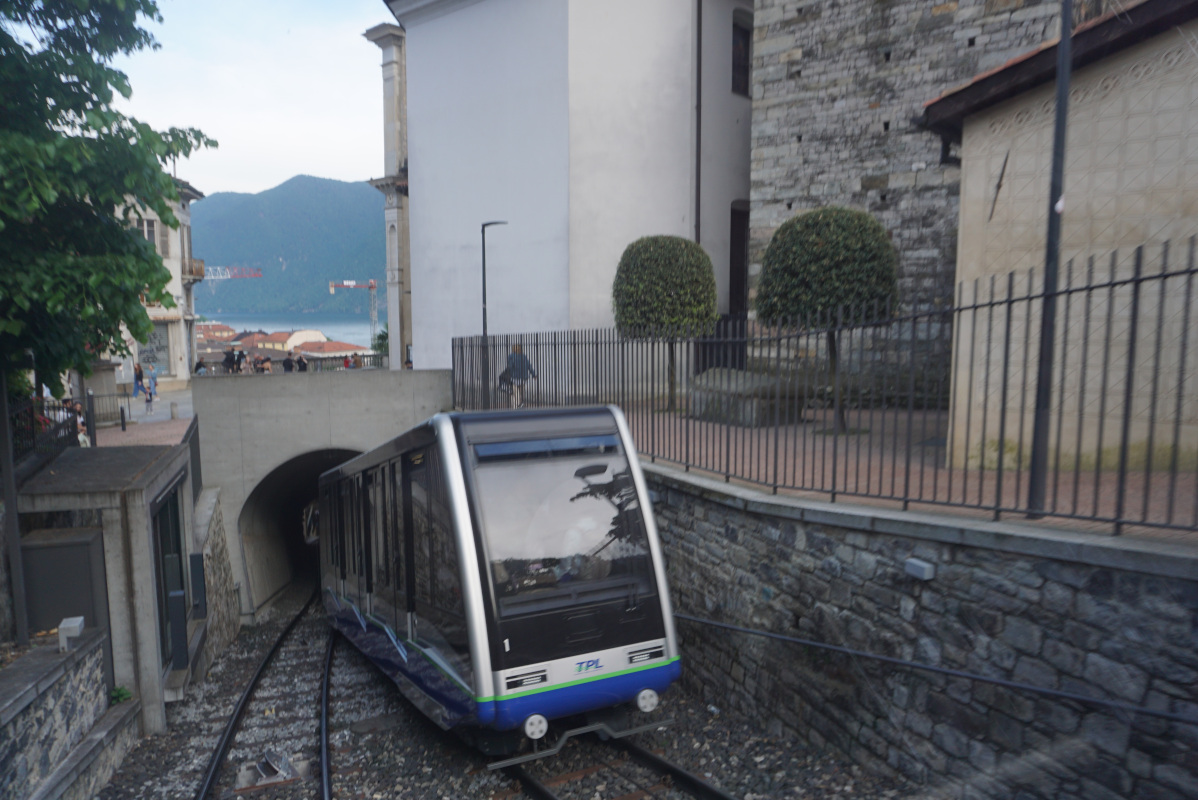 The Lugano Citta is a funicular that connects the central city of Lugano with the railway station, which is high above the city.
The funicular entered service in 1886.
After a thorough revision the modernised funicular opened again in 2016.
[May 2025].
The Lugano Citta is a funicular that connects the central city of Lugano with the railway station, which is high above the city.
The funicular entered service in 1886.
After a thorough revision the modernised funicular opened again in 2016.
[May 2025].
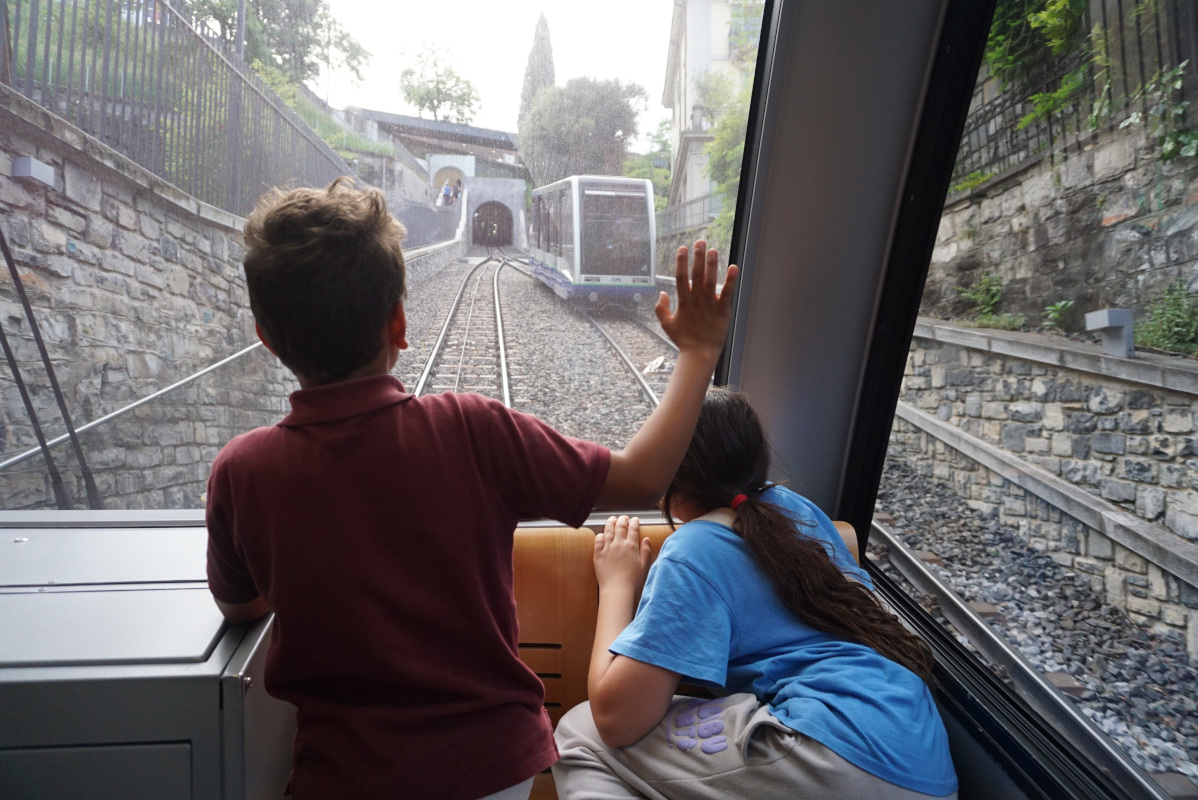 The Lugano Citta is fully automated.
Two children on the upwards car wave passengers on the downwards car.
[May 2025].
The Lugano Citta is fully automated.
Two children on the upwards car wave passengers on the downwards car.
[May 2025].