4_Zermatt.jpg) No cars are permitted in Zermatt.
Therefore most tourists arrive by train.
A class HGe 4/4II locomotive has arrived in Zermatt with its train from Visp.
[Dec 2014].
No cars are permitted in Zermatt.
Therefore most tourists arrive by train.
A class HGe 4/4II locomotive has arrived in Zermatt with its train from Visp.
[Dec 2014].
10_Zermatt.jpg)

8_Zermatt.jpg)
8_Zermatt.jpg)
 To get a good view of the Matterhorn, one has to walk up the valley from Zermatt a bit.
The Matterhorn is the symbol of Zermatt, the Matterhorn-Gotthard-Bahn (MGB), and Switzerland.
[Dec 2014].
To get a good view of the Matterhorn, one has to walk up the valley from Zermatt a bit.
The Matterhorn is the symbol of Zermatt, the Matterhorn-Gotthard-Bahn (MGB), and Switzerland.
[Dec 2014].
 The best view of the Matterhorn is from the Gornergrat.
The Gornergratbahn brings visitors from Zermatt to the Gornergrat.
It is also operated by the MGB.
Here's a train of the Gornergratbahn near Zermatt.
[Dec 2014].
The best view of the Matterhorn is from the Gornergrat.
The Gornergratbahn brings visitors from Zermatt to the Gornergrat.
It is also operated by the MGB.
Here's a train of the Gornergratbahn near Zermatt.
[Dec 2014].
8_Taesch.jpg) Not much sun reaches the valley below Zermatt.
On this winter day, the valley is still in the shade of the mountains,
as a shuttle train consisting of two class BDSeh 4/8 multiple units travels from Zermatt to Täsch.
Two of these EMUs entered service in 2002, two more in 2005.
[Jan 2018].
Not much sun reaches the valley below Zermatt.
On this winter day, the valley is still in the shade of the mountains,
as a shuttle train consisting of two class BDSeh 4/8 multiple units travels from Zermatt to Täsch.
Two of these EMUs entered service in 2002, two more in 2005.
[Jan 2018].
8_Taesch.jpg) A Zermatt-Shuttle on its way from Täsch to Zermatt.
A few days later, more snow fell and rail operations between Täsch and Zermatt had to be suspended
due to the snow masses and the avalanche risk.
[Jan 2018].
A Zermatt-Shuttle on its way from Täsch to Zermatt.
A few days later, more snow fell and rail operations between Täsch and Zermatt had to be suspended
due to the snow masses and the avalanche risk.
[Jan 2018].
8_Taesch.jpg) A Regio from Fiesch is here seen between Täsch and Zermatt.
It is operated by a class ABDeh 4/8 railcar with an additional driving trailer.
[Jan 2018].
A Regio from Fiesch is here seen between Täsch and Zermatt.
It is operated by a class ABDeh 4/8 railcar with an additional driving trailer.
[Jan 2018].
4_Taesch.jpg) The MGB also operates freight trains, particularly because Zermatt cannot be supplied by trucks.
A class HGe 4/4 II locomotive hauls a freight train near Täsch.
[Jan 2018].
The MGB also operates freight trains, particularly because Zermatt cannot be supplied by trucks.
A class HGe 4/4 II locomotive hauls a freight train near Täsch.
[Jan 2018].
4_StNiklaus.jpg) Class HGe 4/4 II locomotives are also used for passenger trains.
They regularly operate regional trains between Visp and Zermatt.
One of the class with its train in St. Niklaus station.
[Jan 2018].
Class HGe 4/4 II locomotives are also used for passenger trains.
They regularly operate regional trains between Visp and Zermatt.
One of the class with its train in St. Niklaus station.
[Jan 2018].
 On the downhill side of trains operated by class HGe 4/4 II locomotives have a driving trailer.
This leads the train on the journey to Visp, whith the locomotive pushing.
With the driving trailer leading, a train arrives in St. Niklaus.
[Jan 2018].
On the downhill side of trains operated by class HGe 4/4 II locomotives have a driving trailer.
This leads the train on the journey to Visp, whith the locomotive pushing.
With the driving trailer leading, a train arrives in St. Niklaus.
[Jan 2018].
 From 2007 to 2014 the MGB purchased several trains of the model KOMET, four of the longer ABDeh 4/10 and eight of the shorter ABDeh 4/8.
These multiple units are mainly used between Zermatt and Fiesch.
One of the class ABDeh 4/10 EMUs arrives in St. Niklaus as Regio to Zermatt.
[Dec 2014].
From 2007 to 2014 the MGB purchased several trains of the model KOMET, four of the longer ABDeh 4/10 and eight of the shorter ABDeh 4/8.
These multiple units are mainly used between Zermatt and Fiesch.
One of the class ABDeh 4/10 EMUs arrives in St. Niklaus as Regio to Zermatt.
[Dec 2014].
8_StNiklaus.jpg) Class ABDeh 4/8 electric multiple units are shorter than their class ABDeh 4/10 cousins.
But they are occasionally lengthened with an additional driving trailer.
Such a driving trailer is seen as a train arrives in St. Niklaus.
[Jan 2018].
Class ABDeh 4/8 electric multiple units are shorter than their class ABDeh 4/10 cousins.
But they are occasionally lengthened with an additional driving trailer.
Such a driving trailer is seen as a train arrives in St. Niklaus.
[Jan 2018].
8_StNiklaus.jpg) The train stops at St. Niklaus station.
[Jan 2018].
The train stops at St. Niklaus station.
[Jan 2018].
4_Visp.jpg)
4_Brig.jpg) The Furka-Oberalp Railway (FO) was electrified in 1941.
These class HGe 4/4I locomotives entered service at this time.
A few of them are still in service as heritage locomotives and as reserves if other engines are not available.
One of the class stands at the head of a heritage train in Brig.
[Jul 2015].
The Furka-Oberalp Railway (FO) was electrified in 1941.
These class HGe 4/4I locomotives entered service at this time.
A few of them are still in service as heritage locomotives and as reserves if other engines are not available.
One of the class stands at the head of a heritage train in Brig.
[Jul 2015].
4_Brig.jpg) A class Deh 4/4I cargo railcar is at the middle of a train in Brig.
Five of these vehicles were supplied to the FO in 1972 and an additional four similar cargo railcars were obtained by the VBZ in 1975.
Here the tracks and platforms of the MGB are on the station square and the trains run for a short distance along the streets
of Brig.
[Dec 2015].
A class Deh 4/4I cargo railcar is at the middle of a train in Brig.
Five of these vehicles were supplied to the FO in 1972 and an additional four similar cargo railcars were obtained by the VBZ in 1975.
Here the tracks and platforms of the MGB are on the station square and the trains run for a short distance along the streets
of Brig.
[Dec 2015].
4_Brig.jpg) Even over 40 years later the cargo railcars Deh 4/4 I were still in service.
One of them arrives in Brig.
[Jun 2025].
Even over 40 years later the cargo railcars Deh 4/4 I were still in service.
One of them arrives in Brig.
[Jun 2025].
4_Brig.jpg) From 1979 onwards the FO took delivery of six more cargo railcars.
These had a somewhat different electrical componentry and a very different car body.
One of these Deh 4/4 II railcars has arrived in Brig.
[Jun 2025].
From 1979 onwards the FO took delivery of six more cargo railcars.
These had a somewhat different electrical componentry and a very different car body.
One of these Deh 4/4 II railcars has arrived in Brig.
[Jun 2025].
4+ABDeh4)10_Brig.jpg) A class HGe4/4 II locomotive stands at the platform in the station square of Brig.
It is about to depart with its train to Disentis.
Pedestrians hurry across the square to Brig station, where standard gauge trains arrive and depart.
[Jan 2018].
A class HGe4/4 II locomotive stands at the platform in the station square of Brig.
It is about to depart with its train to Disentis.
Pedestrians hurry across the square to Brig station, where standard gauge trains arrive and depart.
[Jan 2018].
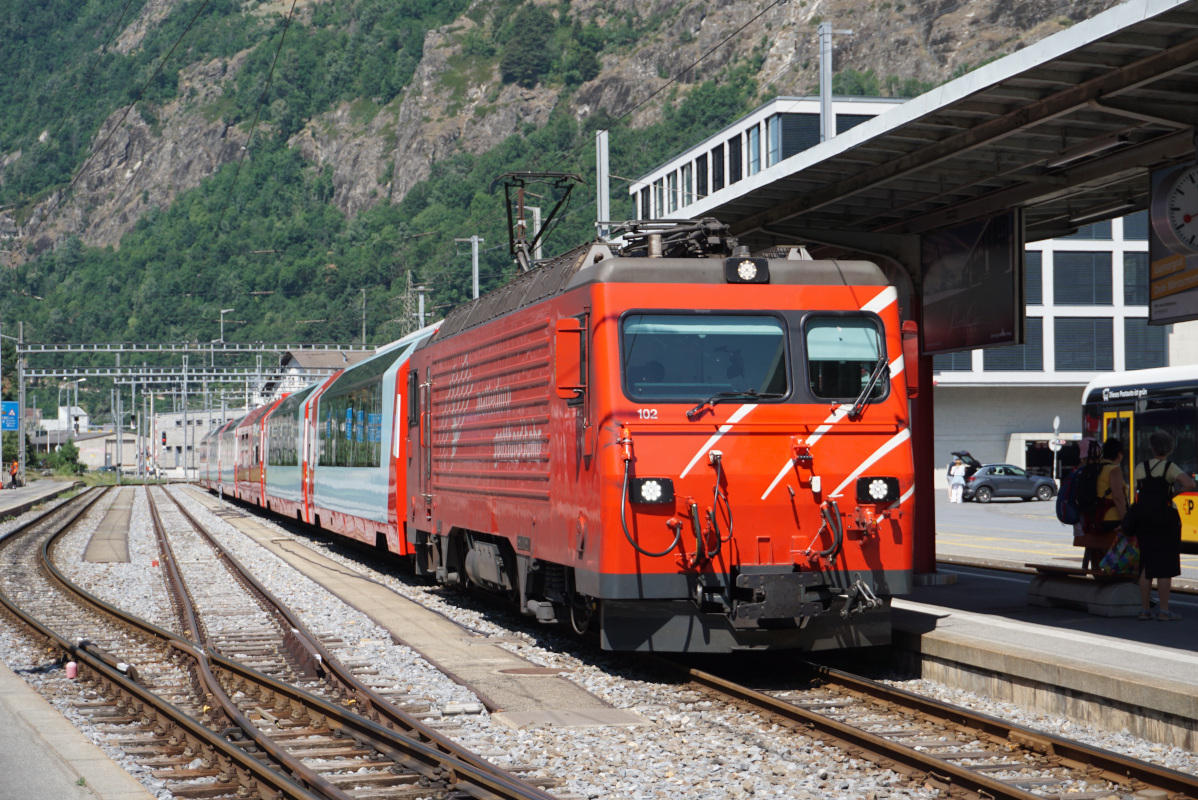 The Class HGe4/4 II locomotives entered service for the Brünig Railway and the FO from 1985 onwards.
Later the BVZ also obtained several of these locomotives, so that the MGB finally had 13 HGe 4/4 II locomotives.
Today these are mainly used to haul the Glacier-Express, as was the case that day.
[Jun 2025].
The Class HGe4/4 II locomotives entered service for the Brünig Railway and the FO from 1985 onwards.
Later the BVZ also obtained several of these locomotives, so that the MGB finally had 13 HGe 4/4 II locomotives.
Today these are mainly used to haul the Glacier-Express, as was the case that day.
[Jun 2025].
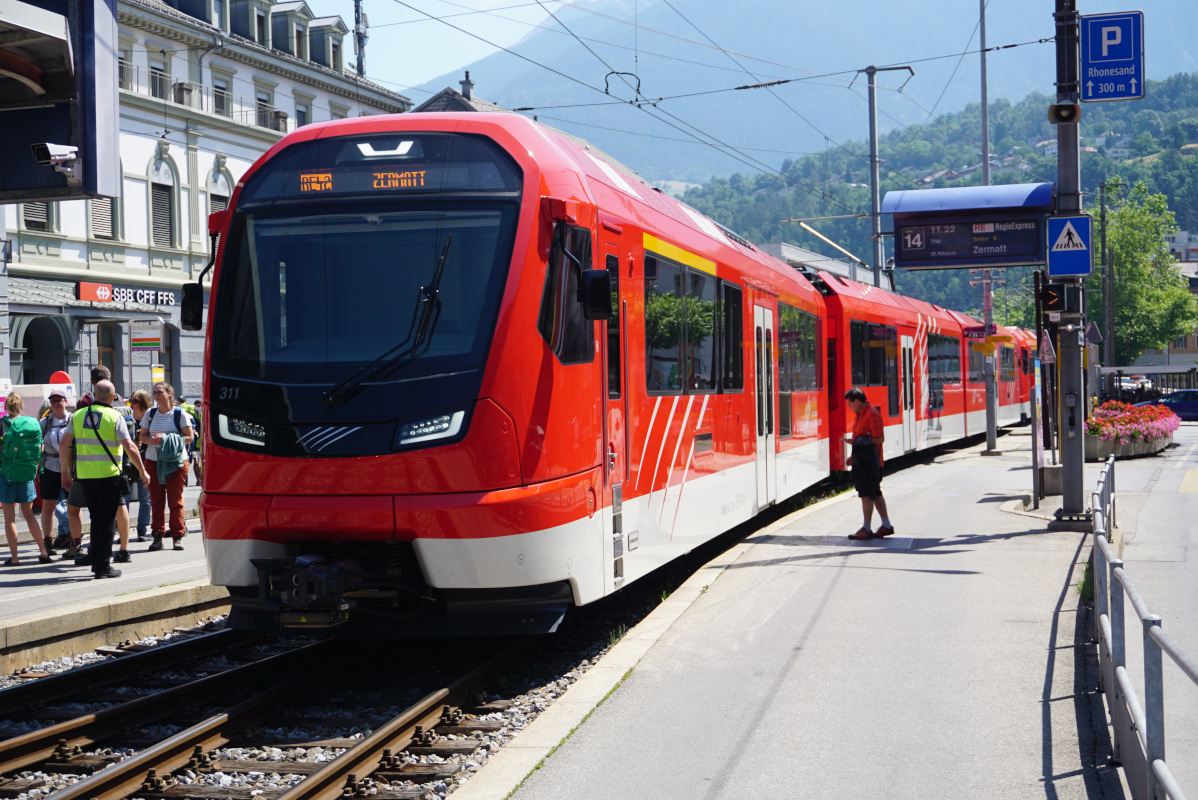 From 2023 onwards the ORION electric multiple units entered service.
It is planned that these EMUs will replace all regional trains hauled by locomotives or cargo railcars.
Through that the service frequency and passenger transport can be improved.
By now 37 of these three-car electric multiple units have been ordered and it is the aim to have them all in service by 2029.
An ORION train arrives in Brig.
[Jun 2025].
From 2023 onwards the ORION electric multiple units entered service.
It is planned that these EMUs will replace all regional trains hauled by locomotives or cargo railcars.
Through that the service frequency and passenger transport can be improved.
By now 37 of these three-car electric multiple units have been ordered and it is the aim to have them all in service by 2029.
An ORION train arrives in Brig.
[Jun 2025].
4_Moerel.jpg) When we were there it was still possible to travel in carriages in which the windows could be opened.
In future that will no longer be possible.
A Class Deh 4/4 I cargo railcar hauls a train near Mörel.
[Jun 2025].
When we were there it was still possible to travel in carriages in which the windows could be opened.
In future that will no longer be possible.
A Class Deh 4/4 I cargo railcar hauls a train near Mörel.
[Jun 2025].
4II_Betten.jpg) A class DeH 4/4II cargo railcar arrives in Betten station.
These railcars have a compartment for luggage and other cargo.
A cable car leaves from near the station to Betten village and to Bettmeralp, a booming tourist resort.
[Aug 2015].
A class DeH 4/4II cargo railcar arrives in Betten station.
These railcars have a compartment for luggage and other cargo.
A cable car leaves from near the station to Betten village and to Bettmeralp, a booming tourist resort.
[Aug 2015].
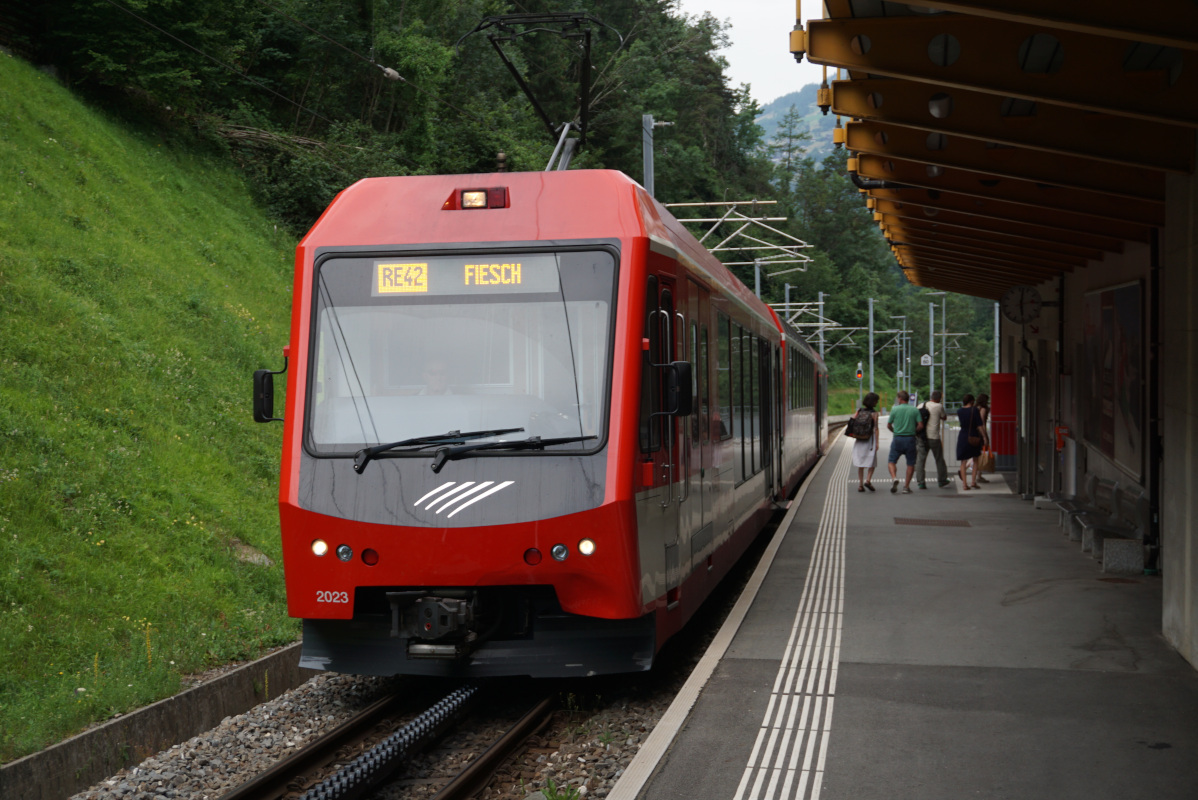 This is Betten Station in the Rhone Valley.
A KOMET multiple unit stops at the station on its run as RegioExpress to Fiesch.
[Jun 2025].
This is Betten Station in the Rhone Valley.
A KOMET multiple unit stops at the station on its run as RegioExpress to Fiesch.
[Jun 2025].
4_Grengiols.jpg) Near Grengiols a 96m high bridge crosses the river Rhone.
A Class Deh 4/4II cargo railcar leads its train onto the bridge and then into the spiral tunnel, which
brings the line to a higher level.
[Jul 2015].
Near Grengiols a 96m high bridge crosses the river Rhone.
A Class Deh 4/4II cargo railcar leads its train onto the bridge and then into the spiral tunnel, which
brings the line to a higher level.
[Jul 2015].
4II_Grengiols.jpg) A train coming from Fiesch skirts the hillside high above the valley and is about to enter
the Grengiols spiral tunnel.
[Jan 2018].
A train coming from Fiesch skirts the hillside high above the valley and is about to enter
the Grengiols spiral tunnel.
[Jan 2018].
4II_Grengiols.jpg) A little time later the train exits the tunnel and crosses the bridge above the river Rhone to arrive at Grengiols station.
[Jan 2018].
A little time later the train exits the tunnel and crosses the bridge above the river Rhone to arrive at Grengiols station.
[Jan 2018].
8+ABDeh4)10_Grengiols.jpg) A Regio from Fiesch to Zermatt crosses the bridge at Grengiols.
The train is formed by class ABDeh 4/8 and ABDeh 4/10 railcars coupled together.
[Jan 2018].
A Regio from Fiesch to Zermatt crosses the bridge at Grengiols.
The train is formed by class ABDeh 4/8 and ABDeh 4/10 railcars coupled together.
[Jan 2018].
4_Fiesch.jpg) A class Deh 4/4I cargo railcar arrives with its train to Göschenen in Fiesch.
Here it crosses the train travelling towards Visp.
[Dec 2015].
A class Deh 4/4I cargo railcar arrives with its train to Göschenen in Fiesch.
Here it crosses the train travelling towards Visp.
[Dec 2015].
 The train coming from Göschenen in the east arrives in Fiesch on its way to Visp.
A driving trailer is at the head of the train.
[Dec 2015].
The train coming from Göschenen in the east arrives in Fiesch on its way to Visp.
A driving trailer is at the head of the train.
[Dec 2015].
 A driving trailer heads this train as it arrives in Reckingen in the Goms Region.
[Jul 2015].
A driving trailer heads this train as it arrives in Reckingen in the Goms Region.
[Jul 2015].
4II_Realp.jpg) The high alpine railway across the Furka Pass was replaced in 1982 by the new Furka base tunnel.
The tunnel is 15.4 km long.
Shuttle trains carry road vehicles through the tunnel between Oberwald and Realp.
A class HGe 4/4II locomotive with one of the shuttles in Realp.
[Jul 2015].
The high alpine railway across the Furka Pass was replaced in 1982 by the new Furka base tunnel.
The tunnel is 15.4 km long.
Shuttle trains carry road vehicles through the tunnel between Oberwald and Realp.
A class HGe 4/4II locomotive with one of the shuttles in Realp.
[Jul 2015].
4_Hospental.jpg) From Realp the line follows the upper valley of the river Reuss to Andermatt.
A class Deh 4/4II cargo railcar leads its train across a bridge near Hospental.
[Jul 2015].
From Realp the line follows the upper valley of the river Reuss to Andermatt.
A class Deh 4/4II cargo railcar leads its train across a bridge near Hospental.
[Jul 2015].
 This is the view across the upper Reuss Valley from Nätschen in winter.
A Glacier-Express has just left Andermatt and is now heading towards Zermatt.
The Glacier-Express is a luxury train that runs between St. Moritz and Zermatt and is operated jointly
by the MGB and the RhB.
[Jan 2015].
This is the view across the upper Reuss Valley from Nätschen in winter.
A Glacier-Express has just left Andermatt and is now heading towards Zermatt.
The Glacier-Express is a luxury train that runs between St. Moritz and Zermatt and is operated jointly
by the MGB and the RhB.
[Jan 2015].
 A view of Andermatt station.
At the upper left of the picture is the line from Brig.
The line to Göschenen curves away at the bottom right.
At the lower left the line to the Oberalppass goes straight before it curves to the left beyond the picture.
The large depot of the MGB is very visible.
[Jan 2015].
A view of Andermatt station.
At the upper left of the picture is the line from Brig.
The line to Göschenen curves away at the bottom right.
At the lower left the line to the Oberalppass goes straight before it curves to the left beyond the picture.
The large depot of the MGB is very visible.
[Jan 2015].
4I_Andermatt.jpg) A class Deh4/4I railcar, originally from the BVZ, stands with its train at the platform in Andermatt.
These cargo railcars entered service from 1975 onwards.
[Jan 2015].
A class Deh4/4I railcar, originally from the BVZ, stands with its train at the platform in Andermatt.
These cargo railcars entered service from 1975 onwards.
[Jan 2015].
4II_Andermatt.jpg) A class Deh 4/4II cargo railcar arrives in Andermatt.
After the FO had also purchased the class Deh 4/4I railcars as the BVZ,
it later placed into serve these class Deh 4/4II cargo railcars from 1979 onwards.
A railway worker stands ready to uncouple several carriages so that the train can continue on the steep section
to Göschenen.
[Jan 2015].
A class Deh 4/4II cargo railcar arrives in Andermatt.
After the FO had also purchased the class Deh 4/4I railcars as the BVZ,
it later placed into serve these class Deh 4/4II cargo railcars from 1979 onwards.
A railway worker stands ready to uncouple several carriages so that the train can continue on the steep section
to Göschenen.
[Jan 2015].
4II+HGe4)4II_Andermatt.jpg) Two class HGe 4/4II locomotives stand side by side in Andermatt.
The engine on the right hauls the Glacier Express to St. Moritz, the one on the left the standard Regio train from
Andermatt to Disentis.
The class HGe 4/4II locomotives were entered service for the FO and the BVZ between 1986 and 1990.
I think this is one of the most handsome modern locomotives in Switzerland.
[Jan 2015].
Two class HGe 4/4II locomotives stand side by side in Andermatt.
The engine on the right hauls the Glacier Express to St. Moritz, the one on the left the standard Regio train from
Andermatt to Disentis.
The class HGe 4/4II locomotives were entered service for the FO and the BVZ between 1986 and 1990.
I think this is one of the most handsome modern locomotives in Switzerland.
[Jan 2015].
4_Andermatt.jpg) The diesel loco HGm 4/4 arrives with a snow clearing train in Andermatt.
The MGB put two of these locomotives into service in 1967.
On this picture the start of the rack section from Andermatt to Nätschen can be seen.
[Jan 2015].
The diesel loco HGm 4/4 arrives with a snow clearing train in Andermatt.
The MGB put two of these locomotives into service in 1967.
On this picture the start of the rack section from Andermatt to Nätschen can be seen.
[Jan 2015].
4II_Naetschen.jpg) A class Deh 4/4II cargo railcar hauls a winter sports train from Andermatt to the Operalp Pass.
In winter the Oberalppass is a ski area and the only road there is closed in winter.
Instead it is used for sledging from Nätschen to Andermatt.
People take the train up the hill to Nätschen and rush down the hill with the sledge.
[Jan 2015].
A class Deh 4/4II cargo railcar hauls a winter sports train from Andermatt to the Operalp Pass.
In winter the Oberalppass is a ski area and the only road there is closed in winter.
Instead it is used for sledging from Nätschen to Andermatt.
People take the train up the hill to Nätschen and rush down the hill with the sledge.
[Jan 2015].
4II_Naetschen.jpg)
 A winter sports train with a low floor carriage at the centre of the train
is seen near Nätschen as it descends towards Andermatt.
[Jan 2015].
A winter sports train with a low floor carriage at the centre of the train
is seen near Nätschen as it descends towards Andermatt.
[Jan 2015].
4II_Naetschen.jpg) A class HGe 4/4II locomotives approaches a tunnel near Nätschen.
[Jan 2015].
A class HGe 4/4II locomotives approaches a tunnel near Nätschen.
[Jan 2015].
4II_Naetschen.jpg) A train of the Matterhorn-Gotthard-Bahn departs Nätschen towards the Oberalp Pass.
The picture symbolizes for me the best aspects of this time:
a class HGe 4/4 locomotive; warm carriages with windows that can be opened; a simple livery; a beautiful landscape.
[Jan 2015].
A train of the Matterhorn-Gotthard-Bahn departs Nätschen towards the Oberalp Pass.
The picture symbolizes for me the best aspects of this time:
a class HGe 4/4 locomotive; warm carriages with windows that can be opened; a simple livery; a beautiful landscape.
[Jan 2015].