Four class Be 4/4 railcars were delivered in 1976.
They were particularly used for shuttle trains between Zweisimmen and Lenk, and also on trains near Montreux.
One of the railcars in Zweisimmen.
[May 2002].
4_Zweisimmen.jpg)
 Between 2004 and 2009 these railcars were rebuilt.
They don't have a driver's cab any more, instead a low-floor driving trailer with cab was added on each side.
One such train stands in Zweisimmen ready for departure towards Lenk.
On the adjacent track is a standard gauge train of the BLS.
[Dec 2015].
Between 2004 and 2009 these railcars were rebuilt.
They don't have a driver's cab any more, instead a low-floor driving trailer with cab was added on each side.
One such train stands in Zweisimmen ready for departure towards Lenk.
On the adjacent track is a standard gauge train of the BLS.
[Dec 2015].
4_Lenk.jpg) A class Be4/4 railcar with a driving trailer on each side.
Teh pantographs of the railcar at the middle of the train can be seen clearly.
Lenk is particularly a winter sport resort.
[Mar 2015].
A class Be4/4 railcar with a driving trailer on each side.
Teh pantographs of the railcar at the middle of the train can be seen clearly.
Lenk is particularly a winter sport resort.
[Mar 2015].
 The four class ABDe 8/8 railcars were introduced from 1968 onwards.
They are used for Regio trains between Montreux and Zweisimmen, generally running the whole length of the line.
Sometimes they haul additional carraiges, sometimes a train consists of just the railcar.
One of the railcars in Zweisimmen ready for departure towards Montreux.
[Dec 2015].
The four class ABDe 8/8 railcars were introduced from 1968 onwards.
They are used for Regio trains between Montreux and Zweisimmen, generally running the whole length of the line.
Sometimes they haul additional carraiges, sometimes a train consists of just the railcar.
One of the railcars in Zweisimmen ready for departure towards Montreux.
[Dec 2015].
4_Saanenmoeser.jpg) The four class Ge 4/4 locomotives entered service in 1995.
They have been developed from the class Ge 4/4III of the Rhätische Bahn.
One of these locomotives arrives in Saanenmöser.
[Apr 2015].
The four class Ge 4/4 locomotives entered service in 1995.
They have been developed from the class Ge 4/4III of the Rhätische Bahn.
One of these locomotives arrives in Saanenmöser.
[Apr 2015].
 Between Montreux and Zweisimmen the MOB operates the Golden Pass Panoramic Express.
These trains have carriages with panorama windows.
Several of the trains have special driving trailers, where passengers have a view on the line ahead.
The driver sits in a small compartment above the passengers.
One of the Golden Pass Panoramic Express trains arrives in Saanenmöser.
[Apr 2015].
Between Montreux and Zweisimmen the MOB operates the Golden Pass Panoramic Express.
These trains have carriages with panorama windows.
Several of the trains have special driving trailers, where passengers have a view on the line ahead.
The driver sits in a small compartment above the passengers.
One of the Golden Pass Panoramic Express trains arrives in Saanenmöser.
[Apr 2015].
 At an altitue of 1269m Saanenmöser is the highest station of the MOB.
A class BDe 4/4 railcar with attached snow plough arrives in Saanenmöser during a snow storm.
That day it ran regularly over the line to allow other trains to pass.
The railcar entered service in 1944 and is now used as maintenance vehicle.
[Dec 2014].
At an altitue of 1269m Saanenmöser is the highest station of the MOB.
A class BDe 4/4 railcar with attached snow plough arrives in Saanenmöser during a snow storm.
That day it ran regularly over the line to allow other trains to pass.
The railcar entered service in 1944 and is now used as maintenance vehicle.
[Dec 2014].
 A Golden Pass Panoramic Express without driving trailer passes through the snow near Saanenmöser.
The Golden-Pass-Route runs from Montreux via the MOB to Zweisimmern,
from there via the BLS to Interlaken Ost,
and finally via Brünig Pass (ZB) to Luzern.
But it is particularly the MOB that uses the name ini its promotional material.
[Dec 2014].
A Golden Pass Panoramic Express without driving trailer passes through the snow near Saanenmöser.
The Golden-Pass-Route runs from Montreux via the MOB to Zweisimmern,
from there via the BLS to Interlaken Ost,
and finally via Brünig Pass (ZB) to Luzern.
But it is particularly the MOB that uses the name ini its promotional material.
[Dec 2014].
 It is Christmas time and a class ABDe 8/8 railcar has arrived in Schönried.
[Dec 2015].
It is Christmas time and a class ABDe 8/8 railcar has arrived in Schönried.
[Dec 2015].
 Clearing the snow off the platform in Schönried.
A train with class Be 4/4 railcar has arrived at the station.
[Dec 2014].
Clearing the snow off the platform in Schönried.
A train with class Be 4/4 railcar has arrived at the station.
[Dec 2014].
 In Schönried a skier waits for the train.
It arrives in the form of a class ABDe 8/8 railcar with several carriages.
[Dec 2014].
In Schönried a skier waits for the train.
It arrives in the form of a class ABDe 8/8 railcar with several carriages.
[Dec 2014].
 The railway line descends from Schönried to Gstaad through various curves.
This is a view from the window to the Rüblihorn ahead.
[Apr 2015].
The railway line descends from Schönried to Gstaad through various curves.
This is a view from the window to the Rüblihorn ahead.
[Apr 2015].
 That's the view from a class ABDe 8/8 railcar on the carriages at the back of the train.
The MOB now uses the Golden Pass brand for its livery and promotional material.
[Apr 2015].
That's the view from a class ABDe 8/8 railcar on the carriages at the back of the train.
The MOB now uses the Golden Pass brand for its livery and promotional material.
[Apr 2015].
8_Flendruz.jpg) Two class ABDe 8/8 railcars cross at Flendruz.
The language frontier between the German and French parts of Switzerland runs near this village.
[Apr 2015].
Two class ABDe 8/8 railcars cross at Flendruz.
The language frontier between the German and French parts of Switzerland runs near this village.
[Apr 2015].
4_Chateau-dOex.jpg) The MOB also operates the Golden Pass Classic Express.
This train has carriages in 1920s style.
The train passes through the picturesque town of Chateaux-d`Oex.
[Apr 2015].
The MOB also operates the Golden Pass Classic Express.
This train has carriages in 1920s style.
The train passes through the picturesque town of Chateaux-d`Oex.
[Apr 2015].
 That's the interior of the Golden Pass Classic carriages.
[Aug 2014].
That's the interior of the Golden Pass Classic carriages.
[Aug 2014].
 That's the view from one of the Golden Pass Classic carriages through the large windows.
[Aug 2014].
That's the view from one of the Golden Pass Classic carriages through the large windows.
[Aug 2014].
 A class Ge 4/4 locomotive heads its Golden Pass Classic Express through a curve.
[Aug 2014].
A class Ge 4/4 locomotive heads its Golden Pass Classic Express through a curve.
[Aug 2014].
4_LacDuVernex.jpg) The Golden Pass Classic Express passes Lac du Vernex.
[Apr 2015].
The Golden Pass Classic Express passes Lac du Vernex.
[Apr 2015].
4_Rossiniere.jpg) A class GDe 4/4 locomotive hauls the Golden Pass Class Express near Rossiniere.
These engines were introduced from 1983 and have a baggage compartment.
[Apr 2015].
A class GDe 4/4 locomotive hauls the Golden Pass Class Express near Rossiniere.
These engines were introduced from 1983 and have a baggage compartment.
[Apr 2015].
4_Rossiniere.jpg) In Rossiniere I also met this class Gm 4/4 diesel loco.
It is mainly used for infrastructure maintenance.
[Apr 2015].
In Rossiniere I also met this class Gm 4/4 diesel loco.
It is mainly used for infrastructure maintenance.
[Apr 2015].
4_TorrentDeRix.jpg) A class Ge 4/4 loco hauls a train across the bridge of the Torrent de Rix stream.
[Apr 2015].
A class Ge 4/4 loco hauls a train across the bridge of the Torrent de Rix stream.
[Apr 2015].
4_LaTine.jpg) Near La Tine a class GDe 4/4 lcoco hauls a Golden Pass Panoramic Exrpess.
The loco carries advertising for Log-in, the Swiss training organization for public transport careers.
[Apr 2015].
Near La Tine a class GDe 4/4 lcoco hauls a Golden Pass Panoramic Exrpess.
The loco carries advertising for Log-in, the Swiss training organization for public transport careers.
[Apr 2015].
4_LaTine.jpg) A train arrives in the little station of La Tine.
This station is in the Saane gorge.
[Apr 2015].
A train arrives in the little station of La Tine.
This station is in the Saane gorge.
[Apr 2015].
4_LaTine.jpg) An old class Be 4/4 railcar stands on a siding in La Tine.
The railcar entered service in 1955 and was refurbished in 1973.
Today it is only used as a reserve railcar.
[Apr 2015].
An old class Be 4/4 railcar stands on a siding in La Tine.
The railcar entered service in 1955 and was refurbished in 1973.
Today it is only used as a reserve railcar.
[Apr 2015].
8_Montbovon.jpg) A class ABDe 8/8 arrives in Montbovon as Regio from Montreux to Zweisimmen.
At this hour of the day only few people are still travelling on this remote railway.
[Aug 2015].
A class ABDe 8/8 arrives in Montbovon as Regio from Montreux to Zweisimmen.
At this hour of the day only few people are still travelling on this remote railway.
[Aug 2015].
 This panoramic driving trailer was an earlier version of the now-famous driving trailers.
Here it arrives in Montbovon at the head of a Golden Pass Panoramic Exrpess.
[Apr 2015].
This panoramic driving trailer was an earlier version of the now-famous driving trailers.
Here it arrives in Montbovon at the head of a Golden Pass Panoramic Exrpess.
[Apr 2015].
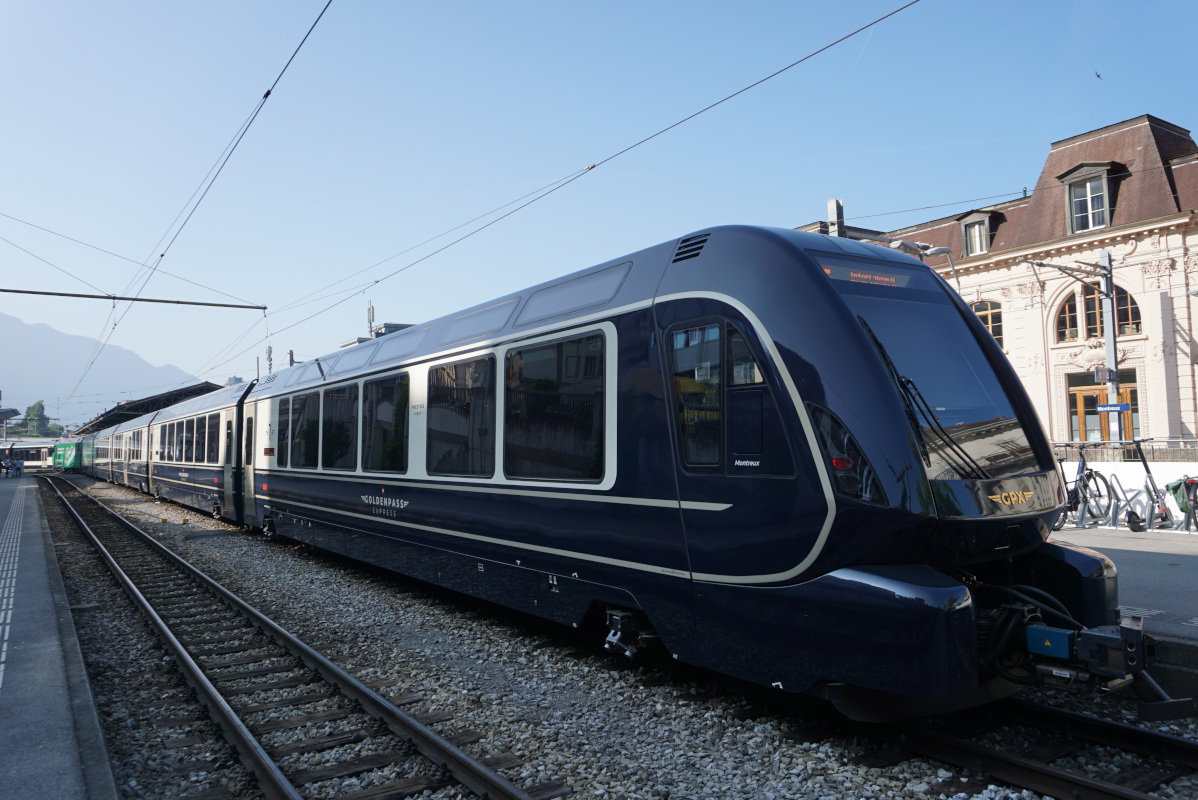 Because the MOB uses the 1 metre gauge and the BLS line is standard gauge, trains cannot travel from Montreux to Interlaken.
In 2008 the MOB announced that it wanted to tackle the barrier of the gauge change with a revolutionary variable-gauge bogie.
After several years of development, the new Golden Pass Express began operation between Montreux and Interlaken on 11 December 2022.
The train changes gauge and locomotives in Zweisimmen.
The carriages were designed by Pininfarina, and manufactured by Stadler Rail.
Alstom produced the bogies.
One such train is here in Montreux.
[Jun 2025].
Because the MOB uses the 1 metre gauge and the BLS line is standard gauge, trains cannot travel from Montreux to Interlaken.
In 2008 the MOB announced that it wanted to tackle the barrier of the gauge change with a revolutionary variable-gauge bogie.
After several years of development, the new Golden Pass Express began operation between Montreux and Interlaken on 11 December 2022.
The train changes gauge and locomotives in Zweisimmen.
The carriages were designed by Pininfarina, and manufactured by Stadler Rail.
Alstom produced the bogies.
One such train is here in Montreux.
[Jun 2025].
6_Montreux.jpg) Die MOB führt auch den Betrieb der MVR - Transports Montreux–Vevey–Riviera.
Die MVR betreibt einige Zahnradbahnstrecken um Montreux and Vevey.
In 2016 it received these Class ABeh 2/6 electric multiple units with rack drive technology.
In this case the train, however, is used on the line of the MOB between Montreux and Les Avants,
which does not have a rack section.
[Jun 2025].
Die MOB führt auch den Betrieb der MVR - Transports Montreux–Vevey–Riviera.
Die MVR betreibt einige Zahnradbahnstrecken um Montreux and Vevey.
In 2016 it received these Class ABeh 2/6 electric multiple units with rack drive technology.
In this case the train, however, is used on the line of the MOB between Montreux and Les Avants,
which does not have a rack section.
[Jun 2025].
8_Haut-de-Caux.jpg) The line from MOntreux to the peak Rochers-de-Naye is also part of the MVR.
Two trains mee tin Caux.
[Jun 2025].
The line from MOntreux to the peak Rochers-de-Naye is also part of the MVR.
Two trains mee tin Caux.
[Jun 2025].
8_LePaccot.jpg) Even in some of the stations the line has a very steep gradient.
This is the station Le Paccot as seen from the train.
[Jun 2025].
Even in some of the stations the line has a very steep gradient.
This is the station Le Paccot as seen from the train.
[Jun 2025].
8+Bhe4)8_Jaman.jpg) The peak Dent de Jaman stands quite prominently as a train arrives at Jaman station.
[Jun 2025].
The peak Dent de Jaman stands quite prominently as a train arrives at Jaman station.
[Jun 2025].
8+Bhe4)8_Jaman.jpg) That's a closer view of the train in Jaman.
The MVR has 5 of these twin railcars.
Three were delivered in 1983, one in 1992, and one was built in the MOB workshop in 2011.
[Jun 2025].
That's a closer view of the train in Jaman.
The MVR has 5 of these twin railcars.
Three were delivered in 1983, one in 1992, and one was built in the MOB workshop in 2011.
[Jun 2025].
8+Bhe4)8_Jaman.jpg) The railway line has several galleries to protect trains and track from snow and avalanches.
[Jun 2025].
The railway line has several galleries to protect trains and track from snow and avalanches.
[Jun 2025].
8_LaPerche.jpg) A train with two Class Bhe4/8 railcars travels near La Perche.
These railcars were originally produced by the Swiss Locomotive and Machinery Factory (SLM) in Winterthur.
Similar railcars were also built for the Monte Generoso railway.
[Jun 2025].
A train with two Class Bhe4/8 railcars travels near La Perche.
These railcars were originally produced by the Swiss Locomotive and Machinery Factory (SLM) in Winterthur.
Similar railcars were also built for the Monte Generoso railway.
[Jun 2025].
8_LaPerche.jpg) A train travels among Alpine flowers in front of the steep rockface of the Rochers-de-Naye.
[Jun 2025].
A train travels among Alpine flowers in front of the steep rockface of the Rochers-de-Naye.
[Jun 2025].
8+Bhe4)8_LaPerche.jpg) Railcars 303 and 305 have just left behind the gallery near La Perche,
which connects immediately to the tunnel through the Rochers-de-Naye.
The steepness of the mountainsides are quite clear to see here.
The railway uses 850 V DC electrical supply.
[Jun 2025].
Railcars 303 and 305 have just left behind the gallery near La Perche,
which connects immediately to the tunnel through the Rochers-de-Naye.
The steepness of the mountainsides are quite clear to see here.
The railway uses 850 V DC electrical supply.
[Jun 2025].
8+Bhe4)8_Rochers-de-Naye.jpg) A train passes an Alpine dairy hut in between a tunnel and a gallery.
The trains on the Rochers-de-Naye line operate on an hourly frequency.
[Jun 2025].
A train passes an Alpine dairy hut in between a tunnel and a gallery.
The trains on the Rochers-de-Naye line operate on an hourly frequency.
[Jun 2025].
8_Rochers-de-Naye.jpg) Railcar 304 is on its way near the top station.
Normally the trains have freight cars to carry freight and in winter skis and snowboards.
The rack rail in the middle of the track is quite visible here.
[Jun 2025].
Railcar 304 is on its way near the top station.
Normally the trains have freight cars to carry freight and in winter skis and snowboards.
The rack rail in the middle of the track is quite visible here.
[Jun 2025].
8_Rochers-de-Naye.jpg) A train arrives at the top station of Rochers-de-Naye.
In the background are the Valais Alps.
High-altitude winds brought particles from forest fires in Canada to Europe, so that the view was affected in those days.
[Jun 2025].
A train arrives at the top station of Rochers-de-Naye.
In the background are the Valais Alps.
High-altitude winds brought particles from forest fires in Canada to Europe, so that the view was affected in those days.
[Jun 2025].
8_Rochers-de-Naye.jpg) Rochers-de-Naye is the highest station in Switzerland that can be reached with the popular national day pass.
The line allows easy access to the mountains.
In winter this is also a ski area.
The station is at 1971 m above sea level, the peak at 2042 m altitude.
[Jun 2025].
Rochers-de-Naye is the highest station in Switzerland that can be reached with the popular national day pass.
The line allows easy access to the mountains.
In winter this is also a ski area.
The station is at 1971 m above sea level, the peak at 2042 m altitude.
[Jun 2025].