On my page on Railways in Germany, there are more photos of the Heilbronn light rail.
[May 2025].
|
Many cities in Germany have trams.
The tram network in Ulm is quite small.
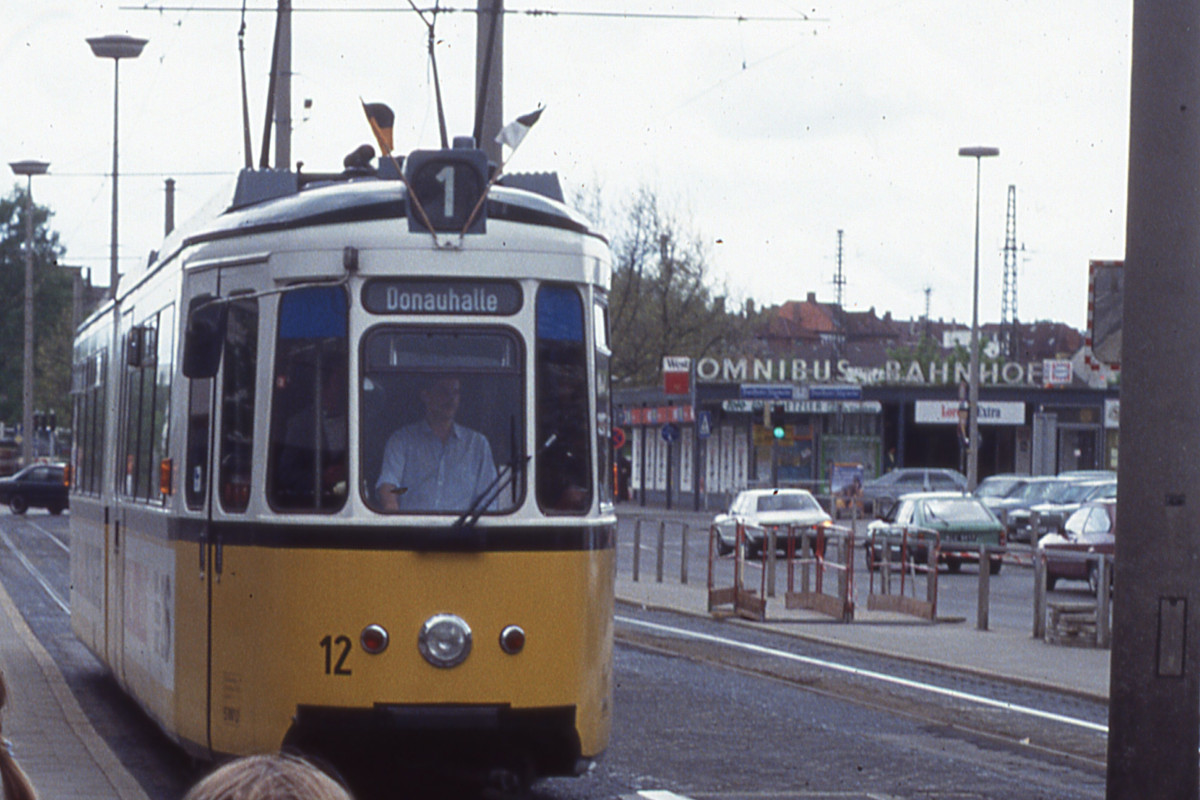
In the 1990s there was only Line 1 from Söflingen past the main station to the Donauhalle, a bit more than 5 km in total.
Since then the line has been extended and a second line has been built.
The tram in Ulm has a 1 m gauge.
Clas GT4 tramcar 12 arrives at the main station.
These tramcars were built from 1959 to 1968 by the Maschinenfabrik Esslingen for the Stuttgart Tram.
They were then sold to Tramways Ulm in 1986.
[Mai 1992].
|
|
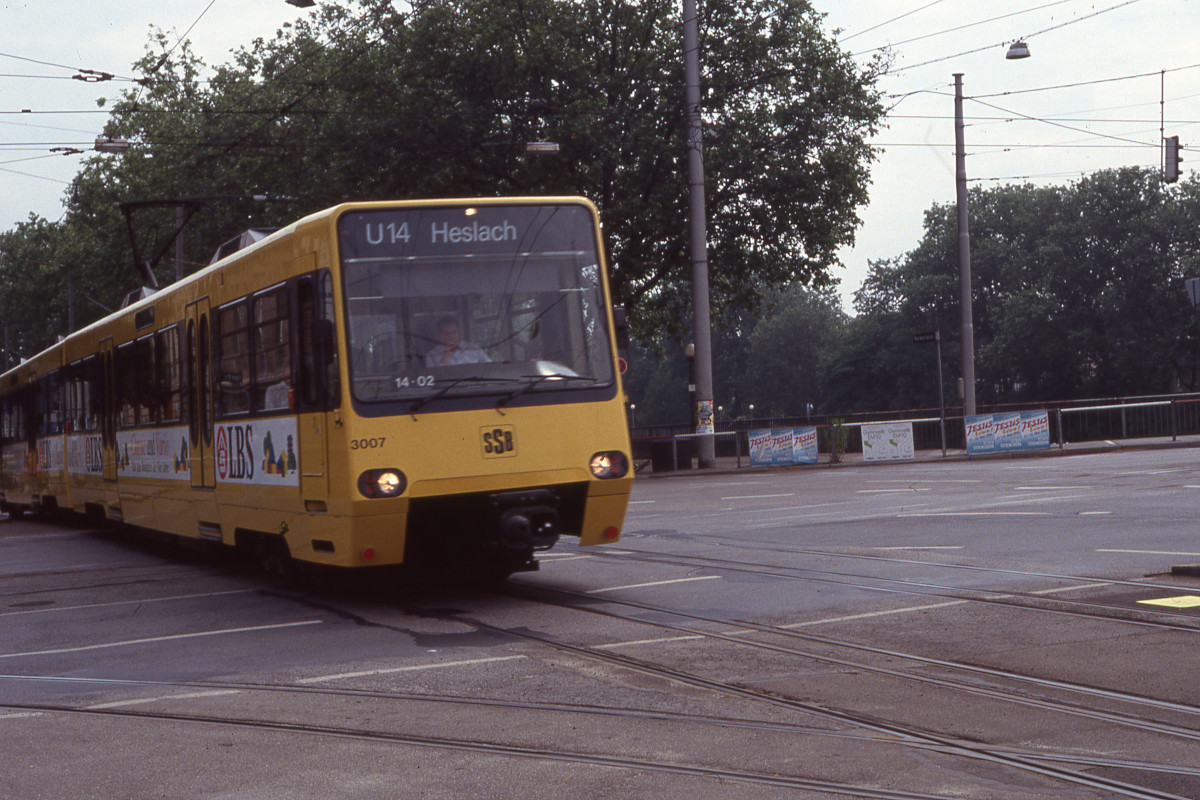
In Stuttgart the narrow-gauge tramway was converted step by step into the standard gauge light rail.
With its many tunnels it was considerably faster and is also designated with the letter U.
With high platforms it also enabled level boarding.
A Line U14 train travels on the network through Bad Canstatt.
[May 1992].
|
|
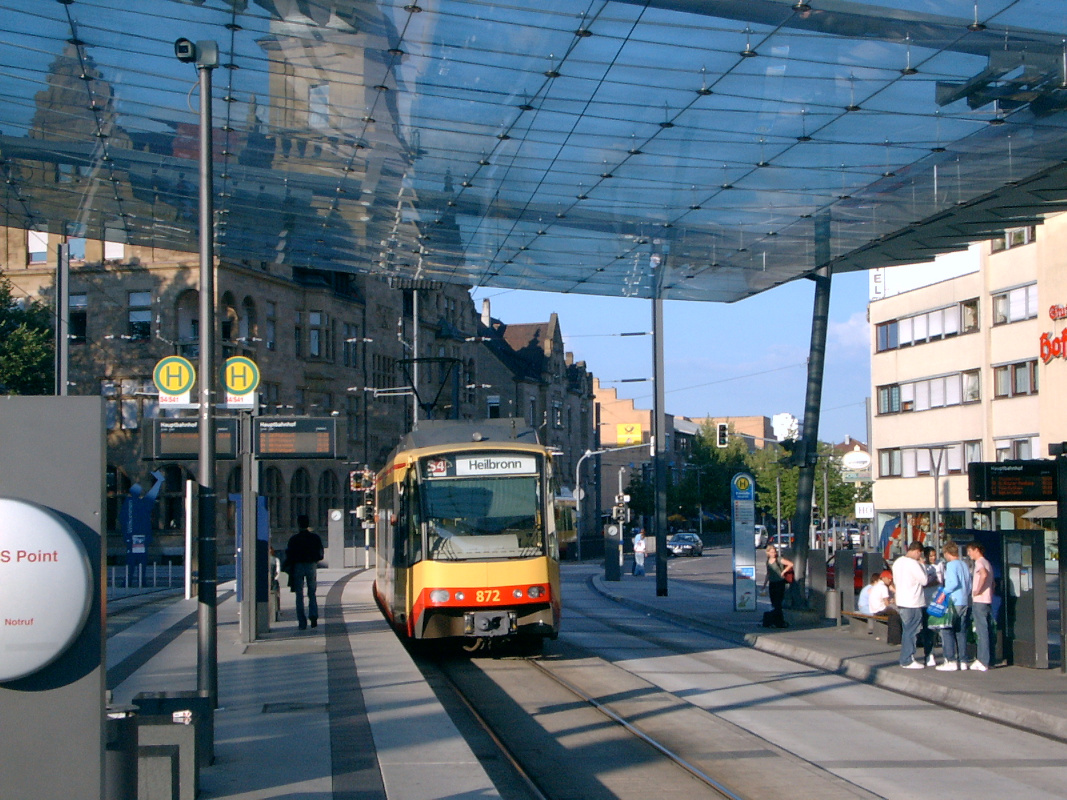
In the vicinity of larger cities the Karlsruhe Model is a good system: electric tram-trains use tramway tracks in the city and then change to railway lines to travel through the more rural countryside, connecting towns and villages to the city.
In Karlsruhe dual system units are in service, which use DC in the city and AC when travelling on railway tracks.
The Heilbronn light rail was opened in 2001 and also connects Karlsruhe and Heilbronn via the Kraichgau Line.
A tram-train arrives in the Heilbronn Station Square.
[Jul 2005].
|
|
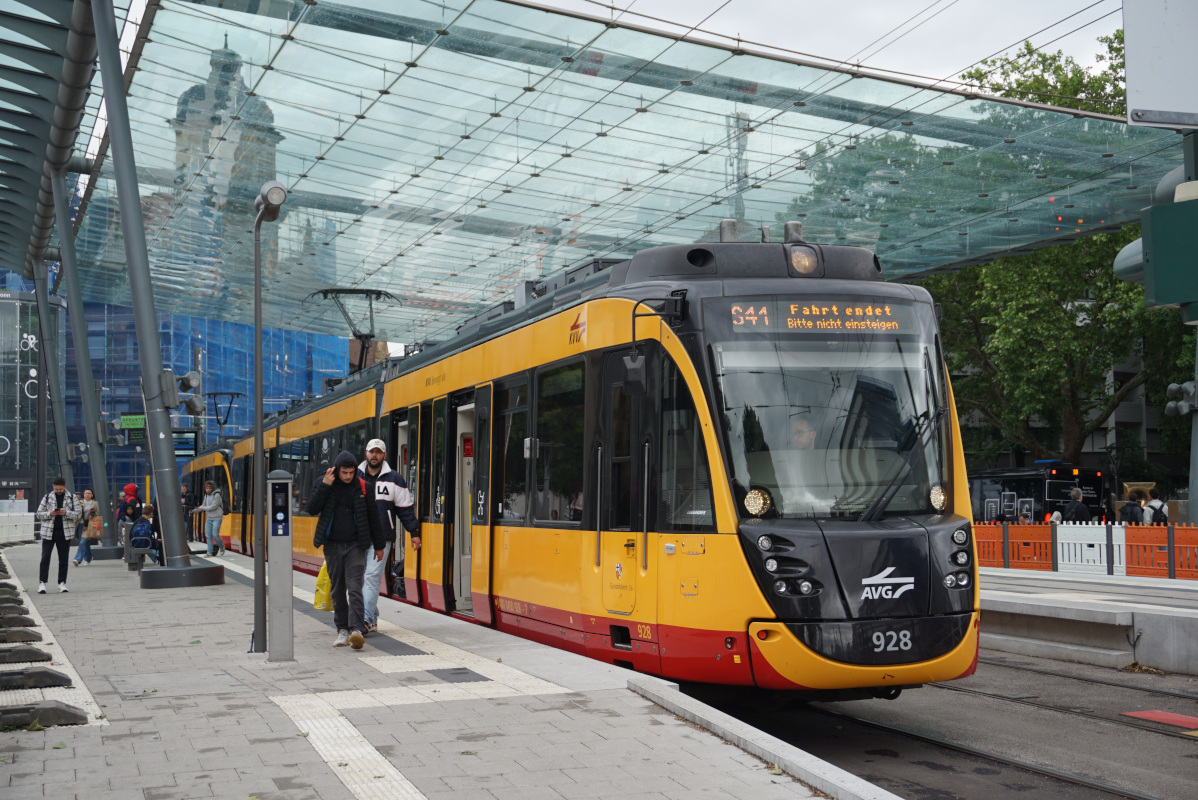
From 2011 onwards the Albtal-Verkehrs-Gesellschaft, which operates light rail in the vicinity of Karlsruhe and Heilbronn,
received new ET2010 trains from Bombardier.
With a floor height of 55 cm they offer level boarding.
One of the trains arrives in the Heilbronn Station Square.
On my page on Railways in Germany, there are more photos of the Heilbronn light rail.
[May 2025].
|
|
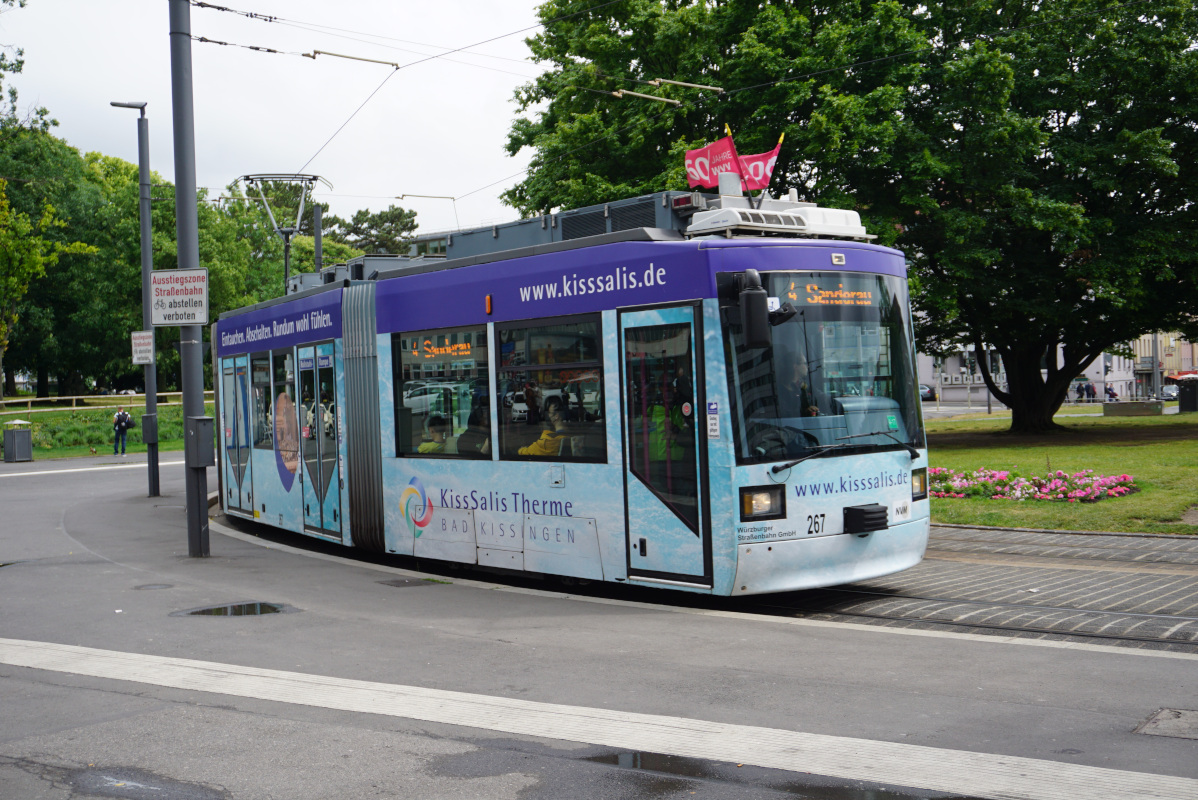
Würzburg has a tram network with 19.7 km of tram lines.
It has a 1 m gauge and uses 750 V DC.
For most services GT-N trains are used.
These were delivered by Linke-Hoffmann-Busch from 1996 onwards.
One of these trains is near the main station.
[May 2025].
|
|
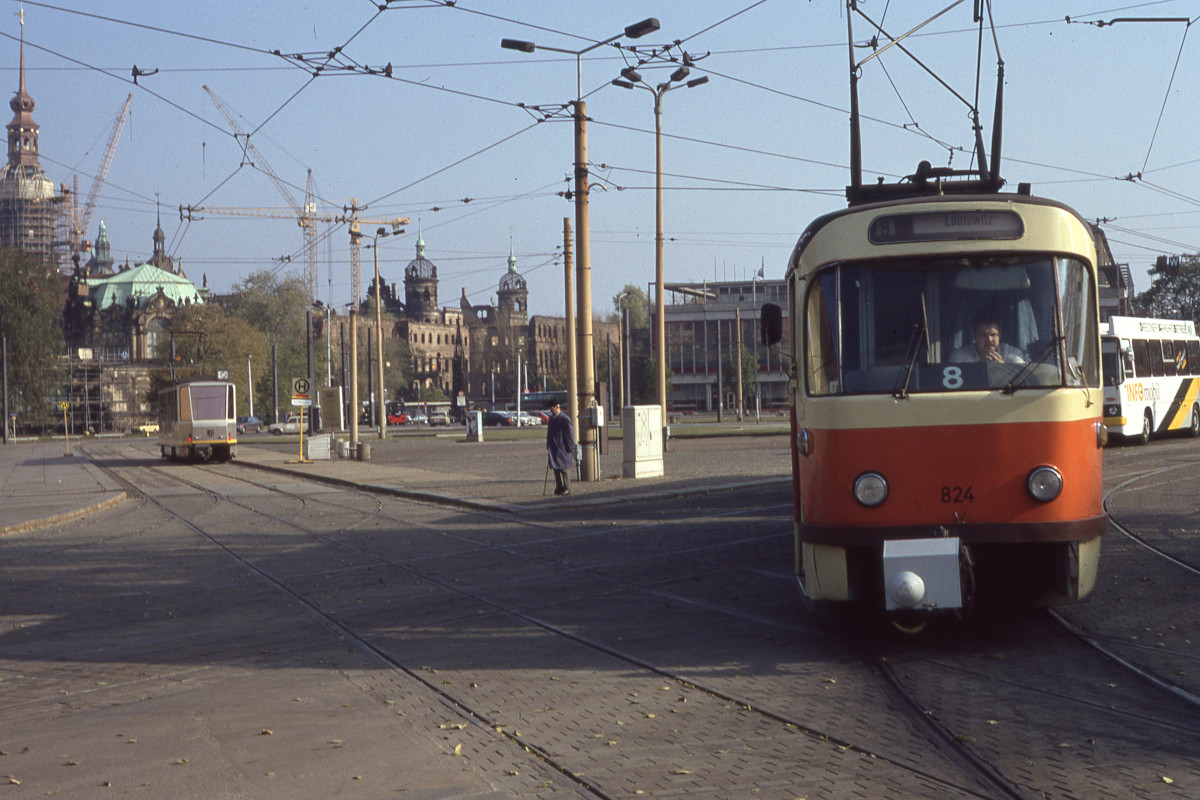
As in most other cities of the German Democratic Republic (East Germany) the Tatra T4D trams were also used in Dresden.
These were delivered by the manufacturer CKD Tatra in Czechoslovakia between 1967 and 1980.
After the German reunification they were in regular service until 2010 and as reserves until 2023.
To the left is a Tatra T6A2 tram, which was not as successful and delivered from 1985 onwards.
[Oct 1991].
|
|
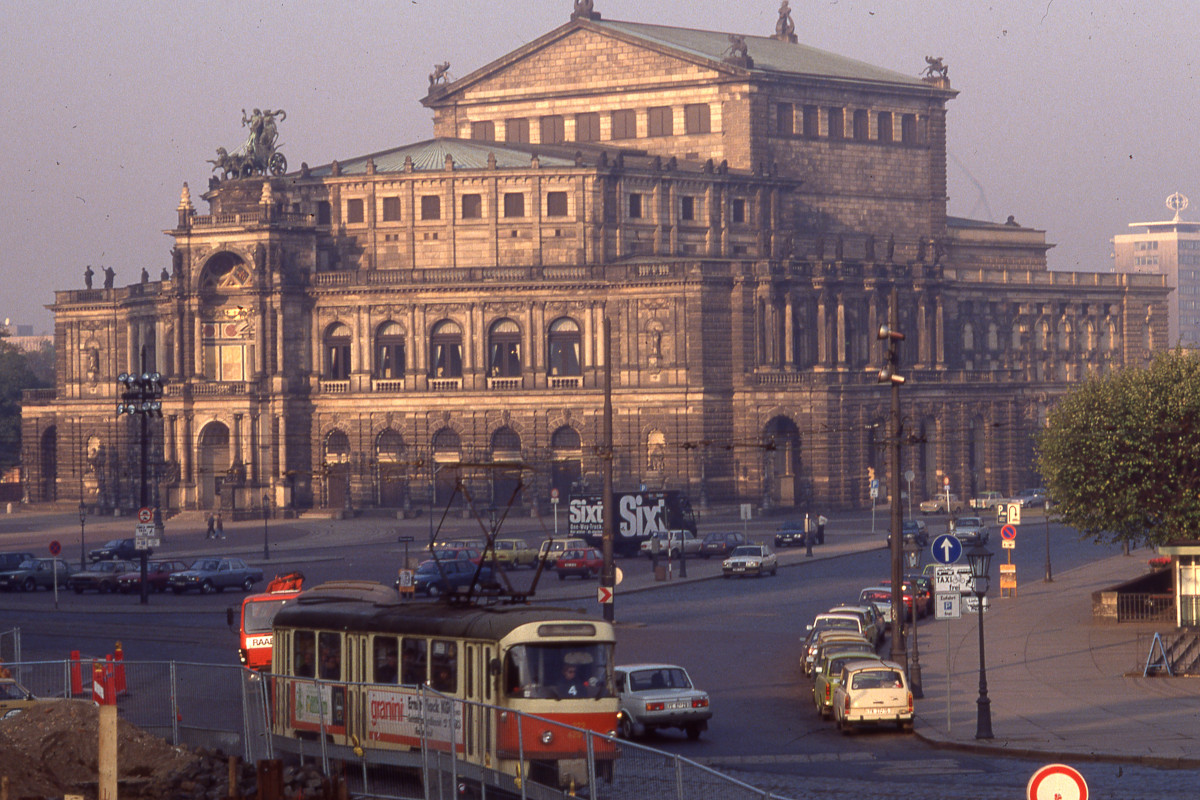
The Tatras were known as tough and solid and were used through the Soviet block.
They shaped the streets of Dresden for decades, even after East Germany became part of the Federal Republic of Germany.
The tram in Dresden has a somewhat unusual gauge of 1450 mm and uses 600 V DC.
[Oct 1991].
|
|
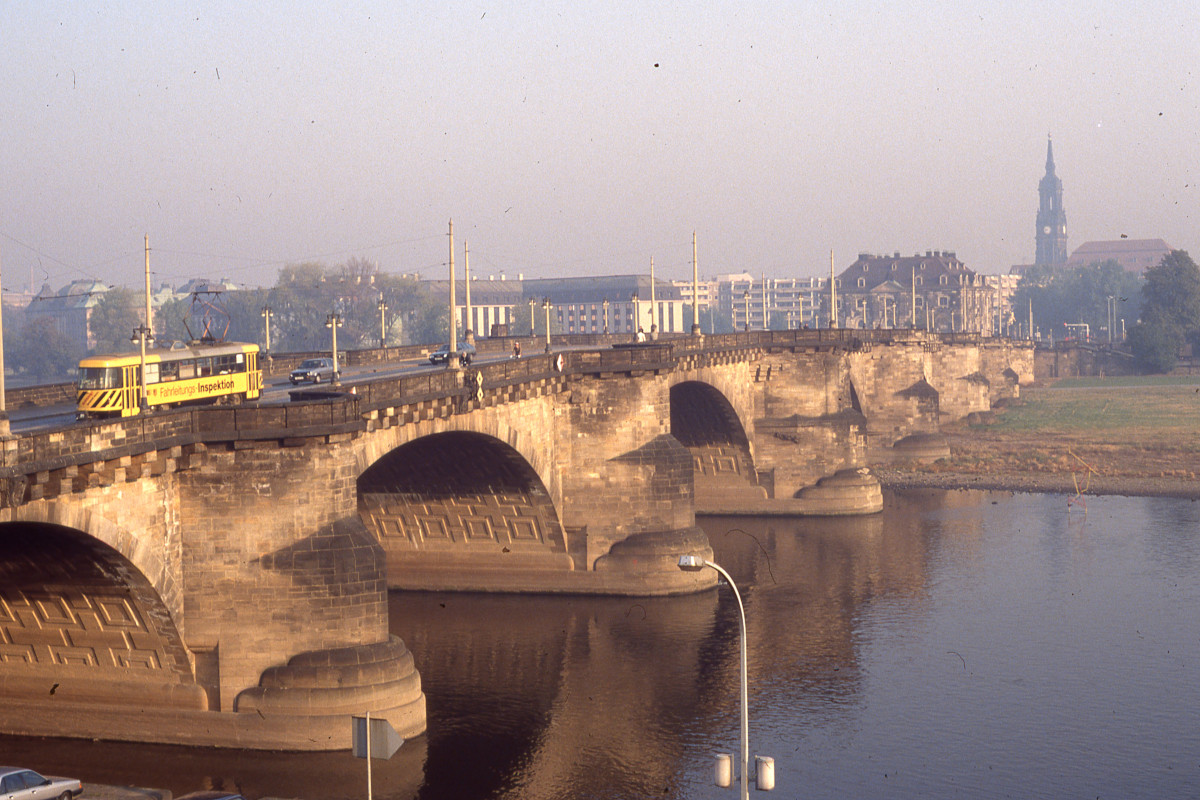
The overhead inspection vehicle was converted in 1976 from a Tatra T4D tram.
Here it cross the August Bridge in Dresden.
[Oct 1991].
|
|
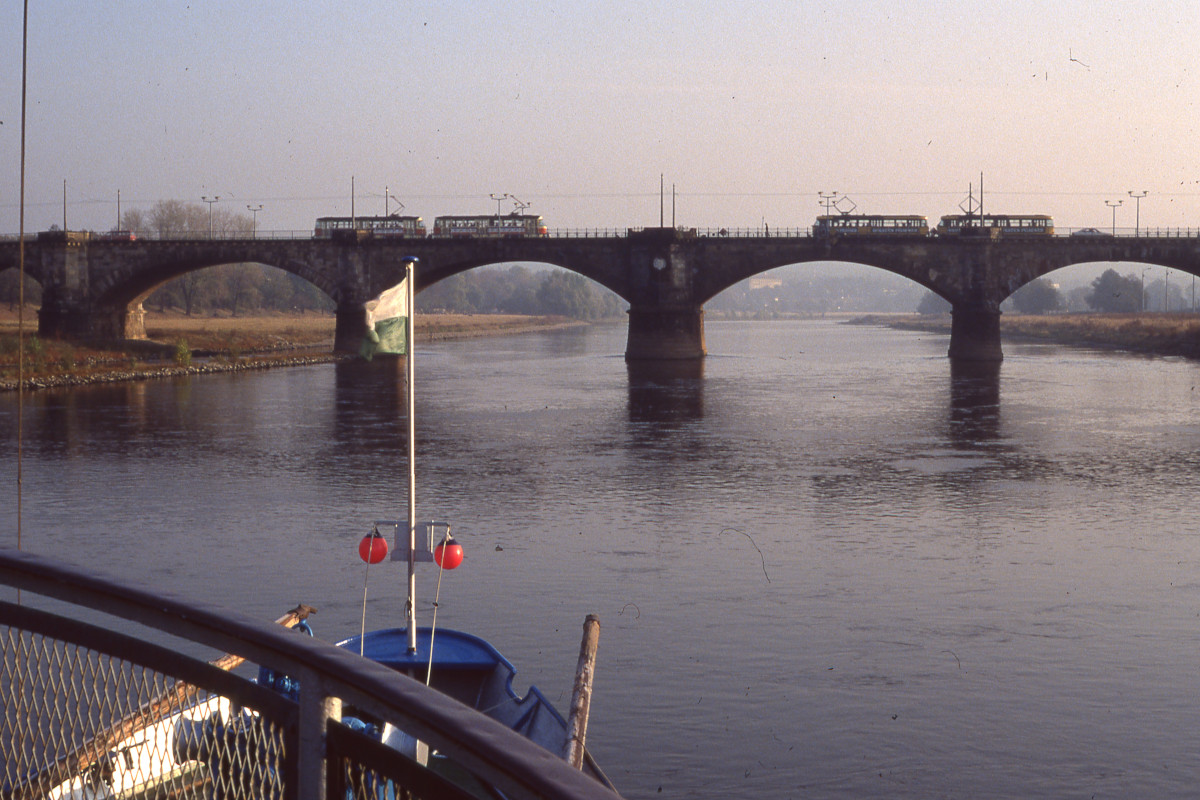
In Dresden there was nearly always a tram in sight.
Even from a ship on the river Elbe one could see the trams crossing the August Bridge.
[Oct 1991].
|
|
After East Germany joined the Federal Republic of Germany in 1990,
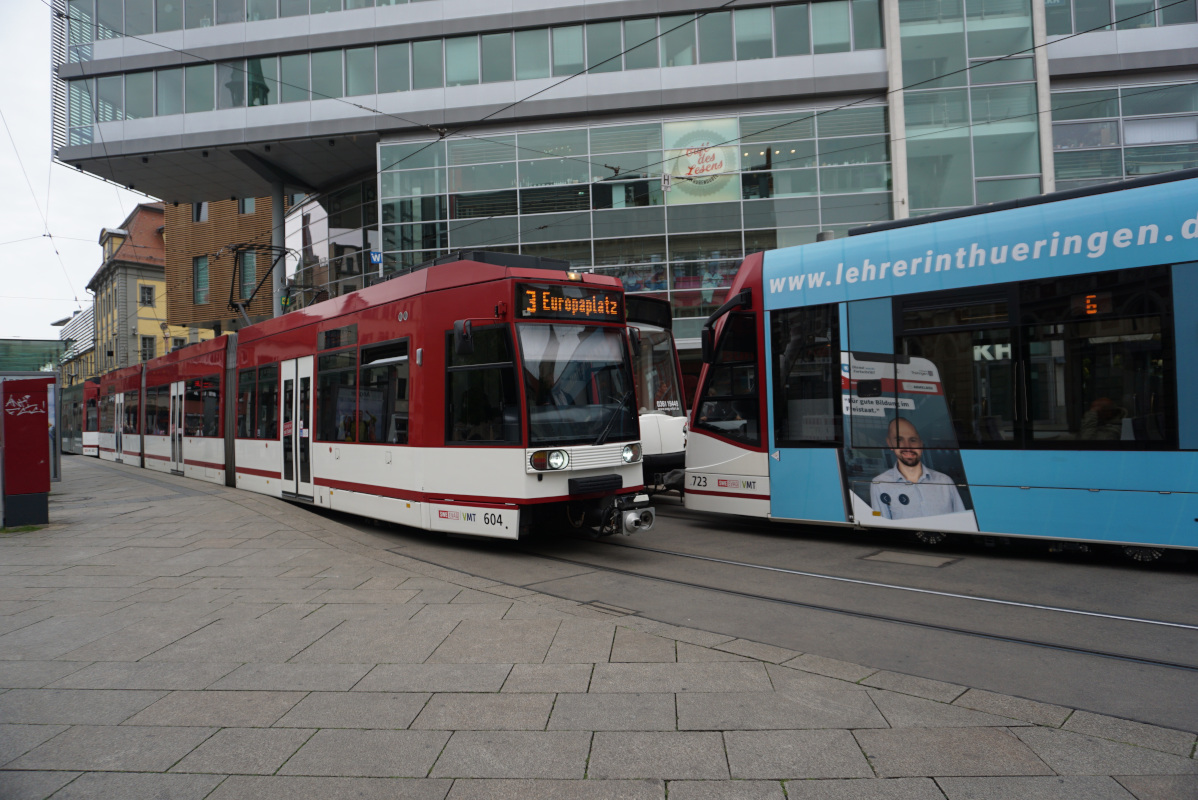
Erfurt Transport (EVAG) received the first low-floor trams in 1994 in the form of the MGT6D from DUEWAG.
Most of these are uni-directional trams MGT6DE (delivered from 1996).
This here is, however, a bi-directional MGT6DZ, which stops here at the Anger.
[May 2025].
|
|
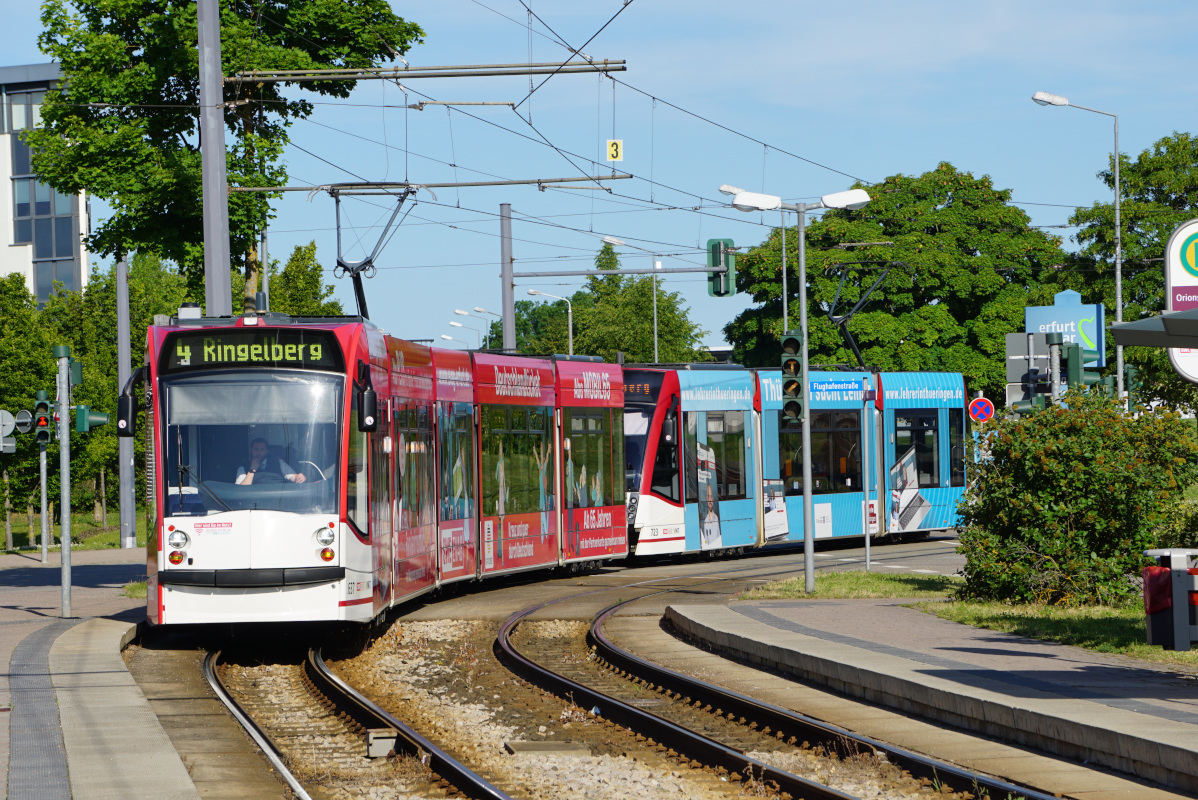
From 2000 onwards EVAG took delivery of Combino trams, which were also developed by DUEWAG.
From 2002 DUEWAG was fully integrated into Siemens, including the production of Combino trams.
The second series of 41 vehicles were the Combino Advanced version and were delivered from 2002 to 2005.
Such a Combino is here travelling together with a Combino of the third series, a Combino Class, which entered service in 2011 and 2012.
The train arrives at the stop Orionstrasse.
[May 2025].
|
|
The tram system in Erfurt has a 1 m gauge and uses 750 V DC.
With six different tram lines and a total length of 45 km it serves as the basis of public transport in Erfurt.
Two Combino trams arrive at the Anger.
[May 2025].
|
|
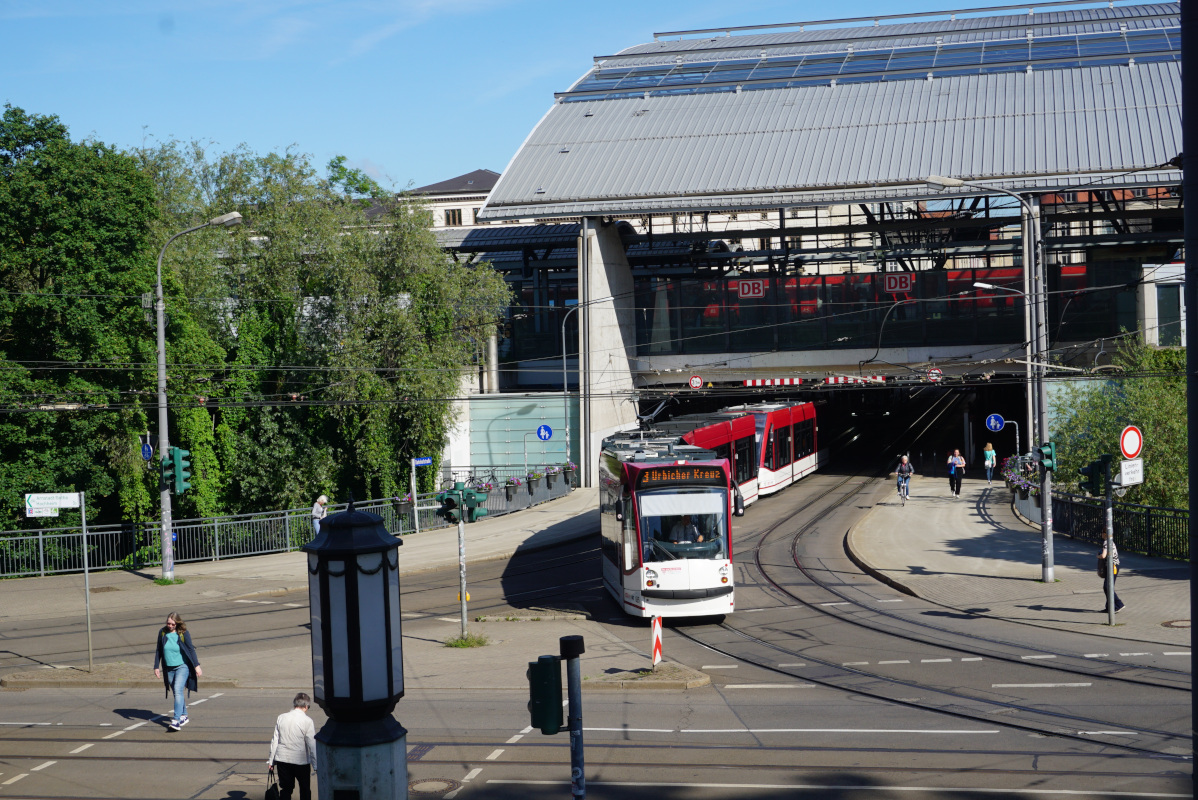
Trams also go under Erfurt Main Station.
Here they connect to regional, national, and international public transport.
Combino trams exit the station subway - at the front a five-part vehicle, at the back a three-part vehicle.
[May 2025].
|
|
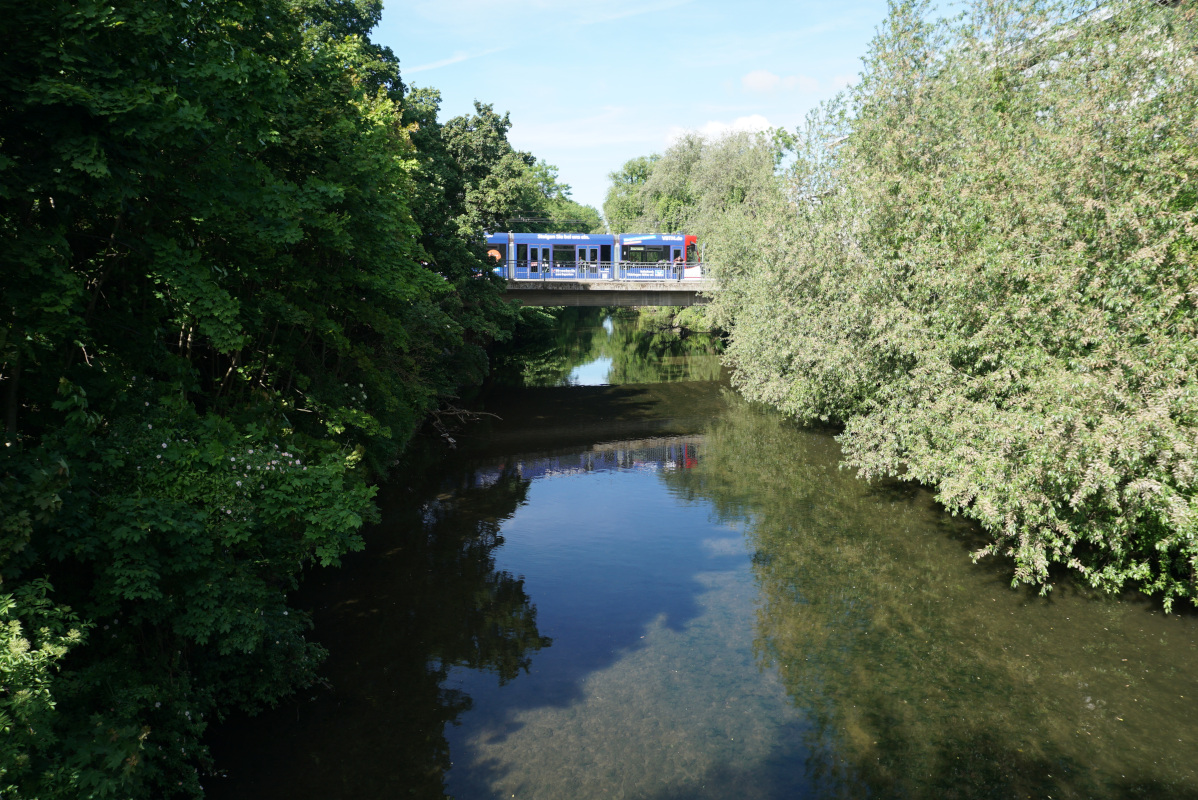
The River Gera runs right through Erfurt.
Because it regularly flooded, a flood diversion was built between 1890 and 1898, to take some of the excess water during floods.
But even at lower river levels it takes some of the water.
Near the main station a Combino tram crosses the flood diversion, which is lined by trees.
[Mai 2025].
|
|
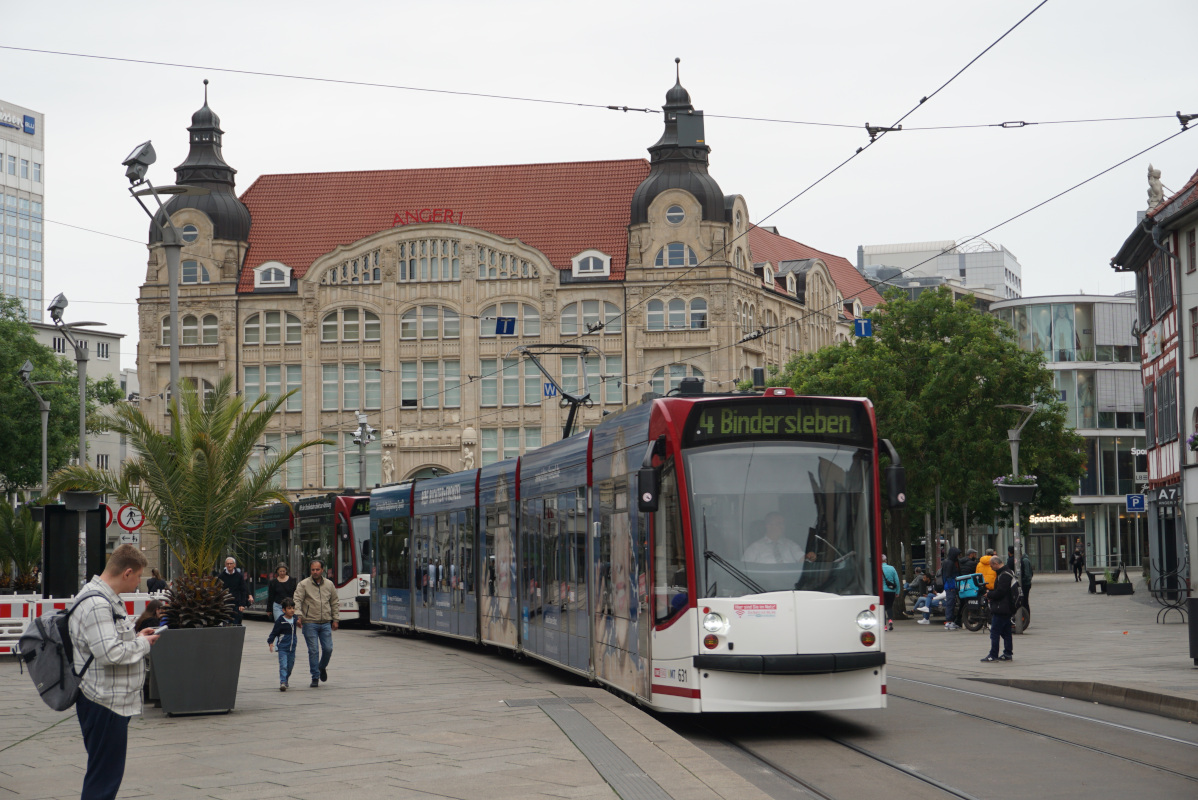
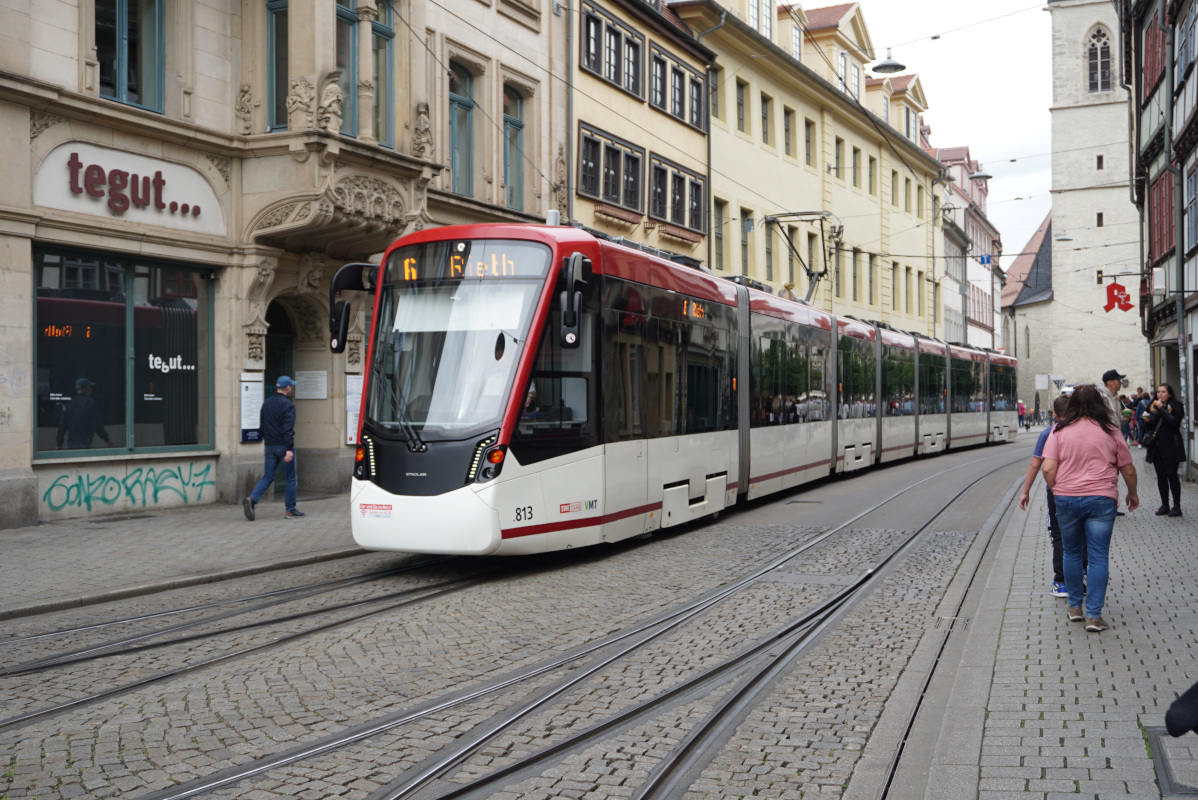
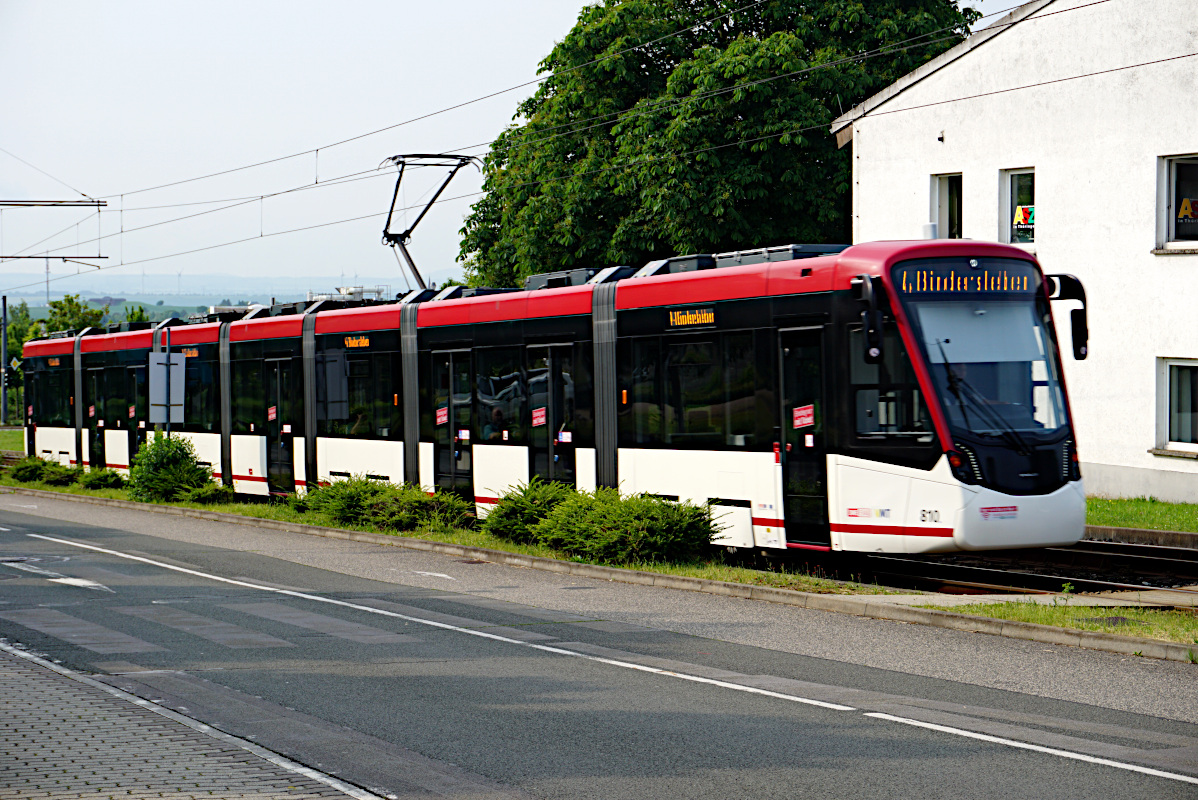
From 2021 onwards Stadler Rail delvered Tramlink trams to Erfurt.
Erfurt chose the uni-directional version.
A Stadler Tramlink tram travels between the cathedral square and the Anger through the old city of Erfurt.
[May 2025].
|
|
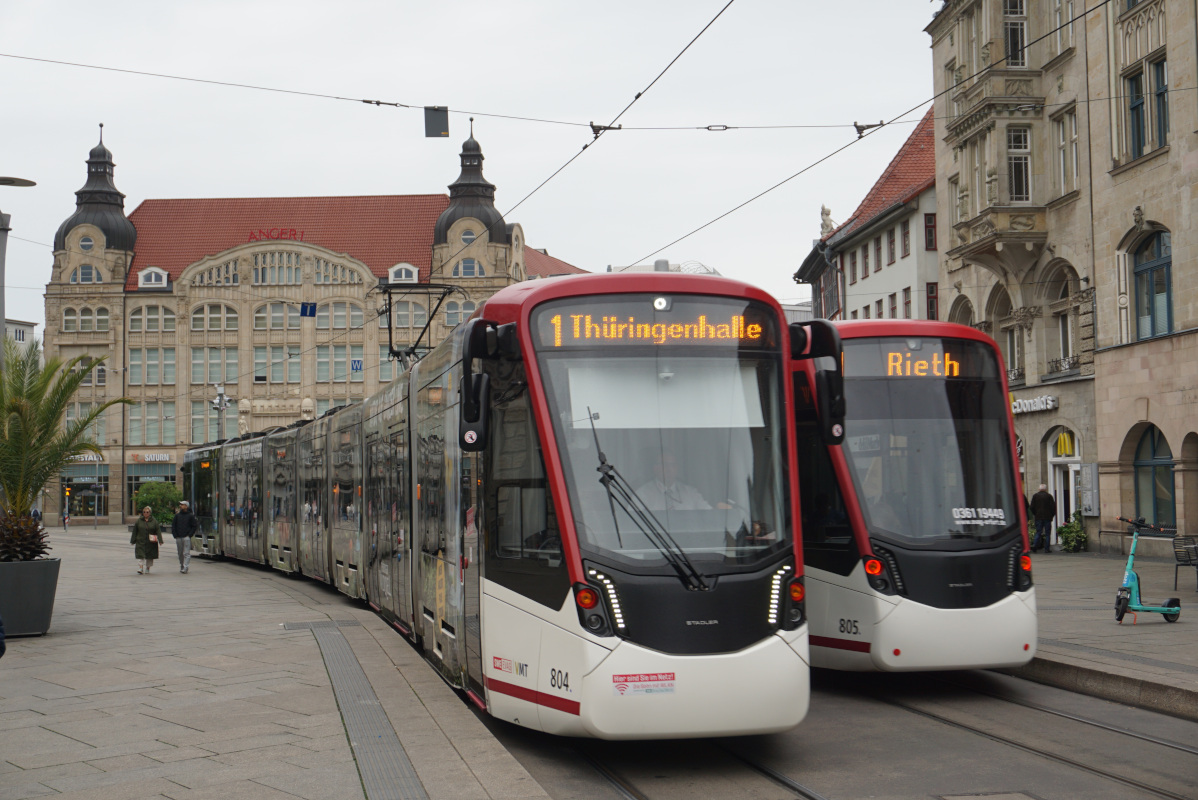
At the Anger all tram lines in Erfurt meet.
The Stadler Tramlink trams are the longest tram vehicles in Erfurt.
By also operating Combino and Tramlink trams, the system in Erfurt has some similarities with the Bern tram system in Switzerland.
[May 2025].
|
|
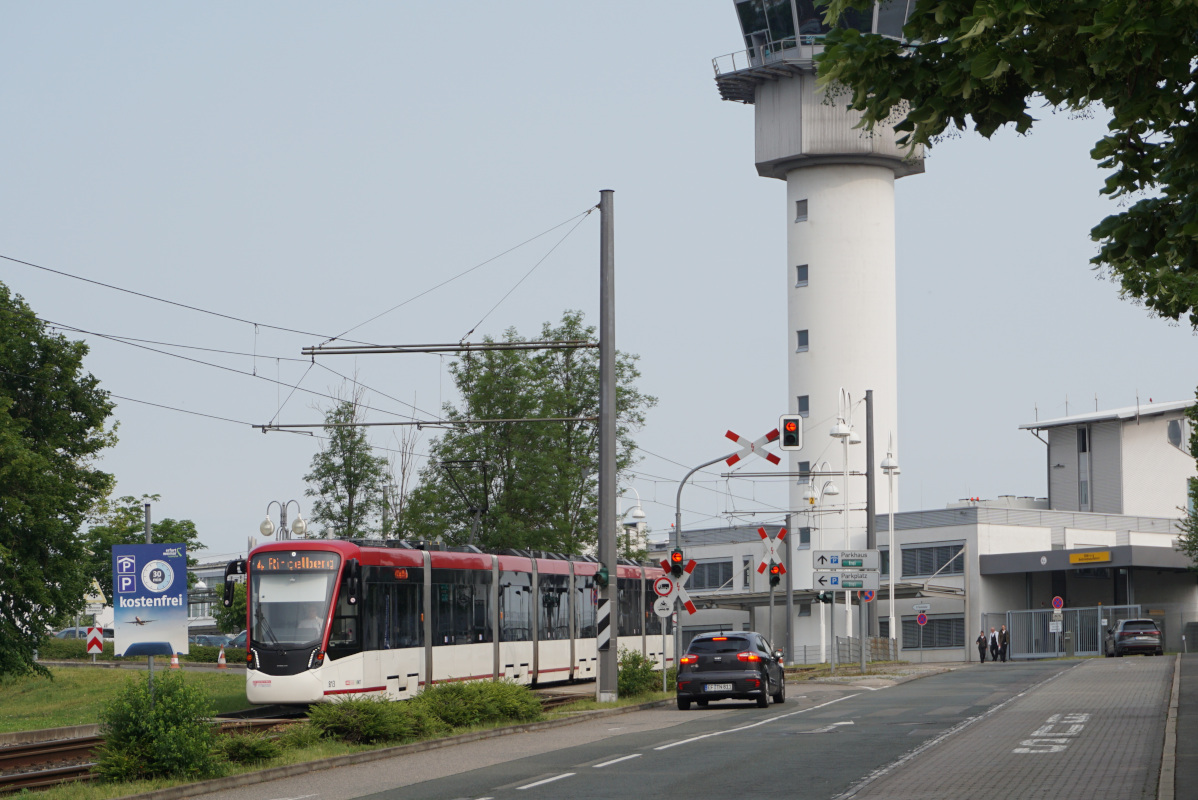
The trams in Erfurt also connect to Erfurt Airport.
This airport is mainly used for charter flights and holiday flights with package deals to the sun, and less for standard flights between centres.
A Tramlink vehicle has just left the Airport stop and continues towards Erfurt.
[Jun 2025].
|
|
The Stadler Tramlink vehicles were constructed at the factory in Valencia in Spain and fitted out at the factory in Berlin-Pankow, Germany.
They are now an important part of public transport in Erfurt.
[Jun 2025].
|