At a time when the Brünig Railway was still part of the SBB,
I took this photo of a class 101 locomotive in Interlaken Ost.
These locos were developed together with the Furka-Oberalp-Bahn (FO) and entered service form 1986 onwards.
For many years they hauled nearly all trains across the Brünig Pass.
[May 2002].

 On a winter night this class 101 locomotive waits in Interlaken Ost with a train to Meiringen.
The loco carries the colours of the Zentralbahn.
By this time class 101 locomotives had been replaced by newer railcars for trains across the Brünig Pass.
[Jan 2016].
On a winter night this class 101 locomotive waits in Interlaken Ost with a train to Meiringen.
The loco carries the colours of the Zentralbahn.
By this time class 101 locomotives had been replaced by newer railcars for trains across the Brünig Pass.
[Jan 2016].
 The Golden-Pass-Route runs from Montreux via the Chemin de Fer Montreux Oberland Bernois (MOB) to Zweisimmen,
from there via the BLS to Interlaken Ost, and then via the Brünig Railway to Luzern.
For severl years, therefore, many carriages of the Brünig Railway carried the Golden-Pass livery.
Such a train is travels through Ebligen on Lake Brienz behind a class 101 loco.
[Jul 2005].
The Golden-Pass-Route runs from Montreux via the Chemin de Fer Montreux Oberland Bernois (MOB) to Zweisimmen,
from there via the BLS to Interlaken Ost, and then via the Brünig Railway to Luzern.
For severl years, therefore, many carriages of the Brünig Railway carried the Golden-Pass livery.
Such a train is travels through Ebligen on Lake Brienz behind a class 101 loco.
[Jul 2005].
 Even though the Zentralbahn was already in existence, at this time many vehicles still operated in the colours of
SBB Brünig Railway.
A class 101 locomotive arrives with its train from Luzern in Brienz.
[Jul 2005].
Even though the Zentralbahn was already in existence, at this time many vehicles still operated in the colours of
SBB Brünig Railway.
A class 101 locomotive arrives with its train from Luzern in Brienz.
[Jul 2005].
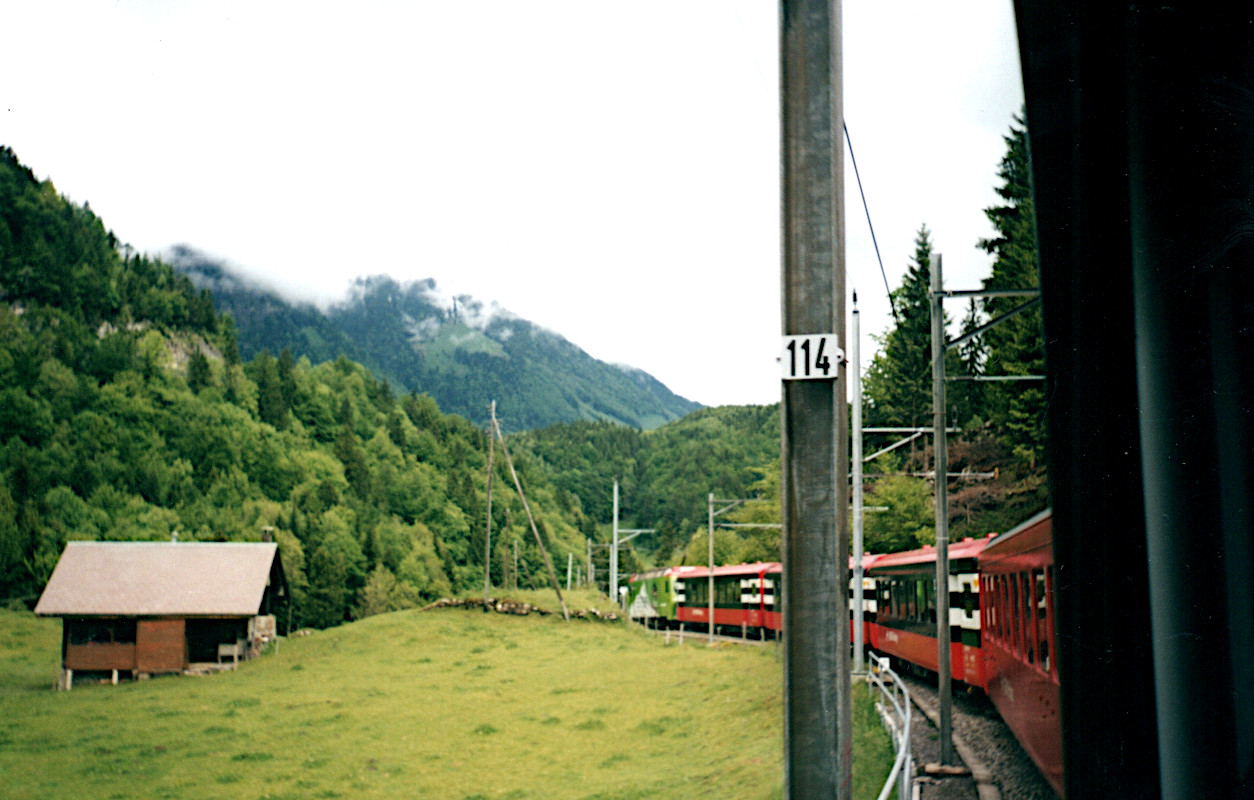 When it was still part of the SBB, a train ascends the incline between Meiringen and Brünig.
A Class 101 locomotive in green advertising livery pulled the train up the rack section.
[May 2002].
When it was still part of the SBB, a train ascends the incline between Meiringen and Brünig.
A Class 101 locomotive in green advertising livery pulled the train up the rack section.
[May 2002].
 In Brienz it is easy to change trains to the 800mm-gauge Brienz-Rothorn-Bahn.
This mountain railway leads to Rothorn Kulm at 2,244m altitude.
Most of the trains are operated by steam locomotives.
Nevertheless many of the locomotives are newer than the class 101 of the ZB.
Loco No. 12 is the first of a new generation of steam locomotives that addressed many of the disadvantages of
steam through new technology.
It entered service in 1992.
It pushes a train up the mountain near Brienz.
[Jul 2005].
In Brienz it is easy to change trains to the 800mm-gauge Brienz-Rothorn-Bahn.
This mountain railway leads to Rothorn Kulm at 2,244m altitude.
Most of the trains are operated by steam locomotives.
Nevertheless many of the locomotives are newer than the class 101 of the ZB.
Loco No. 12 is the first of a new generation of steam locomotives that addressed many of the disadvantages of
steam through new technology.
It entered service in 1992.
It pushes a train up the mountain near Brienz.
[Jul 2005].
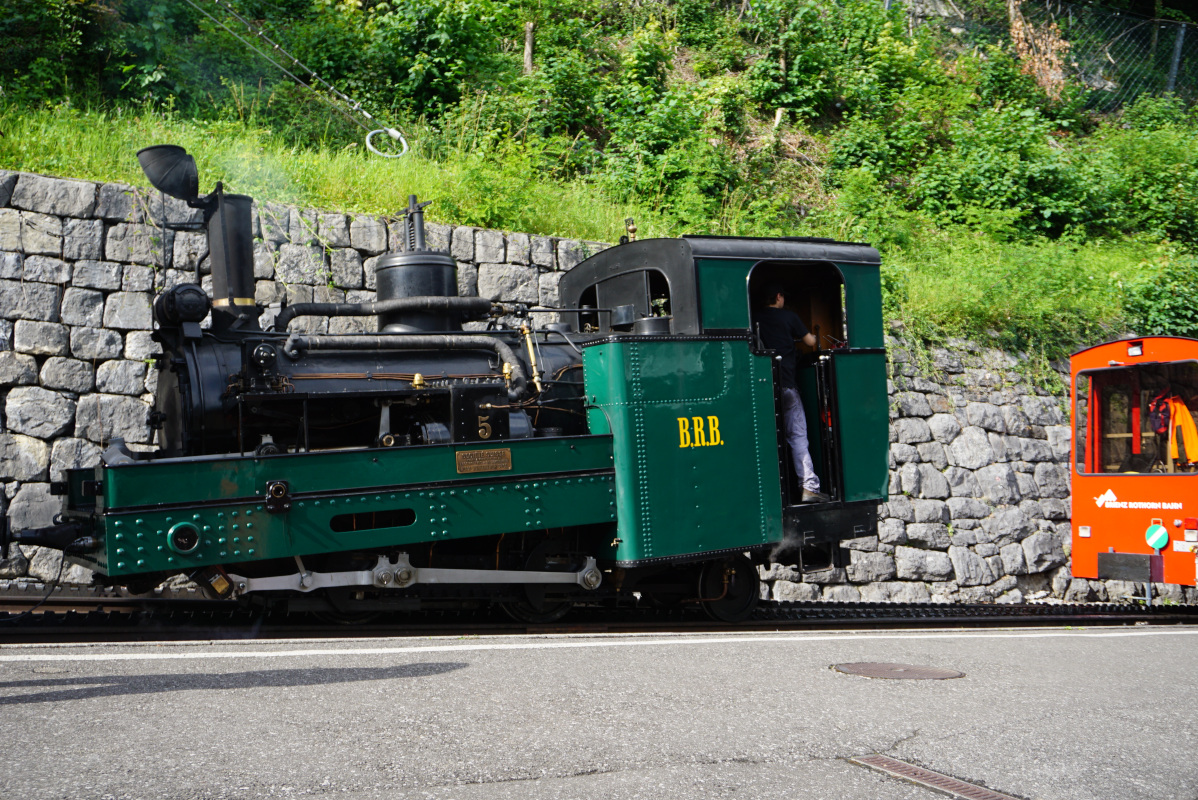 Steam loco No. 5 was built in 1891 and is one of the few old steam locomotives still operating.
It has just arrived in the station of Brienz.
The loco is still coal-fired.
[Jun 2025].
Steam loco No. 5 was built in 1891 and is one of the few old steam locomotives still operating.
It has just arrived in the station of Brienz.
The loco is still coal-fired.
[Jun 2025].
 The class 130 railcars were still ordered by SBB,
but then entered service in Zentralbahn livery from late 2004 onwards.
One of these railcars is seen in Niederried.
[Nov 2015].
The class 130 railcars were still ordered by SBB,
but then entered service in Zentralbahn livery from late 2004 onwards.
One of these railcars is seen in Niederried.
[Nov 2015].
 I took this photos from the ship Jungfrau on Lake Brienz.
A class 130 railcar travels above the lakeshore in Niederried.
[Jul 2015].
I took this photos from the ship Jungfrau on Lake Brienz.
A class 130 railcar travels above the lakeshore in Niederried.
[Jul 2015].
 The class 130 railcars are also called SPATZ (sparrow).
That stands for Schmalspur-Panorama-Triebzug (narrow gauge panorama train set).
These railcars do not have rack propulsion and only can be used on the adhesion sections
between Interlaken and Meiringen and between Luzern and Giswil.
A SPATZ arrives in Oberried.
[Nov 2015].
The class 130 railcars are also called SPATZ (sparrow).
That stands for Schmalspur-Panorama-Triebzug (narrow gauge panorama train set).
These railcars do not have rack propulsion and only can be used on the adhesion sections
between Interlaken and Meiringen and between Luzern and Giswil.
A SPATZ arrives in Oberried.
[Nov 2015].
 The car bodies of the railcars are quite angular.
That allowes for a new door system.
The lower part of the door folds out and becomes a ramp so that people with a wheelchair or pushchair can easily
board the train.
As the floor level of the trains is just 40 cm above the rail, the platforms of the ZB are quite low.
[Nov 2015].
The car bodies of the railcars are quite angular.
That allowes for a new door system.
The lower part of the door folds out and becomes a ramp so that people with a wheelchair or pushchair can easily
board the train.
As the floor level of the trains is just 40 cm above the rail, the platforms of the ZB are quite low.
[Nov 2015].
 Between Interlaken and Brienz the line follows the shore of Lake Brienz closely.
A class 130 railcar near Ebligen.
[Jul 2005].
Between Interlaken and Brienz the line follows the shore of Lake Brienz closely.
A class 130 railcar near Ebligen.
[Jul 2005].
 The SPATZ railcars have been developed from the GTW of Stadler Rail.
The central panorama section was a new concept.
One of the trains arrives in Ebligen.
[Jul 2005].
The SPATZ railcars have been developed from the GTW of Stadler Rail.
The central panorama section was a new concept.
One of the trains arrives in Ebligen.
[Jul 2005].
 Brienz station is right beside the water and not far from the ship landing bridge.
This allows a connection between ship and train.
One of the class 130 railcars arrives in Brienz on a summer evening.
[Jul 2015].
Brienz station is right beside the water and not far from the ship landing bridge.
This allows a connection between ship and train.
One of the class 130 railcars arrives in Brienz on a summer evening.
[Jul 2015].
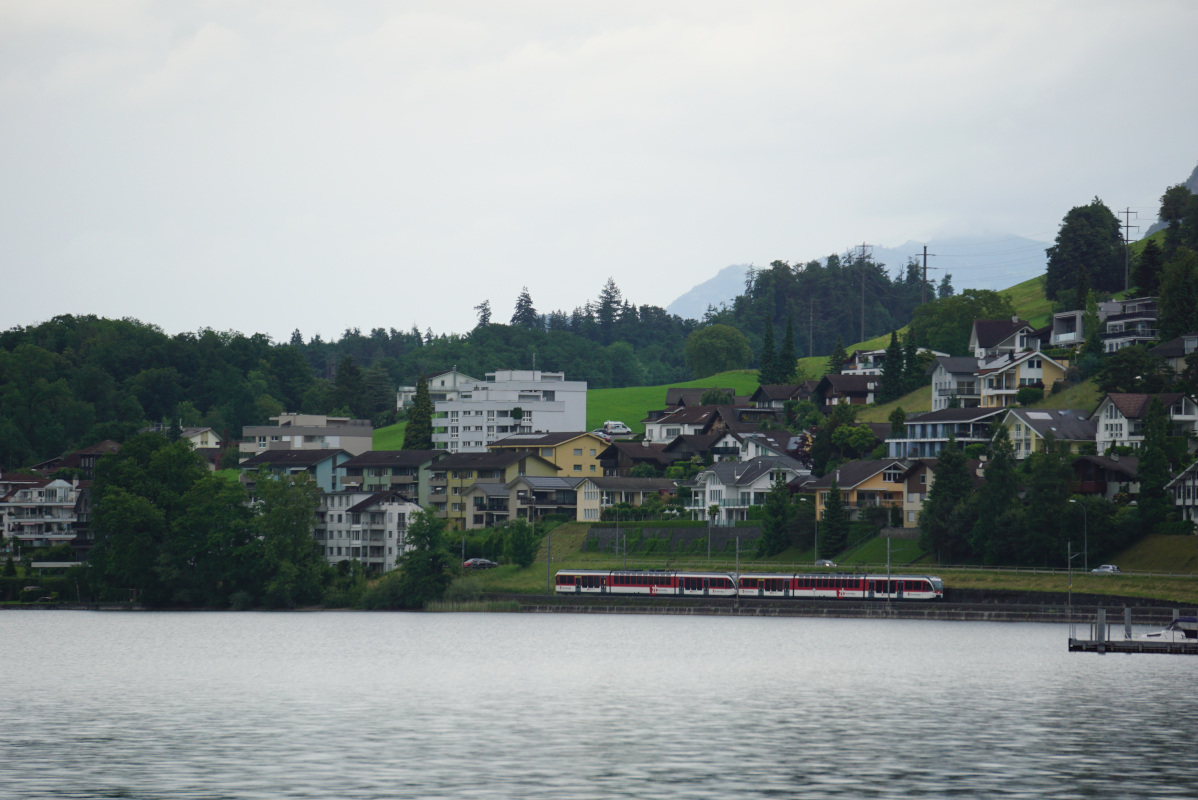 SPATZ railcars are also in service across the Brünig Pass, particularly on S-Bahn lines linking to Lucerne.
They are used on the S5 to Giswil, the S55 to Sachseln, the S4 to Wolfenschiessen and the S44 to Stans.
A train with double SPATZ units is travelling along Lake Sarnen between Sarnen and Sachseln.
[May 2025].
SPATZ railcars are also in service across the Brünig Pass, particularly on S-Bahn lines linking to Lucerne.
They are used on the S5 to Giswil, the S55 to Sachseln, the S4 to Wolfenschiessen and the S44 to Stans.
A train with double SPATZ units is travelling along Lake Sarnen between Sarnen and Sachseln.
[May 2025].
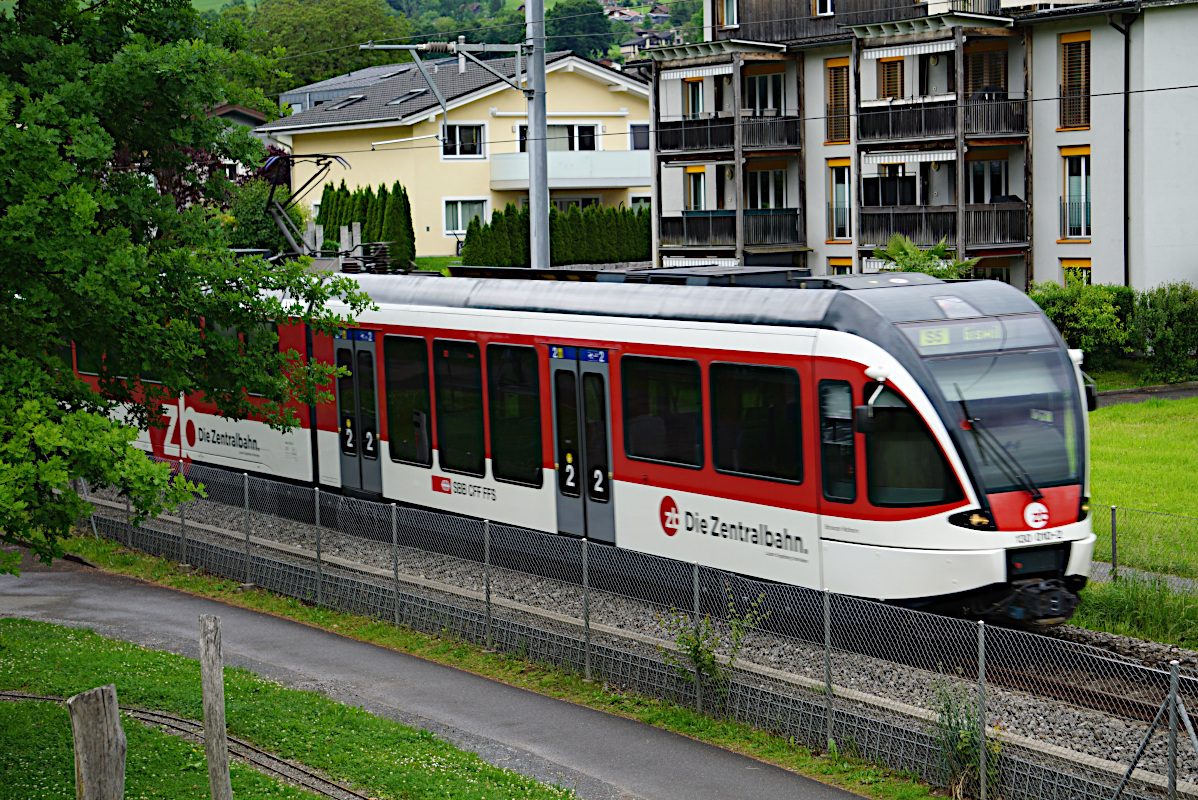 A Class 130 railcar passes as S5 through Sachseln.
[May 2025].
A Class 130 railcar passes as S5 through Sachseln.
[May 2025].
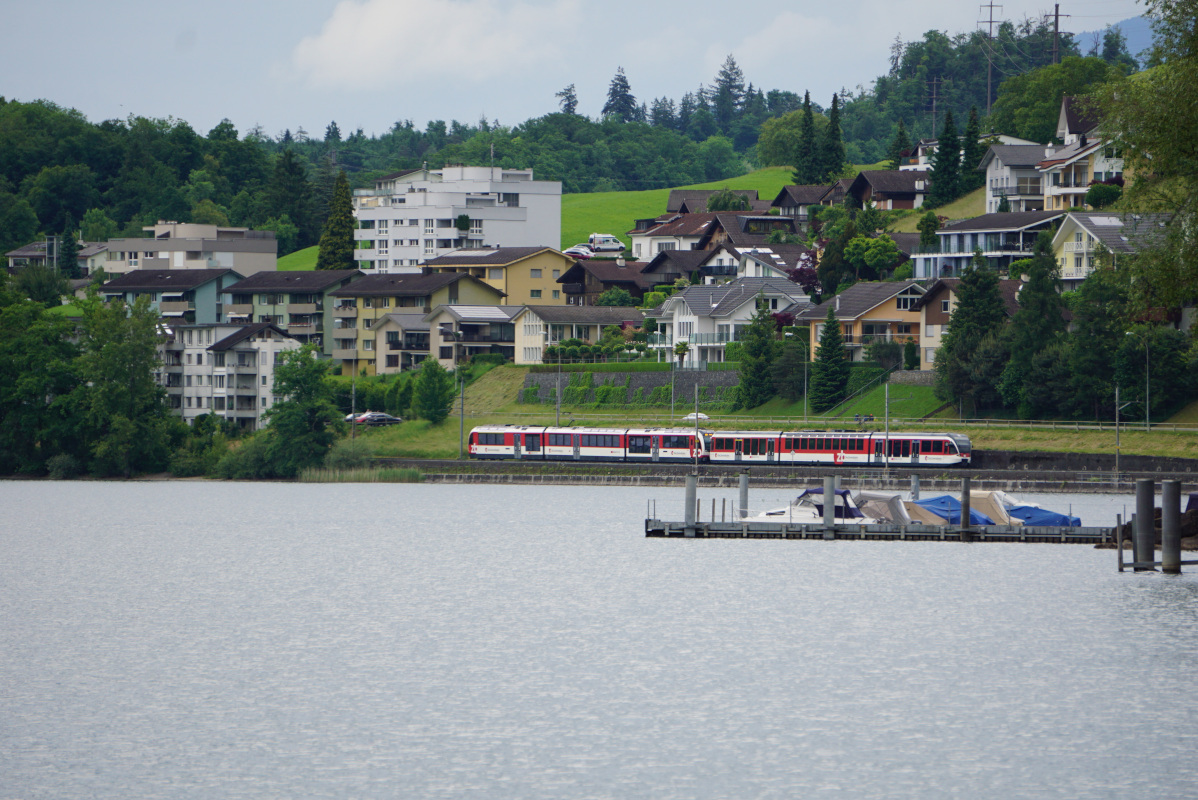 Sometimes Class 130 and Class 160 are coupled together to form a S-Bahn train.
A SPATZ and FINK are travelling together nearch Sachseln.
[May 2025].
Sometimes Class 130 and Class 160 are coupled together to form a S-Bahn train.
A SPATZ and FINK are travelling together nearch Sachseln.
[May 2025].
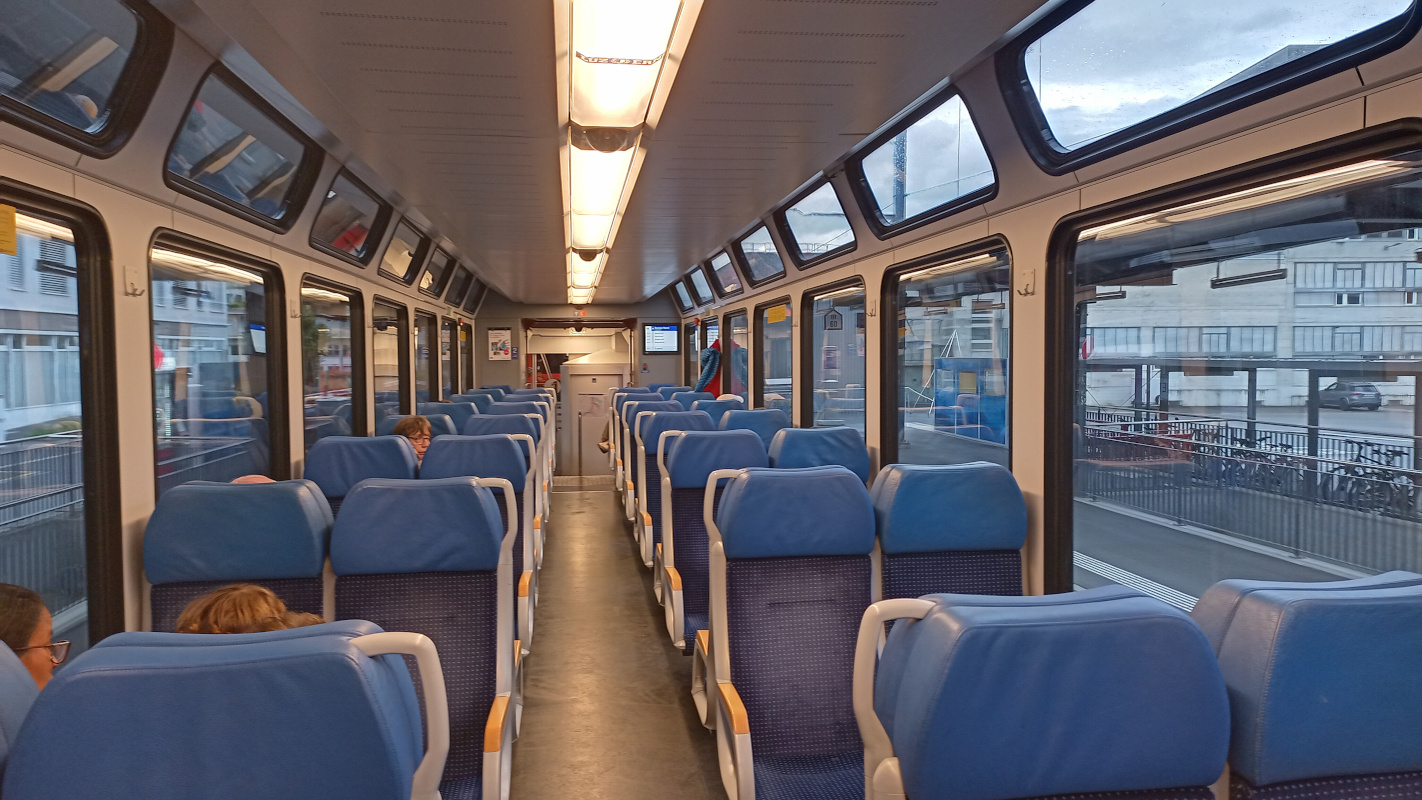 That's how it looks in the central section, high-floor section of a SPATZ.
The train is here close to Lucerne. So sieht es im mittleren, hochflurigen Teil eines SPATZ aus.
Der Zug ist bei Luzern unterwegs.
[May 2025].
That's how it looks in the central section, high-floor section of a SPATZ.
The train is here close to Lucerne. So sieht es im mittleren, hochflurigen Teil eines SPATZ aus.
Der Zug ist bei Luzern unterwegs.
[May 2025].
 In 2012 the Zentralbahn began a sweeping fleet renewal.
It purchased four of these class 150 train sets.
They consist out of two parts with three carriages each plus a dining car at the centre of the train,
so that the trains are seven carriages long.
One of the trains waits in Interlaken Ost.
[May 2014].
In 2012 the Zentralbahn began a sweeping fleet renewal.
It purchased four of these class 150 train sets.
They consist out of two parts with three carriages each plus a dining car at the centre of the train,
so that the trains are seven carriages long.
One of the trains waits in Interlaken Ost.
[May 2014].
 In addition, six three-part class 160 railcars also entered service.
They are built to the same design and can be used together with class 150 train sets for longer trains.
One of the railcars is in Interlaken Ost on a winter night.
[Jan 2016].
In addition, six three-part class 160 railcars also entered service.
They are built to the same design and can be used together with class 150 train sets for longer trains.
One of the railcars is in Interlaken Ost on a winter night.
[Jan 2016].
 Close to its exit from Lake Brienz, the river Aare is bridged by the Zentralbahn.
A class 150 train set leaves Interlaken across the bridge.
[Aug 2015].
Close to its exit from Lake Brienz, the river Aare is bridged by the Zentralbahn.
A class 150 train set leaves Interlaken across the bridge.
[Aug 2015].
 The class 150 train sets area also called ADLER (eagle), though this time it is not an acronym.
And as majestic as an eagle this train rushes through Niederried.
[Nov 2015].
The class 150 train sets area also called ADLER (eagle), though this time it is not an acronym.
And as majestic as an eagle this train rushes through Niederried.
[Nov 2015].
 The smaller railcars are called FINK (finch).
One of the FINK trains arrives in Niederried.
[Nov 2015].
The smaller railcars are called FINK (finch).
One of the FINK trains arrives in Niederried.
[Nov 2015].
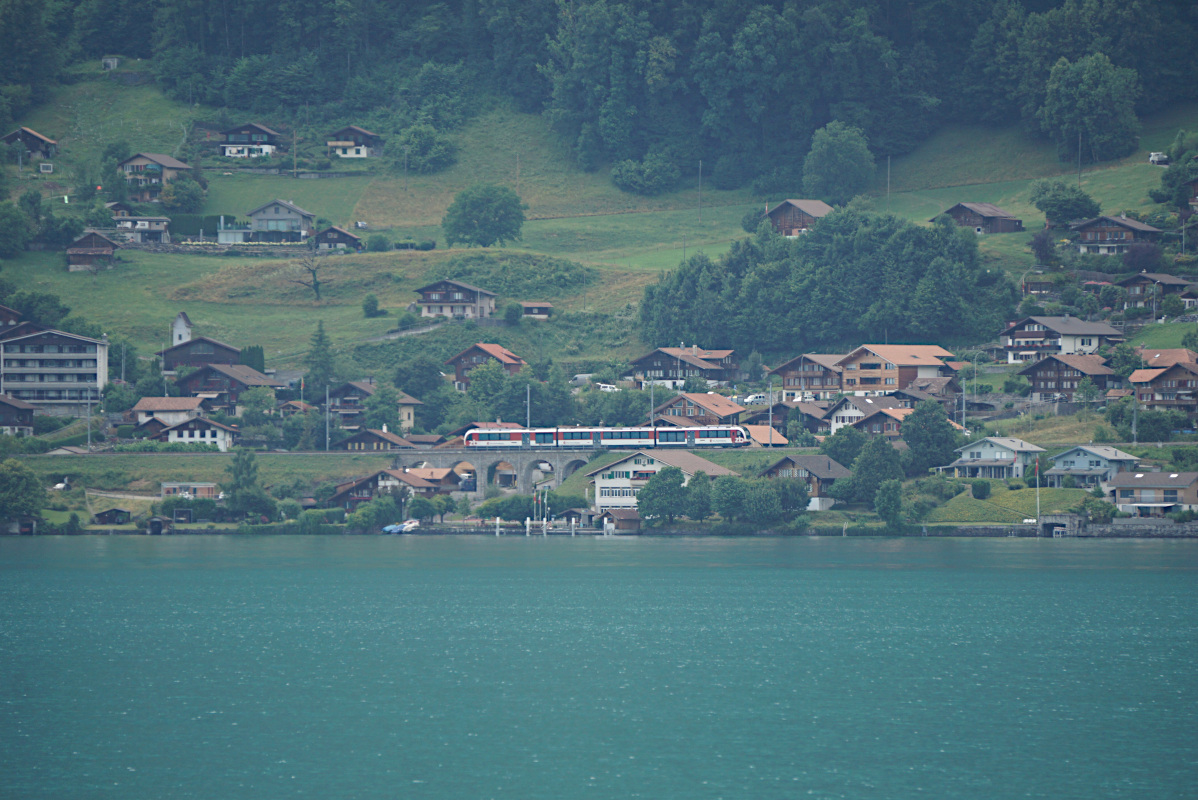 A Class 160 railcar crosses the bridge in Niederried.
[Jul 2025].
A Class 160 railcar crosses the bridge in Niederried.
[Jul 2025].
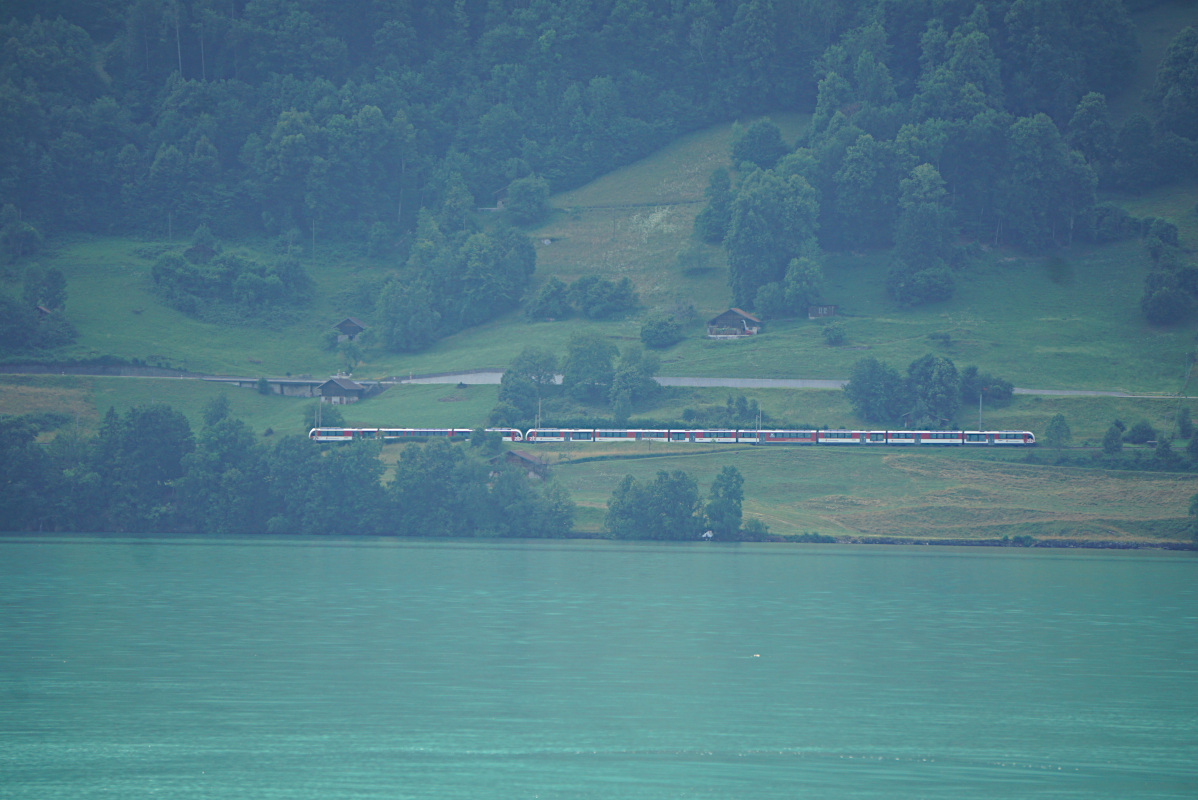 The railway line of the Zentralbahn runs along the right (northern) shore of Lake Brienz.
A ADLER and FINK unit are travelling together between Niederried and Oberried.
[Jul 2025].
The railway line of the Zentralbahn runs along the right (northern) shore of Lake Brienz.
A ADLER and FINK unit are travelling together between Niederried and Oberried.
[Jul 2025].
 An ADLER train set in Oberried, where it crossed a Regio train.
Oberried station was long in the range of model house producer Faller.
I had always wanted this station on my model railway, but never got it.
Still, it was great to see the original.
[Apr 2015].
An ADLER train set in Oberried, where it crossed a Regio train.
Oberried station was long in the range of model house producer Faller.
I had always wanted this station on my model railway, but never got it.
Still, it was great to see the original.
[Apr 2015].
 An ADLER train set in Oberried.
These trains are used for the Luzern-Interlaken-Express,
which connects the two tourist centres every hour.
If one of the train sets is not in service, a carriage train or several class 160 railcars have to be used.
[Nov 2015].
An ADLER train set in Oberried.
These trains are used for the Luzern-Interlaken-Express,
which connects the two tourist centres every hour.
If one of the train sets is not in service, a carriage train or several class 160 railcars have to be used.
[Nov 2015].
 That's the view from one of the train sets across Lake Brienz.
[Nov 2014].
That's the view from one of the train sets across Lake Brienz.
[Nov 2014].
 The interior of the train.
The greater part of the trains are panorama sections.
Many of the compartments have tables.
[Nov 2014].
The interior of the train.
The greater part of the trains are panorama sections.
Many of the compartments have tables.
[Nov 2014].
 Near Brienz the line crosses this long bridge near the shore.
A class 150 train sets crosses the bridge.
[Apr 2015].
Near Brienz the line crosses this long bridge near the shore.
A class 150 train sets crosses the bridge.
[Apr 2015].
 As a Regio train between Interlaken and Meiringen this class 160 railcar
crosses the bridge.
On this section the rack propulsion is not used.
In late 2016 a further five FINK railcars entered service, so that the Zentralbahn now has eleven of these railcars.
[May 2014].
As a Regio train between Interlaken and Meiringen this class 160 railcar
crosses the bridge.
On this section the rack propulsion is not used.
In late 2016 a further five FINK railcars entered service, so that the Zentralbahn now has eleven of these railcars.
[May 2014].
 On trains for which many passengers are expected, an ADLER train set and a FINK railcar are joined into
a 10-car train.
Even though the FINK is partly obscured by trees in this photo, it shows one of these long trains
on the bridge across the Wildbach near Brienz.
[Aug 2015].
On trains for which many passengers are expected, an ADLER train set and a FINK railcar are joined into
a 10-car train.
Even though the FINK is partly obscured by trees in this photo, it shows one of these long trains
on the bridge across the Wildbach near Brienz.
[Aug 2015].
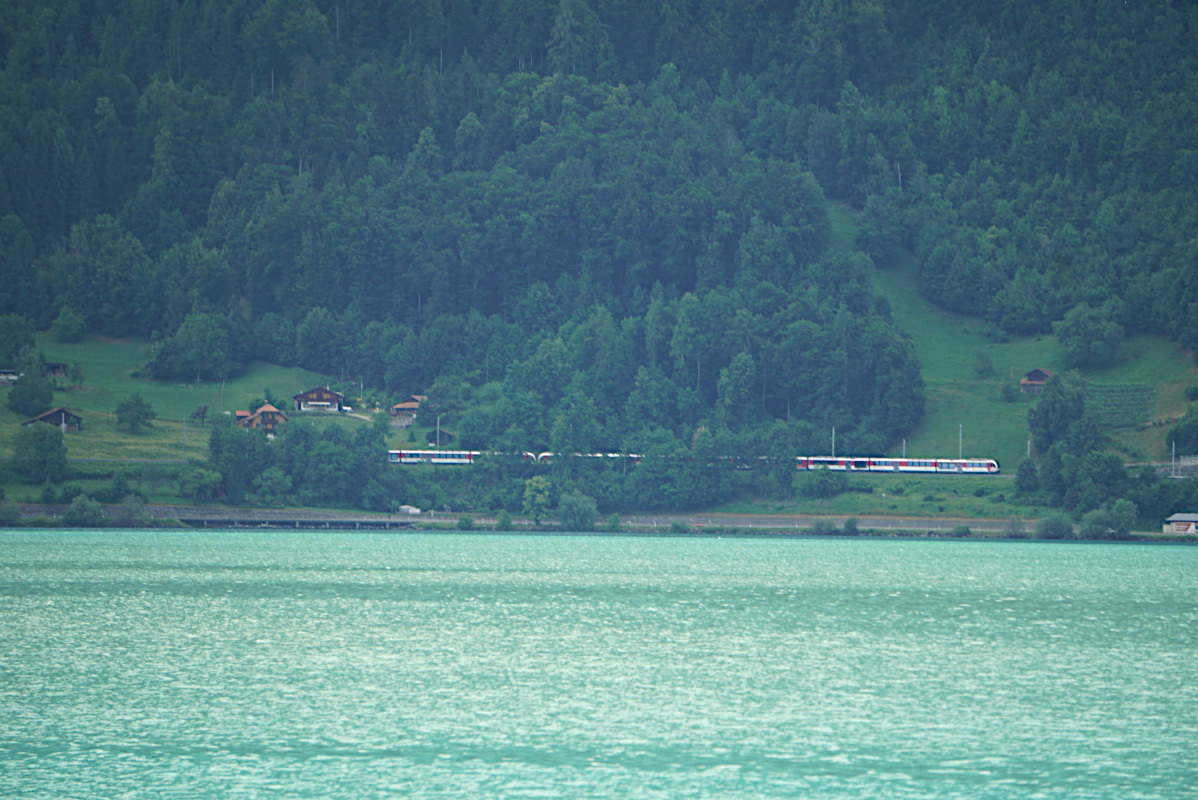 A total of 10 additional FINK and 2 more ADLER trains were ordered between 2019 and 2021.
They are due to be delivered from 2026 onwards.
An ADLER - FINK combination travels along the lake near Brienz.
[Jul 2025].
A total of 10 additional FINK and 2 more ADLER trains were ordered between 2019 and 2021.
They are due to be delivered from 2026 onwards.
An ADLER - FINK combination travels along the lake near Brienz.
[Jul 2025].
 A class 150 train set (ADLER) arrives in Brienz.
The trains between Luzern and Interlaken are called Luzern-Interlaken-Express,
but in the official timetable they operate as InterRegio (IR).
[Jul 2015].
A class 150 train set (ADLER) arrives in Brienz.
The trains between Luzern and Interlaken are called Luzern-Interlaken-Express,
but in the official timetable they operate as InterRegio (IR).
[Jul 2015].
 A class 160 railcar leads a class 150 train set into Brienz on a Luzern-Interlaken-Express.
[Jul 2015].
A class 160 railcar leads a class 150 train set into Brienz on a Luzern-Interlaken-Express.
[Jul 2015].
 On a nice summer's day a FINK and ADLER (finch and eagle) combination arrives in Brienz.
Some of the passengers would have changed to the waiting paddle steamer.
[Aug 2015].
On a nice summer's day a FINK and ADLER (finch and eagle) combination arrives in Brienz.
Some of the passengers would have changed to the waiting paddle steamer.
[Aug 2015].
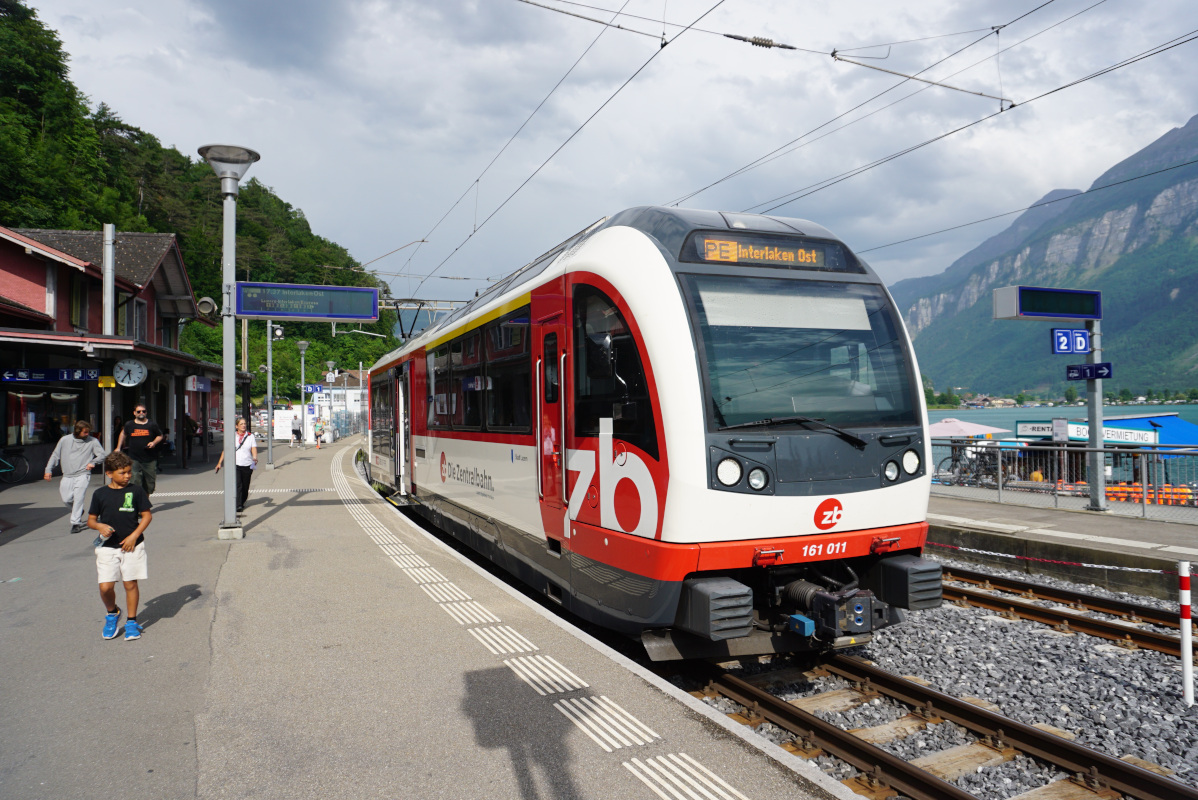 The second series FINK trains received the class designation 161.
One of these railcars leads the PanoramaExpress to Interlaken in Brienz Station.
[Jun 2025].
The second series FINK trains received the class designation 161.
One of these railcars leads the PanoramaExpress to Interlaken in Brienz Station.
[Jun 2025].
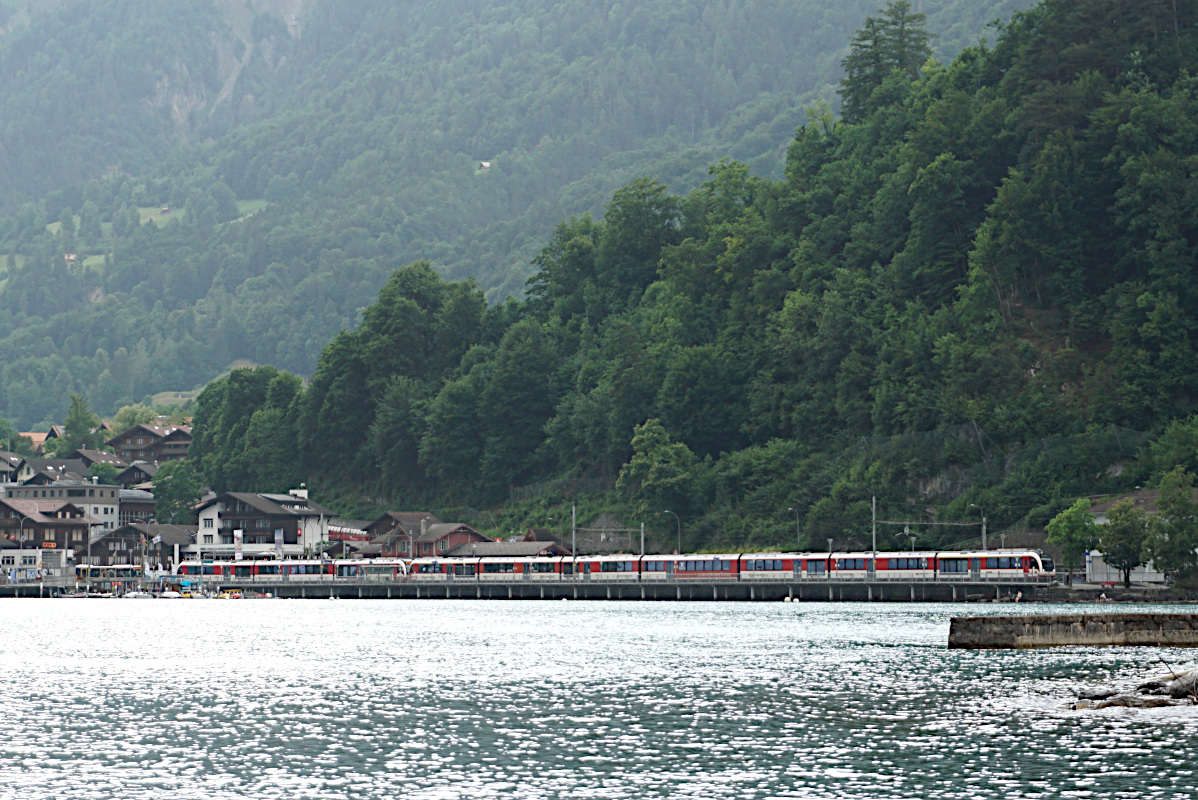 The trains between Interlaken Ost and Luzern via the Brünig Pass are no called PanoramaExpress.
A train consisting of an ADLER and a FINK unit leave Brienz towards Meiringen.
[Jun 2025].
The trains between Interlaken Ost and Luzern via the Brünig Pass are no called PanoramaExpress.
A train consisting of an ADLER and a FINK unit leave Brienz towards Meiringen.
[Jun 2025].
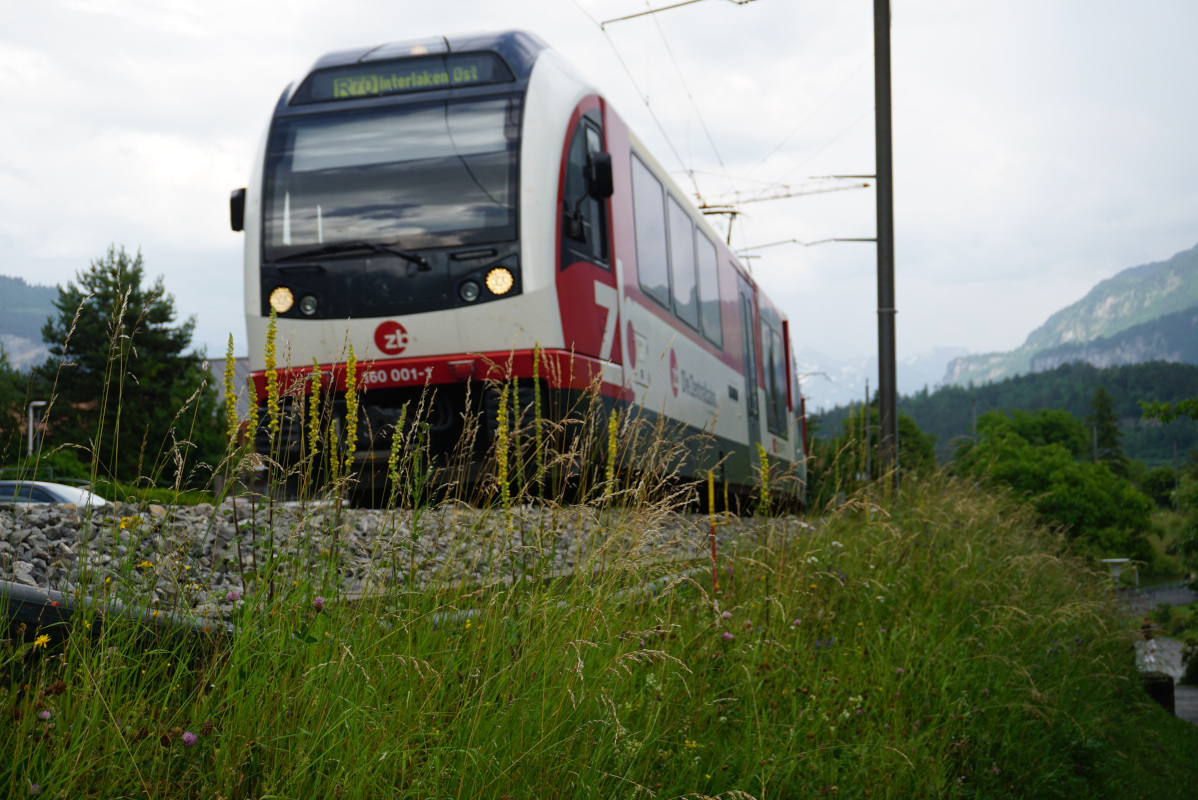 Class 160 and 161 are used without any relevant distinction on services.
A Class 160 railcar travels between Meiringen and Interlaken as Regio train.
[Jun 2025].
Class 160 and 161 are used without any relevant distinction on services.
A Class 160 railcar travels between Meiringen and Interlaken as Regio train.
[Jun 2025].
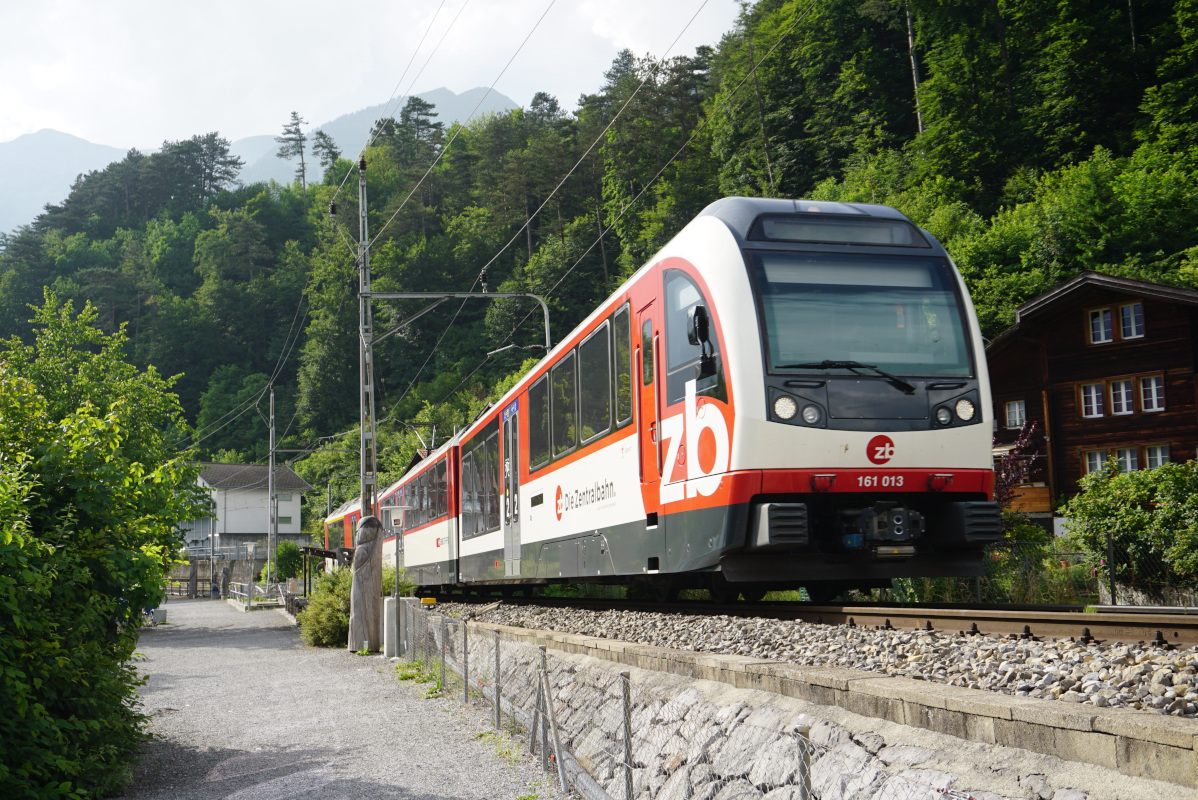 A Class 161 railcar has just departed Brienz towards Meiringen.
The PanoramaExpress and Regio together offer a train every half an hour between Meiringen and Interlaken.
The smaller villages have are served by the Regio every hour.
[Jun 2025].
A Class 161 railcar has just departed Brienz towards Meiringen.
The PanoramaExpress and Regio together offer a train every half an hour between Meiringen and Interlaken.
The smaller villages have are served by the Regio every hour.
[Jun 2025].
 The trains of the Zentralbahn have to reverse in Meiringen.
The class 150 train set on the right has come from Interlaken and now changes direction to travel over the Brünig Pass
to Luzern.
The class 160 railcar on the left will soon depart as Regio train to Interlaken.
[Nov 2014].
The trains of the Zentralbahn have to reverse in Meiringen.
The class 150 train set on the right has come from Interlaken and now changes direction to travel over the Brünig Pass
to Luzern.
The class 160 railcar on the left will soon depart as Regio train to Interlaken.
[Nov 2014].
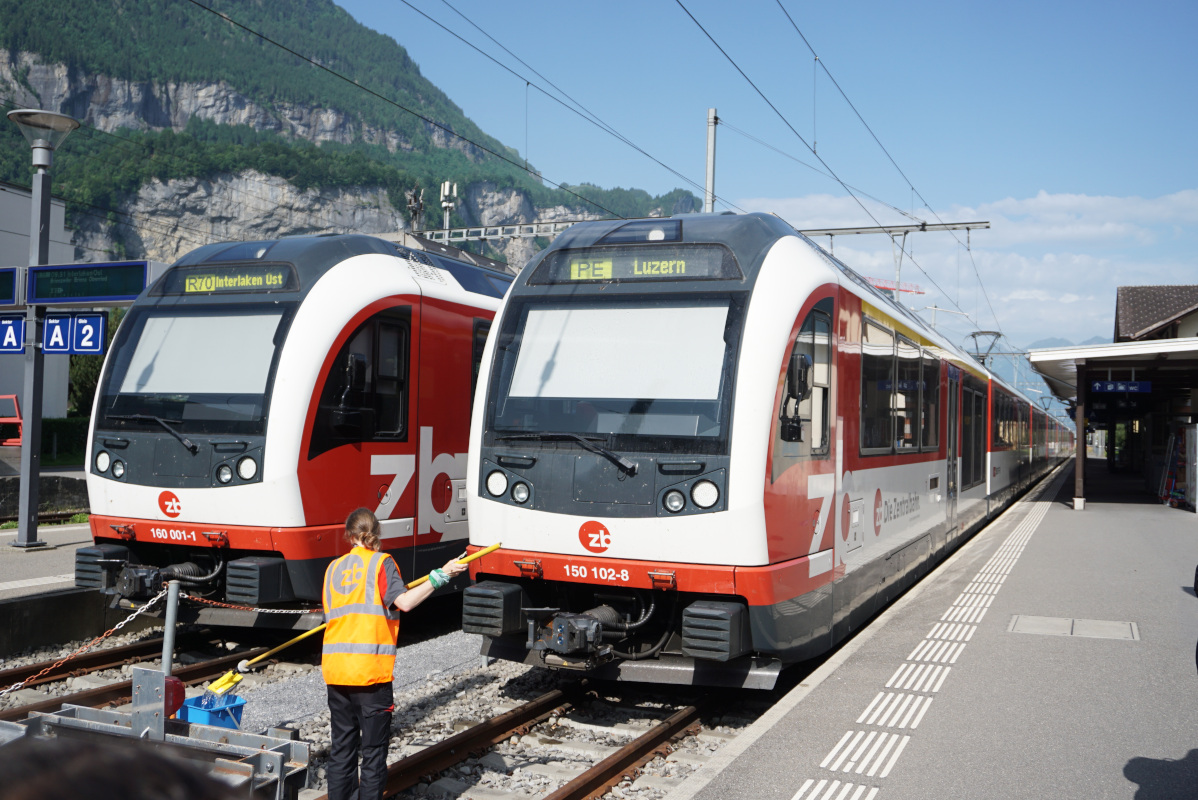 A Panorama-Express to Lucerne and a Regio to Interlaken Ost stand side by side in Meiringen.
A Zentralbahn staff member cleans the wind screens during the stop in the station.
[Jun 2025].
A Panorama-Express to Lucerne and a Regio to Interlaken Ost stand side by side in Meiringen.
A Zentralbahn staff member cleans the wind screens during the stop in the station.
[Jun 2025].
 On the Brünig Pass at an elevation of 1000 m there is already snow in November.
A class 150 train set (ADLER) arrives in Brünig station.
[Nov 2014].
On the Brünig Pass at an elevation of 1000 m there is already snow in November.
A class 150 train set (ADLER) arrives in Brünig station.
[Nov 2014].
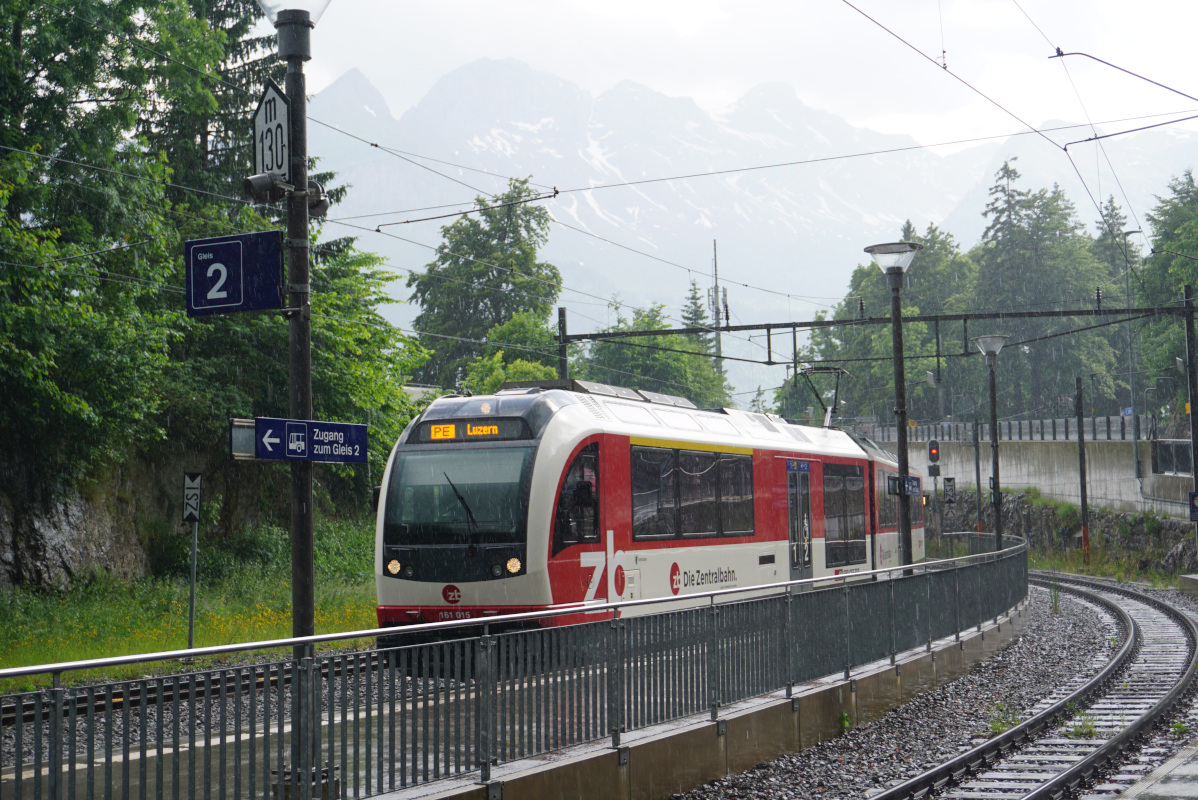 A FINK railcar is at the head of a PanoramaExpress to Lucerne,
as the train arrives during strong rain at the Brünig Station.
[Jun 2025].
A FINK railcar is at the head of a PanoramaExpress to Lucerne,
as the train arrives during strong rain at the Brünig Station.
[Jun 2025].
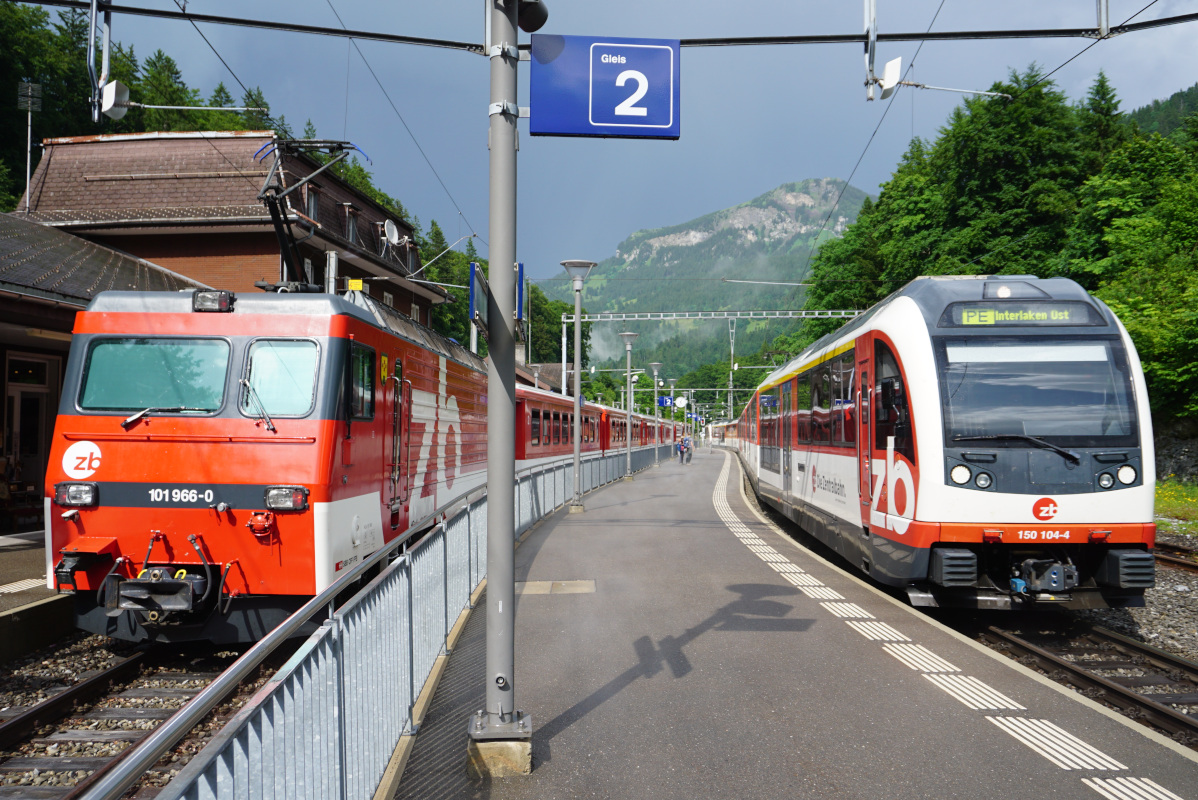 To add capacity in summer there are some additional InterRegio trains between Interlaken Ost and Lucerne.
These trains use older carriages and Class 101 locomotives.
HGe4/4II 101 966-0 has just pushed its train up the incline from Meiringen.
ADLER 150 104-4 has climbed the rack section from Lungern to the Brünig Pass.
The trains meet in Brünig-Hasliberg Station.
[Jun 2025].
To add capacity in summer there are some additional InterRegio trains between Interlaken Ost and Lucerne.
These trains use older carriages and Class 101 locomotives.
HGe4/4II 101 966-0 has just pushed its train up the incline from Meiringen.
ADLER 150 104-4 has climbed the rack section from Lungern to the Brünig Pass.
The trains meet in Brünig-Hasliberg Station.
[Jun 2025].
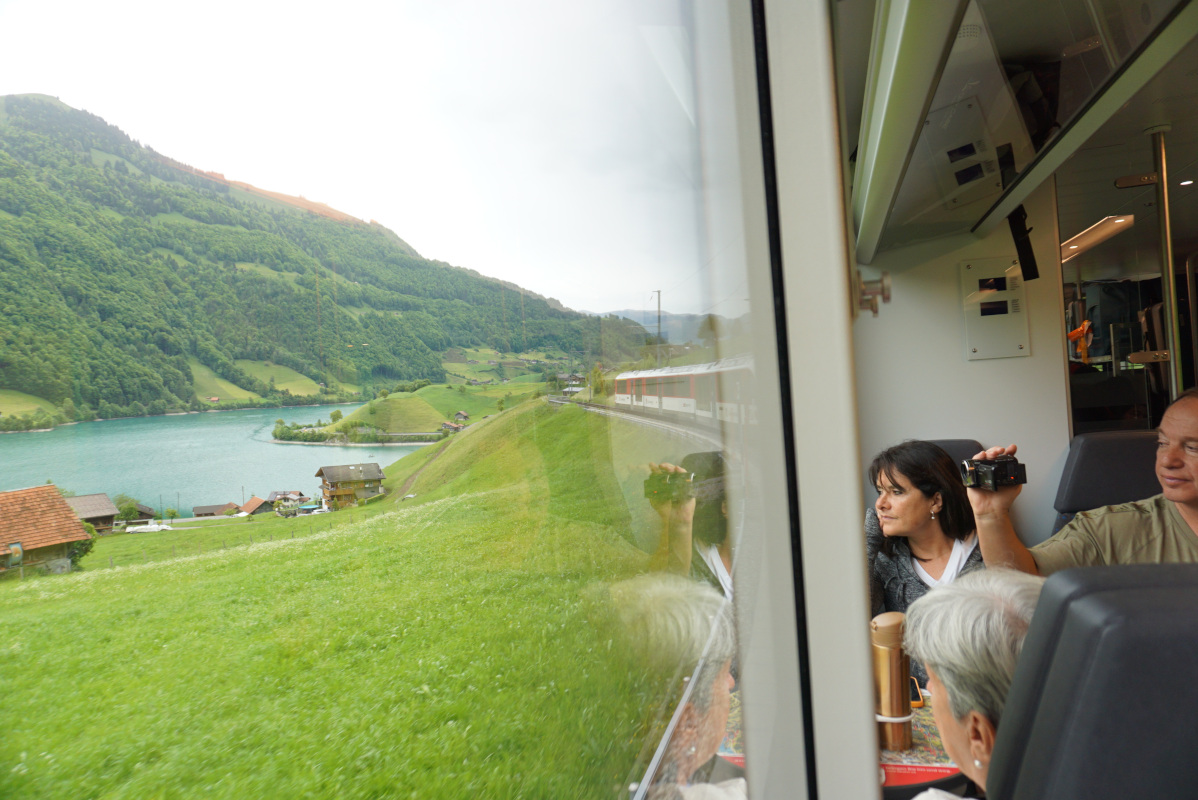 Tourists enjoy the view from the PanoramaExpress.
That's the view from an ADLER train across Lake Lungern.
The train has crossed the Brünig Pass and now travels down the valley towards Lucerne.
[May 2025].
Tourists enjoy the view from the PanoramaExpress.
That's the view from an ADLER train across Lake Lungern.
The train has crossed the Brünig Pass and now travels down the valley towards Lucerne.
[May 2025].
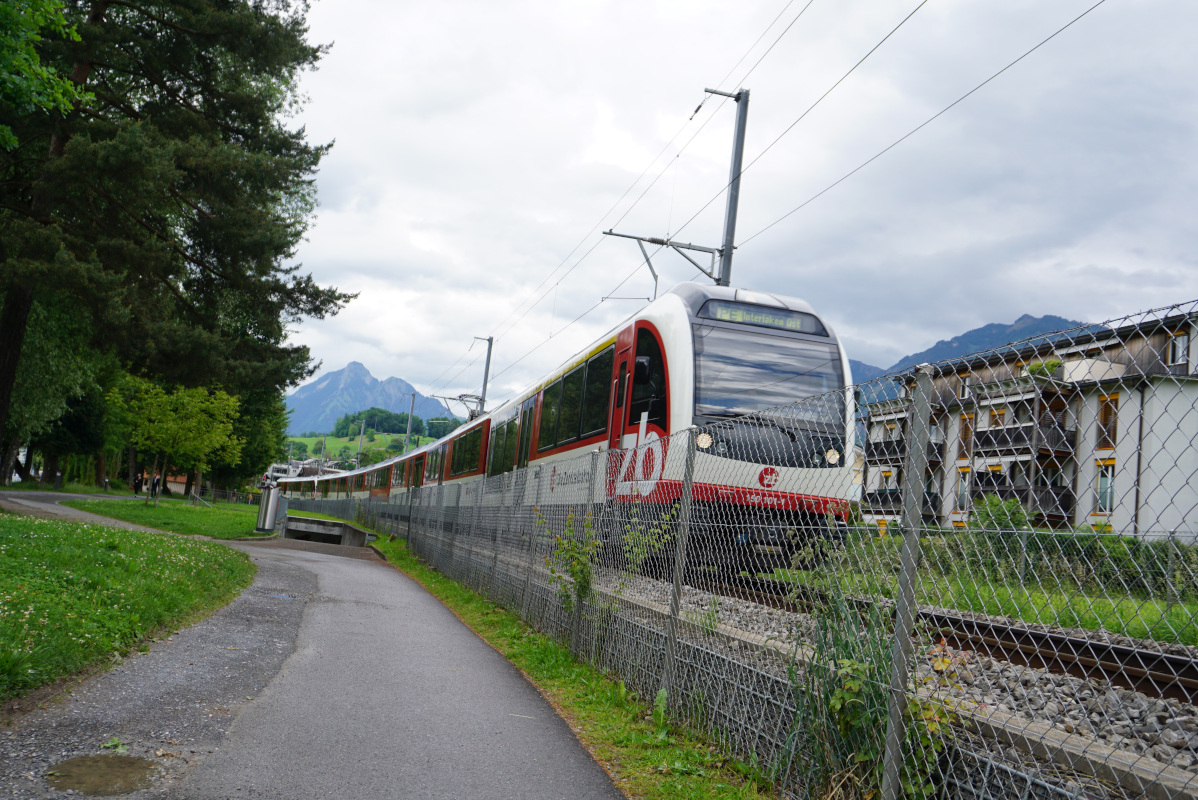 An ADLER train travels through Sachseln in the direction of Interlaken.
[May 2025].
An ADLER train travels through Sachseln in the direction of Interlaken.
[May 2025].
 In Meiringen there is a connection to the Meiringen-Innertkirchen-Bahn (MIB).
This line also has a gauge of 1m, but the electrification is at
1200V DC, and not 15kV AC as on the Zentralbahn.
[Nov 2014].
In Meiringen there is a connection to the Meiringen-Innertkirchen-Bahn (MIB).
This line also has a gauge of 1m, but the electrification is at
1200V DC, and not 15kV AC as on the Zentralbahn.
[Nov 2014].
 The line between Meiringen and Innertkirchen is only 5km long, but there are 7 stops along the line.
Two of them give access to the Aare Gorge, which the line passes through a tunnel.
This is the view from the railcar near Meiringen.
The river Aare is on the right.
[Dec 2014].
The line between Meiringen and Innertkirchen is only 5km long, but there are 7 stops along the line.
Two of them give access to the Aare Gorge, which the line passes through a tunnel.
This is the view from the railcar near Meiringen.
The river Aare is on the right.
[Dec 2014].
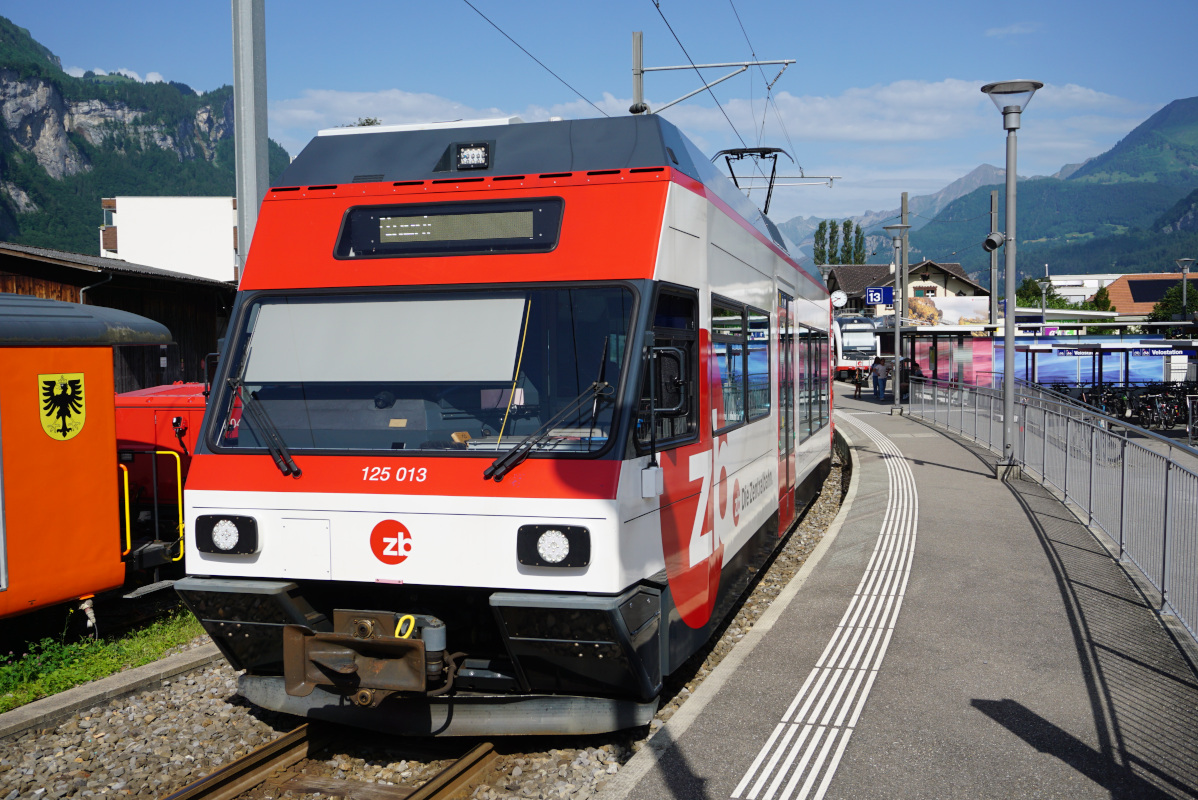 The Meiringen-Innertkirchen-Bahn was taken over by the Zentralbahn in 2021.
These days the normal rolling stock used for passenger traffic is Railcar 125 013,
which was obtained from Transports Montreux–Vevey–Riviera (MVR) in 2018.
The railcar was delivered by Stadler in 1997.
[Jun 2025].
The Meiringen-Innertkirchen-Bahn was taken over by the Zentralbahn in 2021.
These days the normal rolling stock used for passenger traffic is Railcar 125 013,
which was obtained from Transports Montreux–Vevey–Riviera (MVR) in 2018.
The railcar was delivered by Stadler in 1997.
[Jun 2025].
 The railcar of the MIB, called class Be4/4, was built by Stadler in 1996.
It is the only one of its kind.
It travels without any carriage and therefore the whole train only has 40 seats.
The railcar arrives in Innertkrichen Grimseltor, from where in summer busses depart for the alpine passes.
[Dec 2014].
The railcar of the MIB, called class Be4/4, was built by Stadler in 1996.
It is the only one of its kind.
It travels without any carriage and therefore the whole train only has 40 seats.
The railcar arrives in Innertkrichen Grimseltor, from where in summer busses depart for the alpine passes.
[Dec 2014].
 The church of Innertkirchen, where my ancestors also served as pastors.
[Dec 2014].
The church of Innertkirchen, where my ancestors also served as pastors.
[Dec 2014].
 The MIB is a subsidiary of the Kraftwerke Oberhasli (KWO - hydro-electric stations Oberhasli).
The railway ends at the operational centre of the KWO.
The driver has just taken her bicycle from the shelter to ride home after the end of her shift.
[Dec 2014].
The MIB is a subsidiary of the Kraftwerke Oberhasli (KWO - hydro-electric stations Oberhasli).
The railway ends at the operational centre of the KWO.
The driver has just taken her bicycle from the shelter to ride home after the end of her shift.
[Dec 2014].
 On the Sunday after Christmas a lot of snow fell in Innertkirchen.
There are plans to build a railway and electric line tunnel underneath the Grimsel Pass.
This would connect the narrow gauge networks of the ZB and the MGB.
The line of the MIB would form part of that new connection.
[Dec 2014].
On the Sunday after Christmas a lot of snow fell in Innertkirchen.
There are plans to build a railway and electric line tunnel underneath the Grimsel Pass.
This would connect the narrow gauge networks of the ZB and the MGB.
The line of the MIB would form part of that new connection.
[Dec 2014].